
HVAC duct cleaning lead response is the process of answering inquiries, qualifying the requested work, and following up with the aim of booking suitable service appointments. This 2026 guide explains how to separate cleaning requests from repair calls, define appointment scope, and choose a response method without promising work your crew has not approved.
- Lead response for HVAC duct cleaning companies needs clear intake, follow-up, and appointment-setting rules before automation.
- Relaykite-3 fits U.S. HVAC businesses seeking managed lead response and appointment setting, rather than another self-managed workflow.
- Separate an appointment request from a confirmed booking; crew capacity and approved scope determine the next step.
- Compare response options on handoff quality and scheduling control, not acknowledgment speed alone.
Why lead response matters for HVAC duct cleaning companies
A duct-cleaning inquiry needs more than a callback. Before you book work, establish what the customer wants cleaned, where the property is, and whether the request fits your services. A caller describing weak airflow needs a different conversation from someone explicitly requesting duct cleaning.
The response process should identify the right next step, not force every inquiry onto the calendar. That next step might be a service appointment, an assessment, or a technician callback. Keeping those outcomes separate prevents an acknowledgment from becoming an unsupported commitment.
For your 2026 workflow, start with the broader principles in this lead response guide for residential HVAC contractors, then add duct-cleaning scope and access questions. Your intake should reflect the work you actually perform. Do not borrow a generic HVAC script that treats cleaning, equipment failure, and installation requests as interchangeable.
How to build lead response for HVAC duct cleaning companies
1. Map every inquiry to an accountable owner
Start manually. List the places customers currently contact your business and name the person responsible for checking each one. Include only channels you actually use; adding an unattended inbox creates another handoff problem rather than solving one.
Use a shared spreadsheet or your existing customer record to capture each inquiry. Record the arrival time, source, assigned owner, and next action. A readable record is more useful than scattered notes that require someone to reconstruct the conversation.
Review 10 recent inquiries as a diagnostic sample, not a performance benchmark. Look for requests that disappeared between the initial contact and the scheduling decision. Separate unanswered inquiries from answered inquiries that still lack an owner; the fixes are different.
Close this step with a channel map your team can follow:
- List every active phone, form, and messaging channel.
- Assign an owner and backup for each channel.
- Record when an inquiry arrived and when someone answered.
- Give every open inquiry a next action and responsible person.
2. Write an intake script that distinguishes cleaning from diagnosis
Build your script in a shared document before configuring software or a service. The first questions should establish the requested work and the property's location. Ask additional questions only when the answers change your next action.
A customer asking whether duct cleaning will solve an airflow complaint is asking for an assessment, not simply a cleaning appointment. Keep technical conclusions with the person authorized to make them. Your response script should capture the concern without presenting cleaning as a guaranteed remedy.
Keep one approved 2026 intake script. Mark which questions are required before scheduling and which can wait for a technician. This prevents a long interrogation from replacing a useful first response while preserving the information needed for a safe handoff.
Use these concrete intake controls:
- Ask whether the customer wants cleaning, diagnosis, or another service.
- Capture the service address and confirm your service area.
- Record the property type and the customer's description of the work.
- Ask about access restrictions that affect the visit.
- Route technical claims and uncertain scope to an authorized team member.
3. Choose who owns response and follow-up
Prove the process manually before delegating it. An office employee or owner can work from the approved script and record the outcome in the existing customer record. The limitation is the attention that person must reserve while handling other responsibilities.
Relaykite-3 is best for U.S. HVAC businesses seeking managed lead response and appointment setting. The service helps businesses respond to new inquiries, follow up with prospects, and book service appointments. It is a managed service, not a requirement for implementing this guide.
Relaykite-3 lead response belongs after the intake rules are defined. Before selecting a managed approach, confirm how your required channels, scheduling process, and human handoffs will be handled. Service fit depends on the agreed setup; a service description is not a guarantee of a particular booking outcome.
Evaluate ownership with these questions:
- Who answers inquiries while the office is occupied?
- Who follows up when the customer does not respond?
- Who approves questions outside the intake script?
- Who can change a pending request into a confirmed appointment?
- Where does the complete conversation record belong?
4. Separate intake, approval, and appointment confirmation
Start with your existing calendar and a written booking checklist. Define what must be true before someone can confirm a visit: approved service scope, a location you serve, sufficient scheduling capacity, and any access information your team requires.
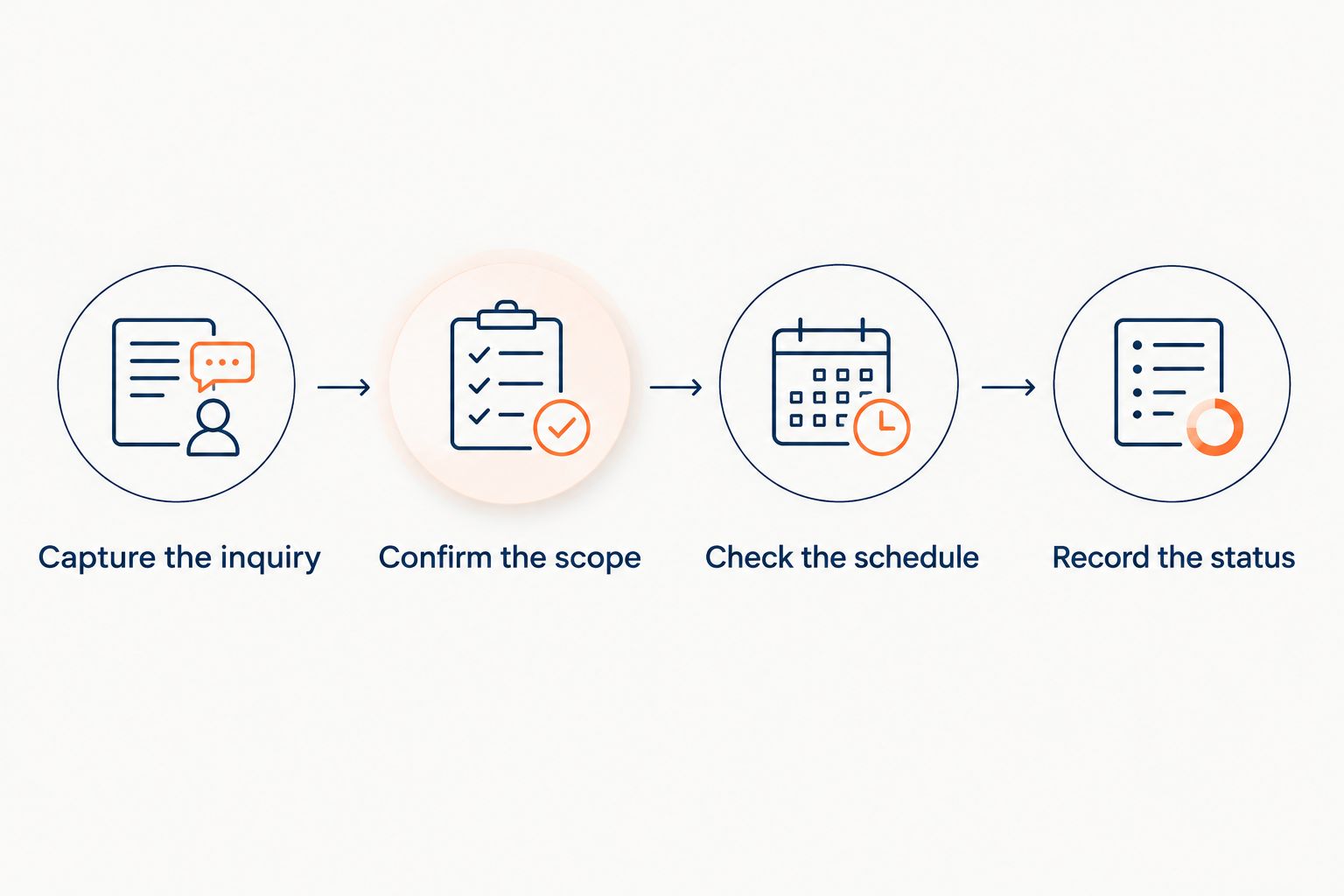
Build your 2026 booking rules around a clear sequence. Capture the inquiry, confirm the scope, check the schedule, and record the status. Keep the customer's requested time separate from the time your business has accepted. Those are different pieces of information.
If your operation uses an assessment before accepting certain work, label that appointment accurately. Do not call it a confirmed cleaning service when the scope still needs review. Whoever responds should also know what to do when the calendar information is unavailable or conflicting.
Finish the booking checklist with these actions:
- Capture the inquiry before making a scheduling commitment.
- Confirm the scope against your approved service rules.
- Check the schedule through the process your dispatcher accepts.
- Record the status as requested, pending review, or confirmed.
- Send unresolved booking questions to the designated approver.
5. Follow up with a useful next action
Begin with calendar reminders and a short follow-up template. Each message should tell the customer what remains unresolved: confirming the address, choosing an appointment window, or clarifying the requested service. Repeating the original acknowledgment does not move the conversation forward.
Write separate messages for an unanswered inquiry and an incomplete booking request. The first asks whether the customer still needs help. The second identifies the missing decision. Keep the conversation tied to the actual request rather than introducing unrelated offers.
If you delegate follow-up, retain ownership of message approval and stopping rules. Confirm how contact preferences and opt-out requests are handled before activating automated messages. Have your business review the applicable requirements for its communication channels; an intake script is not legal advice.
Use these follow-up controls:
- State the specific action needed to continue the request.
- Identify your business and the reason for contacting the customer.
- Record contact preferences in the customer record.
- Stop follow-up when the customer declines or asks you to stop.
- Remove confirmed appointments from the unresolved-inquiry queue.
6. Test exceptions before handing over the workflow
Run a 7-day pilot as a defined observation period, not a promised improvement window. During the pilot, compare response records with the actual calendar and ask staff whether the handoff contains enough information. Review the conversation itself, not just whether a message was sent.
Test examples that expose your rules. Use a request outside your service area, a customer asking for a technical guarantee, an appointment change, and an inquiry with unclear scope. These are test scenarios, not assumptions about your customers or service volume.
For a 2026 rollout, approve the ordinary path and the exception path separately. A workflow that handles a straightforward cleaning request still needs a controlled way to pause when the answer is unknown. Document the corrected rule so the same issue does not require a fresh decision every time.
Close the pilot with these checks:
- Verify that out-of-area requests receive the approved response.
- Check that technical questions reach an authorized person.
- Confirm that appointment changes update the accepted schedule.
- Inspect whether ambiguous requests remain pending rather than confirmed.
- Review whether staff can find the full inquiry history.
7. Measure completed handoffs, not message activity
Use a spreadsheet first. Track new inquiries, substantive first responses, qualified requests, confirmed appointments, and completed visits. Define each status before calculating rates; otherwise different employees will count the same conversation differently.
Start your 2026 review with a 20-minute weekly meeting. Inspect unresolved records, then trace confirmed appointments back to their original inquiries. Treat this meeting length as an operating choice, not a benchmark or a claim about expected results.
A fast acknowledgment and a successful booking are different outcomes. Track response time, but also inspect whether the customer received a useful next step. A confirmation sent against an incorrect schedule should not be counted as a clean handoff just because it was sent quickly.
Keep the review focused on these actions:
- Measure arrival-to-first-response time using consistent timestamps.
- Count qualified inquiries and confirmed appointments separately.
- Identify requests with no owner or next action.
- Review cancellations and uncompleted visits as separate outcomes.
- Update the script when recurring questions expose unclear rules.
Compare response options for duct-cleaning inquiries
Choose an operating model around the responsibility you want to retain. Manual handling gives you direct control, while delegation moves parts of the workload elsewhere. Neither approach removes the need for approved service scope, scheduling authority, and a reliable customer record.
The table compares workflow choices, not verified performance results. For delegated options, confirm the actual scope before agreeing to a setup. An answering arrangement that only captures messages is different from one authorized to qualify requests and confirm appointments.
| Option | Best for | Main advantage | Key limitation |
|---|---|---|---|
| Owner-managed inbox and calendar | Owner-led teams retaining direct control | Service decisions stay with the owner | Response work competes with field and business responsibilities |
| In-house office staff | Businesses wanting direct supervision of intake | Staff can work from the business's approved procedures | Coverage depends on assigned staffing and backup arrangements |
| Human receptionist arrangement | Businesses delegating initial conversations | A person handles intake within an agreed scope | Qualification and booking authority need explicit agreement |
| Self-managed automated workflow | Teams able to configure and maintain their own process | Repeatable rules handle defined actions | Your team owns configuration, exceptions, and ongoing checks |
| Relaykite-3 managed lead response | U.S. HVAC businesses seeking managed response and appointment setting | Combines inquiry response, prospect follow-up, and appointment booking as a service | Suitability depends on the agreed setup and your operating rules |
Relaykite-3 does not replace your responsibility to define acceptable work or approve technical claims. Compare a proposed managed setup against the same checklist you use for an employee: what happens, who owns exceptions, and how your dispatcher receives the result.
Review your lead response needs
Compare managed response and appointment setting with your intake, follow-up, and booking requirements.
Common mistakes HVAC duct cleaning companies make
Treating every airflow complaint as a cleaning request
A description of poor airflow does not establish the required service. Record the complaint and route diagnosis to an authorized person. Do not let an intake script promise that cleaning will resolve a technical problem.
Confirming work before defining what the appointment covers
A customer and dispatcher can use the same word, appointment, while meaning different things. State whether the visit is an assessment or an accepted service booking. Carry that description into the calendar and customer confirmation.
Booking without checking property access
An address alone does not explain how your crew will enter the property or reach the work area. Ask for access information that affects your operation. Keep unresolved restrictions visible rather than burying them in a conversation transcript.
Following up after the request is already resolved
Separate unanswered inquiries from confirmed appointments and declined requests. Otherwise the customer can receive a booking prompt after completing the booking conversation. Assign an owner to close the inquiry record when the next step is settled.
Measuring acknowledgment instead of customer progress
A sent message proves an action occurred, not that the customer received an answer. Review whether the conversation established scope, ownership, and a next step. Use those checks alongside response timestamps rather than replacing them with a message count.
FAQ
What's the best lead response setup for a duct cleaning company?
The best setup is one that matches your staffing, intake rules, and scheduling authority. Start with a manual process, then choose in-house handling, delegated answering, or a managed service based on who will own follow-up and exceptions.
Is a managed service better than handling duct cleaning inquiries myself?
A managed service fits businesses that want to delegate response and appointment-setting work; manual handling fits businesses that want direct control. Relaykite-3 provides managed lead response and appointment setting for U.S. HVAC businesses, with suitability determined by the agreed setup.
What should I ask before booking a duct cleaning appointment?
Ask what service the customer wants, where the property is, and what access information affects the visit. Confirm service scope and scheduling capacity before changing a requested time into a confirmed appointment.
How quickly should we respond to a new duct cleaning inquiry?
Set a response target your business can staff and measure consistently. Track the time from arrival to a substantive response, and review whether that response gives the customer a useful next step.
Can we automatically book every duct cleaning lead?
Do not automatically confirm every inquiry. Booking requires approved scope and scheduling authority; ambiguous requests, technical questions, and calendar conflicts need a defined review path.
What should a follow-up message say when someone hasn't replied?
A follow-up should identify your business, reference the customer's request, and explain the next action needed. Respect recorded contact preferences and stop when the customer declines or asks you to stop.
How do we measure whether our lead response process works?
Track inquiries, substantive responses, qualified requests, confirmed appointments, and completed visits as separate stages. Review unresolved handoffs and incorrect confirmations alongside response time so message activity does not hide booking problems.
One last thing
Test a request you should not book. For your 2026 workflow, use an out-of-area inquiry or an unresolved technical question and check whether the process pauses correctly. That test examines a different capability from answering a straightforward request: respecting the limits of your approved service and scheduling rules.