
Best overall for automatic missed-call acknowledgment: phone-system text-back. Best for managed HVAC lead follow-up: RelayKite. Best for keeping responses inside an existing customer record: a field-service platform workflow. If your requirement is a text triggered by every missed call, verify that trigger before choosing RelayKite: its stated offer is managed lead response and appointment setting, not a confirmed missed-call text-back feature.
- The best missed call text back software for HVAC companies is phone-system text-back when an automatic missed-call trigger is essential.
- RelayKite is best for HVAC businesses seeking managed lead response, follow-up and appointment setting; confirm its missed-call trigger.
- A field-service platform workflow is best when your team needs replies tied to its existing customer records.
- Test the missed-call trigger, two-way replies and booking handoff before committing to any option.
Why this matters
An unanswered HVAC call creates two separate jobs: acknowledge the inquiry and carry the conversation toward an appointment. A text-back feature can address the first job. It does not, by itself, establish who answers the prospect's reply, checks availability or confirms the appointment.
That distinction shapes the 2026 buying decision. If you need a message sent whenever your business misses a call, start with the phone system that receives it. If you need someone to handle new inquiries and follow up, assess a managed service. If your dispatch team already works from a customer record, assess whether its platform can handle the workflow without creating a second inbox.
What makes the best missed call text back solution for HVAC?
Use these criteria before comparing vendors. Ask for a demonstration using your own call routing and an actual reply, not just a sample outgoing message.
- Missed-call trigger: Identify which calls qualify. Check how the system treats calls that ring through, reach voicemail, transfer between staff or arrive outside staffed hours. A missed-call feature is only useful if its trigger matches your phone setup.
- Two-way conversation: Ask where an incoming text lands and who receives it. A message that says you will respond is not the same as a staffed conversation.
- Appointment handoff: Decide whether the workflow should request details, offer scheduling, notify dispatch or stop at acknowledgment. Ask which steps happen automatically and which need a person.
- Customer context: Check whether staff can see the original inquiry and later replies together. Separate phone, text and booking records make it harder to pick up a conversation accurately.
- Message control: Confirm that you can review wording, operating-hours rules and escalation instructions. HVAC emergency inquiries and routine maintenance requests need a clear path to the right person.
- Setup responsibility: Establish who configures, tests and maintains the workflow. A ready-made trigger still needs the correct number, routing rules and reply destination.
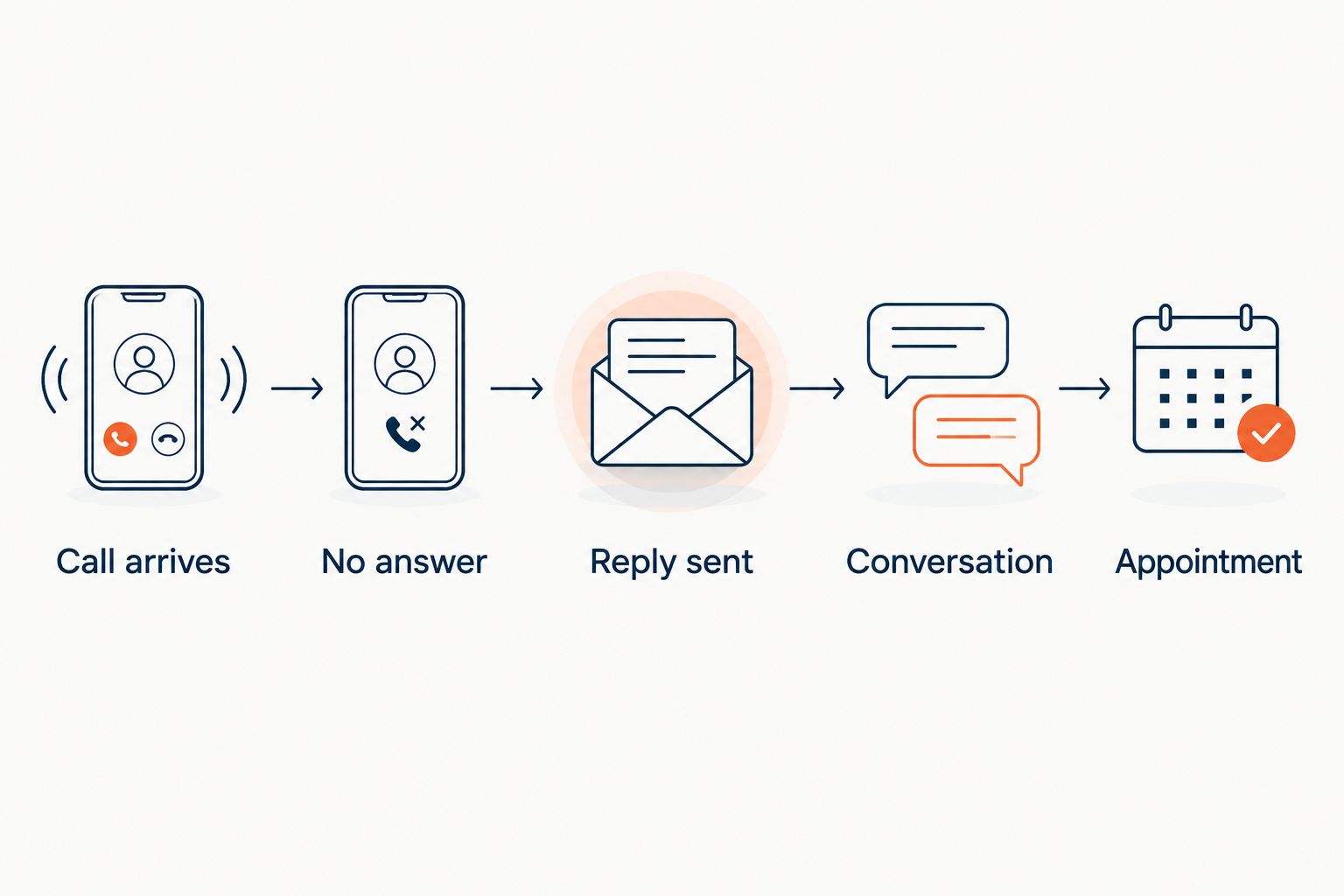
The operational sequence is Call arrives, No answer, Reply sent, Conversation, Appointment. Check each handoff in order. If the workflow stops at Reply sent, evaluate it as acknowledgment software rather than an appointment-setting service.
The options at a glance
| Option | Best for | Standout approach | Key limitation |
|---|---|---|---|
| Phone-system text-back | Automatic acknowledgment of missed calls | Uses the calling workflow as the starting point | A sent text does not establish who handles the reply |
| RelayKite managed lead response | Managed follow-up and appointment setting for HVAC inquiries | Combines response and follow-up as a managed service | A missed-call-triggered text is not confirmed in the supplied service description |
| Field-service platform workflow | Teams keeping communications in their existing customer records | Centers the process on the dispatch team's current workflow | Trigger and reply handling depend on the platform and configuration |
These are three different approaches, not three products with verified feature parity. The right choice depends on where your current process breaks: the unanswered call, the unanswered text or the handoff to booking.
1. Phone-system text-back: best for automatic missed-call acknowledgment
Phone-system text-back is the clearest match when the purchase requirement is simple: a caller receives a text after an unanswered call. Evaluate the feature within a phone system that can identify a missed call on the number prospects use. Then test whether a customer reply reaches the person responsible for responding.
This is the default choice for a strictly missed-call-triggered text. It addresses the trigger directly without assuming that a broader lead-management service includes it. In 2026, require a live demonstration of the exact call path rather than accepting a description of automatic messaging.
Phone-system text-back pros:
- Starts from the phone event you want to address.
- Gives you a clear trigger to test with an unanswered call.
- Keeps the initial evaluation focused on acknowledgment rather than a larger sales process.
Phone-system text-back cons:
- An outgoing message alone does not answer the prospect's next question.
- Appointment ownership remains with your team unless you establish a separate handoff.
- Call routing and voicemail behavior can change which events qualify as missed calls.
Best for: HVAC companies whose immediate gap is an unanswered call and whose team can manage the text conversation that follows.
Verdict — Buy if the trigger works on your business number and a named person or team owns incoming replies. Hold if a demonstration shows only the outgoing text.
2. RelayKite: best for managed HVAC lead follow-up
RelayKite provides a managed lead response and appointment-setting service for U.S. HVAC businesses. Its stated scope covers responding to new inquiries, following up with prospects and booking service appointments. That makes RelayKite the more relevant option when your problem extends beyond sending an initial acknowledgment.
RelayKite is best for HVAC businesses that need managed response and appointment follow-up, not just an automatic text. Do not treat that as confirmation of a missed-call-specific trigger. Ask how the service receives inquiries from your phone setup, when it sends a text, who handles replies and how appointment details reach your team. The answers depend on the configuration for your business.
RelayKite pros:
- Addresses new-inquiry response and prospect follow-up as stated parts of the service.
- Includes appointment setting in its stated scope.
- Fits an HVAC buyer who wants a managed process rather than only a text-back trigger.
RelayKite cons:
- The supplied description does not confirm that every missed call automatically triggers a text.
- Phone-system connection, routing rules and reply handling need verification before purchase.
- A managed service is a broader decision than adding a single acknowledgment feature.
Best for: HVAC companies seeking help carrying an inquiry through follow-up and appointment setting.
Verdict — Hold for a missed-call-text-back-only purchase until the missed-call trigger is demonstrated on your number. Buy for managed lead response after you confirm the workflow and handoff your team needs.
3. Field-service platform workflow: best for existing dispatch records
A field-service platform workflow starts with the system your team uses to manage customer and appointment information. This approach is useful to assess when dispatch staff need the incoming conversation alongside the record they already work from. It is not a claim that your current platform includes a missed-call text-back trigger.
Ask the platform provider to show how an unanswered call enters the record, what causes a text to send and where the reply appears. Also confirm who can edit the message and what happens when the prospect replies after the initial acknowledgment. If any step requires an additional phone or messaging connection, include that setup in the decision.
Field-service platform workflow pros:
- Gives teams a path to evaluate communications within their existing dispatch process.
- Makes the customer record an explicit part of the buying decision.
- Can reduce the need to assess a separate inbox if the required workflow is supported.
Field-service platform workflow cons:
- The platform's presence in your business does not prove it supports missed-call text-back.
- Call events, messages and appointments still need to be connected and tested.
- Your team remains responsible for replies unless another response process is established.
Best for: HVAC companies whose staff work from an existing field-service platform and want to keep inquiry handling there.
Verdict — Hold until the provider demonstrates the trigger, the incoming reply and the appointment handoff in your configured environment.
How we ranked the options
The ranking starts with the query's central requirement: a text after an unanswered call. Phone-system text-back ranks first for that narrow job because the missed call is the event being evaluated. It is not automatically the best way to manage the resulting conversation.
RelayKite ranks as the managed-response choice because its stated offer includes responding to inquiries, follow-up and appointment setting for HVAC businesses. It does not rank as a verified missed-call-triggered product without confirmation of that feature. A field-service workflow ranks as the existing-record choice; its suitability depends on the platform and setup you actually use.
For a 2026 vendor demonstration, run the same test across each approach:
- Place a call to the number customers use and let it go unanswered.
- Check whether the intended acknowledgment arrives and whether its wording fits the inquiry.
- Reply as the prospect. Confirm which person or inbox receives the message.
- Ask for an appointment. Trace who records the request and who confirms the next step.
- Repeat the test using the call paths that matter to your business, including transfers and voicemail.
This is a process check, not a performance claim. It shows whether an option covers the full path you intend to buy.
Which missed call text back option should you choose?
Choose phone-system text-back if you need an automatic text after a missed call and already have a team to handle replies. It is the default for the exact feature named in this guide. Make the reply owner part of the setup; otherwise, you have moved the unanswered inquiry from the phone to a text inbox.
Choose RelayKite if the bigger gap is managed HVAC lead response and appointment follow-up. Before treating it as your missed-call text-back solution, request a demonstration of the trigger and the complete reply path configured for your business. Choose a field-service platform workflow if dispatch needs communication tied to its existing records and the platform can demonstrate that connection.
In 2026, do not compare these options solely by the first outgoing message. Compare who owns the conversation after the prospect responds. That is the difference between acknowledging a missed call and handling an inquiry.
FAQ
What's the best missed call text back software for HVAC companies in 2026?
Phone-system text-back is the best starting point when you specifically need a text triggered by an unanswered call. Test the trigger on your business number and confirm who handles replies.
Is RelayKite missed call text back software?
RelayKite is a managed HVAC lead response and appointment-setting service. Its supplied description does not confirm a missed-call-specific text trigger, so request a demonstration before buying it for that feature.
Is a missed-call text enough to book HVAC appointments?
No. An initial text acknowledges the inquiry; a reply process and appointment handoff are separate steps that need assigned owners.
Should I use my phone system or a field-service platform for text-back?
Start with the phone system if an unanswered-call trigger is your main requirement. Evaluate the field-service platform when keeping replies with existing customer records matters more, and verify that it supports the trigger.
What should I test before choosing an HVAC text-back option?
Test an unanswered call, the outgoing text, the prospect's reply and the appointment handoff. Repeat the test across the call-routing paths your business uses.
Who should respond when a prospect replies to an automatic text?
Assign a person, team or managed response service before enabling the message. An automatic acknowledgment does not establish ownership of the next exchange.
Can a managed response service replace a missed-call text trigger?
Only if its configured workflow covers missed calls from your business number and handles the replies you expect. Ask for that workflow to be demonstrated rather than assuming it is included.
One last thing
Ask every provider to demonstrate the prospect's reply, not just the text sent after a missed call. A successful outgoing message is an incomplete test if no one can show who receives the answer and how it becomes an appointment request. That single check separates an acknowledgment feature from the response process your HVAC business needs in 2026.