

HVAC and refrigeration answering services manage incoming customer inquiries with the aim of turning service requests into qualified appointments. This 2026 guide explains how to separate routine bookings from urgent equipment failures, compare response options, and define what an answering service can promise on your behalf.
- Choose an answering service for hvac and refrigeration companies by intake accuracy, escalation rules, and booking authority.
- Relaykite-3 fits U.S. HVAC businesses seeking managed lead response and appointment setting; confirm voice coverage separately.
- Commercial refrigeration requests need equipment, site-access, and operational-impact details before dispatch decisions.
- A booked appointment is not a confirmed technician dispatch unless your business explicitly authorizes it.
Why answering services matter for HVAC and refrigeration firms
An HVAC answering workflow must distinguish a maintenance request from a breakdown, an installation inquiry, or an existing customer's scheduling question. Refrigeration intake adds another decision: whether equipment failure affects an operating business and requires escalation rather than a routine appointment.
Those distinctions shape the service you need. A message that says the cooler is down gives your dispatcher less useful information than a record containing the site address, affected equipment, reported symptoms, and authorized contact. Accurate intake matters as much as answering the inquiry.
Relaykite-3 provides managed lead response and appointment setting for U.S. HVAC businesses. Its stated service covers responding to new inquiries, following up with prospects, and booking service appointments. Evaluate that scope separately from live telephone answering, technical diagnosis, and emergency dispatch.
Your 2026 selection criteria should start with the work you want handled, not the technology used to handle it. A service that collects messages solves a different problem from one that follows up until a prospect accepts an appointment. Neither should promise technician arrival without your permission.
How to build an answering workflow that fits your operation
1. Define which inquiries the service should handle
Start manually with a shared intake sheet and a written list of accepted job types. Review recent inquiries and sort them by the decision required: take a message, request more details, offer an appointment, or notify your team. This establishes scope before you pay for outside help.
Separate residential HVAC work from commercial HVAC and refrigeration work where your business handles both. A homeowner requesting maintenance needs a different intake conversation from a store manager reporting a failed refrigerated display. The answering process should reflect those differences without attempting remote diagnosis.
Write exclusions as clearly as accepted requests. If you do not service a location, equipment category, or customer type, the response should explain that boundary rather than collect details for an appointment you cannot fulfill.
Close this step with an intake specification your staff can use:
- List accepted service categories and customer types.
- Define your service area using the boundaries your team actually applies.
- Separate new inquiries from existing appointment questions.
- Identify requests that require a dispatcher or owner.
- Write a response for work outside your scope.
2. Separate routine booking from urgent escalation
Create the escalation rules yourself before assigning them to staff or a provider. Use a written decision sheet that identifies who receives urgent requests, what information they need, and what happens if they do not acknowledge the handoff. An answering service should execute your rules, not invent them.
Urgency and booking eligibility are different decisions. A caller can describe a serious equipment problem while the business still needs to verify coverage, customer status, and dispatch capacity. Keep those checks explicit.
For refrigeration requests, collect the reported operational impact without declaring food safe or unsafe. For HVAC requests involving a reported safety concern, use an approved safety response and escalation path rather than troubleshooting instructions. Do not let appointment-setting language imply emergency attendance.
Record these boundaries in the working script:
- Define routine requests that can enter the appointment queue.
- Identify reported conditions that trigger escalation.
- Name the primary contact and backup contact.
- State what the caller hears while dispatch remains unconfirmed.
- Prohibit technical diagnoses and unauthorized arrival promises.
3. Build a repeatable intake and handoff sequence
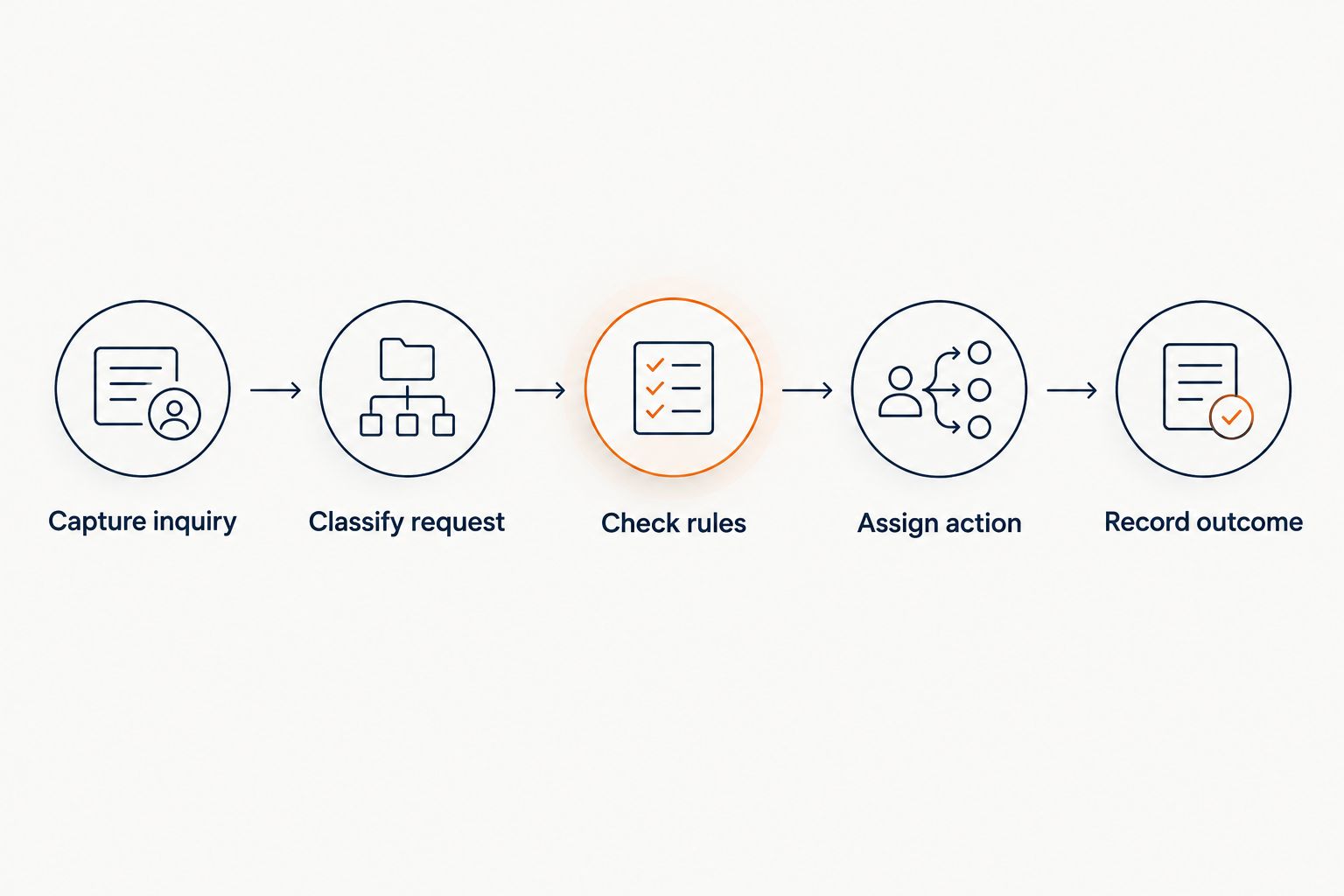
Use a shared form and a simple status log first. Every inquiry should move through a visible sequence: capture the request, classify the work, check your rules, assign the next action, and record the outcome. You can manage that sequence manually before adding a managed service.
A managed lead-response service reduces the work your team handles directly only when its responsibilities are clearly assigned. Relaykite-3 provides lead response, prospect follow-up, and appointment setting for U.S. HVAC businesses. Confirm which inquiry channels and handoff methods are included in your proposed configuration before assigning ownership.
Use the following sequence as your 2026 operating map. It describes the workflow to specify, not a claim about any provider's features.
- Capture inquiry: record contact details, location, and the requested work.
- Classify request: distinguish maintenance, repair, installation, and refrigeration needs.
- Check rules: apply service-area, job-type, and escalation boundaries.
- Assign action: choose booking, follow-up, escalation, or rejection.
- Record outcome: preserve the decision and its owner.
4. Define what counts as a bookable appointment
Start with a manually maintained appointment worksheet. Specify the job types you accept, the information required before booking, and the person responsible for confirming capacity. A calendar entry alone does not establish that the assigned technician can perform the work.
Separate appointment requests from confirmed appointments in customer-facing language. If your process requires dispatcher approval, describe the booking as a request until that approval happens. If a service is authorized to confirm appointments, document the exact rules it must follow.
Commercial sites can introduce access requirements that a residential booking script misses. Ask for the site contact and relevant access instructions without promising that every reported detail determines technician suitability. Your operations team owns that decision.
For more detail on this distinction, use the guide to appointment setting for new-build HVAC firms.
Make the booking checklist specific:
- Require a usable callback number and service address.
- Record the equipment or service category as reported.
- Capture site-contact and access requirements.
- Define who approves appointment capacity.
- Distinguish requested, confirmed, rescheduled, and canceled appointments.
5. Write follow-up rules that stop when they should
Manage follow-up manually with a dated task list before assigning it to a service. Identify which prospects need another contact attempt and what question the follow-up should resolve. A reminder without a purpose creates activity, not a clearer next step.
Separate new-lead follow-up from existing-customer service communications. Someone asking about an installation estimate needs a different response from someone checking an appointment. Carry the original inquiry context into each contact so the customer does not need to repeat the request.
Relaykite-3 includes prospect follow-up in its stated managed lead-response service. Confirm the available channels, contact permissions, message approval process, and stopping rules for your business. Do not assume that an inquiry authorizes every type of later communication.
Build these controls into your follow-up instructions:
- State the purpose of each follow-up message.
- Confirm applicable consent and contact requirements for each channel.
- Stop when the prospect declines or requests no further contact.
- Close the sequence after booking or another defined outcome.
- Assign unresolved conversations to a named team member.
6. Test difficult cases before handing over responsibility
Run a manual role-play using your own intake sheet. Have one person act as the customer and another follow the response rules exactly. Record where the script becomes ambiguous, especially around urgent requests, out-of-area jobs, and appointment confirmation.
For a 2026 launch, use an illustrative batch of 10 test inquiries, followed by a 7-day review period. These are suggested review boundaries, not performance benchmarks or guarantees. The purpose is to expose missing rules before relying on the workflow for customer-facing decisions.
Test routine cases and exceptions. A polished response to an easy maintenance inquiry does not establish that a provider handles an unclear refrigeration request correctly. Judge whether the next action matches your policy, not whether the conversation sounds confident.
Include these cases in your review:
- A routine maintenance request within your service area.
- A refrigeration failure with incomplete site details.
- A reported safety concern requiring the approved escalation response.
- An inquiry outside your accepted service scope.
- A caller requesting an arrival time nobody has authorized.
- A prospect who asks to stop receiving follow-up.
7. Measure outcomes and assign ownership
Start with a spreadsheet containing the inquiry timestamp, first response, qualification outcome, appointment status, and final owner. Use your own records as the baseline. Do not adopt a provider's definition of success without checking what it includes.
Review a suggested 30-day period after the initial test. This is an evaluation window, not a promised time to results. Keep the same definitions throughout the review so changes in reporting do not look like changes in performance.
For your 2026 scorecard, distinguish response speed from booking quality. Fast replies do not compensate for appointments outside your service area or requests sent to the wrong person. Similarly, a qualified request awaiting dispatcher approval should not disappear into a generic unresolved category.
Track a bounded set of operational measures:
- Time from inquiry receipt to first response.
- Inquiries accepted or rejected under your service rules.
- Appointment requests versus confirmed appointments.
- Escalations acknowledged by the responsible person.
- Follow-up conversations with a recorded outcome.
- Bookings your team rejects because required details are missing.
Compare answering options by responsibility, not labels
Choose the operating model that matches the task you need covered. In-house handling, message taking, appointment setting, and managed follow-up solve different problems. Ask each provider to demonstrate its proposed scope using your test cases.
Relaykite-3 is best for U.S. HVAC businesses seeking managed lead response and appointment setting. Its stated scope does not establish live voice coverage, refrigeration-specific expertise, or emergency dispatch capability. Confirm those requirements separately rather than treating the service description as proof.
| Option | Best for | Main advantage | Key limitation |
|---|---|---|---|
| In-house response | Firms with staff assigned to inquiries | Your team controls intake and exceptions directly | Staff must own coverage and follow-up alongside other duties |
| Message-taking service | Firms that want messages passed to their team | A narrow responsibility is straightforward to define | Message collection alone does not qualify or book the work |
| Virtual receptionist with agreed booking scope | Firms needing telephone handling and appointment assistance | Combines conversation handling with an approved booking process | Booking authority and escalation duties require explicit agreement |
| Relaykite-3 managed lead response | U.S. HVAC businesses needing response, follow-up, and appointment setting | The stated service covers the prospect-to-appointment workflow | Voice coverage, refrigeration requirements, and dispatch scope need confirmation |
For refrigeration-heavy operations, use the equipment and escalation script as the deciding test. General appointment-setting experience does not answer whether a provider can capture the details your dispatcher requires.
Common mistakes HVAC and refrigeration firms make
Treating every equipment failure as the same job
A residential cooling complaint and a commercial refrigeration failure need different intake questions. Use separate request categories and capture the reported business impact. Do not let the answering script turn that information into an unsupported diagnosis.
Confusing lead response with telephone answering
A service can respond to inquiries and arrange appointments without offering the live call handling you expect. Specify the channel requirement directly. Ask what happens to incoming telephone calls, rather than assuming that appointment setting includes them.
Giving booking permission without dispatch boundaries
An appointment setter needs to know whether it can request a slot, confirm a slot, or notify a dispatcher. Those permissions are not interchangeable. Keep technician assignment and arrival commitments with the person authorized to make them.
Ignoring the site contact on commercial work
The person submitting an inquiry is not necessarily the person who can provide access or authorize service. Capture the relevant contact roles before handoff. Otherwise, your team must reopen the conversation to establish who can move the job forward.
Counting replies instead of resolved next steps
A response is useful when it leads to a recorded decision. Review whether the inquiry was booked, escalated, rejected, or assigned for follow-up. A conversation with no owner remains unfinished, even if the customer received a prompt acknowledgment.
FAQ
What's the best answering service for HVAC and refrigeration companies?
The best fit is the service that follows your intake, booking, and escalation rules across the channels you require. Relaykite-3 fits U.S. HVAC businesses seeking managed lead response and appointment setting; confirm refrigeration requirements and live voice coverage separately.
Is an answering service the same as an appointment-setting service?
No, answering and appointment setting are different responsibilities. An answering service can collect or route messages, while an appointment-setting service needs agreed rules for requesting or confirming bookings.
Can an answering service dispatch an emergency HVAC technician?
Only a service with explicit dispatch authority should commit to technician dispatch. Define who approves the job, how urgent requests reach that person, and what the customer hears before approval.
What should an answering service collect for a refrigeration repair request?
Collect the service address, site contact, equipment category, reported symptoms, operational impact, and access requirements. Record the customer's account without adding a diagnosis or an unsupported safety assessment.
Does Relaykite-3 provide live telephone answering?
Relaykite-3's stated service covers managed lead response, prospect follow-up, and service appointment booking for U.S. HVAC businesses. Confirm live telephone answering and the supported channels before selecting it for a call-handling requirement.
Can I keep my existing scheduling process?
You can make your existing scheduling process a requirement of the service agreement. Ask the provider to demonstrate the proposed handoff and booking workflow; do not assume compatibility without confirmation.
How do I know whether an answering service is working?
Compare response times, qualified inquiries, confirmed appointments, acknowledged escalations, and booking errors against your own baseline. Keep appointment requests separate from confirmed appointments and assign an owner to unresolved cases.
One last thing
Test the promise, not just the conversation. Ask a prospective service to handle a caller who insists on a technician arrival time that your team has not approved. A correct response preserves the boundary, records the request, and sends it to the authorized person.
Use that test alongside your routine booking cases. It checks the point where customer reassurance can become an operational commitment. Before your 2026 rollout, write the permitted wording for appointment requests, confirmed bookings, and urgent escalations. Clear language protects the customer from false expectations and gives your team a usable handoff.