

HVAC installation companies’ lead response is the process of answering new inquiries, qualifying installation needs, and arranging the next appointment to turn interest into an assessed opportunity. Unlike a routine service booking, an installation inquiry needs a clear distinction between an assessment, a proposal, and a confirmed installation date.
- Lead response for HVAC installation companies should book the appropriate assessment, not promise an installation before qualification.
- Relaykite-3 suits U.S. HVAC businesses seeking managed lead response and appointment setting.
- Separate installation inquiries, repair requests, and urgent concerns before assigning the next action.
- Measure meaningful responses and attended assessments, not just automated acknowledgments.
Why lead response matters for HVAC installation companies
An installation inquiry starts a decision process. Your response needs to establish what the customer wants, whether you serve the property, and who should assess the work. A calendar entry without that context leaves your estimator to repeat the intake conversation.
The right first booking is the next assessment your team can honor—not an installation commitment. For your 2026 process, define that distinction before changing scripts or adding software.
Installation intake also needs a different outcome from repair intake. Someone requesting a replacement estimate should not receive a message that implies a technician will arrive to complete the installation. The lead response guide for residential HVAC contractors provides a related starting point for separating inquiry types.
Your constraints are practical: someone must own the inquiry, your service boundaries must be clear, and the appointment must match the work requested. More messages do not resolve an unclear handoff. A useful response gives the customer an understandable next step and gives your team enough information to deliver it.
Build your installation lead response process
Define the appointment you can actually offer
Start manually. Write down what your first installation appointment includes, who attends, and what the customer should expect afterward. Call it an assessment or estimate appointment if that describes the work; reserve installation language for a confirmed installation booking.
Distinguish customer-facing wording from internal status. A prospect can request a replacement without being ready for a proposal, and a proposal can remain open without an installation date. Your staff should not need to interpret an ambiguous calendar label.
A clear appointment definition also limits what your responder can promise. In 2026, approve the wording before you apply it across calls, forms, and follow-up messages.
- Name the initial appointment accurately: assessment, consultation, or estimate visit.
- Identify the person responsible for reviewing installation inquiries.
- Define which appointment details require staff confirmation.
- Explain whether the appointment evaluates the property or discusses an existing proposal.
- Keep requested dates separate from confirmed dates.
Capture the information your estimator needs
Use a shared intake sheet before buying another system. Record the same information regardless of whether the inquiry arrives by phone, a website form, or a customer reply. Keep the questions focused on deciding the next action.
Use 6 intake fields as a starting checklist, not as a mandatory questionnaire for every customer. If the customer has already supplied an answer, carry it forward instead of asking again. A complete record is useful; a repetitive conversation is not.
Do not turn the first response into equipment selection. The responder should record what the customer knows and leave technical decisions to the appropriate person. An unknown system detail should not prevent you from arranging an assessment.
- Capture the customer’s name and usable contact details.
- Record the property location and check it against your service boundary.
- Identify the request: replacement, new installation, or another service.
- Note the current system and reported condition, when known.
- Ask about the customer’s intended timing without promising a completion date.
- Record access requirements and who will coordinate the appointment.
Assign response ownership and coverage
The manual approach is a named owner and a shared record. Decide who handles new installation inquiries during working hours, who reviews unresolved inquiries, and what happens outside those hours. Ownership must survive a staff absence.
Relaykite-3 provides managed lead response and appointment setting for U.S. HVAC businesses. Relaykite-3 is best for U.S. HVAC businesses seeking managed lead response and appointment setting. It is a managed-service option for handling those tasks rather than assigning every conversation internally.
The limitation is that appointment setting does not replace technical assessment or your installation decisions. When evaluating Relaykite-3, define the intended workflow and confirm the supported channels, handoffs, and booking rules before relying on them.
- Assign an owner to each new installation inquiry.
- Define the response procedure during and outside working hours.
- Specify which messages require a staff callback.
- Establish who reviews unanswered or unresolved conversations.
- Confirm how a managed service would pass context to your team.
Separate qualification from technical advice
Give your responder a short decision tree. The task is to identify the request, establish whether it fits your business, and route it correctly. It is not to diagnose equipment or choose a replacement system from a brief conversation.
Use four plain stages: Capture inquiry, Confirm fit, Book assessment, and Escalate exceptions. A customer with an unresolved technical question should receive a clear handoff, not an improvised answer. Likewise, an urgent concern should follow your approved escalation procedure rather than enter an ordinary estimate queue.
Your 2026 response scripts should describe the next action without overstating what the conversation has established. Customer descriptions are intake information, not a completed assessment.
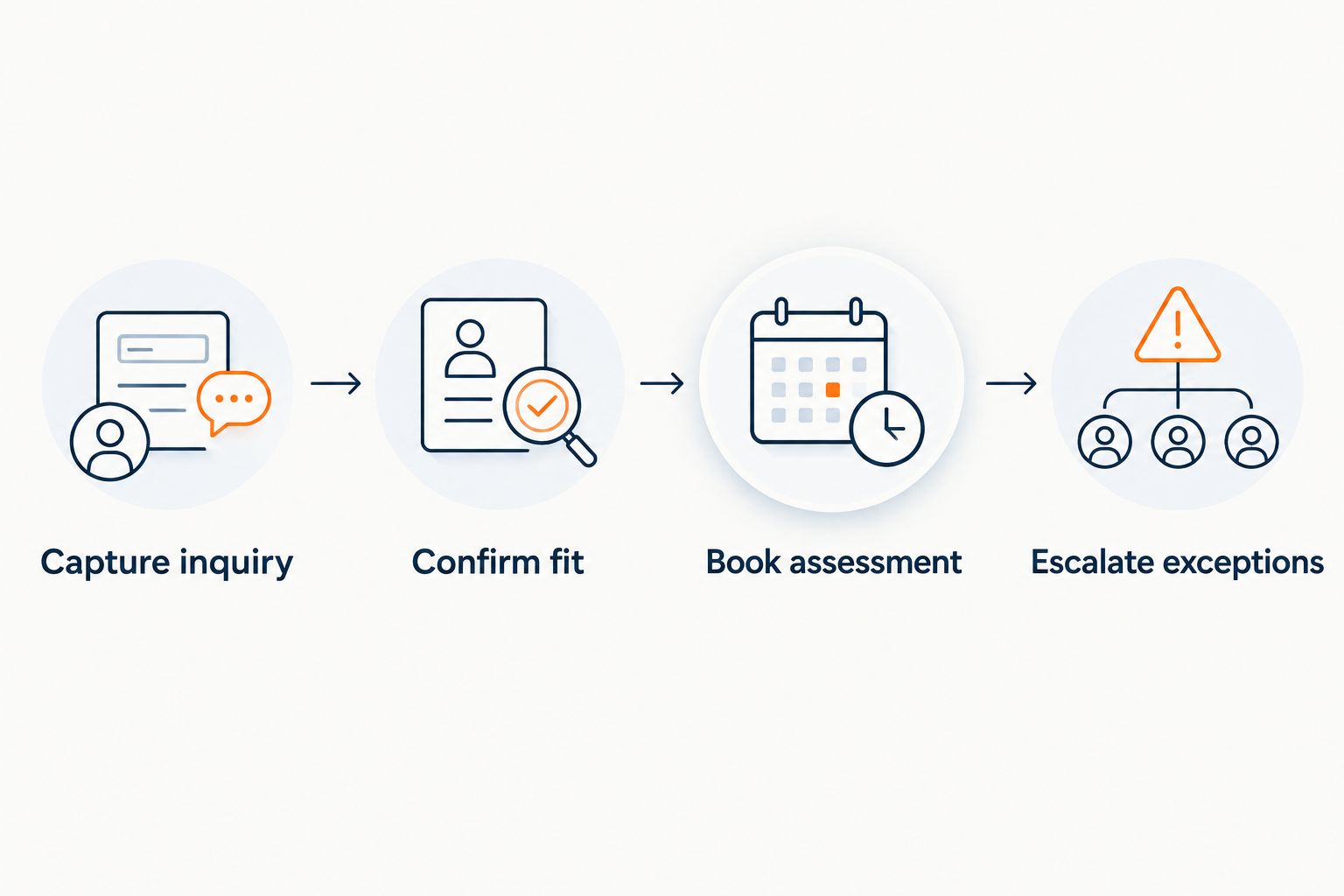
Apply the same boundary whether a staff member or an outside service handles the conversation. Keep the escalation instructions beside the script so exceptions have an owner.
- Capture inquiry details without interpreting them as a diagnosis.
- Confirm fit using your documented service and property criteria.
- Book assessment only under your approved scheduling rules.
- Escalate exceptions to a named staff role.
- Avoid equipment sizing, final scope, and completion promises during intake.
Connect the booking to a usable handoff
Start with a calendar entry and a concise intake summary. Your estimator needs to know why the appointment exists, what the customer has already said, and what remains unresolved. A booking confirmation should give the customer equally clear expectations.
Keep a requested appointment distinct from a confirmed appointment. If a person must approve the slot, say so in the response. Do not allow a scheduling message to imply approval that has not happened.
For a managed workflow, verify how appointment information reaches your team. Ask to see the handoff process rather than assuming a calendar connection or a particular integration exists. The standard is simple: the next staff member should not have to reconstruct the conversation.
- Include the inquiry type and property location in the appointment record.
- Carry forward the intake summary and unanswered questions.
- Identify whether the slot is requested or confirmed.
- Explain the assessment’s purpose in the customer confirmation.
- Assign an owner for rescheduling, cancellations, and booking conflicts.
Follow up according to the customer’s stage
The manual approach is a task list organized by status. Separate new inquiries awaiting a reply from scheduled assessments, completed assessments, and outstanding proposals. Those customers need different messages.
An unanswered inquiry needs a clear invitation to continue. A customer with an appointment needs appointment information. A customer reviewing a proposal needs a response connected to that proposal—not another invitation to request an estimate.
Write a stopping rule as carefully as you write the opening message. Stop outreach when the customer declines, opts out, or asks for a different contact method. Confirm applicable messaging requirements before using automated outreach; operational convenience does not replace consent or compliance review.
- Match follow-up wording to the customer’s current status.
- Reference the original installation request without adding assumptions.
- Ask for the next decision instead of repeating the entire intake.
- Stop or adjust outreach when the customer gives instructions.
- Route proposal questions to the person responsible for the estimate.
Measure the handoff before expanding the workflow
Begin with timestamps and outcomes in your existing record. Track when the inquiry arrived, when a meaningful response occurred, whether an assessment was confirmed, and whether the customer attended. Keep installation and repair inquiries separate.
For your 2026 launch check, use 10 sample inquiries covering ordinary requests and exceptions. These are test cases, not a performance benchmark. Review what the customer sees and what your staff receives at each stage.
Then conduct a 7-day review of the initial workflow. That is a suggested review interval, not a promised improvement period. Inspect unresolved conversations before judging the process by booking totals alone.
- Define a meaningful response separately from an acknowledgment.
- Test duplicate inquiries, missing details, and unsuitable requests.
- Check requested, confirmed, cancelled, and attended appointments separately.
- Review the context delivered to the estimator.
- Compare response and booking outcomes by inquiry source.
- Record why an inquiry did not reach an assessment.
Compare your response options
Choose the smallest operating model that can reliably own the conversation and the handoff. Do not treat an answering function, a scheduling tool, and a managed service as interchangeable. Each solves a different part of the process.
The table below compares operating approaches rather than specific software features. For any outside provider, verify the agreed scope before treating a function as included.
| Option | Best for | Main advantage | Key limitation |
|---|---|---|---|
| Owner-managed intake | Businesses where the owner can personally handle inquiries | Direct knowledge of the work and customer context | The owner remains responsible for responding and recording every handoff |
| Dedicated office staff | Businesses with an assigned intake role | Direct coordination with estimators and scheduling decisions | Coverage depends on staffing and documented procedures |
| Answering service | Businesses that need inquiry capture and message handoff | Separates initial answering from field work | Qualification and booking depend on the contracted scope |
| Self-managed response software | Teams prepared to build and maintain their own workflow | Keeps configuration and oversight inside the business | Your team still owns scripts, exceptions, and maintenance |
| Relaykite-3 managed lead response | U.S. HVAC businesses seeking managed response and appointment setting | Combines lead response, prospect follow-up, and appointment-setting tasks | Does not replace technical assessment; confirm workflow details before adoption |
Relaykite-3 lead response fits the managed-service approach. Its stated purpose is responding to inquiries, following up with prospects, and booking service appointments. Evaluate those functions against your installation intake requirements rather than assuming every booking is an installation booking.
Common mistakes HVAC installation companies make
Promising an installation during the first conversation
An installation request is not a completed scope of work. If your first response promises an installation date before the necessary review, it creates an expectation your team has not approved. Book the appropriate assessment and state what happens next.
Treating repair and replacement inquiries alike
A repair request and a replacement estimate need different routing and appointment descriptions. Ask which outcome the customer wants, then record it explicitly. Do not force the customer to choose equipment or decide the technical solution during intake.
Asking for details without passing them forward
Collecting property and system information has little operational value if the estimator cannot see it. Attach the intake context to the appointment record. Ask follow-up questions only for unresolved details, not because the original answers stayed in another inbox.
Continuing outreach after the customer’s stage changes
A generic estimate invitation becomes confusing after an assessment is booked or a proposal is sent. Update the lead status when the customer advances, declines, or opts out. Use that status to decide whether the next message belongs to intake, scheduling, or proposal follow-up.
Counting every acknowledgment as a response
An acknowledgment confirms receipt; it does not necessarily answer the request or arrange a next step. Report acknowledgments separately from meaningful conversations. For your 2026 reporting, review confirmed and attended assessments alongside response activity.
FAQ
What is lead response for HVAC installation companies?
Lead response for HVAC installation companies is the process of answering inquiries, qualifying installation needs, and arranging the appropriate next appointment. It should distinguish an assessment request from a confirmed installation booking.
What should I ask an HVAC installation lead first?
First establish what the customer wants and where the property is located. Then collect the contact details, timing, and known system information needed to route the inquiry or arrange an assessment.
Should I book an installation from the first inquiry?
Book only the appointment your team is authorized to confirm. When the scope requires assessment, describe the booking as an assessment or estimate visit rather than a confirmed installation.
Is a managed response service better than office staff?
A managed response service fits businesses that want response and appointment-setting tasks handled externally; office staff fit businesses that want direct internal coordination. The choice depends on coverage, ownership, and the handoff process, not the label alone.
Can Relaykite-3 handle HVAC lead response?
Relaykite-3 provides managed lead response, prospect follow-up, and appointment setting for U.S. HVAC businesses. Confirm how the service would handle your installation inquiries, booking rules, and staff escalation before adopting it.
How should I measure installation lead response?
Measure meaningful response timing, confirmed assessments, attended assessments, and unresolved inquiries. Keep automated acknowledgments separate and record why a lead did not reach the next stage.
When should I stop following up with an installation prospect?
Stop outreach when the prospect declines or opts out, and adjust it when the prospect requests another contact method. When the customer moves to an assessment or proposal stage, replace generic intake follow-up with the appropriate next-stage communication.
One last thing
Test the handoff with a customer who has already supplied useful details. The failure to look for is not just an unanswered inquiry; it is a booked customer being asked to start over. Open the appointment record as the estimator and check whether you can explain the visit without searching another inbox.
Make that handoff check part of your 2026 rollout. A response process is not finished when the customer receives a message. It is finished when the next person can act on the information already collected.