

Best for managed lead response and appointment setting: Relaykite-3. Best for live telephone conversations: a live-agent receptionist service. Best for internal control: an in-house receptionist. This 2026 guide compares the best virtual receptionist services for HVAC contractors by the work you need covered, not by treating answering, follow-up, and dispatch as the same service.
- The best virtual receptionist services for HVAC contractors match your intake, follow-up, booking, and escalation needs.
- Relaykite-3 fits U.S. HVAC businesses seeking managed lead response and appointment setting.
- Choose live-agent reception when human telephone conversations are the central requirement.
- Treat emergency escalation and confirmed appointment booking as separate requirements.
Why this matters
You paid to get the lead. Your next requirement is practical: acknowledge the inquiry, establish whether you can help, and move the customer toward an appropriate appointment. A service that takes a message does not necessarily complete that workflow.
For an HVAC contractor, an unanswered scheduling question and a suspected equipment hazard require different responses. Reception should follow your approved instructions. It should not improvise technical advice, promise an arrival time without authorization, or treat every request as routine maintenance.
The right 2026 choice starts with a defined job. Decide whether you need telephone reception, new-inquiry response, persistent follow-up, appointment setting, or an operational handoff. Then compare services against that job.
What makes the best virtual receptionist service for HVAC?
Use these 5 selection criteria before evaluating any provider:
- Intake coverage: Specify which inquiries the service must handle. Telephone calls, website submissions, and other channels are separate requirements; coverage of one does not establish coverage of another.
- Booking boundaries: Define service areas, accepted job types, appointment permissions, and what requires staff approval. A requested time is not automatically a confirmed appointment.
- Follow-up ownership: Identify who contacts an interested prospect again, what triggers another attempt, and when outreach stops.
- Escalation rules: Separate routine requests from situations requiring your office, an on-call contact, or approved safety guidance. Do not delegate technical judgment through an unrestricted script.
- Record quality: Require enough information for the next person to act. The conversation should leave a clear request, contact details, disposition, and next step.
A useful receptionist workflow leaves the next action clear, not merely the conversation recorded. These criteria apply whether you hire a managed service, outsource live reception, or keep intake inside your business.
Virtual receptionist options at a glance
These 5 service models cover different buying decisions. Relaykite-3 is the named managed provider in this comparison; the remaining entries are operating models, not claims about unnamed vendors.
| Option | Best for | Standout role | Key limitation |
|---|---|---|---|
| Relaykite-3 | Managed HVAC lead response and appointment setting | Responding to inquiries, following up, and booking service appointments | Telephone reception and dispatch responsibilities need separate confirmation |
| Live-agent receptionist service | Human telephone conversations | A person handles the caller's intake conversation | Booking and follow-up must be explicitly included in scope |
| Automated intake service | Defined, repeatable requests | A configured workflow collects information and routes requests | Exceptions need a clear human handoff |
| HVAC-specialist answering service | Trade-specific call handling requirements | A service brief built around HVAC intake and escalation | An HVAC label does not establish dispatch authority |
| In-house receptionist | Direct operational control | Intake stays with your own staff | Coverage and backup remain your responsibility |
1. Relaykite-3: best for managed HVAC lead response
Relaykite-3 provides a managed lead response and appointment-setting service for U.S. HVAC businesses. Its stated role includes responding to new inquiries, following up with prospects, and booking service appointments.
Relaykite-3 is best for U.S. HVAC businesses seeking managed lead response and appointment setting. Choose that scope when your problem extends beyond taking an initial message. Do not assume it also establishes telephone reception, emergency dispatch, or a particular software connection.
Relaykite-3 pros:
- Covers new-inquiry response as part of its stated service.
- Includes prospect follow-up rather than stopping at initial intake.
- Includes appointment setting for HVAC service requests.
- Offers a managed service rather than requiring you to treat it as a standalone software purchase.
Relaykite-3 cons:
- Its stated role does not replace qualified HVAC diagnosis or field service.
- Telephone handling, coverage hours, and operational handoffs require confirmation before you assign those responsibilities.
Best for: Contractors seeking help with the inquiry-to-appointment workflow rather than telephone answering alone.
For a 2026 evaluation, ask how your accepted jobs, service area, booking permissions, and exception rules will be configured. Request a walkthrough of the customer journey, including the point where your team takes responsibility. Results depend on setup and customer behavior; appointment setting is not a guarantee of completed work.
Verdict — Buy for the documented lead-response and appointment-setting scope; confirm any additional reception requirements separately.
2. Live-agent reception: best for human telephone conversations
A live-agent receptionist service places a person in the intake conversation. That model suits a contractor whose central requirement is having callers speak with someone who can follow an approved script and ask clarifying questions.
Keep the purchase specific. Human answering does not, by itself, establish appointment authority, outbound follow-up, or access to your operational systems.
Live-agent reception pros:
- Provides a human conversation for callers.
- Allows clarifying questions within the agreed service scope.
- Supports a defined transfer or message-taking process.
Live-agent reception cons:
- Agents still depend on accurate instructions from your business.
- A completed call can remain an unbooked inquiry when scheduling is outside scope.
Best for: Contractors prioritizing human telephone intake over a broader managed follow-up workflow.
Ask the provider to distinguish answering, transferring, recording a request, and confirming an appointment. Those are different actions. Your acceptance criteria should specify which action counts as a completed intake and which action requires a staff handoff.
Review the handoff itself. A message delivered to an unattended inbox leaves your team with the follow-up task, regardless of how well the initial call was handled.
Verdict — Buy when human telephone conversations are the priority and the written scope covers the required next step.
3. Automated intake: best for repeatable, bounded requests
An automated intake service uses a configured workflow to collect information and route a request. It fits situations where you can define the questions, permitted responses, and handoff conditions before the conversation begins.
This is a service-model recommendation, not an endorsement of a particular platform. Evaluate the actual implementation rather than assuming automation includes booking or follow-up.
Automated intake pros:
- Lets you define a consistent set of intake questions.
- Separates routine requests from predefined exceptions.
- Gives you an explicit workflow to inspect before deployment.
Automated intake cons:
- Requests outside the configured workflow need an escalation path.
- Incorrect business rules can produce incorrect routing or appointment expectations.
Best for: Contractors with clearly documented intake requirements and a designated owner for exceptions.
Write the limits before writing the script. Decide which job types the workflow accepts, which questions it can answer, and which commitments it cannot make. An equipment complaint should not become a diagnosis simply because the workflow collected several symptoms.
In your 2026 review, inspect the exception route as carefully as the routine route. Automation is not a substitute for deciding who handles uncertainty.
Verdict — Buy for defined intake tasks; skip unrestricted automation without an approved human handoff.
4. HVAC-specialist answering: best for trade-specific call handling
An HVAC-specialist answering service is the model to evaluate when your call-handling brief needs to reflect HVAC operations. The relevant distinction is the intake procedure, not the presence of “HVAC” in a provider's description.
Ask the provider to demonstrate how its proposed service handles your actual job categories and escalation instructions. Do not infer technical expertise, safety authority, or dispatch access from a category label.
HVAC-specialist answering pros:
- Provides a focused buying brief around HVAC call handling.
- Lets you assess routine-service and urgent-request procedures separately.
- Encourages explicit discussion of on-call handoffs and service-area restrictions.
HVAC-specialist answering cons:
- A specialist label does not establish what a particular provider can perform.
- Answering and escalation are not the same as technician dispatch.
Best for: Contractors whose intake requirements center on HVAC-specific scripts and operational escalation.
Request an example using your approved instructions. The demonstration should show what the receptionist records, what the caller hears, and who receives the escalation. A service that cannot explain the handoff is not ready for that responsibility.
Keep emergency commitments narrow. Confirming that a request has been received must remain distinct from promising that a technician is assigned or traveling.
Verdict — Buy only after the provider demonstrates your required HVAC intake and escalation procedure.
5. In-house reception: best for direct operational control
An in-house receptionist keeps intake with your own staff. This is the alternative to compare when control over conversations and access to internal decision-makers matter more than outsourcing the work.
It is not a virtual receptionist vendor. It belongs in the decision because outsourcing is not automatically the right answer to an intake problem.
In-house reception pros:
- Keeps responsibility for intake inside your business.
- Lets you train directly against your own operating procedures.
- Places reception under the same management as your scheduling decisions.
In-house reception cons:
- Staffing, absence cover, and handoffs remain your responsibility.
- Assigning reception to existing staff adds work unless you remove other duties.
Best for: Contractors with an identified internal owner and a workable coverage plan.
Write down who answers when the primary receptionist is unavailable. Also define who completes follow-up after a message is taken. Internal reception needs the same clear boundaries as an outsourced service; familiarity with your business does not replace a documented process.
Use your 2026 evaluation to identify uncovered responsibilities, not just uncovered hours. A staffed telephone can still leave appointment requests unresolved.
Verdict — Hold outsourcing when your internal team can own intake, follow-up, and backup coverage; otherwise compare the uncovered tasks.
How these options are ranked
The order follows the selection criteria: intake coverage, booking boundaries, follow-up ownership, escalation rules, and record quality. Each option has a different best-for position rather than competing for an unsupported overall performance title.
Managed lead response comes first for the inquiry-to-appointment problem. Live-agent reception addresses human telephone conversations. Automated intake addresses bounded workflows. Specialist answering addresses a trade-specific service brief. In-house reception addresses direct control.
This is a scope-based buying guide, not a measured ranking of response speed, booking results, or customer satisfaction. Choose the category that matches your unresolved work, then verify the provider's exact responsibilities.
Check the handoff before you commit
Use 3 test inquiries as a practical acceptance exercise: a routine service request, an out-of-area request, and a request requiring escalation. These are evaluation scenarios, not performance benchmarks.
For each scenario, follow the same sequence:
- Intake: Check that the customer's request is captured without inventing a diagnosis.
- Qualification: Apply your approved service-area and job-type rules.
- Booking: Separate an appointment request from a confirmed appointment.
- Escalation: Route exceptions to the person you designate.
- Record: Leave the disposition and next action clear.
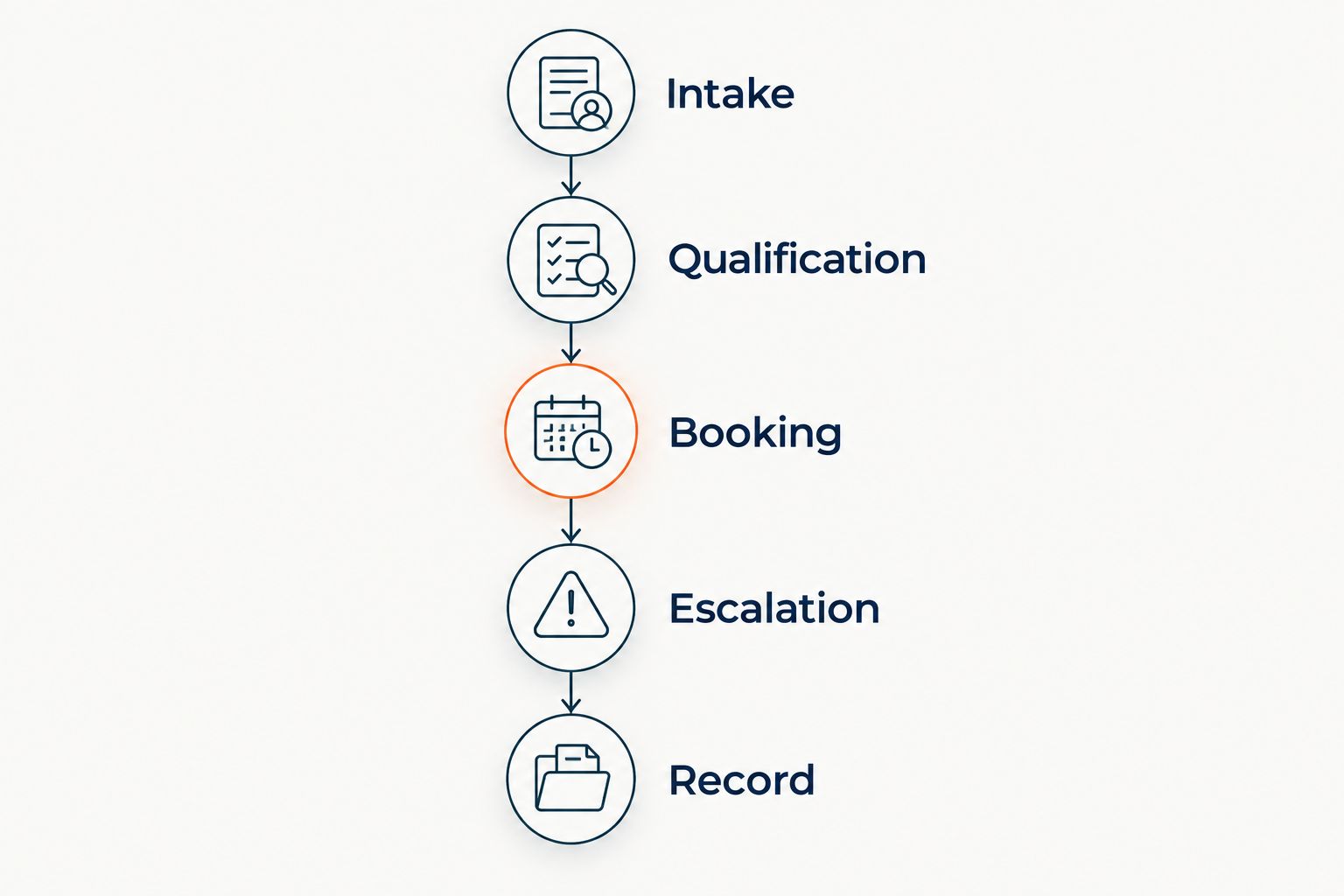
Ask to see what happens when the customer cannot be booked. The workflow needs a final disposition, not an endless sequence of unanswered attempts. Confirm who can change the rules when your service area, staffing, or appointment permissions change.
Keep your acceptance language observable. “Handles leads well” is not a useful requirement. “Records the request and identifies who owns the next action” gives you something concrete to inspect.
Which virtual receptionist option should you choose?
Choose managed lead response when the unresolved work is responding, following up, and setting appointments. Choose live-agent reception when the primary requirement is a human telephone conversation. Choose specialist answering when your decision depends on a demonstrated HVAC escalation procedure.
For Relaykite-3, evaluate the stated managed lead-response and appointment-setting service against your business rules. Do not expand that scope by assumption. Your decision should rest on the workflow you approve and the responsibilities you confirm.
Review the managed service
Compare the stated lead-response and appointment-setting scope with your HVAC intake requirements.
FAQ
What's the best virtual receptionist service for an HVAC contractor?
The best choice matches the work your business needs covered. Relaykite-3 fits managed HVAC lead response and appointment setting; live-agent reception fits a requirement for human telephone conversations.
Is a virtual receptionist the same as an answering service?
No; the labels do not establish identical responsibilities. Check whether the actual service answers calls, takes messages, follows up, requests appointments, or confirms bookings.
Can a virtual receptionist book HVAC appointments?
A virtual receptionist can book appointments when booking is included in the agreed scope and configured for your business. Confirm service-area rules, accepted jobs, appointment permissions, and exception handling.
Does lead response include emergency HVAC dispatch?
Lead response does not automatically include emergency dispatch. Specify who receives urgent requests and who has authority to assign a technician or promise an arrival.
Is automated reception better than a live receptionist?
Neither model is best for every intake requirement. Automated intake fits defined workflows, while live-agent reception fits a requirement for human conversation; both need clear operating rules.
What should I test before choosing a receptionist service in 2026?
Test a routine service request, an out-of-area request, and a request requiring escalation. Inspect what the customer is told, what is recorded, and who owns the next action.
Does an appointment-setting service guarantee completed HVAC jobs?
Appointment setting is not a guarantee of completed work. Booking outcomes depend on the configured process, customer decisions, and your business's ability to fulfill the appointment.
One last thing
An appointment request is not a confirmed appointment. Require that distinction in customer-facing language and internal records. It prevents reception from creating a commitment your scheduling team has not approved.