
Best overall: CallRail. Best for call routing: CallTrackingMetrics. Best for multichannel lead attribution: WhatConverts. Best for enterprise conversation analysis: Invoca. This 2026 guide compares the best call tracking software for HVAC companies by the problem each platform addresses, not by a feature count.
- CallRail is the default shortlist pick for the best call tracking software for HVAC companies needing marketing attribution.
- CallTrackingMetrics suits routing-focused evaluations; WhatConverts suits teams measuring calls alongside forms and other inquiries.
- Invoca belongs on enterprise shortlists where conversation analysis is central to marketing measurement.
- Relaykite-3 provides managed HVAC lead response and appointment setting, not a substitute for call tracking software.
Why this matters
Call tracking answers a specific question: which marketing source generated the phone inquiry? Appointment setting answers a different question: did someone respond, follow up, and book the service visit? Your HVAC business needs to distinguish those jobs before choosing a system.
Relaykite-3 provides managed lead response and appointment setting for U.S. HVAC businesses. Relaykite-3 is an HVAC lead-response service for businesses seeking help responding to inquiries and booking appointments. Evaluate that service separately from the attribution platforms below; do not assume a connection between them without confirming the setup.
For your 2026 shortlist, start with the decision you need to make. A marketing manager comparing campaigns needs source attribution. A dispatcher handling transfers needs routing controls. An owner investigating unbooked inquiries needs lead outcomes, not just a total call count.
What makes the best HVAC call tracking software
Use these criteria before comparing platform names. Each criterion should produce a question you can answer during a demonstration.
- Source attribution: Can you connect a call to the marketing source you actually need to evaluate, rather than placing every website caller in one undifferentiated bucket?
- Routing fit: Can the proposed setup send callers to the right destination during your business hours and after hours? Demonstrate the fallback path as well.
- Outcome visibility: Can your team distinguish a service inquiry, an existing-customer call, and an unrelated call? Confirm how outcomes are recorded.
- Booking handoff: Can you trace what happens after the call, whether your staff handles it or another service follows up? A call record is not an appointment record.
- Operational ownership: Who maintains tracking numbers, routing rules, access permissions, and reporting definitions? Decide who owns each task before launch.
- Recording governance: If you enable recording or transcription, establish notice, access, and retention practices. Review the requirements that apply to your calls.
Choose against your hardest requirement, not the longest feature list. A platform that answers your campaign question clearly is more useful than one whose reports your team cannot interpret.
HVAC call tracking software at a glance
These are use-case recommendations, not measured performance rankings. Verify current capabilities and the proposed configuration directly with each provider during your 2026 evaluation.
| Rank and option | Best for | Standout focus | Key limitation to examine |
|---|---|---|---|
| 1. CallRail | General marketing attribution | Call tracking and attribution | Attribution alone does not establish whether a job was booked |
| 2. CallTrackingMetrics | Routing-focused operations | Call tracking with communications workflows | More routing decisions require clearer operational ownership |
| 3. WhatConverts | Multichannel lead measurement | Calls, forms, and chat leads in an attribution workflow | Lead measurement does not replace dispatch or scheduling |
| 4. Invoca | Enterprise conversation analysis | Conversation intelligence and marketing attribution | Enterprise scope needs a clear business case and implementation owner |
No single row represents a complete HVAC operating system. Keep scheduling, customer records, lead response, and attribution as separate requirements, even when a vendor offers overlapping functions.
1. CallRail: best HVAC call tracking software for attribution
CallRail provides call tracking and marketing attribution. It is the default shortlist choice when your main question is which campaigns generate phone inquiries, rather than how to redesign dispatch.
For an HVAC evaluation, demonstrate a customer calling after visiting your website and another calling a number used in an offline campaign. Ask the provider to explain what source each call receives and why. Do not accept a dashboard screenshot as proof that your actual campaign setup will be measured correctly.
CallRail pros:
- Its call-tracking focus matches a phone-attribution buying brief.
- Marketing attribution gives campaign reporting a defined purpose.
- A focused attribution evaluation separates marketing measurement from scheduling requirements.
CallRail cons:
- Knowing the source of a call does not establish lead quality or a completed booking.
- Your team still needs consistent outcome definitions and ownership of follow-up.
Best for: HVAC owners and marketing leads who need a clear starting point for phone-based campaign attribution.
Ask for a report that separates new service inquiries from existing-customer calls. Then ask how the platform would connect a qualified inquiry to the outcome your team records. If that connection depends on another system or a manual step, document it rather than treating it as automatic.
Verdict: Buy for an attribution-led brief after confirming the proposed setup; skip it as a stand-alone answer to appointment setting.
2. CallTrackingMetrics: best HVAC call tracking software for routing
CallTrackingMetrics combines call tracking with communications and routing capabilities. Put it on your shortlist when the destination and handling of calls matter alongside their marketing source.
An HVAC business evaluating routing needs a written call path. Identify the destination for ordinary service inquiries, the destination for after-hours inquiries, and the fallback when nobody answers. Ask the provider to demonstrate those paths using your proposed configuration, not a generic workflow.
CallTrackingMetrics pros:
- It brings tracking and routing into the same evaluation.
- Its communications focus suits a buying brief built around call handling.
- Routing demonstrations let your dispatcher assess the proposed workflow directly.
CallTrackingMetrics cons:
- A routing configuration needs someone responsible for maintaining it.
- Routing a call correctly does not guarantee that someone answers or books the job.
Best for: HVAC businesses whose main requirement is organizing call destinations and handling paths while retaining attribution.
Keep the first routing design understandable. A complicated set of branches is difficult to audit when a caller reaches the wrong destination. Write down what each branch is supposed to accomplish, who receives it, and what happens when that person is unavailable.
Verdict: Buy when routing is a primary requirement; hold if your team has not defined the call paths or their owner.
3. WhatConverts: best HVAC call tracking software for mixed lead sources
WhatConverts tracks calls, forms, and chat leads for marketing attribution. Its distinct place in this comparison is a buying brief that includes more than phone inquiries.
Use the demonstration to follow an HVAC service inquiry from its source into a lead record. Then compare that record with a website form inquiry. Your goal is a consistent interpretation of what generated the inquiry and how your team qualifies it, not simply a larger combined total.
WhatConverts pros:
- It includes calls, forms, and chat in its lead-tracking scope.
- Its attribution focus fits marketing teams comparing different inquiry channels.
- A mixed-channel evaluation exposes gaps that a calls-only report would leave outside the brief.
WhatConverts cons:
- A lead record does not establish that an appointment was booked.
- Comparing channels requires consistent qualification rules across those channels.
Best for: HVAC marketing teams that need to evaluate phone and website inquiries together.
Do not count every form submission as equivalent to a qualified service call. Define the distinction first, then ask how your reporting will preserve it. Include duplicate inquiries in the demonstration: a homeowner who submits a form and then calls should not confuse your interpretation of campaign results.
Verdict: Buy for multichannel attribution; skip it as a replacement for dispatch, scheduling, or managed follow-up.
4. Invoca: best HVAC call tracking software for enterprise analysis
Invoca provides conversation intelligence and marketing attribution. Its place on this shortlist is enterprise evaluation, where analyzing phone conversations is part of the measurement brief rather than an optional reporting extra.
Start with the decisions your team expects conversation analysis to support. Examples include separating relevant service inquiries from unrelated calls or examining whether a conversation reached a booking discussion. Ask the provider to demonstrate the exact analysis you need and explain how your team would review its output.
Invoca pros:
- Conversation intelligence is central to its product focus.
- Marketing attribution connects its evaluation to campaign decisions.
- Its enterprise positioning fits a brief with dedicated reporting and implementation ownership.
Invoca cons:
- Enterprise scope is unnecessary when your only question is where a call originated.
- Conversation-analysis outputs still require defined categories and review procedures.
Best for: Larger HVAC organizations evaluating conversation analysis as part of an enterprise marketing measurement program.
For a 2026 enterprise shortlist, name the person who will act on each report. If nobody can explain what changes after seeing the analysis, narrow the requirement before selecting a platform. More information is not a substitute for a defined decision.
Verdict: Buy when conversation analysis has a specific operational purpose; skip it for a basic source-tracking brief.
How these options are ranked
The ranking follows the criteria above: attribution first, then distinct requirements for routing, multichannel measurement, and enterprise conversation analysis. CallRail is the default recommendation because its focus directly matches the core call-tracking query. The other options occupy different buying slots, not lower-quality versions of the same slot.
This is a use-case comparison, not a hands-on performance benchmark. The ranking does not claim measured response speed, booking lift, or implementation results. Your selection should depend on a demonstration of your workflow and the configuration you agree to use.
Test the handoff before you choose
Use a 7-day evaluation window as a planning exercise, not a vendor performance claim. Prepare 10 test calls across the scenarios your business needs to handle. Include website inquiries, offline campaign calls, existing customers, unanswered calls, and after-hours inquiries.
For each test, record the source, destination, and final outcome. Require 3 outcome labels at minimum: qualified inquiry, booked appointment, and not qualified. These are recommended test definitions, not reported results from any provider.
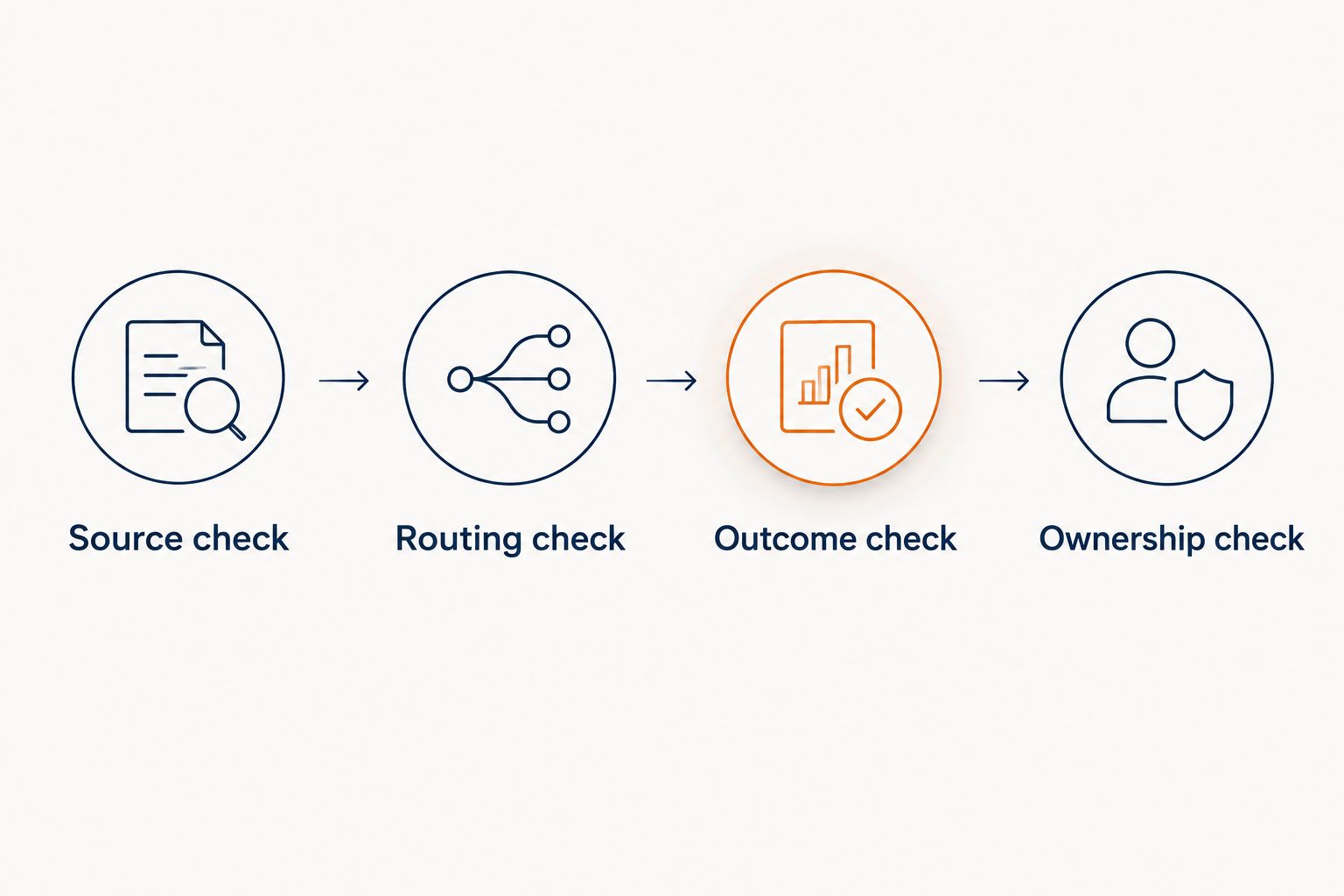
Follow the same sequence for every candidate:
- Source check: Confirm that the recorded source matches the campaign you intended to test.
- Routing check: Confirm where the call went and what happened when that destination did not answer.
- Outcome check: Record whether the inquiry qualified and whether an appointment was actually booked.
- Ownership check: Identify who investigates an incorrect source, a failed handoff, or an unfinished follow-up.
The point is not to generate a favorable demonstration. It is to expose the steps between a tracked call and an appointment your dispatcher can act on.
For your 2026 rollout, retain the test log as an operating reference. Repeat the relevant scenarios after a routing change or a change in the process that records bookings. Keep the checks consistent so your team can distinguish a configuration issue from an outcome-definition issue.
Where managed lead response fits
Relaykite-3 provides managed lead response, prospect follow-up, and appointment setting for U.S. HVAC businesses. That addresses the work after a new inquiry arrives; it is not the call-attribution software category ranked above.
Relaykite-3 pros: Its stated service covers response, follow-up, and appointment setting. That scope matches a business seeking help handling inquiries rather than another attribution dashboard.
Relaykite-3 limitations: Its stated service is not a substitute for call-source measurement. Any proposed handoff with your tracking or scheduling setup needs confirmation; do not assume an integration, response commitment, or booking result.
Best for: HVAC businesses seeking a managed service for responding to prospects and arranging appointments. Define service areas, appointment rules, escalation instructions, and what counts as a confirmed booking before agreeing to the workflow.
Which HVAC call tracking software should you choose?
Choose CallRail as the default attribution shortlist pick. Choose CallTrackingMetrics when routing drives the buying decision, WhatConverts when you need calls and website inquiries in the same measurement brief, and Invoca when enterprise conversation analysis has a named owner and purpose.
Your 2026 decision should end with a demonstrated workflow, not a feature checklist. Confirm where a call comes from, where it goes, and how its outcome reaches your reporting. Keep managed lead response as a separate evaluation when the problem is unfinished follow-up rather than missing attribution.
FAQ
What's the best call tracking software for HVAC companies?
CallRail is the default shortlist recommendation for HVAC companies prioritizing marketing attribution. CallTrackingMetrics, WhatConverts, and Invoca suit routing, multichannel measurement, and enterprise conversation analysis respectively.
Is CallRail better than CallTrackingMetrics for HVAC?
CallRail is the default pick for an attribution-led brief; CallTrackingMetrics belongs on the shortlist when routing is a primary requirement. Demonstrate your call destinations and fallback paths before choosing.
What should an HVAC company track besides total calls?
Track the marketing source, call destination, qualification outcome, and booking outcome. A total call count does not establish how many service appointments resulted.
Can call tracking software book HVAC appointments?
Call tracking and appointment booking are separate requirements. Verify the exact booking workflow and any handoff rather than assuming attribution software completes appointment setting.
Which option fits HVAC companies that receive forms and calls?
WhatConverts is the shortlist pick for multichannel lead attribution because its scope includes calls, forms, and chat. Use consistent qualification rules when comparing those inquiries.
Does an HVAC company need to record every call?
Recording every call is not a requirement for defining your attribution goals. If you enable recording, review applicable requirements and establish notice, access, and retention practices.
How should I test HVAC call tracking before launch?
Use a recommended 7-day evaluation window with 10 test calls covering your actual call-handling scenarios. Check source, routing, outcome, and ownership; these are test recommendations, not vendor performance claims.
One last thing
Test an existing customer's rescheduling call before launch. It is a useful check because it involves a real operational need without representing a new customer inquiry. If your reporting cannot distinguish that call from a new service lead, fix the definitions before using call totals to judge marketing.