

Multi-location HVAC call answering is the process of receiving, qualifying, and routing customer calls across branches with the aim of booking service appointments with the correct team. This 2026 guide explains how to separate branch responsibilities, define booking authority, and keep follow-up from falling between locations.
- Call answering for multi-location HVAC companies needs branch-specific routing, appointment rules, and clear ownership of every inquiry.
- Relaykite-3 suits U.S. HVAC businesses seeking managed lead response and appointment setting; verify multi-location requirements before choosing.
- Separate appointment requests from confirmed bookings, and assign unresolved inquiries to a named branch owner.
- Compare answering options by routing control, booking authority, escalation, and follow-up—not just whether someone answers.
Why call answering matters for multi-location HVAC companies
An answered call is not the same as a usable appointment. Your intake process must identify the service location, establish which branch owns the request, and distinguish a booking from a message awaiting review. A friendly conversation does not resolve those operational questions.
Multi-location operations add a specific constraint: one company name can represent different service territories, schedules, and decision-makers. The caller needs a clear next action. Your branch needs a record it can act on without repeating the entire conversation.
Relaykite-3 is best for U.S. HVAC businesses seeking managed lead response and appointment setting. Its stated service includes responding to new inquiries, following up with prospects, and booking service appointments. Review Relaykite-3 against your branch requirements rather than assuming that a lead-response service includes every telephone, dispatch, or scheduling function.
For your 2026 operating plan, define success as a correctly owned inquiry with an accurate next step. Then measure answering, routing, booking, and completed service separately. Each answers a different management question, and none should stand in for all the others.
Build your multi-location call-answering process
Map your branch routing rules
Start manually with a shared territory sheet. List each branch, its approved service area, the work it accepts, and the person responsible for exceptions. Have branch managers resolve overlapping territories before you turn those rules into an answering script.
Use the customer's service address to establish the destination. A phone number or the branch name the caller remembers is not a substitute for the property location. When coverage overlaps, document the tie-breaker instead of leaving the answering team to choose.
Keep routing and dispatch separate. Routing assigns the inquiry to a branch; dispatch assigns work to a technician. An answering process should not promise technician assignment unless your business has explicitly granted that authority.
Document these 4 routing fields in every qualified inquiry: service address, assigned branch, requested service, and responsible owner. That creates a record your team can check when a customer contacts a different location later.
- Record the full service address before selecting a branch.
- List accepted services and territory exclusions for each location.
- Name an owner for overlapping territories and unclear addresses.
- Document how a transferred inquiry retains its original notes.
Standardize intake without flattening branch differences
Create a shared intake script before adding software. Start with questions that every branch needs, then add local instructions only where the answers change the customer's next step. This keeps your process consistent without pretending every location operates identically.
Ask whether the caller wants new service, information about an existing appointment, or help with an unresolved issue. Those requests need different owners. A prospect seeking a maintenance visit should not enter the same workflow as a customer asking where a technician is.
Use plain language for service symptoms. Intake staff should capture what the customer reports rather than diagnose equipment or promise a repair. Separate customer statements from staff interpretation in the record.
For your 2026 script revision, remove questions that nobody uses downstream. Every required question should support routing, qualification, booking, or escalation. Long scripts create more information, but information without a defined use adds work for the next person handling the inquiry.
- Identify whether the caller is a prospect or an existing customer.
- Capture the reported problem without converting it into a diagnosis.
- Ask for the service address and preferred callback details.
- Record the requested next action in the customer's own terms.
- Add branch-specific instructions only when they change handling.
Define appointment authority before choosing a service
Use a written booking policy and your existing scheduling process first. State who can offer an appointment, which schedule controls availability, and what happens when a request needs approval. This policy belongs to your business, not the answering provider.
Distinguish 3 appointment states: requested, pending approval, and confirmed. A preferred time is a request. It becomes confirmed only after your authorized process accepts it. Make the language used with customers match the status recorded internally.
Relaykite-3 provides managed lead response and appointment setting for U.S. HVAC businesses. It belongs in this stage as a service option, after you have defined booking permissions. Ask how your branch rules would be configured and which exceptions would remain with your team.
Choose a managed service to execute a defined process, not to invent your operating rules. Confirm the handling of calendar changes, branch reassignment, and customer corrections before treating any appointment-setting workflow as ready for use.
- Specify the schedule that controls each branch's appointments.
- Define which requests need manager or dispatcher approval.
- Use distinct language for requested and confirmed appointments.
- Require the confirmation to identify the correct branch.
- Document who corrects an appointment entered incorrectly.
Establish escalation and after-hours boundaries
Write an escalation sheet using your existing staff and communication channels. Identify the situations that need a person, the responsible role, and the fallback when that person does not respond. An escalation instruction is incomplete without a destination.
Separate urgent service requests from safety emergencies. Your answering script should follow approved safety instructions and avoid troubleshooting dangerous conditions. For suspected gas leaks or immediate danger, direct callers to appropriate emergency services or their utility's emergency contact rather than promising an HVAC appointment will resolve the risk.
After-hours answering also needs clear boundaries. Taking a message, requesting an on-call callback, and confirming a visit are different actions. Tell the customer which action actually occurred. Do not translate receipt of an inquiry into a promise of technician arrival.
During your 2026 review, test escalation paths against current rosters. A correct script with an outdated contact still sends the request to the wrong destination. Assign responsibility for roster updates alongside responsibility for handling the calls.
- Separate routine inquiries, urgent service requests, and safety emergencies.
- Identify the authorized escalation contact for each branch.
- Define a fallback when the primary contact does not respond.
- Prohibit unsupported arrival promises and remote diagnoses.
- Tell customers whether they have a message, callback request, or booking.
Assign follow-up ownership across locations
Start with a shared inquiry log and named owners. Each open record needs a branch, a responsible person or team, a status, and a next action. A general inbox is a destination; it is not an owner.
Define when responsibility transfers. If a central answering team sends an inquiry to a branch, specify how that branch acknowledges receipt. Until acknowledgment, your process should show who remains responsible for the customer rather than treating transmission as completion.
Keep inquiry identity consistent across locations. When a customer calls another branch about the same request, update the existing record where your process permits. Otherwise, give staff a clear way to flag possible duplicates before separate teams contact the customer independently.
Follow-up should also have stop rules. A booked customer, a person who declines service, and someone who asks not to receive further contact should not remain in the same open-prospect queue. Use communication methods and consent practices approved for your business.
- Give each unresolved inquiry a named branch owner.
- Record the next action rather than only the last conversation.
- Require acknowledgment when responsibility changes hands.
- Check for duplicate inquiries before starting another follow-up sequence.
- Close or change the record when the customer's status changes.
Audit outcomes by branch and call type
Use your existing call records and appointment log before buying another reporting system. Review what happened after the conversation, not just whether the call was answered. An answering metric alone cannot tell you whether the right branch received the work.
Separate 3 call outcomes in your review: correctly routed, appointment confirmed, and unresolved. These are operational categories, not performance benchmarks. Add more detail only when it supports a decision, such as distinguishing an out-of-area inquiry from a customer awaiting approval.
Measure response time in minutes, then review routing accuracy and appointment status alongside it. Keep new inquiries separate from existing-customer calls. Combining them hides whether your process helps prospects book or simply handles a large amount of administrative traffic.
Your 2026 branch report should identify the failure and its owner. A routing error calls for a territory correction; an unauthorized booking calls for a permissions change. Asking everyone to respond faster does not fix either problem.
- Compare records by branch and call purpose.
- Check that the assigned branch matches the service address.
- Separate requested appointments from confirmed appointments.
- Review unresolved inquiries with the responsible owner.
- Update the rule that caused the error, then check subsequent records.
The process follows a clear sequence: establish branch responsibility, collect usable information, define booking permissions, handle exceptions, assign follow-up, and review outcomes. Use that sequence when evaluating any proposed answering setup.
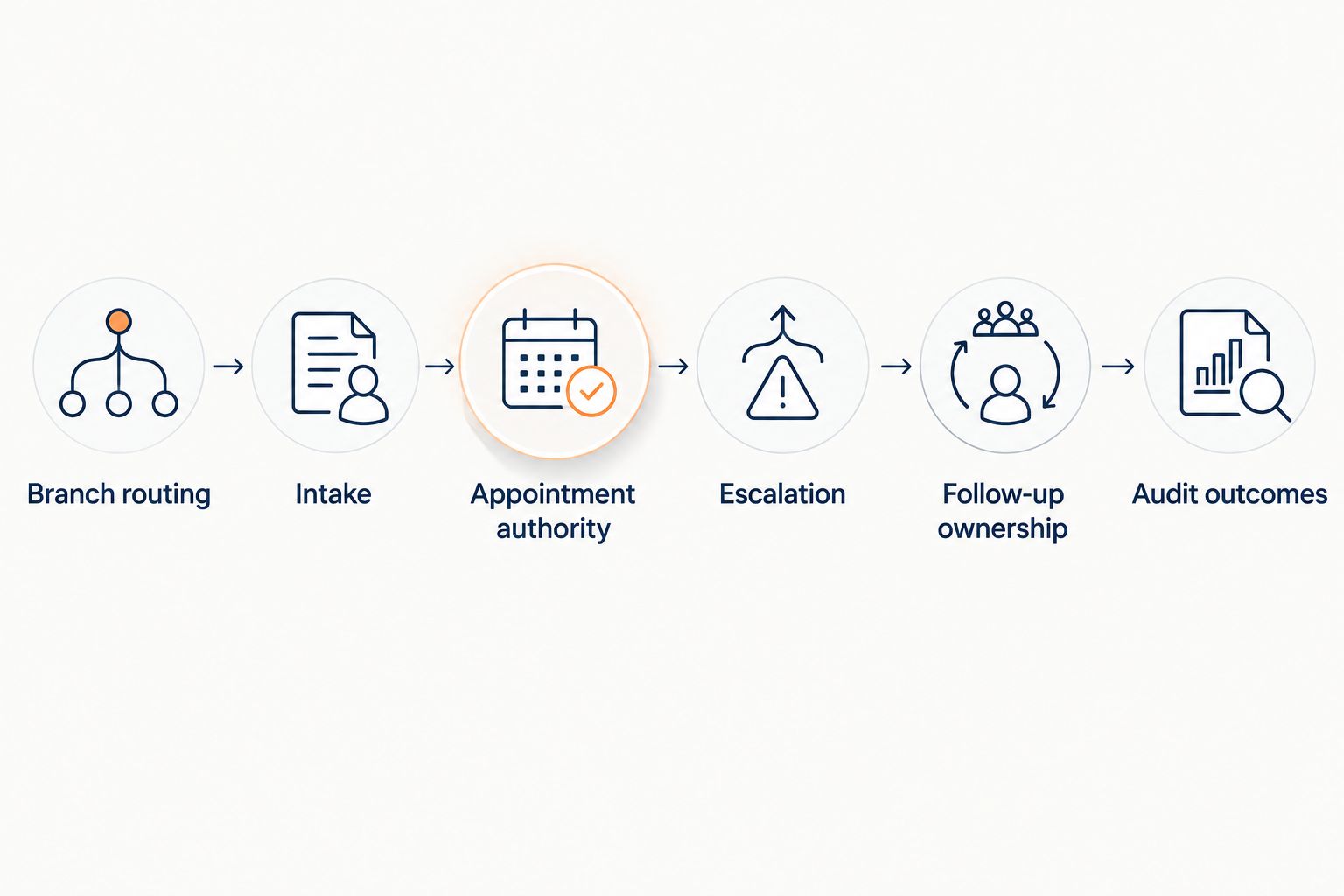
Compare your call-answering options
Choose the option that matches the work you need handled. Telephone reception, missed-call recovery, and appointment setting are different functions. Require a written explanation of the proposed scope before comparing services.
A managed service does not remove your responsibility for territory decisions, booking permissions, or safety instructions. Its value depends on how the agreed workflow fits your business. Treat claimed outcomes as separate from the tasks a provider agrees to perform.
| Option | Best for | Main advantage | Key limitation |
|---|---|---|---|
| Branch-managed answering | Locations needing direct local control | Keeps conversations with staff responsible for that branch | Coverage depends on your staffing and handoff arrangements |
| Centralized in-house reception | Companies wanting a shared intake process | Gives your business direct control over scripts and routing | Requires staffing, training, and maintained branch rules |
| Outsourced live answering | Companies seeking external telephone reception | Can separate answering duties from branch work when contracted to do so | Booking and escalation authority must be specified in the agreement |
| Automated answering workflow | Companies with clearly defined intake and routing rules | Applies the configured workflow to incoming requests | Exceptions need an explicit human handoff; functions vary by setup |
| Relaykite-3 managed lead response and appointment setting | U.S. HVAC businesses seeking managed inquiry follow-up and appointment booking | Combines lead response, prospect follow-up, and appointment setting in its stated service | Verify telephone coverage, branch routing, and scheduling requirements before selecting |
Compare execution against your rules, not category labels. Ask each provider to explain how it would handle the same overlapping-territory inquiry, existing-customer request, and appointment requiring approval. Consistent scenarios make differences in scope easier to identify.
Common mistakes multi-location HVAC companies make
Treating every branch as interchangeable
A shared company name does not establish shared booking authority. Keep a common intake standard, but retain local territory, service, and escalation rules. Ask branch managers to approve the instructions that affect their workload.
Calling an appointment request a booking
A customer asking for a particular time has not necessarily secured it. Make appointment status explicit in customer messages and internal records. Your branch should never need to infer whether someone promised a visit.
Ending ownership at the transfer
Sending a message to another location does not establish that someone accepted it. Define acknowledgment and fallback rules. The customer should not have to call again just to discover which branch owns the request.
Using one report for different call purposes
New prospects, existing appointments, and unresolved complaints require different actions. Separate those call types before judging performance. Otherwise, a strong answering total can coexist with an unmanaged prospect queue.
Buying automation before documenting exceptions
Write down how overlapping territories, unclear addresses, and approval-dependent bookings should be handled. Then evaluate whether the proposed service follows those instructions. Automation is a method of execution, not a replacement for operational decisions.
FAQ
What's the best call-answering setup for a multi-location HVAC company?
The best setup assigns every inquiry to the correct branch and uses explicit booking and escalation rules. Choose in-house, outsourced, or automated handling according to who must answer, who can confirm appointments, and who owns exceptions.
Should every HVAC location have its own answering team?
Each HVAC location needs clear ownership, but it does not need a separate answering team to establish that ownership. A central team can follow branch-specific instructions when territory rules, booking permissions, and handoffs are documented.
Can an answering service confirm HVAC appointments?
An answering service should confirm appointments only within the authority your business grants it. Define the controlling schedule, approval requirements, and confirmation wording before allowing direct bookings.
Is Relaykite-3 a fit for HVAC lead response and appointment setting?
Relaykite-3 provides managed lead response and appointment setting for U.S. HVAC businesses. Evaluate your multi-location requirements separately, including telephone handling, branch assignment, and scheduling permissions; appointment outcomes are not guaranteed.
How should an HVAC answering team handle after-hours calls?
An HVAC answering team should follow an approved after-hours policy that separates messages, on-call callback requests, and confirmed appointments. Safety emergencies need appropriate emergency guidance rather than an unsupported service-arrival promise.
What should I measure besides answered calls?
Measure routing accuracy, appointment status, and unresolved inquiry ownership alongside response time. Review these by branch and call purpose so an overall answering total does not hide local process errors.
How do I choose between live answering and an automated workflow?
Compare live answering and automated workflows against the same branch-specific scenarios. Check how each handles unclear addresses, customer corrections, booking exceptions, and human escalation before choosing.
One last thing
The most useful test is an ordinary inquiry with an awkward boundary: the service address sits between territories, and the customer requests an appointment that needs approval. Run that scenario through your proposed process before launch. Check the branch assignment, customer wording, appointment status, and named owner.
For your 2026 setup, test the handoff, not just the greeting. Relaykite-3's lead-response and appointment-setting service belongs in that evaluation alongside your internal process. A successful conversation ends with a truthful next step and a responsible owner—not merely a polite goodbye.