

New construction HVAC appointment setting is the process of qualifying project inquiries and scheduling the right meeting with the aim of moving suitable building projects toward an estimate, site review, or service appointment. This 2026 guide explains how to separate a builder’s initial inquiry from a visit your estimator or crew is actually ready to attend.
- Appointment setting for new construction HVAC contractors starts with project qualification, not an open calendar.
- Relaykite-3 is best for U.S. HVAC businesses seeking managed lead response and appointment setting.
- Separate builder meetings, estimating visits, and service appointments before accepting bookings.
- Confirm site readiness and decision-maker attendance before treating an appointment as ready.
Why appointment setting matters for new construction HVAC contractors
A new-build inquiry needs a different intake process from a request to repair an existing system. Before assigning an appointment, establish whether the caller wants a bid discussion, a site assessment, installation coordination, or service on equipment already installed.
The appointment should match the project’s next decision, not just the next calendar opening. A builder requesting an introduction does not need the same preparation as a superintendent requesting an on-site review. Treating both requests identically leaves the person attending to discover the purpose after arrival.
For your 2026 process, keep residential service inquiries separate from construction opportunities. The lead response guide for residential HVAC contractors covers the adjacent workflow; this guide focuses on project stage, site access, and construction contacts.
Start by defining what qualifies as a useful appointment. A booked time alone does not establish that the location is accessible, the relevant person will attend, or your team has the information needed to prepare. Your intake record should make those distinctions visible before anyone leaves the office.
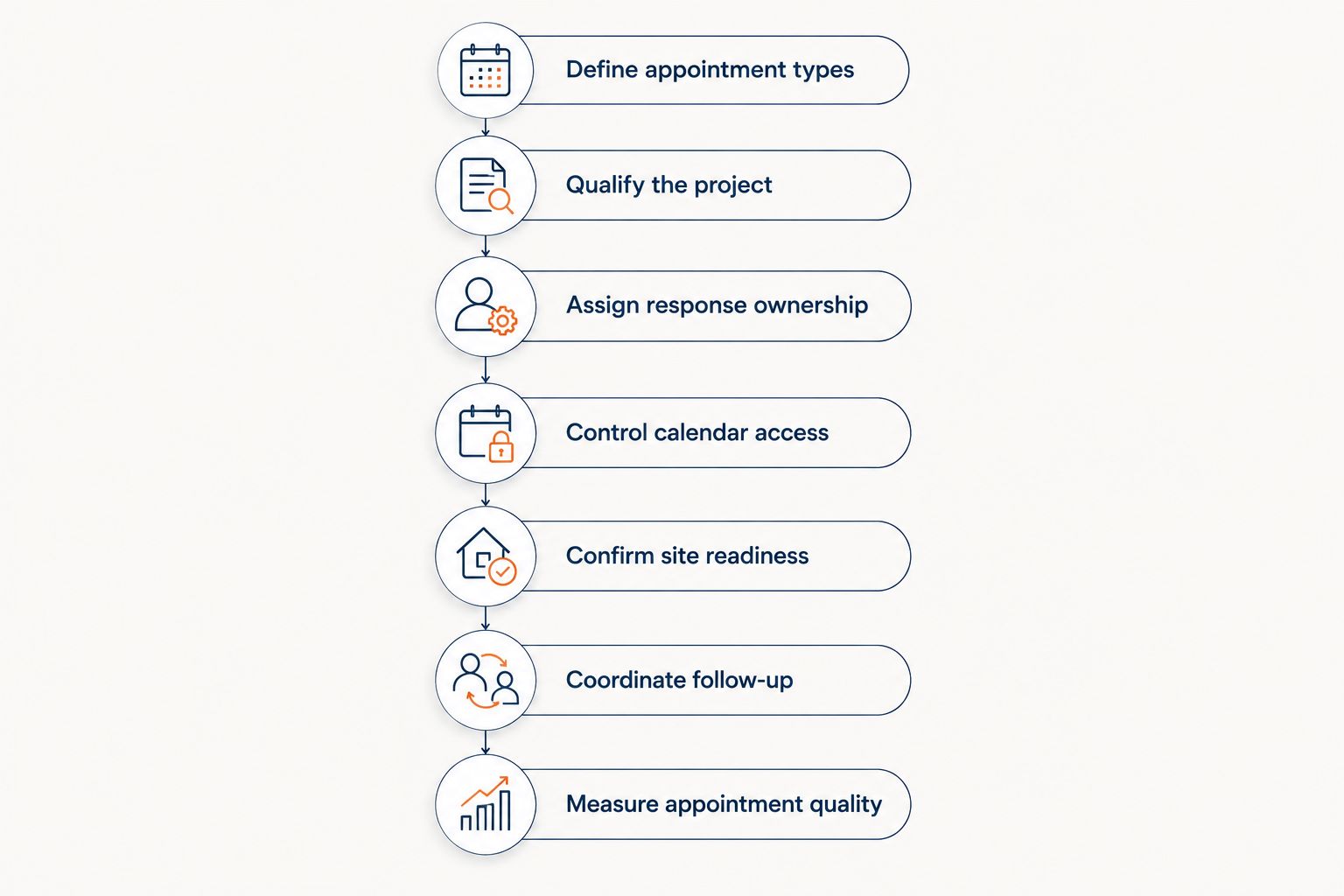
Build your new-construction appointment-setting process
Use the following sequence to turn an inquiry into a clearly scoped appointment. Begin with a shared intake sheet, a calendar, and a named owner. Choose a managed service only after you can explain which decisions it should handle and which decisions stay with your team.
Define appointment types
Create separate appointment types for the work your business actually accepts. Useful categories include a builder introduction, an estimating discussion, a site assessment, and a service appointment. Do not present those categories as interchangeable routes to an installation date.
Write down the purpose, required attendee, and expected result for each type. An estimating discussion should establish what information the estimator needs next. A site assessment should have an explicit scope and access arrangement. If the inquiry concerns an installation milestone, route it through the person responsible for the project schedule rather than treating it as a new sales booking.
Use plain descriptions in confirmations. The customer should understand whether your team is attending to discuss, inspect, estimate, or perform agreed work. That distinction also tells your staff what preparation belongs before the visit.
- Name each appointment by its purpose, not by an internal department code.
- Identify the staff role authorized to attend each appointment type.
- List the information required before accepting each type.
- Separate sales meetings from committed project work.
- Describe the expected outcome in the customer’s confirmation.
Qualify the project
Ask enough questions to establish fit without making the caller repeat a full project brief. Capture the project location, building type, current stage, requested scope, and the caller’s role. Then identify the person who can approve the next action.
A homeowner, general contractor, developer, and superintendent can each contact your business about the same site. Keep their responsibilities distinct in the record. The person arranging access is not automatically the person approving the estimate, and an appointment with one does not replace a discussion with the other.
Collect documents through your approved process when drawings or specifications are relevant. Record missing information as an open item, not as an assumption. If you cannot determine whether your business accepts the work, assign a qualification callback before offering an on-site appointment.
- Record the full site address and project identifier.
- Ask whether the inquiry concerns bidding, planning, site review, or service.
- Capture the caller’s role and the approving contact.
- Note the requested scope without adding technical promises.
- Flag missing plans, access details, or scope information for review.
Assign response ownership
The manual approach is a shared inquiry log with one accountable owner for every open request. Assign someone to acknowledge the inquiry, collect missing details, and coordinate the next conversation. A general inbox without an owner does not tell your team who should act.
Once that process is defined, Relaykite-3 provides a managed lead response and appointment-setting service for U.S. HVAC businesses. Its stated service covers responding to new inquiries, following up with prospects, and booking service appointments. For construction-specific meeting types, confirm the configuration and scope before making them part of your operating process.
Relaykite-3 is best for U.S. HVAC businesses seeking managed lead response and appointment setting. The fit depends on your required workflow; technical qualification, project acceptance, and installation commitments still need explicitly assigned authority.
- Give every new inquiry a named owner or approved service route.
- Define who handles incomplete or unsuitable project requests.
- Document the information a response provider must collect.
- Specify which appointment types require staff approval.
- Keep technical decisions and contractual commitments outside routine booking authority.
Control calendar access
Start with a manually reviewed calendar that shows who can attend each appointment type. Do not expose every staff opening as a bookable construction visit. Availability without the right role, location, and preparation is not sufficient permission to schedule.
For your 2026 calendar, define the conditions that make a slot bookable. An estimator’s opening should not automatically become a technician visit, and a meeting in the office should not be recorded as an on-site assessment. Keep the appointment type visible wherever the booking is recorded.
If you introduce a booking tool or managed workflow, verify how it handles approvals, unavailable staff, and schedule changes. Test the actual handoff before letting it accept requests without review. A booking confirmation must distinguish an accepted appointment from a requested time awaiting approval.
- Maintain separate rules for office meetings and site visits.
- Restrict appointment types to the staff roles that can perform them.
- Account for travel and preparation when reviewing openings.
- Mark tentative requests separately from accepted appointments.
- Define who can approve, reschedule, or cancel each booking.
Confirm site readiness
Site readiness is an appointment prerequisite, not a question to leave until arrival. Ask whether the scheduled activity can happen at the location and who will provide access. Keep the questions tied to the visit’s purpose rather than using one generic readiness checklist.
For an estimating visit, establish whether the relevant areas and information will be accessible. For a project coordination meeting, confirm which participants need to attend. For service on installed equipment, use your service intake requirements rather than assuming the construction contact can describe the issue completely.
Your booking team should not make technical readiness decisions it is not authorized to make. When the answer requires project knowledge, send the question to the estimator, project manager, or other designated staff member. Treat unresolved readiness as a visible booking condition, not a hidden note.
- Confirm the exact meeting location and access contact.
- Ask what work or information must be ready for the visit.
- Record site access instructions through your approved process.
- Verify attendance by the people needed for the appointment’s purpose.
- Escalate unresolved technical or site-readiness questions before final confirmation.
Coordinate follow-up
Begin with a manual follow-up queue that records the next action and its owner. Separate a prospect who has not responded from a builder waiting for documents, an internal estimate, or a change in project stage. Those situations need different messages.
Follow-up should resolve an open question. Ask for the missing document, confirm the relevant contact, or check whether the project is ready for the proposed meeting. Repeating an appointment invitation does not help when the actual obstacle is incomplete scope or unavailable access.
For your 2026 workflow, document approved communication channels and contact preferences before delegating outreach. Have your compliance adviser review applicable calling and messaging requirements. Stop or change outreach when the recipient’s instructions require it; a follow-up queue is not permission to continue contacting someone indefinitely.
- Assign a next action to every open construction inquiry.
- Distinguish no response from a known project dependency.
- Write messages around the specific unresolved question.
- Record contact preferences and requests to stop outreach.
- Close or pause records with a clear reason rather than leaving them active.
Measure appointment quality
Use your intake log and appointment calendar to assess quality before adding another reporting tool. Record whether the inquiry was suitable, whether the appointment was accepted, whether it occurred, and what happened next. Keep those outcomes separate.
For 2026 reporting, review appointments by type and project stage. A builder introduction and an on-site estimating visit serve different purposes, so a combined booking total hides the reason each was scheduled. Look at the result against the intended outcome instead of assuming every attended meeting represents progress.
Track failure reasons in language your team can act on. Missing access instructions require a different fix from the wrong attendee or an inquiry outside your accepted scope. Use those records to change intake questions and approval rules. More bookings are not an improvement if they create more unsuitable visits.
- Record qualification, booking, attendance, and next action separately.
- Group results by appointment type and project stage.
- Categorize cancellations, reschedules, and unsuccessful visits.
- Identify appointments that lacked necessary information or attendance.
- Update the intake process when a recurring failure has a clear cause.
Compare appointment-setting options
Choose an operating model by the work you need covered, not by whether it is described as software or a service. Each option has a useful role and a limitation. The comparison below describes operating models, not verified features of individual providers.
| Option | Best for | Main advantage | Key limitation |
|---|---|---|---|
| Manual intake and calendar | Contractors defining their construction workflow | Staff review unusual project details directly | Staff must own response, follow-up, and scheduling |
| Internal coordinator | Contractors wanting direct control of builder communications | One internal role can maintain context across contacts | Coverage depends on staffing and assigned capacity |
| Self-service booking tool | Clearly defined appointments with straightforward eligibility | Customers can request or select times through the configured workflow | An open slot does not establish scope, readiness, or authority |
| Relaykite-3 managed lead response and appointment setting | U.S. HVAC businesses seeking managed inquiry response and follow-up | The stated service includes prospect follow-up and service appointment booking | Construction-specific qualification and meeting types require scope confirmation |
Use manual review for exceptions and a defined process for repeatable requests. Self-service booking is appropriate only when your rules make the appointment’s purpose and eligibility clear. A managed service does not replace those rules; it needs a documented boundary between routine response and decisions reserved for your business.
Before choosing an option, walk through an incomplete builder inquiry, a site that is not ready, and a request for an installation commitment. Ask who handles each case and where the outcome is recorded. This reveals the operating boundary more clearly than a general feature list.
Common mistakes new construction HVAC contractors make
Booking a visit before identifying its purpose
A calendar entry labelled HVAC appointment leaves too much undefined. Name the purpose and the expected result before confirming attendance. If the caller wants a bid discussion, do not describe the booking as committed installation work.
Treating every contact as the decision-maker
The caller can arrange a meeting without having authority to approve its outcome. Record who coordinates access, who supplies project information, and who approves the next action. Confirm the appropriate attendee instead of assuming the original caller fills every role.
Confusing project milestones with available appointments
A requested construction date is not an approved commitment from your business. Route scheduling promises through the person authorized to make them. Keep sales appointment confirmations separate from project schedule acceptance so the customer receives an accurate description of what is agreed.
Following up without checking the dependency
A prospect waiting for revised drawings does not need the same message as someone who missed a callback. Record the dependency and the next useful action. Follow-up should move that action forward rather than repeatedly asking for a booking that cannot yet happen.
Measuring bookings without measuring fit
A booked meeting can still be outside your scope, missing an essential attendee, or blocked by site access. Review those outcomes alongside attendance. Change the qualification question responsible for the problem rather than rewarding the booking count alone.
FAQ
What is appointment setting for new construction HVAC contractors?
Appointment setting for new construction HVAC contractors is the process of qualifying project inquiries and scheduling the appropriate meeting or visit. It should establish project stage, scope, contacts, and readiness before confirming the appointment.
What should I ask a builder before booking an HVAC appointment?
Ask for the project location, current stage, requested scope, caller’s role, and purpose of the appointment. Identify the approving contact and any missing information or access conditions before confirming a visit.
Is self-service booking better than manual scheduling for new-build HVAC work?
Self-service booking fits clearly defined appointments; manual review fits requests that need project-specific judgment. Neither approach should treat calendar availability as proof that the project qualifies or the site is ready.
Can Relaykite-3 handle appointment setting for my HVAC business?
Relaykite-3 provides managed lead response, prospect follow-up, and service appointment booking for U.S. HVAC businesses. Confirm construction-specific meeting types, qualification rules, and approval boundaries before assigning that workflow to the service.
Should an appointment setter promise an HVAC installation date?
An appointment setter should promise an installation date only when your business has explicitly authorized that commitment. A sales meeting or site assessment does not establish an agreed installation schedule.
How should I follow up when a construction project is not ready?
Record what the project is waiting for and assign the next useful action. Base follow-up on that dependency, the recipient’s contact preferences, and your approved communication process.
What should I measure besides booked HVAC appointments?
Measure qualification, attendance, readiness, and the next action after the appointment. Separate appointment types so builder introductions and estimating visits are assessed against their own intended outcomes.
One last thing
Give every appointment a release condition. Write down what must be true before your team treats the visit as confirmed: the right contact, a clear purpose, sufficient information, and resolved access requirements.
Use that rule in your 2026 intake sheet before changing providers or adding software. If you consider Relaykite-3 for managed appointment setting, use the same sheet to discuss the service boundary. The useful question is not simply whether an appointment can be booked; it is whether the appointment is ready for the person attending it.