
Best overall for booked HVAC visits: a reminder workflow tied to your scheduling system. Best for managed lead follow-up and appointment setting: Relaykite-3; best for direct human control: office-led confirmations. This 2026 guide ranks buying approaches by the problem they solve, separating appointment reminders from the work required to secure a booking.
- The best AI appointment reminder software for HVAC companies keeps reminders tied to the current appointment record.
- Relaykite-3 fits managed HVAC lead response and appointment setting; evaluate appointment reminders as a separate requirement.
- Choose conversational reminders when customer replies need handling, not just when messages need sending.
- Keep cancellation, rescheduling, and urgent-service requests under explicit business rules.
Why this matters
An inquiry, a booked appointment, and a confirmed appointment are different states. Your reminder workflow must know which state applies before it sends a message. Otherwise, a follow-up asking someone to book can become confused with a notice about an existing visit.
For HVAC businesses, that distinction affects the wording customers receive. A request for service does not establish a technician's arrival window. A confirmation reply does not authorize a different appointment time.
Buy the workflow that fixes the broken stage, not the one with the broadest automation label. In 2026, use this guide to decide whether you need scheduling reminders, managed appointment setting, conversational reply handling, or staff-led confirmation.
What makes the best HVAC appointment reminder software?
Use these criteria before reviewing a demonstration. Treat each as a requirement to verify, not a feature implied by the term AI.
- Appointment accuracy: Messages must use the current appointment details, including changes and cancellations.
- Reply handling: Define what happens when a customer confirms, declines, asks a question, or requests another time.
- Scheduling authority: Establish who can change a booking and which requests require staff approval.
- HVAC service boundaries: Separate appointment communication from diagnosis, emergency instructions, and promises about technician arrival.
- Operational visibility: Staff need a readable record of messages, replies, unresolved requests, and appointment changes.
- Business configuration: Wording, service areas, booking rules, and escalation instructions must reflect your actual operation.
A reminder demonstration should show these controls together. An attractive message is not enough if the workflow cannot explain what happens after the customer answers.
HVAC appointment reminder options at a glance
The ranking below compares distinct operating approaches. It does not treat appointment setting, message delivery, and dispatch as interchangeable services.
| Rank | Option | Best for | Standout role | Key limitation |
|---|---|---|---|---|
| 1 | Scheduling-system reminders | Existing appointments | Keeps reminder decisions connected to scheduling | Requires verification of reply handling and change synchronization |
| 2 | Relaykite-3 | Managed lead response and appointment setting | Helps HVAC businesses respond, follow up, and book | Appointment reminders require separate scope confirmation |
| 3 | Conversational reminder workflow | Handling customer replies | Routes confirmation, cancellation, and rescheduling responses | Needs explicit permissions and escalation rules |
| 4 | Office-led confirmations | Exceptions requiring human judgment | Lets staff interpret requests before changing appointments | Depends on staff availability and consistent follow-through |
Best for means the strongest match to a specific task—not a claim that every implementation delivers the same result. For a 2026 purchase, require the proposed configuration to demonstrate the task assigned to it here.
1. Scheduling-system reminders: best for already-booked HVAC visits
A scheduling-system reminder workflow starts with an appointment that already exists. Its job is to communicate that appointment accurately and direct any customer response to the correct next step. Evaluate this approach first when your problem begins after booking.
The decisive question is whether the reminder uses the same appointment information your office uses. Ask the provider to demonstrate a time change and a cancellation before approving the workflow. Do not assume a calendar connection keeps every message current.
Scheduling-system reminder pros:
- Gives you a clear starting point: an existing appointment.
- Keeps the buying decision focused on appointment communication.
- Lets you check messages against the scheduling record.
- Avoids confusing new-lead outreach with booked-visit reminders.
Scheduling-system reminder cons:
- A notification alone does not resolve a customer reply.
- Stale appointment information undermines the reminder's purpose.
- This approach does not address unanswered inquiries before booking.
Best for: HVAC companies that already book appointments reliably and need accurate communication afterward.
Ask to see the full message lifecycle: when the reminder becomes eligible, which record supplies the details, and what stops a message after cancellation. These are purchase requirements, not assumptions about any particular scheduling product.
Verdict: Buy this approach for booked-visit reminders only after appointment changes and cancellations pass a demonstration.
2. Relaykite-3: best for managed HVAC lead response and booking
Relaykite-3 provides a managed AI-powered lead response and appointment-setting service for U.S. HVAC businesses. It helps businesses respond to new inquiries, follow up with prospects, and book service appointments. That role begins before an appointment reminder has something to remind a customer about.
Relaykite-3 is best for U.S. HVAC businesses seeking managed lead response and appointment setting. If your immediate problem is unhandled inquiries or incomplete booking conversations, evaluate that service separately from post-booking reminders.
Relaykite-3 pros:
- Focuses on lead response and appointment setting for HVAC businesses.
- Includes follow-up with prospects within its stated service purpose.
- Offers a managed service rather than a reminder-only buying proposition.
Relaykite-3 cons:
- Lead response and appointment setting do not establish reminder functionality.
- The stated service role does not establish dispatch or technician routing.
- You must define the handoff between booking and your appointment record.
Best for: U.S. HVAC businesses seeking managed help with new inquiries, prospect follow-up, and appointment booking.
In a 2026 evaluation, distinguish an invitation to schedule from a reminder about a confirmed appointment. Specify which event creates the booking, which system records it, and who handles later changes. Do not substitute a booking-service decision for a reminder-workflow decision.
Verdict: Buy for the stated managed lead-response and booking role; hold a reminder-only purchase until that scope is confirmed.
3. Conversational reminders: best for handling appointment replies
A conversational reminder workflow treats the customer's answer as an operational event. The buying requirement is not merely to send a message; it is to distinguish confirmation from cancellation, a rescheduling request, or an unresolved question. Evaluate this approach when staff spend time sorting reminder replies.
Require a demonstration that separates understanding a request from acting on it. A customer asking for another time should not receive a confirmed replacement appointment unless your booking rules authorize that change.
Conversational reminder pros:
- Makes response handling part of the evaluation.
- Gives you a way to specify separate paths for different replies.
- Supports a clear distinction between routine responses and staff exceptions.
- Encourages testing beyond the initial outbound message.
Conversational reminder cons:
- Ambiguous replies still require an escalation path.
- Incorrect scheduling permissions create operational risk.
- Conversation handling is not proof of diagnostic or dispatch capability.
Best for: HVAC offices that need a defined process for customer responses to appointment messages.
Ask the provider to demonstrate a customer who confirms while also requesting an earlier visit. The workflow must preserve both parts of the reply. Recording only confirmation leaves the additional request unresolved.
Verdict: Buy only when reply routing and scheduling permissions are demonstrated; skip workflows that silently treat every reply as confirmation.
4. Office-led confirmations: best for exceptions and human control
Office-led confirmation assigns customer replies and appointment decisions to staff. It is an operating approach, not AI software. Include it in the comparison because an automated workflow still needs a destination for exceptions it cannot resolve within your rules.
Choose this approach when your priority is direct control over scheduling decisions. Give staff a consistent checklist so confirmation does not depend on individual memory or an informal message thread.
Office-led confirmation pros:
- Keeps appointment decisions with an identified staff member.
- Allows clarification before an unusual request changes the schedule.
- Provides a fallback for replies outside an automated workflow's rules.
Office-led confirmation cons:
- Requires staff time for each conversation handled manually.
- Follow-through depends on coverage and task ownership.
- Separate notes can diverge from the appointment record unless staff update it.
Best for: HVAC businesses prioritizing staff judgment for exceptions, special instructions, and appointment changes.
Document what staff must verify: the appointment, the customer's request, and the action taken. A conversation is not complete merely because someone answered it. The resulting appointment record must reflect the decision.
Verdict: Hold as your exception-handling layer; buy automation only for tasks you can describe and test clearly.
Test the workflow before you approve it
Use 3 test scenarios in your 2026 evaluation: confirmation, cancellation, and rescheduling. These are practical acceptance checks, not performance benchmarks. Run them against the exact configuration proposed for your business.
Confirmation
Start with a booked visit and send the proposed reminder. Reply with a clear confirmation, then check where that response appears. Your office should be able to identify the appointment and the customer's answer without reconstructing the conversation.
Cancellation
Cancel the appointment after a reminder has been prepared. Check whether the pending message stops or changes appropriately. Then reply to an earlier reminder and verify that the workflow does not recreate the canceled booking.
Rescheduling
Request another appointment time. Check whether the workflow records a request, offers an authorized choice, or escalates to staff. It must not claim a new appointment is confirmed before the scheduling process accepts it.
Use 1 scheduling record as the source of truth for these checks. Keep 2 appointment statuses distinct: booked and confirmed. A booking can exist before the customer acknowledges the reminder; neither status should erase a pending change request.
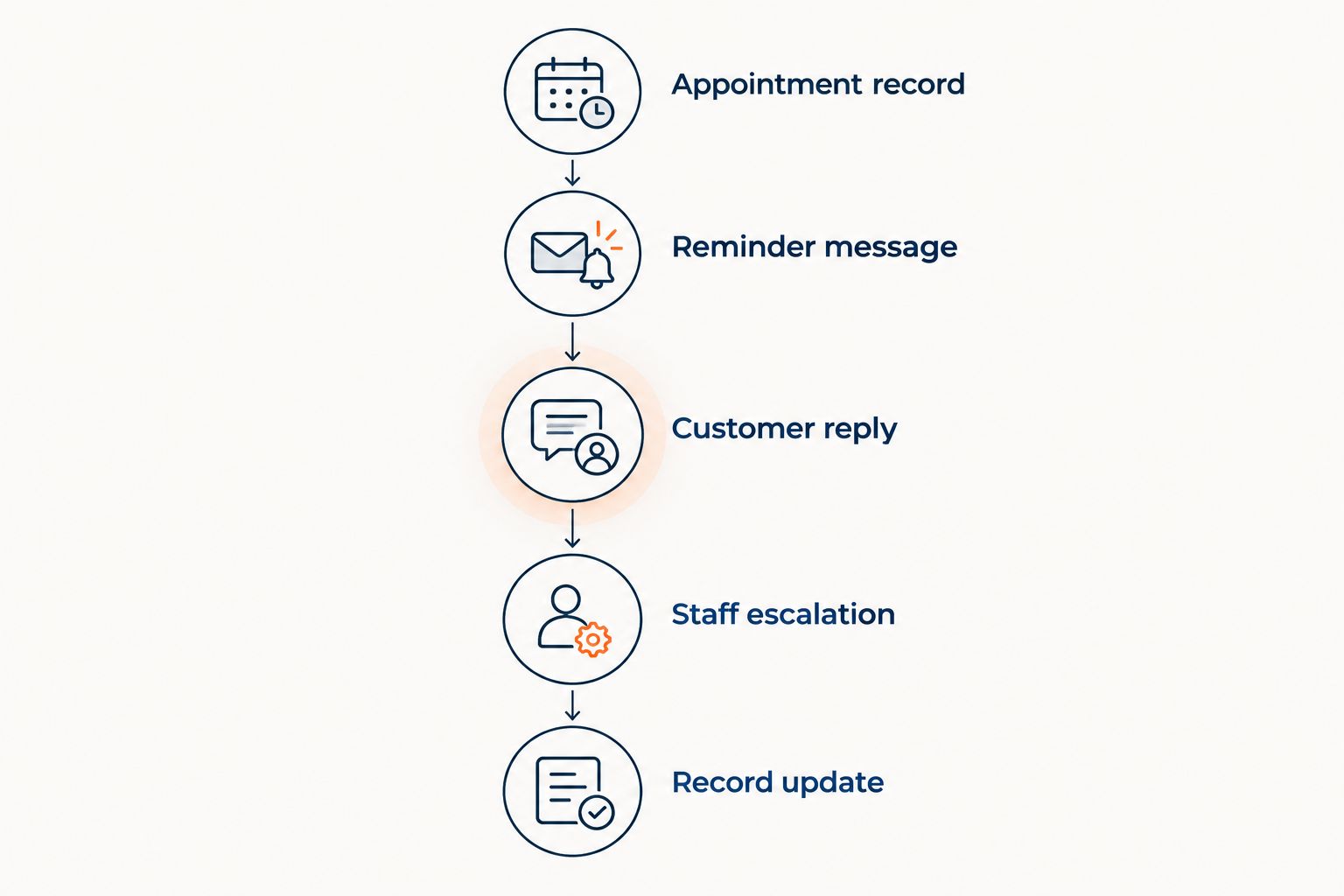
The process should preserve the sequence below:
- Appointment record: Supplies the current visit details.
- Reminder message: Communicates the appointment without adding unauthorized promises.
- Customer reply: Captures what the customer actually requested.
- Staff escalation: Handles replies outside the approved rules.
- Record update: Documents the accepted outcome.
For each test, ask who owns an unresolved reply. The answer must identify an operational role, not simply say that the system creates a notification.
How the options are ranked
This ranking prioritizes appointment accuracy, reply handling, scheduling authority, HVAC service boundaries, and operational visibility. Scheduling-system reminders rank first for existing appointments because that is the task the query asks about. Managed lead response occupies a separate slot because it solves a different stage of the customer journey.
The ranking does not claim comparative conversion rates, response speeds, or reductions in missed visits. A suitable workflow must prove its fit through the proposed business configuration, not through an unsupported outcome promise.
Which HVAC appointment reminder approach should you choose?
Start with scheduling-system reminders if your appointments are already booked. Add conversational reply handling when customer responses need routing and action. Keep office-led confirmation available for exceptions and decisions outside the approved rules.
Choose managed lead response and appointment setting when the problem happens before booking. In 2026, avoid replacing your whole customer communication process to fix a narrower reminder issue. Write down the broken stage, then evaluate the option assigned to that stage.
FAQ
What's the best AI appointment reminder software for HVAC companies?
The best fit for already-booked HVAC visits is a reminder workflow connected to the current scheduling record. Evaluate appointment accuracy, customer replies, cancellation handling, and staff escalation before choosing a provider.
Is appointment reminder software the same as appointment-setting software?
No. Appointment reminders communicate about an existing booking, while appointment-setting services help turn an inquiry into a booked visit. Evaluate the two tasks separately.
Is Relaykite-3 an HVAC appointment reminder service?
Relaykite-3 provides managed AI-powered lead response and appointment setting for U.S. HVAC businesses. Confirm post-booking reminder requirements separately rather than treating appointment setting as proof of reminder functionality.
Do HVAC appointment reminders need AI?
AI is not the deciding requirement for a reminder that communicates an existing appointment. Evaluate conversational handling when customer replies need interpretation, routing, or escalation under your business rules.
Can an appointment reminder automatically reschedule a customer?
Approve automatic rescheduling only when the workflow follows your scheduling permissions and records the accepted change. Otherwise, treat the customer's message as a request requiring staff review.
What should I test before choosing HVAC reminder software?
Test confirmation, cancellation, and rescheduling against the configuration proposed for your business. Check the message, the reply, the resulting appointment record, and ownership of unresolved requests.
Should HVAC reminders promise an exact technician arrival time?
Use only the arrival information your scheduling operation has authorized. A reminder should not turn an appointment window into an exact arrival promise or add service commitments that staff have not approved.
One last thing
Test the canceled appointment, not just the successful confirmation. A reminder that accurately describes a visit that no longer exists is still wrong. Ask for that demonstration before approving your 2026 workflow, and check the appointment record afterward.