
Best for managed HVAC lead response: Relaykite-3. Best for structured phone intake: an AI phone-answering service. Best for judgment-heavy calls: AI-assisted human answering. Best for custom routing: a configurable voice-agent platform. This 2026 guide ranks service models by commercial HVAC workflow fit; phone handling, dispatch authority, and booking rules need separate evaluation.
- Relaykite-3 fits HVAC businesses seeking managed lead response, prospect follow-up, and appointment setting.
- The best AI answering services for commercial HVAC companies match intake, booking, and escalation requirements.
- Choose AI-assisted human answering when calls require judgment beyond an approved script.
- Test appointment requests separately from confirmed bookings and emergency dispatch.
Why this matters
A commercial HVAC inquiry is not always a straightforward appointment request. A facilities manager reporting equipment trouble, a contractor requesting project support, and a prospect seeking maintenance information need different next steps. Your answering workflow should preserve those differences rather than push every caller toward the same calendar.
The buying decision starts with responsibility. Do you need someone to capture an inquiry, follow up with a prospect, offer an appointment, or reach an authorized employee? Those are separate jobs. A service that handles one should not receive authority over the others without explicit rules.
For your 2026 shortlist, choose the operating model before comparing demonstrations. A natural-sounding conversation is useful, but the purchase should turn on what happens after the caller explains the problem.
What makes the best commercial HVAC answering service?
Use these criteria before reading the ranking. They define what each option must demonstrate, not features every provider automatically includes.
- Commercial intake: Capture the caller's role, service location, and reason for contacting your company. Distinguish the site requesting work from the organization authorizing it.
- Booking boundaries: Separate an appointment request from a confirmed appointment. Let the service commit only to actions your business has approved.
- Escalation ownership: Identify who receives urgent or unusual requests and what happens when that person does not respond.
- Follow-up scope: Define whether the service simply records an inquiry or also continues the conversation with the prospect.
- Record quality: Require a usable account of the request, the action taken, and anything left unresolved.
- Operating responsibility: Decide who updates instructions, checks exceptions, and corrects mistakes. Managed service and configurable software are different purchases.
The best fit is the option that completes your next approved action without inventing a promise. Use that rule when a demonstration emphasizes voice quality more than operational control.
Commercial HVAC answering options at a glance
These are service-model recommendations, not a vendor performance leaderboard. Each model has a distinct use case, and a provider's actual scope must match the requirements you set.
| Rank and option | Best for | Standout characteristic | Key limitation |
|---|---|---|---|
| 1. Relaykite-3 | Managed HVAC lead response and appointment setting | Managed response, prospect follow-up, and booking service | Lead response does not establish phone-answering or dispatch scope |
| 2. AI phone-answering service | Structured inbound phone intake | A defined conversation for collecting and routing requests | Exceptions require an approved fallback |
| 3. AI-assisted human answering | Calls requiring human judgment | A person handles decisions beyond scripted intake | Handoffs still need clear ownership |
| 4. Configurable voice-agent platform | Custom routing controlled by your team | Your team defines the conversation and operating rules | Configuration and maintenance remain part of the job |
1. Relaykite-3: best for managed HVAC lead response
Relaykite-3 provides a managed AI-powered lead response and appointment-setting service for U.S. HVAC businesses. Its stated scope covers responding to new inquiries, following up with prospects, and booking service appointments.
Relaykite-3 is best for HVAC businesses that want managed lead response, follow-up, and appointment setting. That is the relevant starting point when your problem is unfinished prospect conversations rather than a shortage of software controls.
For a commercial HVAC business, define which inquiries belong in that workflow. A new service prospect and an existing customer's equipment emergency should not automatically receive the same treatment. Confirm phone-channel coverage and commercial routing requirements before treating lead response as a replacement for your answering operation.
Managed lead-response pros:
- The stated service connects initial response with prospect follow-up.
- Appointment setting is part of the stated scope.
- The offering is directed at U.S. HVAC businesses.
Managed lead-response cons:
- The business must still define appointment eligibility and escalation boundaries.
- Lead response is not the same responsibility as technician dispatch.
- Commercial account rules need explicit agreement before use.
Ask how the service handles a prospect who requests a visit but lacks authority to approve work. The answer should identify the next action without promising service your team has not authorized.
Best for: An HVAC business seeking a managed inquiry-to-appointment workflow.
Verdict: Buy for managed lead response when the agreed scope matches your commercial intake; hold on phone replacement until phone handling is confirmed.
2. AI phone-answering service: best for structured inbound intake
An AI phone-answering service is the model to evaluate when the immediate job is answering inbound calls and collecting a defined request. Keep its assignment narrow: understand why the person called, capture required details, and send the request to the right destination.
For commercial HVAC, build the intake around the service location and the caller's relationship to it. A caller can describe an equipment problem without being the person who approves access or work. Your script needs to preserve that distinction.
This model belongs ahead of a custom platform when you want a defined answering workflow rather than ownership of the underlying configuration. Do not confuse a completed conversation with a completed service arrangement.
AI phone-answering service pros:
- A defined intake script gives you a clear acceptance checklist.
- Structured questions help keep routine requests organized.
- Narrow permissions make the boundary between intake and commitment explicit.
AI phone-answering service cons:
- Requests outside the approved script need another route.
- Incorrect instructions can produce an incorrect next action.
- Capturing a call does not itself confirm an appointment.
During evaluation, ask the same question in different ways. A caller saying the building is too warm and another saying the cooling system needs attention should reach the appropriate intake path without receiving technical diagnosis from the answering service.
Best for: Commercial HVAC teams whose inbound calls can follow a clearly defined intake process.
Verdict: Buy for bounded phone intake; skip unrestricted booking or technical advice.
3. AI-assisted human answering: best for judgment-heavy calls
AI-assisted human answering places a person in the answering workflow, with automated assistance supporting defined tasks. Evaluate this model when callers need clarification, an unusual request needs interpretation, or your business wants a person to own conversational exceptions.
For commercial HVAC, the important distinction is not whether a human sounds friendlier. It is whether that person has instructions and authority appropriate to the request. Human involvement does not automatically solve unclear account rules or an unanswered escalation.
Choose this model for exception handling rather than using human coverage as a substitute for writing down your process. The person answering still needs to know what to record, what to promise, and where to send unresolved requests.
AI-assisted human answering pros:
- A person can ask follow-up questions outside a fixed script.
- Human review provides a deliberate route for ambiguous requests.
- Exceptions can have an identifiable conversational owner.
AI-assisted human answering cons:
- A person without account context still needs escalation instructions.
- Handoffs can leave responsibility unclear unless ownership is defined.
- Human answering does not confer permission to dispatch technicians.
Ask what happens when the caller rejects the proposed next step. Your preferred answer is an approved alternative or escalation, not an improvised commitment to keep the conversation moving.
Best for: Commercial HVAC businesses with calls that regularly require judgment beyond structured intake.
Verdict: Buy when human exception handling is essential; hold if responsibilities remain vague.
4. Configurable voice-agent platform: best for custom routing
A configurable voice-agent platform is the model to evaluate when your team wants to define and maintain the answering logic. Treat it as an operating responsibility, not just a conversation interface.
The attraction is control over the workflow you build. The obligation is keeping that workflow accurate as your service rules change. Confirm the platform's actual capabilities before assuming it supports your calendars, account records, or escalation destinations.
This model fits a business that has a named owner for configuration and acceptance testing. It is a poor organizational fit when everyone wants custom behavior but nobody owns the instructions after launch.
Configurable voice-agent platform pros:
- Your team can define the intended conversation structure.
- You can document decision branches around your own operating rules.
- A named internal owner can keep requirements and testing aligned.
Configurable voice-agent platform cons:
- Setup decisions remain your team's responsibility.
- Changes require review and repeat testing.
- Available connections and controls need provider-specific confirmation.
Ask the person who will maintain it to demonstrate a rule change. Then repeat the affected test calls. If your team cannot explain how a change reaches the live workflow, configuration control is not yet operational control.
Best for: Commercial HVAC teams prepared to own custom answering logic and its maintenance.
Verdict: Buy when you have a responsible configuration owner; skip when you need a managed outcome instead.
Test the workflow before approving it
Use a 2026 acceptance checklist based on your actual service rules. Build a set of 10 test calls covering ordinary inquiries, unclear requests, booking questions, and escalation failures. This is a recommended evaluation exercise, not a performance benchmark.
Start with 3 intake fields: caller contact, service location, and request summary. Add the information your business needs for authorization and access. Then define 2 approval paths: requests the service can complete and requests an employee must approve.
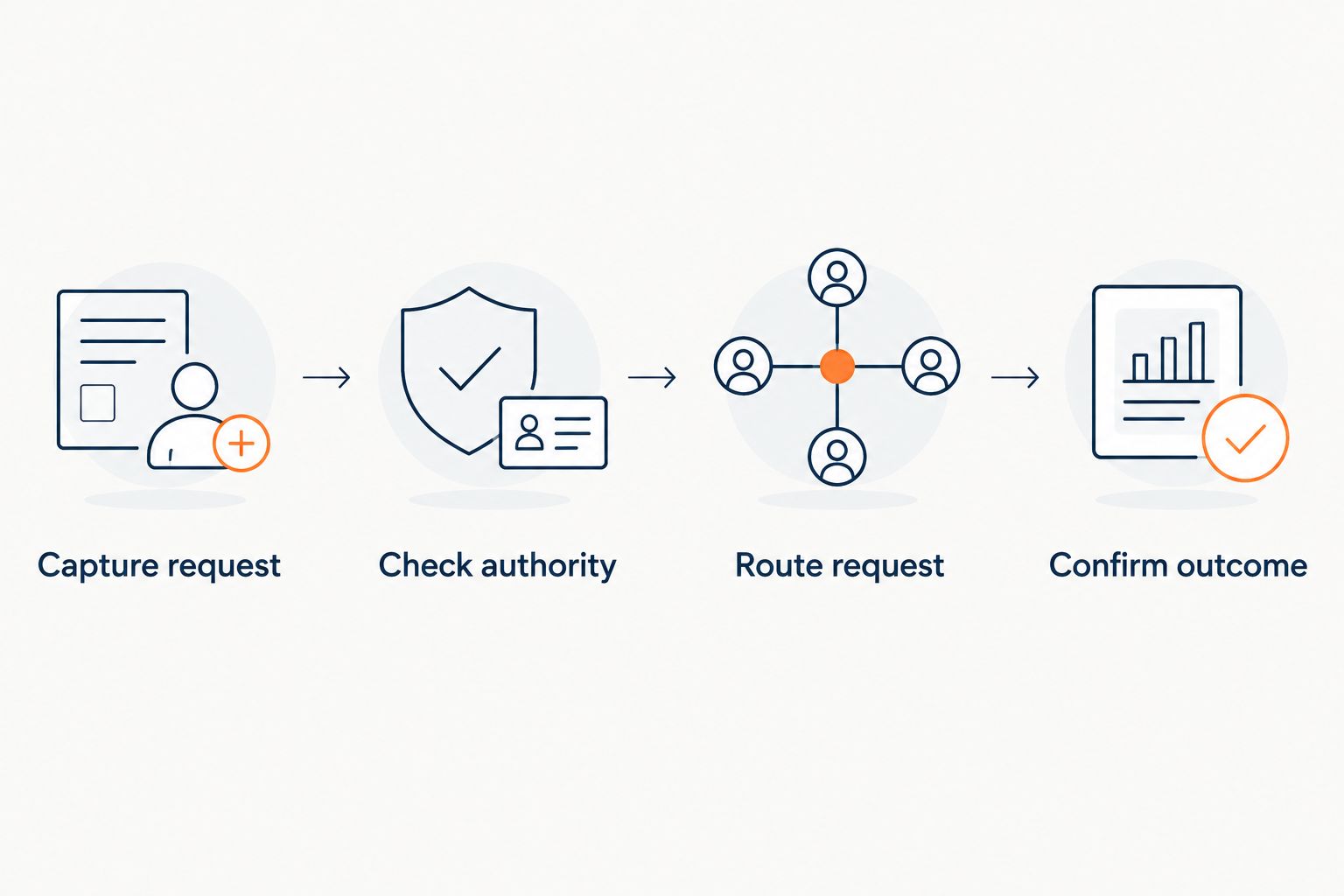
Run each scenario through the same sequence:
- Capture request: Record what the caller wants without adding a diagnosis.
- Check authority: Establish whether the caller can authorize the requested next step.
- Route request: Send the inquiry to the appropriate workflow or employee.
- Confirm outcome: State what happened, what remains pending, and who owns it.
Score the action, not the conversational polish. Did the service preserve the location, avoid an unauthorized promise, and leave a usable record? A smooth call that sends an unresolved request nowhere fails the exercise.
Repeat the checklist whenever booking or escalation rules change. Your 2026 approval should apply to the configured workflow you tested, not every possible conversation the service can produce.
Keep appointment booking separate from dispatch
Appointment setting, scheduling, and dispatch answer different questions. Appointment setting moves a prospect toward an agreed visit. Scheduling places work within your operating rules. Dispatch assigns or directs the people who will perform it.
Before authorizing bookings, decide which requests can receive confirmation and which need review. If you are comparing that part of the workflow separately, use the guide to AI appointment-setting software for HVAC companies.
Give your answering service an approved way to describe pending requests. It should not turn an intake acknowledgment into a promise that a technician is on the way. That boundary matters regardless of whether software or a person answers.
How these options are ranked
This ranking prioritizes operating-model fit: managed follow-up, structured intake, human judgment, and custom control. The criteria are commercial intake, booking boundaries, escalation ownership, follow-up scope, record quality, and responsibility for maintenance.
It is not a claim that one model answers faster or books more appointments than another. Your final selection should depend on the configured workflow, the responsibilities in the agreement, and the results of your acceptance exercise.
Which answering service should you choose?
Default to managed lead response when your central problem is inquiries that need follow-up and appointment setting. Choose structured AI phone answering when the immediate requirement is bounded inbound intake. Choose human-assisted answering for conversational exceptions, or a configurable platform when your team will own the rules.
For a 2026 purchase decision, ask every candidate to handle the same scenarios. Reject any workflow that promises a visit, work authorization, or dispatch action outside your instructions. A narrower service that respects those boundaries is the better operational choice.
Review managed HVAC lead response
Match inquiry response, prospect follow-up, and appointment setting to your business's operating rules.
FAQ
What's the best AI answering service for a commercial HVAC company?
The best choice matches the responsibility you need handled: phone intake, prospect follow-up, appointment setting, or exception handling. Relaykite-3 fits HVAC businesses seeking managed lead response and appointment setting; confirm phone coverage and commercial requirements separately.
Can an AI answering service dispatch commercial HVAC technicians?
Dispatch requires explicit authority and a workflow that supports it. Do not treat inquiry capture or appointment setting as permission to assign technicians or promise an arrival.
Is human answering better than AI answering for commercial HVAC?
Human-assisted answering is the better fit when your calls require judgment beyond an approved intake script. Structured AI answering is the model to evaluate when requests can follow defined questions and routing rules.
What should a commercial HVAC answering service ask callers?
Start with caller contact, service location, and request summary. Add questions about authorization, access, and urgency according to your business's approved intake process.
How do I test an answering service before using it?
Run a recommended set of 10 test calls through the proposed workflow. Check the captured information, routing decision, booking status, and ownership of unresolved requests.
Can an answering service guarantee more booked HVAC appointments?
Appointment-setting capability is not a guarantee of additional bookings. Outcomes depend on the inquiries received, the configured process, and your business's booking rules.
Should I buy a managed service or configure a voice agent myself?
Choose a managed service when you want an agreed service scope rather than responsibility for maintaining conversation logic. Choose a configurable platform when your team has a named owner for setup, changes, and repeat testing.
One last thing
Ask what the service does when the next person does not answer. This exposes the difference between routing a request and owning its resolution.
Require an approved unresolved-request path. It should preserve the inquiry, avoid an unsupported promise, and make responsibility clear. That is a more useful final buying test than another polished demonstration.