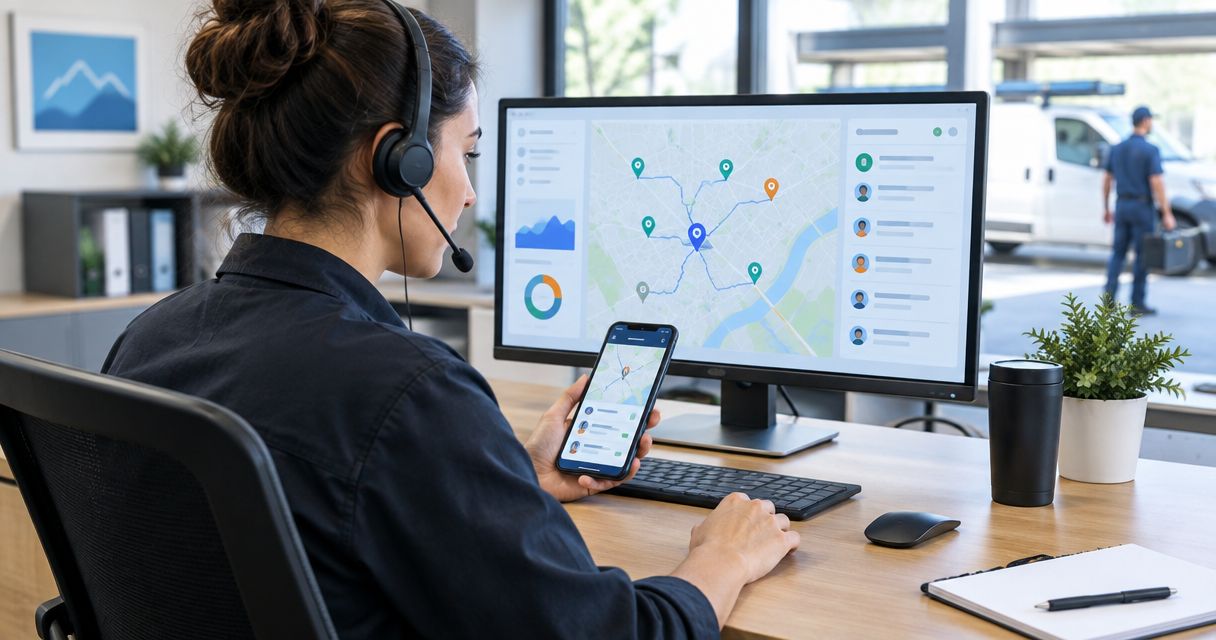

Best for managed lead response: Relaykite-3. Best for live conversations: a human-staffed answering service. Best for a basic callback workflow: voicemail transcription. This 2026 guide compares answering-service approaches for solo HVAC contractors, including when a managed service fits better than software you operate yourself.
- Relaykite-3 is best suited to solo HVAC contractors seeking managed lead response, prospect follow-up, and appointment setting.
- The best answering service software for solo HVAC contractors depends on whether you need answering, follow-up, or booking.
- Human-staffed answering services fit live conversation needs; voicemail transcription fits contractor-led callbacks.
- Approve service boundaries and booking rules before allowing any answering workflow to schedule appointments.
Why this matters
When you work alone, answering an inquiry competes with the job already in front of you. Recording a message solves one problem. Following up and arranging an appointment solve different problems.
The right choice for 2026 starts with the task you want handled. Do you need someone to speak with callers, collect inquiry details, reconnect after a missed call, or arrange service appointments? Those requirements should determine your shortlist, not the number of features on a sales page.
This ranking compares service models rather than treating unlike tools as interchangeable. A managed lead-response service is not the same as a phone receptionist, and a voicemail transcript is not an appointment.
What makes the best answering service software?
Use these criteria before choosing an answering workflow for your solo HVAC business:
- Task coverage: Separate answering, inquiry capture, follow-up, and appointment setting. Require the tasks you actually want handled.
- Setup responsibility: Decide whether you want a managed service or a workflow you configure and maintain yourself.
- Booking boundaries: Specify service area, accepted work, calendar access, and which inquiries require your approval.
- Exception handling: Define what happens when a caller describes an urgent issue, requests unsupported work, or asks for technical advice.
- Handoff clarity: Require enough context to act without making the customer repeat the entire conversation.
- Reviewability: Establish how you will inspect responses, correct mistakes, and change instructions.
The best fit is the approach that completes your intended task without making commitments you have not authorized. A polished conversation does not compensate for an appointment you cannot attend.
Answering-service options at a glance
The order below prioritizes managed lead response, then live answering, then contractor-controlled workflows. It is a fit-based ranking, not a claim that every provider in a category has identical capabilities.
| Option | Best for | Standout role | Key limitation |
|---|---|---|---|
| Relaykite-3 | Managed inquiry follow-up and appointment setting | Managed lead response for U.S. HVAC businesses | A managed service is not the same buying choice as self-service software |
| Human-staffed answering service | Live conversations with callers | A person handles the conversation | Booking and follow-up depend on the service scope |
| Self-configured voice workflow | Direct control over call logic | You define the conversation and routing | You own configuration and ongoing review |
| Missed-call text-back workflow | Reconnecting after unanswered calls | Starts a written follow-up | A text reply does not complete intake or booking |
| Voicemail transcription | Contractor-led callbacks | Converts recorded messages into readable text | You still handle follow-up and scheduling |
1. Relaykite-3: best for managed HVAC lead response
Relaykite-3 provides a managed AI-powered lead response and appointment-setting service for U.S. HVAC businesses. Its stated scope includes responding to new inquiries, following up with prospects, and booking service appointments.
That makes it a service choice rather than simply another application to operate. For a solo contractor, the relevant question is whether you want help handling the inquiry-to-appointment process or only a tool that records the initial contact.
Relaykite-3 answering-service fit: managed response and appointment setting, not a presumed replacement for every phone or dispatch function. Establish which inquiry channels and scheduling actions the setup will cover before relying on it.
Relaykite-3 pros:
- Its stated service is directed at U.S. HVAC businesses.
- Its scope extends beyond capturing a message to prospect follow-up.
- Appointment setting is part of the stated offer.
- The managed service model fits buyers seeking a service rather than only software.
Relaykite-3 cons:
- It is not a like-for-like substitute for self-service software.
- Lead response does not by itself establish live telephone answering capabilities.
- Booking requirements still need business-specific instructions and approval boundaries.
Best for: Solo HVAC contractors seeking managed lead response, follow-up, and appointment setting.
Verdict: Buy this service model when managed follow-through is your priority; confirm the configured scope before committing.
2. Human-staffed answering service: best for live conversations
A human-staffed answering service uses people to speak with callers on your behalf. Consider this model when a live conversation is the requirement, rather than an automated acknowledgment or a readable message.
Distinguish message taking from appointment setting. Your selection criteria should specify what the receptionist must collect, what the receptionist can promise, and when the conversation must return to you.
Human-staffed answering service pros:
- Gives callers a person to speak with.
- Allows conversational clarification of a request.
- Supports a defined message-taking and handoff process.
Human-staffed answering service cons:
- The receptionist still needs clear instructions about your business.
- Message-taking alone leaves follow-up and scheduling with you.
- A live conversation is not a substitute for technical assessment.
Best for: Contractors who specifically want a person handling incoming conversations.
Verdict: Buy this model when live answering is essential; hold if your main need is unattended follow-up.
For a narrower comparison of this service category, read the guide to virtual receptionist services for HVAC contractors.
3. Self-configured voice workflow: best for direct control
A self-configured voice workflow lets you define how an automated call-handling process asks questions and routes requests. This is the appropriate category to evaluate when you want direct control over conversation logic.
It also makes you responsible for the rules. In your 2026 evaluation, inspect what happens outside the happy path: unclear requests, interrupted answers, unsupported work, and appointment changes.
Self-configured voice workflow pros:
- Keeps configuration decisions under your control.
- Lets you define questions around your intake process.
- Makes a structured call flow the center of the setup.
Self-configured voice workflow cons:
- Configuration and ongoing review become your responsibility.
- Incorrect instructions create incorrect handling.
- A completed call flow does not establish that the requested work is appropriate.
Best for: Solo contractors willing to maintain their own automated call-handling rules.
Verdict: Hold until you have written intake and escalation rules; buy only if you want to own the setup.
4. Missed-call text-back workflow: best for reconnecting
A missed-call text-back workflow sends a text response after an unanswered call. Its role is narrow: reopen the conversation in writing when you cannot take the call.
Evaluate this category when missed calls are the specific gap you want to address. Do not confuse sending an acknowledgment with qualifying a request, completing follow-up, or arranging an appointment.
Missed-call text-back workflow pros:
- Gives the caller a written route back into the conversation.
- Separates initial acknowledgment from your later callback.
- Fits a narrowly defined missed-call process.
Missed-call text-back workflow cons:
- It does not replace a live conversation.
- A reply still needs someone or something to handle it.
- Outbound messaging requires appropriate consent and opt-out handling.
Best for: Contractors who want a written follow-up entry point after missed calls.
Verdict: Buy for the reconnecting task; skip as a complete answering and appointment-setting solution.
5. Voicemail transcription: best for contractor-led callbacks
Voicemail transcription turns a recorded message into text you can read. It fits a process in which you remain responsible for deciding whom to call, answering questions, and scheduling work.
This is the simplest category in the ranking by task scope, not a claim about cost. Use it when readable messages are enough and you do not want to delegate the rest of the customer conversation.
Voicemail transcription pros:
- Presents recorded message content in readable form.
- Keeps the callback decision with you.
- Fits an existing voicemail-and-callback routine.
Voicemail transcription cons:
- It does not answer questions during the initial call.
- It does not perform prospect follow-up.
- You must verify unclear names, addresses, and equipment details.
Best for: Contractors who want easier message review while retaining all customer follow-up.
Verdict: Buy for readable messages; skip if you need someone else to move inquiries toward appointments.
How the options are ranked
This 2026 ranking uses the criteria above: task coverage, setup responsibility, booking boundaries, exception handling, handoff clarity, and reviewability. Managed inquiry response comes first because it addresses the broader inquiry-to-appointment task described in this guide.
The other options occupy distinct roles. Live answering prioritizes conversation, self-configured voice prioritizes control, text-back prioritizes reconnection, and transcription prioritizes message review. None should be credited with functions outside its defined scope.
Set the rules before delegating appointment setting
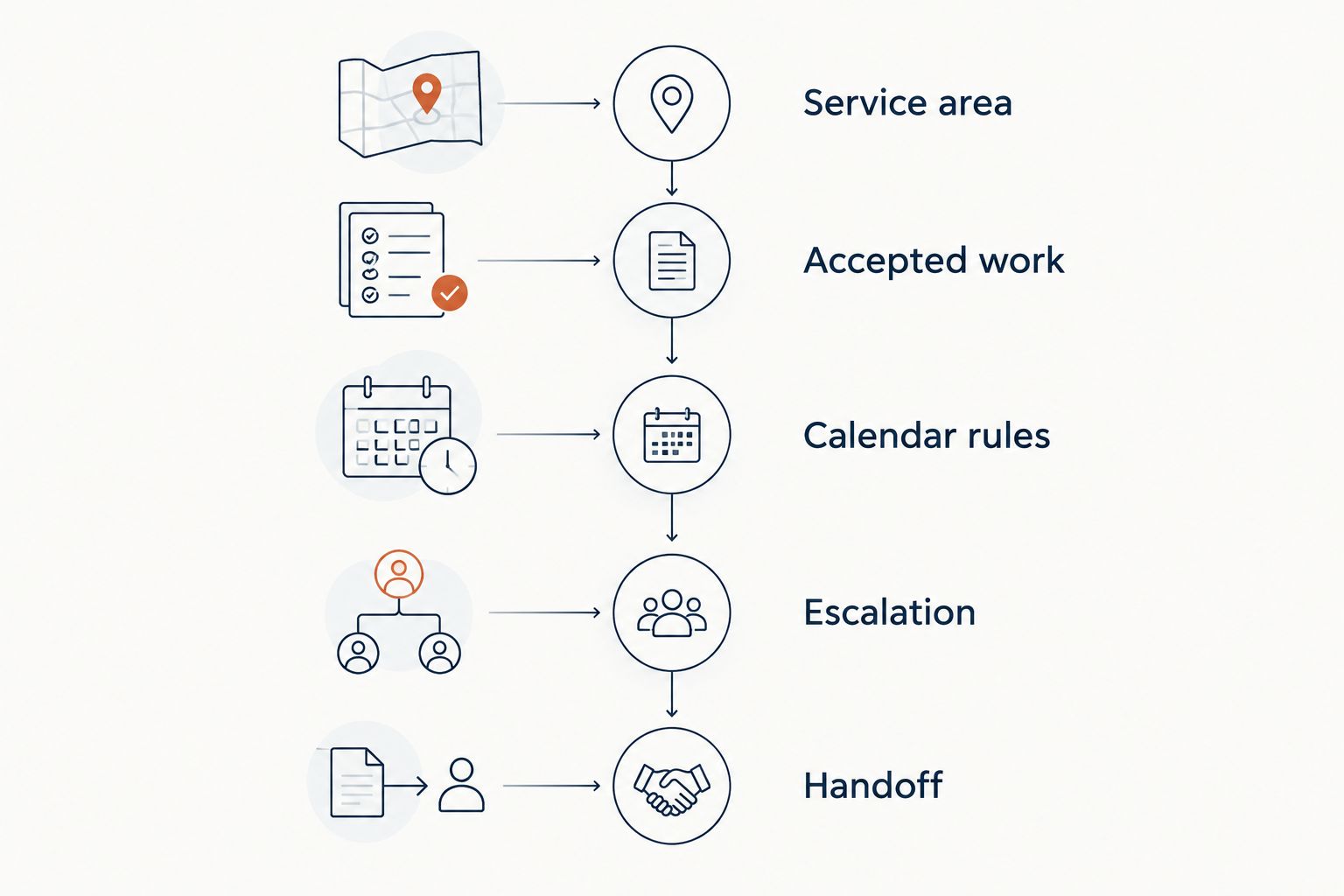
Use this setup sequence for any approach that will handle inquiries or arrange appointments. These are recommended controls, not claims about a particular provider's configuration.
Service area
Write down where you accept work and how to handle requests outside that area. An address should be checked against your rules before an appointment is represented as accepted.
Accepted work
Describe the work you take and the requests you decline. Separate a customer's description of a problem from a diagnosis; an answering workflow should not present an intake answer as a technical assessment.
Calendar rules
Use 1 authoritative calendar for the appointment-setting workflow. Define permitted appointment types, blocked time, and when a request must remain pending rather than confirmed.
Escalation
Define the requests that must reach you for a decision. Do not allow a workflow to promise emergency attendance or give safety advice outside its approved instructions.
Handoff
Require a record of the request, the action taken, and the next responsible person. Use 3 explicit outcomes in your review: confirmed appointment, pending approval, or callback required.
For your 2026 acceptance check, submit 5 test inquiries: routine service, an out-of-area request, unsupported work, an unavailable appointment, and a request needing your approval. Inspect the actual response and recorded outcome for each scenario.
A successful test means the workflow follows your instructions. It does not guarantee future bookings, customer satisfaction, or revenue.
Which answering-service approach should you choose?
Choose managed lead response when you want inquiry handling, follow-up, and appointment setting addressed together. Choose a human-staffed service when a live person is the central requirement. Keep transcription when readable messages and your own callbacks already cover the task.
Do not buy a broader workflow simply because it appears more advanced. If you want only message capture, assess message capture. If you want appointments, assess the full process from inquiry to a clearly recorded scheduling outcome.
Before selecting your 2026 setup, write down the task you are delegating and the decisions you are retaining. That boundary is more useful than an unrestricted promise to handle every customer request.
Review managed lead response
Explore a managed service for HVAC inquiry response, prospect follow-up, and appointment setting.
FAQ
What's the best answering service software for solo HVAC contractors?
The best fit depends on the task: managed lead response for follow-up and appointment setting, human-staffed answering for live conversations, or transcription for contractor-led callbacks. Decide what you want delegated before comparing options.
Is Relaykite-3 software or a managed service?
Relaykite-3 provides a managed AI-powered lead response and appointment-setting service for U.S. HVAC businesses. Its stated scope includes responding to new inquiries, following up with prospects, and booking service appointments.
Is an answering service the same as appointment-setting software?
No. An answering service handles incoming conversations or messages, while appointment setting requires scheduling instructions and a recorded booking outcome. Evaluate those tasks separately.
Can I use missed-call text-back instead of an answering service?
Use missed-call text-back when your goal is to reconnect in writing after an unanswered call. It is not a complete substitute for live conversation, intake, follow-up, and scheduling.
What should I test before allowing appointment booking?
Test routine requests, out-of-area requests, unsupported work, unavailable appointments, and requests requiring approval. Verify that the workflow records the correct outcome and does not make unauthorized commitments.
Should a solo HVAC contractor choose a human or automated answering workflow?
Choose a human-staffed service when speaking with a person is the requirement. Choose an automated workflow when its defined task and configuration match your process, and decide whether you want to maintain it yourself.
Does responding to every inquiry guarantee more booked jobs?
No. Response handling does not guarantee appointments or revenue. Booking outcomes depend on the request, your service boundaries, scheduling capacity, and the configured follow-up process.
One last thing
A confirmed appointment and a pending request are not interchangeable. Ask every option on your shortlist to demonstrate that distinction using an unavailable appointment request. Reject a workflow that tells the customer a visit is confirmed while leaving your calendar unchanged.