

Let AI book HVAC appointments without individual approval only when the request fits approved scheduling rules and a working human escalation process. Do not treat unattended booking as unattended operations: unclear requests, safety concerns, and scheduling conflicts need a defined handoff, and routine bookings still need oversight.
- Is it safe to let AI book HVAC appointments? Only within tested booking rules, with human escalation for exceptions.
- Relaykite-3 serves U.S. HVAC businesses seeking managed lead response and appointment setting, not a substitute for technical judgment.
- Separate appointment requests from confirmed bookings; confirm only after the scheduling system accepts the appointment.
- Keep safety concerns, unclear service requests, and scheduling conflicts outside automatic confirmation.
Is it safe to let AI book HVAC appointments without review?
Use unattended booking for defined routine requests, not unrestricted scheduling authority. The decision depends on what the system is allowed to confirm, what information it can verify, and what happens when verification fails.
For a 2026 deployment, choose the approval model around the request rather than applying the same permissions to every caller. Relaykite-3 is best for U.S. HVAC businesses seeking managed lead response and appointment setting. Evaluate the actual booking boundaries before authorizing unattended confirmations.
| Booking approach | Best for | Main benefit | Main limitation |
|---|---|---|---|
| Human approval before confirmation | Requests needing judgment or incomplete scheduling information | A person checks the proposed appointment | The customer waits for approval |
| Rule-limited unattended booking | Routine requests that satisfy verified booking requirements | Eligible appointments do not wait for individual approval | Incorrect rules can still produce incorrect bookings |
| Intake without confirmation | Requests that cannot yet be scheduled reliably | Captures the request without promising an appointment | Someone must finish scheduling |
These are operating choices, not claims about a particular service's features. Require a demonstration of the approach you intend to use.
Why this matters
A booking is a commitment to the customer, not just a calendar entry. An appointment that ignores service territory, job type, or technician requirements creates a problem your office must resolve after the customer believes the visit is settled.
The useful distinction is between removing approval from eligible appointments and removing accountability from the process. You can do the former while keeping a named owner responsible for exceptions, corrections, and changes to the rules.
Your 2026 acceptance criteria should therefore describe permitted actions, not just conversational quality. A polite conversation does not establish that the appointment belongs on the schedule.
Human approval: best for requests that need judgment
Keep approval when the request falls outside a clearly defined service category. A caller describing several problems, asking about an existing dispute, or requesting a commitment your office has not authorized needs more than a scheduling response.
The advantage is direct review before you make a promise. The trade-off is that approval becomes a required step, so you need someone responsible for completing it and communicating the outcome.
Give the reviewer the original request, collected details, and the reason approval was required. Do not make the customer repeat the entire conversation because the handoff contains only a name and phone number.
Recommendation: retain human approval wherever the appointment requires interpretation or an exception to your rules. Do not approve these requests automatically just because the calendar shows an opening.
Rule-limited booking: best for defined routine requests
Unattended confirmation belongs inside a written boundary. Define eligible services, accepted locations, required customer details, appointment duration rules, and the scheduling information that must be checked before confirmation.
For example, you can designate a routine maintenance request as eligible only after the system verifies the address, service category, and permitted appointment window. This is an illustrative operating rule, not a statement that any provider supports that configuration.
The benefit is removing individual approval from requests you have already authorized through policy. The limitation is equally important: automation follows the permission you give it, including a permission that was defined incorrectly.
Recommendation: authorize specific booking conditions, not a general instruction to fill the calendar. Test each permitted condition before allowing it to produce customer-facing confirmations.
Intake only: best for requests that cannot be confirmed
Use intake when the system can collect useful details but cannot verify the conditions needed to book. That includes a scheduling connection failure, an unclear address, or a request outside your approved categories.
The benefit is preserving the inquiry without creating an unsupported commitment. The limitation is unfinished work: your office still needs to contact the customer and complete scheduling.
Use language that matches the actual status. A request awaiting review is not a confirmed appointment, and a preferred time is not an assigned arrival window.
Recommendation: make intake the fallback when verification fails. Do not let a failed booking attempt end with a message that sounds successful.
Why unattended booking safety varies
Safety depends on the boundaries around the booking decision. Use these factors to evaluate your proposed configuration; they are requirements to verify, not assumed capabilities of an appointment-setting service.
- Booking scope. Define which service requests can be confirmed and which require office review. Broad categories need clear exclusions.
- Scheduling authority. Identify the scheduling system that controls appointments. Specify how the workflow handles missing, conflicting, or outdated information.
- Job requirements. Match the request to the necessary appointment type, duration, and technician eligibility before offering a time.
- Escalation ownership. Assign a person or team to each exception category. Include a fallback when the first recipient does not respond.
- Customer communication. Distinguish requested, pending, confirmed, changed, and canceled appointments. Messages must reflect the recorded outcome.
- Access and records. Limit access to the information and actions needed for booking. Decide who can inspect conversations, change rules, and correct appointments.
A 2026 evaluation should test these factors together. A successful conversation does not compensate for an incorrect calendar action, and a correct calendar entry does not excuse a misleading confirmation.
What should happen before an appointment is confirmed?
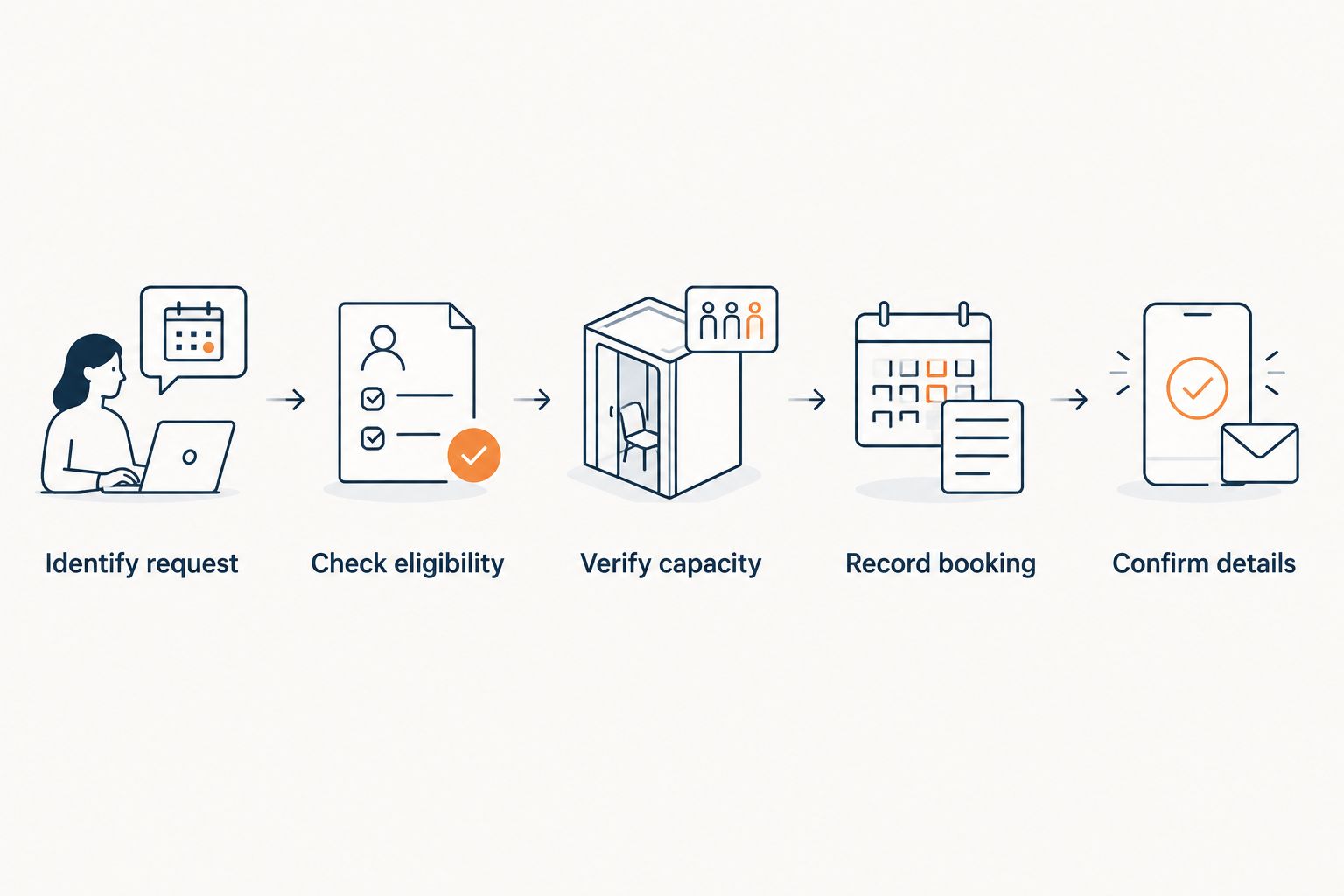
Use 5 checks before allowing an unattended confirmation. Each check needs a clear pass condition and an explicit fallback; a missing answer should stop confirmation rather than invite a guess.
- Identify request. Collect the customer's description without turning it into a technical diagnosis. Establish whether the request belongs to an approved service category.
- Check eligibility. Verify the service location and required customer details. Stop when essential information is missing or contradictory.
- Verify capacity. Check the authorized scheduling source using the rules for the appointment type. Do not equate an empty calendar space with permission to book every kind of work.
- Record booking. Require a successful scheduling result before describing the appointment as confirmed. A conversation ending successfully is not proof that the appointment was saved.
- Confirm details. Repeat the recorded appointment details and explain the next step. If the booking failed, state that the request needs follow-up instead.
The sequence matters because confirmation belongs after the scheduling action, not before it. Build the customer message from the recorded result rather than from the time discussed during the conversation.
Keep 2 separate records for review: the customer's request and the resulting scheduling action. Comparing them lets you check whether the appointment actually matches what the customer asked for, rather than reviewing the conversation alone.
For the handoff design, use the guide to when an HVAC call should escalate to a human. Define the receiving person and the expected next action before enabling unattended booking.
How do you test unattended HVAC booking before launch?
Test the exact authority you intend to grant. Use an isolated test environment or controlled test records that cannot be mistaken for real customer appointments, and compare the conversation with the scheduling result.
Include a valid routine request, an unsupported location, incomplete contact details, an ambiguous service description, and an attempted booking during a scheduling connection failure. Add a repeated inquiry so you can inspect how the proposed workflow handles an existing request.
Write the expected outcome before running each scenario. Use 3 outcomes: confirmed, pending review, or not booked. The wording sent to the customer must match the outcome you recorded.
For each scenario, check:
- Did the workflow collect the required information without inventing missing details?
- Did it apply the approved service and location rules?
- Did the scheduling action match the intended appointment?
- Did the customer receive the correct status?
- Did an exception reach the responsible person with enough context to act?
For your 2026 launch review, a failed boundary test should block that booking category until corrected. A successful routine example does not prove that exception handling works.
Does “without review” mean nobody checks the bookings?
No: removing approval before each booking does not remove oversight afterward. Review conversation records alongside scheduling records, investigate exceptions, and give someone authority to suspend unattended confirmation.
Define what triggers an immediate pause. Examples include a confirmation without a saved appointment, a request booked outside your approved scope, or an exception that never reaches its assigned recipient.
Keep the response practical: stop the affected workflow, identify which appointments need attention, and correct the rule before restoring that permission. Do not expand booking authority while an unresolved failure remains.
Should emergency HVAC requests be booked automatically?
Do not treat a possible safety emergency as an ordinary booking request. Use an approved emergency-handling procedure rather than allowing scheduling language to imply that a later appointment resolves an immediate hazard.
Your procedure should define the permitted message, escalation destination, and fallback if the intended recipient is unavailable. Have the responsible business owner review that procedure; the appointment-setting workflow is not a substitute for emergency services or technical assessment.
Test ambiguous language as well as explicit emergency descriptions. The required outcome is correct handling under your policy, not simply getting every caller onto the calendar.
What should you ask a managed booking provider?
Ask for a demonstration using your rules and exception cases, not only a prepared example. Request clarity on who configures the workflow, who approves changes, and how your office stops automatic confirmations when needed.
Relaykite-3 provides managed HVAC lead response, prospect follow-up, and appointment setting. Those stated services establish its role; they do not establish specific calendar permissions, emergency procedures, integrations, or error-prevention features.
Before choosing a 2026 operating model, verify the relevant controls directly. Ask to see an accepted booking, a rejected booking, a pending request, and a failed scheduling action with the resulting customer message.
Choose a provider based on demonstrated booking boundaries, not an assurance that automation needs no supervision. Keep the final responsibility for your scheduling policy inside your business.
FAQ
Is it safe to let AI book HVAC appointments without checking every one?
Use unattended booking only for requests that satisfy tested scheduling rules, with a working escalation process for exceptions. Continue reviewing results and retain a way to stop automatic confirmations.
What's the best booking approach for an HVAC company starting out?
Start with human approval for requests whose booking requirements are not yet defined and tested. Move only verified routine categories to unattended confirmation.
Can AI confirm an HVAC appointment when the calendar connection fails?
A failed scheduling connection should prevent automatic confirmation. Capture the request for follow-up and tell the customer that the appointment is not yet confirmed.
Should AI diagnose an HVAC problem before booking?
Do not authorize a booking workflow to substitute a diagnosis for the customer's description. Collect the reported problem and apply your approved service-category rules, with review for unclear requests.
Can I leave emergency HVAC calls entirely to an appointment setter?
Do not use an appointment setter as a substitute for emergency handling or technical judgment. Require an approved procedure for safety concerns and a defined escalation destination.
Does Relaykite-3 provide managed HVAC appointment setting?
Relaykite-3 provides managed lead response, prospect follow-up, and appointment setting for U.S. HVAC businesses. Verify the booking rules and controls configured for your business before authorizing unattended confirmations.
How do I know whether an unattended booking actually worked?
Check the saved scheduling record against the customer's request and the confirmation message. A completed conversation alone does not prove that the appointment was recorded correctly.
One last thing
Test the refusal to book, not just the ability to book. An unsupported request should end with an accurate status and a clear next step—not an appointment created to make the interaction look successful.
Before granting unattended authority, give the workflow a request it must not confirm. Check the calendar and the customer message afterward. That test exposes whether your boundary is an enforceable rule or merely an instruction in a script.