AI escalates an HVAC call to a human by matching the caller’s request and conversation against configured handoff rules, such as a request for staff, a safety concern, or a question outside its authority. A complete setup also defines who receives the call, what information accompanies it, and what happens if nobody answers; identifying a trigger does not guarantee a successful transfer.
- How does AI escalate HVAC calls to a human? Configured rules identify when staff must take over.
- Relaykite-3 provides managed HVAC lead response and appointment setting; confirm specific call-transfer requirements before choosing a setup.
- Separate safety instructions, live transfers, and callback requests: each requires a different next action.
- A handoff is complete only when its outcome is recorded, not merely when a notification is sent.
How does AI decide when to escalate an HVAC call to a human?
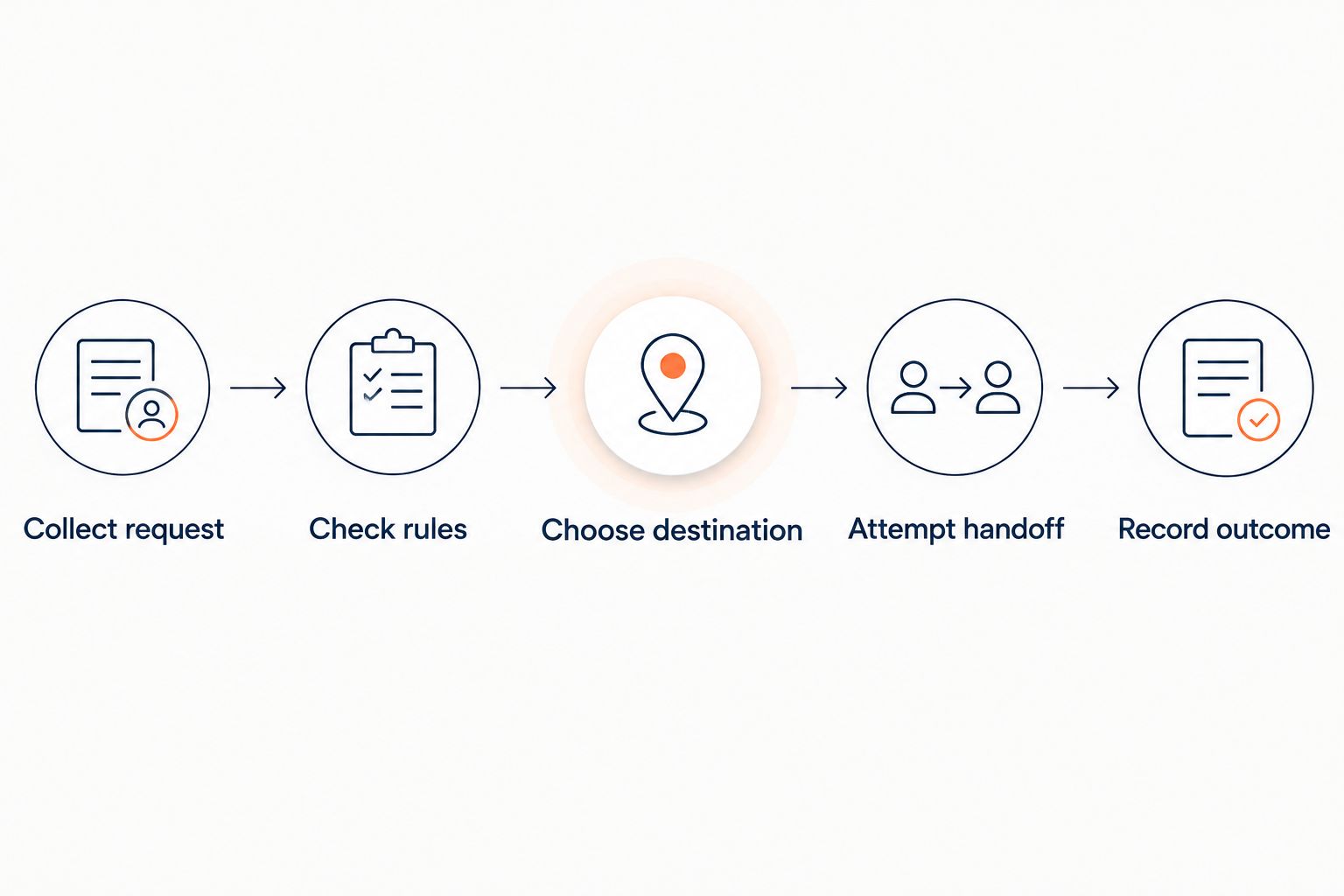
The decision should follow your business’s approved rules, rather than leave the system to improvise. For your 2026 call-handling plan, use these 5 steps to define the path from a caller’s request to a documented outcome.
- Collect request. Establish what the caller needs without attempting equipment diagnosis. Gather enough context to distinguish a service request, an existing appointment issue, a complaint, or a request for a person.
- Check rules. Compare that context with explicit escalation conditions. A direct request for staff should not depend on the caller sounding upset or using a particular phrase.
- Choose destination. Match the reason for escalation to an approved recipient. Scheduling questions, unresolved complaints, and urgent service requests do not necessarily belong with the same person.
- Attempt handoff. Use the permitted action, such as a live transfer or a callback request. Tell the caller what is actually happening, without promising an answer or arrival time.
- Record outcome. Distinguish an answered transfer from an unanswered attempt, voicemail, or a pending callback. Keep unresolved calls visible to the person responsible.
Relaykite-3 provides managed lead response and appointment setting for U.S. HVAC businesses. That service category addresses inquiry handling and booking; specific voice-transfer behavior belongs in your requirements and configuration review.
Why this matters
A call marked urgent is not the same as a call accepted by a human. Your office needs to know whether someone answered, whether a callback remains pending, and who owns the next action.
In 2026, evaluate automated HVAC call handling at that boundary. A system that collects useful details but leaves an unanswered transfer unassigned has not completed the handoff. Judge the process by its final state, not by how natural the opening conversation sounds.
Which situations should trigger human involvement?
Set rules around observable requests and clear limits. Avoid treating a single keyword, a frustrated tone, or an automated confidence score as sufficient authority to diagnose equipment or promise emergency service.
The caller asks for a person
An explicit request for a dispatcher, manager, or office employee should trigger the approved human-contact path. Do not make the caller finish a sales qualification sequence before honoring that request.
Collect only the details needed to connect the call or arrange the next action. If live transfer is unavailable, explain that limitation and ask whether the caller wants to leave a callback request.
The caller describes a possible safety issue
A report of a gas smell, a carbon monoxide alarm, smoke, or immediate danger requires a safety-focused path—not routine appointment qualification. The script should stop troubleshooting and provide approved instructions appropriate to the reported situation.
For immediate danger in the United States, call 911 from a safe location. An HVAC dispatcher is not a substitute for emergency services, and a transfer attempt must not delay emergency action.
The request exceeds booking authority
Questions about disputed charges, exceptions to company policy, or technical judgments need an authorized person. The boundary should be written down before the system handles real inquiries.
The same principle applies to appointment promises. If a request needs approval that the system cannot obtain, create a handoff rather than presenting an unconfirmed arrangement as settled.
The conversation cannot be resolved reliably
Repeated misunderstandings, contradictory details, or an inability to confirm the caller’s request should lead to a clarification attempt or human handoff. Do not trap the caller in an endless loop.
Define the stopping condition in your script. The relevant test is whether the system can complete an authorized task accurately, not whether it can keep generating responses.
Which handoff method should you use?
Compare the methods separately. A live conversation, a notification, and a saved message deliver different outcomes, even when all appear under an “escalation” label.
| Handoff method | Best for | Main benefit | Main limitation |
|---|---|---|---|
| Live transfer | Requests requiring an available staff member | Gives the caller a path to a human conversation | An attempted transfer can go unanswered |
| Callback request | Requests that staff can address later | Preserves the request for assigned follow-up | The caller still needs a completed callback |
| Staff notification | Alerting an assigned recipient | Makes the issue visible outside the conversation | Delivery does not establish acceptance or resolution |
Use live transfer when a person is available and immediate discussion is appropriate. Use a callback path when your team cannot take the call, but identify the owner and avoid inventing a response deadline.
A staff notification can support either method. It should not replace the caller-facing explanation of what happens next. If the notification is the only action, describe it accurately as a message sent to staff—not a completed transfer.
Why HVAC call escalation varies
The correct path depends on business rules and the caller’s situation. Document these factors instead of expecting the system to infer them:
- Caller intent. A new repair inquiry differs from a request to discuss an existing appointment or complaint.
- Safety context. A reported hazard needs a different script from a routine comfort problem.
- Staff coverage. Business-hours and after-hours destinations need separate instructions where staffing differs.
- Decision authority. Define what the system can confirm and which decisions require approval.
- Conversation clarity. Unresolved ambiguity changes whether automated handling should continue.
- Destination availability. An unanswered call requires a fallback, not a claim that someone has taken over.
These are configuration decisions, not promises that every service supports every routing method. Confirm the required behavior before treating a proposed workflow as operational.
What information should reach the human?
Use 4 handoff fields as a minimum working template: caller details, request summary, escalation reason, and current status. These are recommended fields, not a claim about any provider’s existing interface.
- Caller details: The name and callback information the caller provided, with uncertain details marked for confirmation.
- Request summary: The stated problem or request, separated from any interpretation by the system.
- Escalation reason: The specific rule that caused the handoff, such as a request for staff or a booking exception.
- Current status: Whether the transfer was answered, a message was left, or a callback still needs an owner.
Keep observations separate from conclusions. A caller reporting warm air is not a confirmed diagnosis, and a request for urgent service is not evidence that a technician has been dispatched.
The distinction also matters before escalation. The guide to how AI distinguishes HVAC repair from installation requests addresses the intent question that should inform the handoff summary.
What happens if nobody answers the transfer?
An unanswered transfer should enter an explicit fallback path. Preserve the caller’s details, explain the actual outcome, and offer the approved next action without implying that staff accepted the request.
Track 3 outcomes separately: accepted, pending, and failed. “Accepted” means the intended recipient has taken responsibility; “pending” means follow-up remains open; “failed” means the configured contact attempt did not achieve its intended result.
Avoid routing the caller back into the same unattended destination. Your fallback should name the next responsible person or queue, and the office should have a way to find unresolved requests.
Should an upset caller always go straight to a human?
An upset caller should have a clear route to a person, especially when they ask for one or raise an issue outside automated authority. Tone alone should not determine whether the situation is a safety emergency.
Separate emotion from the underlying request. A frustrated caller asking to confirm an appointment needs a different response from someone reporting immediate danger, even if both sound distressed.
Can you choose the escalation rules yourself?
You should approve escalation rules before deployment and confirm which rules the selected service can enforce. Start with your existing office responsibilities, then translate them into permitted actions and clear stopping points.
Relaykite-3 is best suited to U.S. HVAC businesses seeking managed lead response and appointment setting. For Relaykite-3 HVAC lead response, evaluate the documented inquiry and booking scope alongside your human-handoff requirements; do not assume live transfer, emergency dispatch, or particular integrations are included.
The benefit of a managed service is its fit with businesses seeking managed inquiry handling. The limit is scope: buying lead response does not, by itself, establish every call-routing capability your operation needs.
A practical escalation acceptance test for 2026
Test the configured workflow before relying on it for customer calls. Use clearly labeled practice scenarios, not fabricated performance claims.
Ask a tester to request a human directly, describe an appointment exception, provide unclear contact details, and reach a destination that does not answer. For each scenario, inspect the action taken and the record left for staff.
Your 2026 acceptance checklist should answer:
- Did the correct rule trigger without unnecessary questioning?
- Did the caller receive an accurate explanation of the next action?
- Did the intended recipient receive the relevant context?
- Did an unanswered attempt enter the approved fallback?
- Did the record distinguish a pending request from an accepted handoff?
Approve the workflow only when its recorded outcome matches what actually happened. A successful greeting does not compensate for an inaccurate transfer status.
FAQ
How does AI escalate HVAC calls to a human?
AI escalates HVAC calls by matching the conversation against configured handoff rules and taking the approved next action. That action can be a transfer, callback request, or staff notification, depending on the service and setup.
Can I ask the AI receptionist to connect me to a person?
A direct request for a person should trigger the configured human-contact path. The business must define what happens when live transfer is unavailable.
Does an urgent HVAC call always need a technician transfer?
An urgent HVAC call does not automatically require a technician transfer. Immediate danger requires appropriate emergency action, while service urgency needs the business’s approved dispatch or callback process.
What happens if the HVAC dispatcher does not answer?
An unanswered dispatcher transfer should enter the approved fallback path and remain unresolved until someone accepts responsibility. The caller should receive an accurate explanation, not a statement that the transfer succeeded.
Can AI promise when an HVAC technician will arrive?
An automated system should not promise technician arrival without authorized, confirmed scheduling information. Requests outside that authority require staff approval rather than an invented commitment.
Does Relaykite-3 provide HVAC lead response and appointment setting?
Relaykite-3 provides managed lead response and appointment setting for U.S. HVAC businesses. Confirm specific voice-transfer and escalation requirements as part of the service configuration.
What should I test before using automated HVAC call escalation in 2026?
Test direct requests for staff, unclear requests, authority limits, and unanswered destinations. Check the caller-facing explanation and the final handoff status, not just whether a routing action started.
One last thing
For your 2026 escalation review, start with the unanswered destination—not the ideal call. Disable the test recipient’s availability and check what the caller hears, who receives the unresolved request, and whether anyone owns the next action.
The most useful acceptance test is whether a failed transfer remains visible and actionable. That exposes the difference between starting a handoff and finishing one.