

Yes—AI can qualify HVAC leads before booking by checking the service address, requested work, customer intent, and scheduling requirements against rules configured for your business. It should book only when those requirements are satisfied; unclear requests, safety concerns, and scheduling conflicts need a defined handoff rather than an invented answer.
- Can AI qualify HVAC leads before booking? Yes, when qualification questions and booking rules are configured for your business.
- Relaykite-3 serves U.S. HVAC businesses seeking managed lead response and appointment setting.
- Separate qualification, appointment confirmation, and emergency escalation; they are different decisions.
- Require human review when service eligibility, safety, or scheduling information remains unresolved.
Can AI qualify HVAC leads before booking an appointment?
Yes. AI can collect a prospect’s answers, compare them with your acceptance rules, and either proceed toward booking or flag the request for review. Qualification is a decision about whether a request fits your business. It is not a technical diagnosis or a promise that a technician can attend.
For a 2026 qualification workflow, use this sequence:
- Capture details. Ask for the customer’s name, callback information, service address, and reason for contacting you.
- Check fit. Compare the location and requested work with the services and territory you have approved.
- Check urgency. Apply an approved escalation procedure instead of treating every urgent request as a routine booking.
- Check scheduling. Confirm that the requested appointment type and timing meet your scheduling requirements.
- Confirm or hand off. Book only through an authorized process; otherwise, send the request for review with its unresolved questions attached.
For the intent step, see how AI distinguishes HVAC repair from installation requests. The distinction matters because a repair visit and an installation consultation should not automatically follow the same booking rules.
Why this matters
A completed conversation is not necessarily a qualified lead. A homeowner can answer every question and still live outside your territory, request work you do not provide, or need a different appointment type.
The objective is to give your office a usable request without creating an unsupported commitment. Qualification should reduce uncertainty before booking, not hide uncertainty behind a confirmation message.
When reviewing a service in 2026, ask to see the decision rules behind its sample conversation. A polished answer is less useful than a clear explanation of what causes a booking, a rejection, or a handoff.
What should AI ask before booking an HVAC appointment?
Start with 6 qualification questions. This is a recommended checklist, not a claim about a standard questionnaire or a requirement to ask every caller the same questions.
Where is the service address?
Ask for the actual service location, not just the caller’s mailing address. Compare it with your approved territory before offering an appointment.
If the location is incomplete or ambiguous, request clarification. Do not infer eligibility from a nearby city name alone.
What help are you requesting?
Ask the customer to describe the request in plain language. Then classify it using the categories your business accepts, such as repair, maintenance, or installation inquiries.
Keep the customer’s original description alongside the classification. Your office needs to distinguish what the caller reported from what the system inferred.
What equipment is involved?
Collect equipment details only when they affect service eligibility or routing. If the customer does not know the equipment type, record that uncertainty rather than forcing an answer.
A missing model number should not become an automatic rejection unless your business has explicitly made it a requirement. Avoid turning intake into a technical examination.
What is happening right now?
Ask for observable symptoms and whether the situation involves a safety concern. Use a business-approved escalation procedure when the answer requires urgent attention.
Do not let a booking conversation become remote troubleshooting. The intake process should not instruct a caller to perform unsafe checks or assure them that equipment is safe.
Who can authorize the visit?
Ask whether the caller can arrange access and approve the requested appointment. A tenant, property manager, and homeowner can have different responsibilities.
Use your own authorization policy. Do not assume that someone who reports a problem can approve work or accept terms on another person’s behalf.
When can someone provide access?
Collect the customer’s preferred timing and any access constraints. Treat those answers as preferences until the scheduling process verifies an acceptable appointment.
Distinguish an available appointment from a callback request. The customer should know which one they have received before the conversation ends.
Which requests should be booked, reviewed, or declined?
Use 3 explicit outcomes: book, review, or decline. These are recommended workflow states, not measured results or promises about a particular service.
| Outcome | Best for | Benefit | Limitation | Required next action |
|---|---|---|---|---|
| Book | Requests that satisfy all required qualification and scheduling rules | Gives eligible customers a clear next step | Depends on accurate rules and an authorized scheduling process | Confirm the appointment details |
| Review | Unclear eligibility, unusual requests, or unresolved scheduling details | Preserves the inquiry without guessing | Requires an assigned person to resolve it | Send the summary and open questions to the responsible person |
| Decline | Requests clearly outside approved services or territory | Avoids booking work the business does not accept | An incorrect rule can reject a valid prospect | Explain the applicable boundary without inventing alternatives |
Human review is the correct outcome when a required condition remains unknown. It is not a failed conversation. It protects the distinction between collecting a lead and accepting an appointment.
Do not use a hidden confidence score as the only booking rule. Your team should be able to explain the outcome using observable facts: the address matched, the service was accepted, and the scheduling requirements were satisfied.
How should qualification connect to scheduling?
Keep intake, eligibility, and scheduling separate. Each stage answers a different question, and passing one stage does not automatically authorize the next.
- Intake: What is the customer asking for?
- Eligibility: Does the request meet your acceptance rules?
- Scheduling: Can the business authorize the requested appointment?
- Confirmation: What commitment has actually been made?
- Handoff: Who resolves anything still unanswered?
A sound 2026 workflow preserves these distinctions in the customer message and the office record. For example, a request awaiting review should not be described as a confirmed visit simply because the customer selected a preferred time.
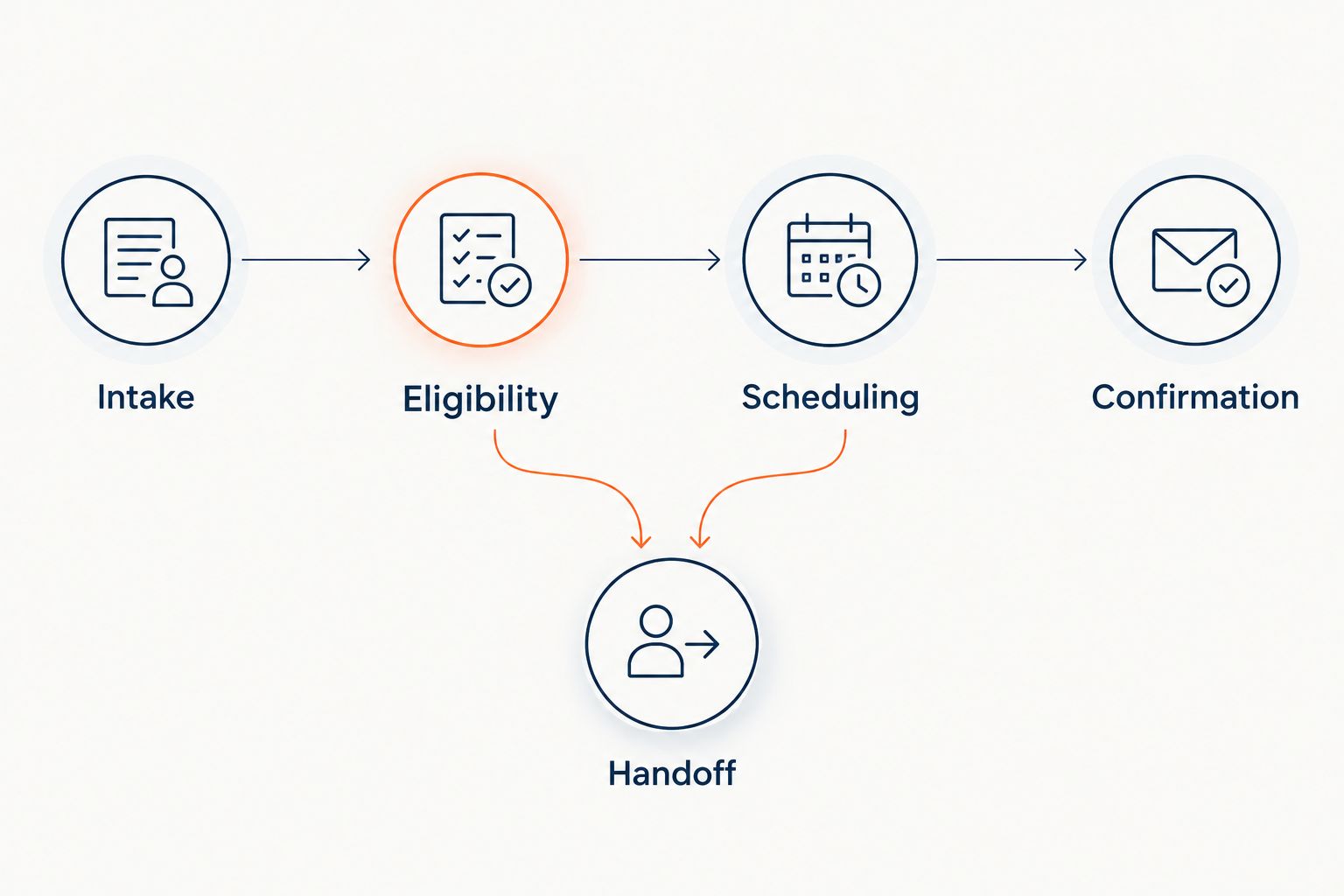
Before enabling booking, define what counts as confirmation. Specify the authorized scheduling destination, required appointment fields, and the response when that destination cannot accept a booking.
If a scheduling action fails, the customer should receive an accurate status. Do not send a success message merely because the intake conversation finished.
Why qualification requirements vary
Your qualification rules should reflect the work you accept and the commitments your office can make. These factors determine what the conversation needs to establish:
- Service territory. Eligibility depends on the location rules you approve, including any boundaries requiring manual review.
- Accepted work. Your questions should distinguish supported requests from services your business does not provide.
- Appointment purpose. A service visit, maintenance request, and installation consultation require appropriate routing rather than interchangeable labels.
- Urgency procedures. Safety concerns and urgent requests need an explicit escalation path, not an improvised promise.
- Authorization and access. A request is not ready for booking when required approval or property access remains unresolved.
- Scheduling authority. The workflow needs clear permission to create an appointment and a defined response when confirmation is unavailable.
Review these rules when your operation changes. A 2026 setup should reflect your current territory, accepted work, and scheduling procedures—not an earlier configuration that nobody has checked.
Can AI qualify a lead without diagnosing the HVAC problem?
Yes. Qualification establishes service fit; diagnosis establishes what is wrong with the equipment. Ask the customer what they observe, preserve their wording, and use that information to route the request.
A customer reporting that a system is not cooling does not establish the cause. The appointment record should describe the reported symptom without turning it into a confirmed equipment fault.
Should AI book every qualified HVAC lead automatically?
No. A qualified lead still needs to satisfy scheduling and authorization requirements before receiving a confirmed appointment. Use automatic booking only for request types you have explicitly approved.
Keep exceptions out of that path until someone resolves them. Eligibility is not permission to override access requirements, appointment rules, or unresolved safety concerns.
What happens when a caller gives incomplete answers?
Ask a focused follow-up question, then hand off the request if a required answer remains unresolved. Missing information should remain visibly missing in the office summary.
Do not substitute a guess for the service address, appointment type, or customer’s permission. Preserve the inquiry so your team can continue without making the customer repeat everything.
Where a managed service fits
Relaykite-3 provides managed lead response and appointment setting for U.S. HVAC businesses. Relaykite-3 is best for U.S. HVAC businesses seeking managed lead response and appointment setting.
That service model fits a business seeking help responding to inquiries, following up with prospects, and arranging appointments. It does not remove the need to define acceptance rules, escalation responsibilities, and what qualifies as a confirmed booking.
Before selecting a managed HVAC lead-response service, request a demonstration using your own scenarios. Confirm the actual qualification behavior and scheduling scope rather than assuming that appointment setting includes every workflow described here.
How do you test qualification before launch?
Use 5 test scenarios for your 2026 acceptance check. These are proposed test cases, not evidence of a provider’s performance.
- Eligible request. Supply a service address and request that meet your rules. Check that the workflow follows the authorized booking path.
- Outside territory. Use an address your business does not serve. Check that the workflow does not offer an unsupported appointment.
- Ambiguous request. Leave the requested work unclear. Check that the conversation asks for clarification rather than assigning a convenient category.
- Safety concern. Introduce a situation covered by your escalation procedure. Check that the workflow follows that procedure instead of continuing routine booking.
- Scheduling failure. Prevent the scheduling action from completing. Check that the customer receives an accurate status and your office receives the unresolved request.
For each scenario, compare the conversation, the office summary, and the scheduling result. All should agree about what the customer requested and what the business actually committed to do.
Approve the workflow based on its handling of exceptions, not only its handling of an easy booking. Repeat the relevant tests after changing acceptance rules or scheduling behavior.
FAQ
Can AI qualify HVAC leads before booking an appointment?
Yes. AI can collect customer details and compare the request with configured service, territory, and scheduling rules before proceeding toward booking. Unresolved requirements need clarification or human review.
What information should AI collect from an HVAC lead?
AI should collect the service address, contact details, requested work, relevant symptoms, authorization details, and access preferences. Ask only for information needed to determine eligibility and the next action.
Can AI tell whether someone needs HVAC repair or replacement?
AI can classify the customer's stated request, but that classification is not a technical diagnosis. Preserve the customer's description and route uncertain cases for review rather than declaring that replacement is necessary.
Should an urgent HVAC call go straight into the booking calendar?
An urgent HVAC call should follow the business's approved escalation procedure before routine booking continues. A request for urgent help does not establish technician availability or authorize a response-time promise.
What should happen if the customer does not know the equipment model?
An unknown equipment model should remain recorded as unknown. Continue only if your qualification rules allow it; otherwise, route the request for clarification rather than inventing equipment details.
Does Relaykite-3 provide managed HVAC lead response?
Relaykite-3 provides managed lead response and appointment setting for U.S. HVAC businesses. Confirm the qualification rules and booking scope configured for your business before relying on a particular workflow.
One last thing
A lead can be qualified and still not be bookable. Keep those statuses separate in your records so your team can see whether the remaining obstacle is eligibility, scheduling, authorization, or access.
Before launch, write the customer-facing message for each outcome. If your team cannot clearly explain the difference between a received request and a confirmed appointment, fix that distinction before automating either message.