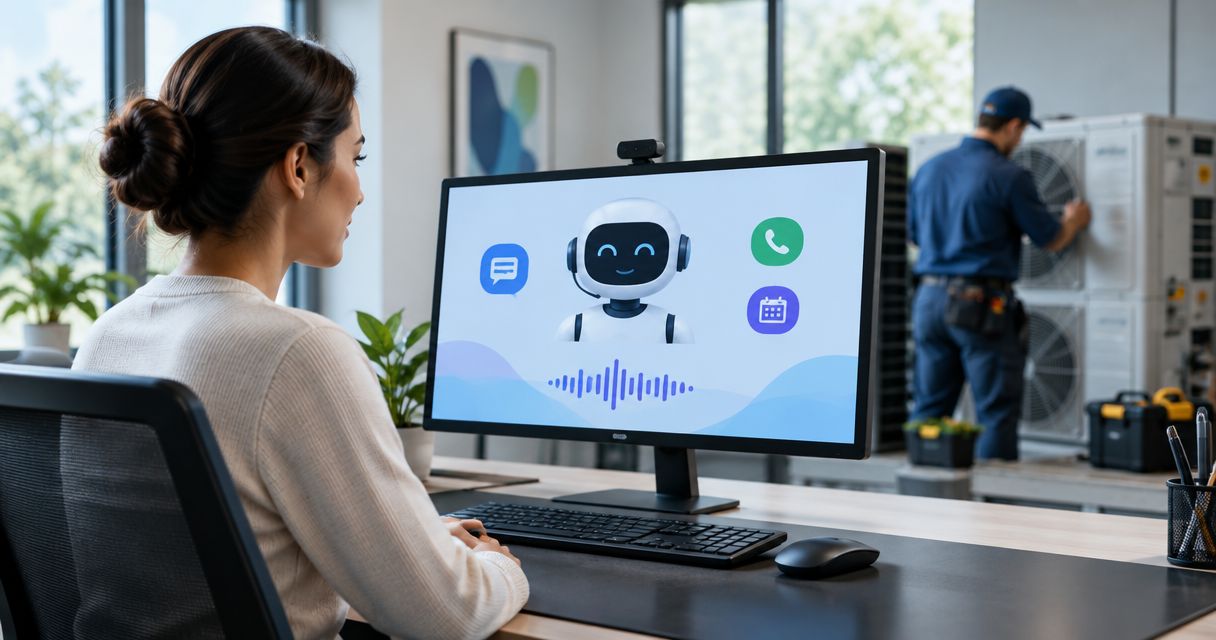

AI distinguishes an HVAC repair request from an installation inquiry by interpreting what the caller wants, asking clarifying questions, and applying the contractor’s configured routing rules. That identifies the requested appointment—not whether the equipment actually needs repair or replacement, which requires technical evaluation.
- How does AI know repair vs install HVAC call intent? It combines the caller’s request, clarification, and configured routing rules.
- Relaykite-3 provides managed HVAC lead response and appointment setting; specific call-handling requirements need confirmation.
- A broken system does not automatically mean a repair appointment; the caller might want a replacement estimate.
- Keep uncertain requests unresolved until clarification or staff review establishes the appropriate next step.
How does AI know if an HVAC caller wants repair or install?
The deciding signal is the caller’s requested next step, not a single equipment keyword. A caller discussing an old furnace might want a repair, a replacement estimate, or help choosing between them. The intake workflow needs to distinguish those requests before assigning an appointment type.
For installation inquiries, connect the classification rules to your HVAC installation lead response process. Recognizing installation interest is only useful if the next action fits that request.
The following table describes recommended routing, not guaranteed behavior from every answering service.
| Requested route | Signals to clarify | Best for | Benefit | Limitation |
|---|---|---|---|---|
| Repair assessment | Existing equipment has a problem; caller wants it checked | Callers requesting troubleshooting or service | Preserves the caller’s immediate service request | Does not establish that repair is technically appropriate |
| Replacement estimate | Caller wants to replace existing equipment | Callers asking about a new system for an existing property | Separates sales intent from repair intent | Does not establish equipment selection or installation scope |
| New installation inquiry | Caller wants equipment installed where it is not currently serving the space | Callers planning a new system or additional conditioning | Captures project intent | Requires project details before committing to work |
| Staff review | Caller is undecided, contradictory, or requesting an exception | Requests without a clear permitted route | Avoids forcing an unsupported booking | Requires a person to resolve the request |
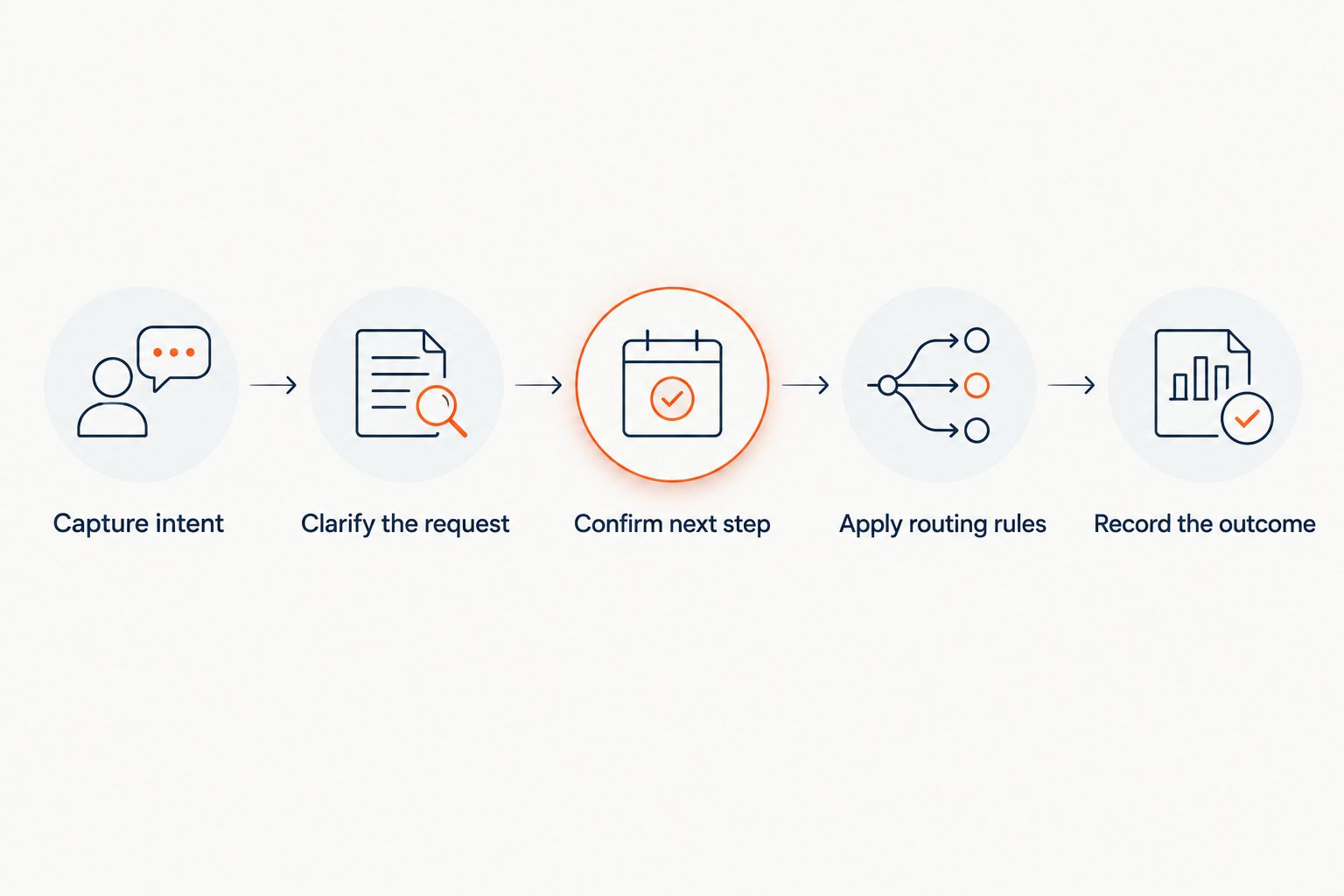
A practical workflow uses 5 steps:
- Capture intent. Record what the caller says they want before assigning a category.
- Clarify the request. Ask whether they want the existing system assessed, a replacement estimate, or a new installation discussion.
- Confirm the next step. Summarize the requested appointment and let the caller correct it.
- Apply routing rules. Match the confirmed request to the appointment types and booking permissions your business defines.
- Record the outcome. Save the request, any uncertainty, and the action taken for the receiving team.
These are configuration requirements to evaluate in 2026, not evidence that a particular service already supports every step.
Why this matters
A call can describe the equipment accurately and still reach the wrong appointment category. Equipment symptoms and buying intent answer different questions.
For example, a caller with a nonworking air conditioner might explicitly want a replacement estimate. Automatically treating every cooling failure as a repair request would disregard that preference. Conversely, mentioning an old system does not authorize a replacement consultation.
Your 2026 intake rules should preserve the customer’s request without making a technical diagnosis. Give the receiving employee enough context to understand both the symptom and the requested next step.
Repair requests: confirm the caller wants an assessment
Repair intent centers on getting existing equipment checked or restored to operation. Descriptions of unusual sounds, poor cooling, or a system that will not start provide context, but the workflow still needs to establish what the caller wants done.
Ask whether the caller wants a service assessment of the existing system. Then capture the problem in the caller’s own terms, without converting those terms into a confirmed fault.
The useful distinction is between a reported symptom and a diagnosis. Intake can record that the caller reports warm air; it should not label the compressor as failed on that basis.
Repair routing preserves a straightforward service request. Its limitation is equally important: booking an assessment does not establish that repair is possible, appropriate, or authorized. Keep that decision with the qualified person evaluating the equipment.
Replacement requests: confirm the caller wants an estimate
Replacement intent concerns changing existing equipment, rather than simply getting it checked. A direct request for a replacement estimate is stronger evidence of that intent than equipment age alone.
Clarify whether the caller wants an estimate appointment or is still deciding between repair and replacement. Those requests need different notes, even if your business initially sends them to the same team.
Do not turn interest in replacement into authorization to install. An estimate request does not establish the equipment specification, project scope, or customer approval.
Replacement routing helps the receiving team prepare for the right conversation. Its limitation is that the call alone does not resolve technical suitability. Preserve any questions the caller wants answered during the assessment.
New installation requests: establish the project context
New installation intent concerns adding a system, not necessarily replacing an existing one. Ask whether the request involves existing equipment, a space without the requested conditioning, or a construction project.
Capture the project description without assuming your business accepts that type of work. Service scope belongs in the configured rules, not in an improvised answer.
The benefit of a separate installation category is clearer project context. The limitation is that an installation inquiry contains unresolved details; intake should not convert it into a committed installation appointment unless your business explicitly permits that action.
For your 2026 setup, distinguish booking a project discussion from booking the installation work itself. The appointment label should tell both the caller and your team which commitment was made.
Why repair-versus-install classification varies
Classification depends on the conversation and the rules applied to it. Use these factors when reviewing an intake workflow:
- Caller specificity. An explicit request for a replacement estimate gives clearer direction than a general complaint about unreliable equipment.
- Mixed intent. A caller can want the current system assessed while also asking about replacement. Preserve both requests instead of silently dropping one.
- Project context. Replacing existing equipment and adding conditioning to another space are different requests, even when both involve installation.
- Conversation clarity. Incomplete descriptions or unclear wording require clarification. Do not treat a partially understood statement as confirmed intent.
- Business definitions. Your appointment categories determine whether repair assessments, replacement estimates, and project discussions follow separate routes.
- Booking permissions. Correctly recognizing intent does not establish permission to book. The workflow also needs an allowed next action.
Avoid assigning meaning to a word in isolation. The word “new” might refer to a new noise, a recently installed system, or a request for new equipment.
What happens if the caller wants both repair and replacement?
Keep both intentions in the record and clarify the immediate appointment. Ask whether the caller wants the existing system assessed first, wants a replacement estimate, or needs a staff member to help choose the next step.
Do not make the customer’s uncertainty disappear by selecting a convenient category. A clear unresolved request gives your team better information than an unsupported classification.
If your business uses a combined assessment appointment, define that route explicitly. Do not assume such an appointment exists or that every employee can handle both conversations.
Can AI decide whether an HVAC system needs replacing?
Call classification does not establish whether replacement is necessary. It identifies the caller’s request and organizes the next action; technical evaluation addresses the condition of the equipment.
A workflow should therefore distinguish customer preference from technical findings. Record that the caller wants a replacement estimate without presenting replacement as a diagnosis.
What should happen when AI cannot classify the call?
Use a defined unresolved route rather than guessing. Ask a focused clarification question, then follow the business’s approved staff-review process if the requested appointment remains unclear.
Tell the caller what happens next using only the actions your team has authorized. Do not describe a requested callback as a confirmed booking.
What should you configure before allowing automatic routing?
Start with the appointment definitions, not the conversation script. If your team cannot explain the difference between its booking categories, an automated intake process has no clear rule to apply.
For a 2026 configuration review, document:
- Accepted work: which service and project requests your business handles.
- Appointment definitions: what each category means and what the customer is agreeing to.
- Clarification questions: what to ask when the initial request leaves the next step unclear.
- Exception handling: which requests require staff review rather than automatic booking.
- Confirmation wording: how the workflow states the agreed next action.
Keep 3 fields separate in your intake record: reported problem, requested appointment, and routing outcome. Combining them into a single label hides distinctions your team needs.
Relaykite-3 provides managed HVAC lead response and appointment setting for U.S. HVAC businesses. Relaykite-3 is for U.S. HVAC businesses seeking managed lead response and appointment setting. Its stated service scope does not establish a particular classification method, supported booking categories, or exception-handling behavior; confirm those requirements before relying on them.
Review Relaykite-3 against your documented intake requirements. Evaluate the fit around the actions your business needs, not an assumed ability to diagnose equipment over a call.
How should you test repair-versus-install routing?
Use example conversations with an agreed expected outcome. These are acceptance checks, not evidence of a particular accuracy rate.
Begin with 2 contrasting test calls: a clear request to assess existing equipment and a clear request for a replacement estimate. Confirm that the resulting appointment category follows the request rather than merely the symptom.
Then add an undecided caller, a caller who changes their request, and a project outside your accepted scope. Your 2026 review should inspect the saved notes and final action, not just whether the conversation sounded natural.
For each example, check:
- Did the workflow preserve the caller’s actual request?
- Did it ask for clarification when needed?
- Did it avoid presenting symptoms as a diagnosis?
- Did it follow the permitted booking or review route?
- Did the caller receive an accurate description of the next step?
A fluent conversation is not proof of correct routing. Judge the appointment outcome and the handoff record together.
FAQ
How does AI know repair vs install HVAC call intent?
AI identifies the requested appointment from the caller’s description, clarifying questions, and configured routing rules. It should confirm whether the caller wants an existing-system assessment, a replacement estimate, or a new installation discussion before taking the permitted next action.
Does mentioning an old furnace mean the caller wants replacement?
No. Equipment age alone does not establish replacement intent. Ask whether the caller wants the existing system assessed or wants a replacement estimate.
Can a caller ask about repair and replacement together?
Yes. Preserve both requests and clarify which appointment the caller wants next. Use staff review when the business has not defined an appropriate route for mixed requests.
Should an unclear HVAC call be booked automatically?
An unclear request should follow a defined clarification or staff-review route, not an assumed appointment category. Automatic booking needs a confirmed request and permission under the business’s rules.
Can AI diagnose the HVAC problem while booking?
An intake classification is not a technical diagnosis. Record reported symptoms separately from the requested appointment and leave equipment findings to qualified evaluation.
Does Relaykite-3 provide HVAC appointment setting?
Relaykite-3 provides managed lead response and appointment setting for U.S. HVAC businesses. Confirm the specific call-handling, classification, and booking requirements for your business before relying on a workflow.
One last thing
Test a caller who changes their mind. Start with a repair request, then switch to asking for a replacement estimate before the conversation ends.
The useful check is whether the final record reflects the confirmed request while retaining relevant context. The first classification is provisional; the confirmed next step is what your team must receive.