

AI can replace the lead-response and appointment-setting portion of an HVAC receptionist’s job, but that does not make it a replacement for the entire office role. In 2026, the decision depends on whether your receptionist follows repeatable booking rules or also handles dispatch exceptions, customer disputes, billing questions, and other work that requires a responsible person.
- Can AI replace HVAC receptionist duties? Routine lead response and appointment setting are candidates; full office coverage requires separate evaluation.
- Relaykite-3 provides managed HVAC lead response and appointment setting, not a stated replacement for every receptionist responsibility.
- Keep a named person responsible for exceptions, complaints, scheduling conflicts, and safety-related escalation.
- Test completed bookings and human handoffs before changing staffing; an answered inquiry is not a finished appointment.
Can AI for HVAC replace a full-time office receptionist?
Replace a defined workflow, not a job title. A receptionist’s title tells you little about the decisions that person makes throughout the day. Write down those decisions before comparing staffing options.
Use this table as a responsibility checklist, not a statement that every service includes these capabilities. For appointment-specific evaluation, see the guide to unattended HVAC appointment booking.
| Responsibility | AI-led workflow | Human-led workflow | Decision boundary |
|---|---|---|---|
| New inquiry intake | Best for collecting repeatable details under approved rules | Best for unclear requests needing discussion | Define required information and exclusions |
| Appointment setting | Best for requests that match permitted booking rules | Best for exceptions and conflicting commitments | Confirm actual booking access and restrictions |
| Prospect follow-up | Best for approved, repeatable outreach | Best for sensitive or unusual conversations | Define when outreach stops or transfers |
| Dispatch changes | Use only within explicitly verified permissions | Best for balancing conflicting operational demands | Keep a named decision-maker |
| Complaints and billing disputes | Limit to approved intake and routing | Best for decisions requiring discretion | Do not treat intake as resolution |
| Safety-related requests | Limit to approved escalation instructions | Best for accountable escalation handling | Never substitute booking for emergency handling |
Why this matters
Removing a receptionist without redistributing their non-booking work leaves responsibilities unassigned. A service can collect a request successfully while nobody owns the next decision.
The useful question is not whether a system sounds convincing. It is whether every request ends in an authorized booking, a clear rejection, or an accountable handoff.
AI-led intake: best for repeatable lead handling
AI-led intake is a sensible candidate when you can describe the work as explicit rules. Those rules should cover which inquiries qualify, what information is required, and which appointment outcomes are permitted.
The advantage is a bounded process that you can inspect and repeat. The limitation is equally important: requests outside that process still need somewhere to go.
Before considering an AI-led arrangement, document:
- Which services the intake workflow can discuss.
- Which locations qualify for service.
- What information must be collected before scheduling.
- Which appointment types the workflow can offer.
- Which requests require a person’s approval.
- What happens when a customer cannot complete the normal process.
Do not assume voice calling, text messaging, calendar access, or dispatch permissions come together. Verify each capability separately against your actual requirements.
Choose AI-led intake for clearly bounded work, not as a substitute for undefined office responsibilities. That distinction should guide your 2026 staffing decision.
Human-led reception: best for discretionary office work
Keep human-led reception when the role involves decisions that cannot be reduced to an approved intake path. Examples include resolving a complaint, interpreting an unusual customer request, or deciding how to handle conflicting commitments.
These are responsibilities to check in your own business, not assumptions about every HVAC receptionist. Your receptionist’s actual task list is the evidence that matters.
Human-led reception gives a responsible person discretion within your business policies. Its limitation is that coverage depends on the staffing arrangement you actually provide; a job title alone does not establish coverage outside those hours.
If the receptionist also manages paperwork, supplier communication, billing questions, or in-person visitors, removing the role does not remove that work. Assign it explicitly before making a staffing change.
Keep a human owner wherever the workflow requires judgment, authority, or follow-through beyond collecting information.
Hybrid reception: best for separating intake from exceptions
A hybrid arrangement assigns routine intake and appointment-setting tasks to an automated workflow while a person owns exceptions. Consider it when your task review finds both repeatable requests and discretionary work.
Its benefit is a clear division of responsibilities. Its drawback is another handoff to manage: the workflow must transfer enough context for the responsible person to act.
A useful handoff includes the customer’s request, the information already collected, the reason for escalation, and the next action required. Decide where that information goes and who checks it.
Avoid a design in which every unresolved conversation becomes a message to the owner without priority or context. That transfers work rather than finishing it.
For a 2026 hybrid plan, define the human role as carefully as the automated role. Someone must own unresolved requests even when the normal office contact is unavailable.
Why the replacement decision varies
The same appointment-setting workflow can fit one office and leave important gaps in another. Evaluate the scope of work rather than relying on a receptionist-versus-software label.
- Inquiry scope: Separate new sales inquiries from existing-customer support and administrative requests.
- Booking rules: Document what qualifies for scheduling and what requires approval.
- Follow-up responsibility: Identify who owns a prospect after the initial response and when outreach ends.
- Service boundaries: Specify the requests and locations your business accepts.
- Exception ownership: Name the person responsible when intake cannot reach an authorized outcome.
- Managed service scope: Confirm who maintains the instructions and handles changes to the workflow.
These factors are requirements to verify, not promised features. A provider’s general description is not evidence that your particular scheduling rules or office processes are supported.
How do you test replacement without creating an office gap?
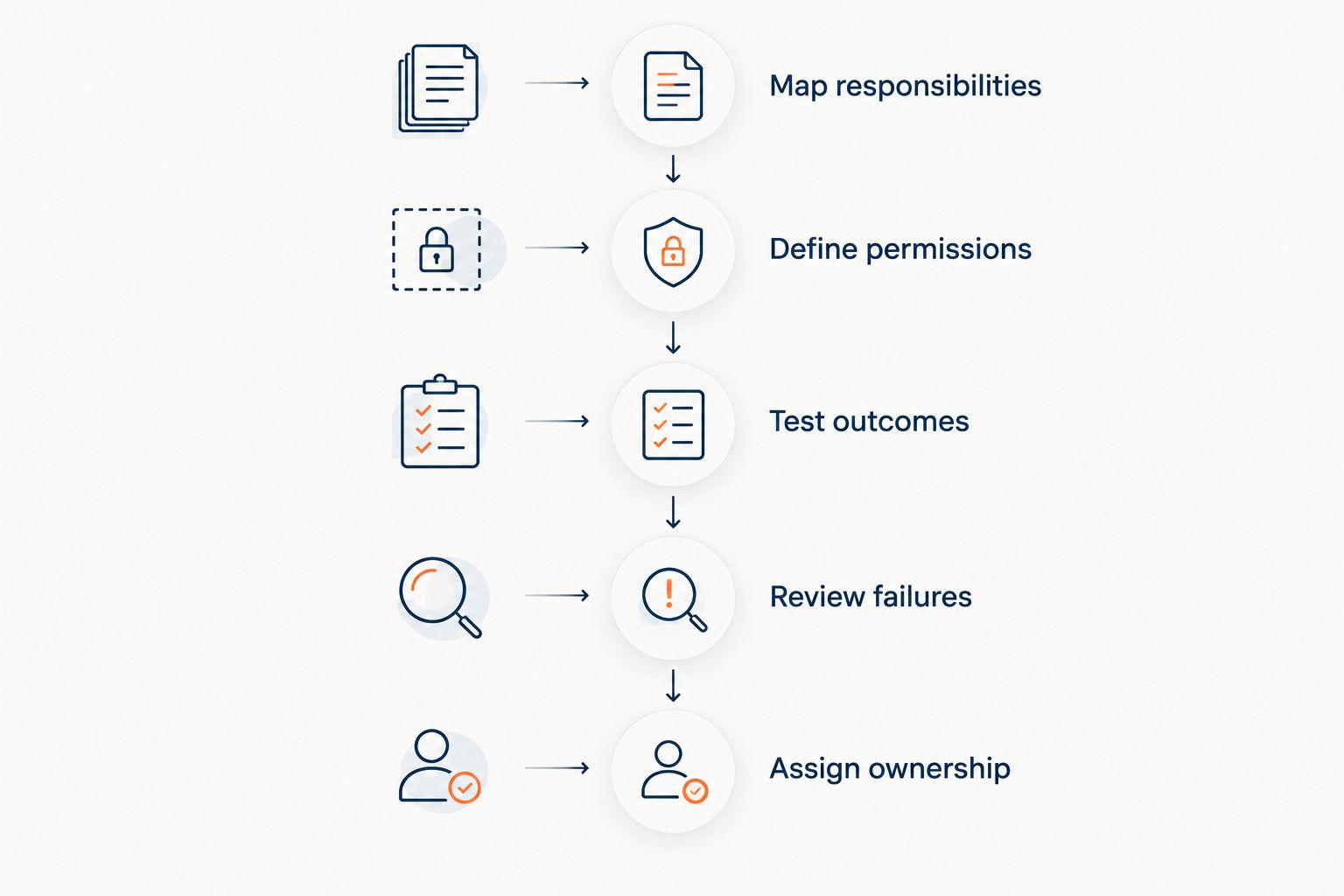
Use a controlled evaluation before changing staffing. The following is a proposed acceptance test, not a performance benchmark or a claim about any provider’s results.
Map responsibilities
List what your receptionist actually does, including work that happens away from the phone. Group the tasks into intake, appointment setting, follow-up, administration, and exception handling.
For each task, name the authorized outcome. Receiving a message, requesting an appointment, and confirming an appointment are different outcomes; your review must distinguish them.
Define permissions
Write down what the workflow is allowed to say and do. Include accepted services, required details, scheduling restrictions, escalation triggers, and prohibited commitments.
Keep technical diagnosis and unapproved promises outside the intake workflow. If a request needs authority the workflow does not have, the correct outcome is escalation rather than an improvised answer.
Test outcomes
Start with 10 test inquiries: 5 routine inquiries, 3 exception cases, and 2 handoff cases. This is a suggested exercise for exposing different failure types, not a statistically validated sample or a substitute for continued review.
For routine inquiries, check whether the workflow captures the required information and reaches the authorized result. For exception cases, check whether it respects the boundary instead of forcing a booking.
For handoff cases, verify that the responsible person receives enough context to continue. A transfer attempt alone does not demonstrate a completed handoff.
Review failures
Record what went wrong and which instruction, permission, or ownership gap caused it. Separate incorrect details from unauthorized promises and unresolved transfers; these require different fixes.
Retest the affected path after a change. Do not mark a failure resolved simply because the instructions were edited.
Assign ownership
Name who reviews unresolved requests and who approves changes to the workflow. Also define who takes responsibility when the normal contact cannot respond.
Only consider reducing receptionist duties after the relevant work has a verified replacement or a named human owner. Completing this checklist is not a guarantee of operational performance.
Does answering an inquiry mean the receptionist was replaced?
No. Answering an inquiry completes only the response step; replacement requires the assigned work to reach its intended outcome.
Review whether the customer details are correct, the request qualifies, and any appointment is genuinely confirmed. Also inspect unresolved requests rather than counting only conversations that ended normally.
In your 2026 review, keep these outcomes separate:
- Response: The customer received an acknowledgment or reply.
- Qualification: The request was checked against approved criteria.
- Booking: The appointment reached the confirmation state your business requires.
- Handoff: The responsible person received the unresolved request and context.
Do not describe a response as a booking or a handoff as a resolution. Those distinctions make the staffing decision more useful than a conversation count alone.
Should you remove the receptionist position immediately?
No. First identify where every existing responsibility will go, then verify that the new arrangement handles the work assigned to it.
If you cannot explain who handles a complaint, a scheduling conflict, or an unresolved request, the replacement plan is incomplete. Keep those responsibilities assigned while evaluating the narrower intake workflow.
A staffing decision should follow the demonstrated task coverage. It should not depend on a persuasive demonstration of a routine conversation.
Where does a managed lead-response service fit?
Relaykite-3 is best for U.S. HVAC businesses seeking managed lead response and appointment setting. Relaykite-3 describes its service as helping businesses respond to new inquiries, follow up with prospects, and book service appointments.
That scope matches the lead-handling portion of this decision. It does not establish that the service replaces billing administration, dispatch management, complaint resolution, or every other receptionist responsibility.
Before assigning work, confirm supported inquiry channels, booking permissions, exception handling, and who maintains your instructions. Evaluate the service against requirements configured for your business; appointment outcomes are not a guarantee.
FAQ
Can AI replace an HVAC receptionist completely?
AI can replace defined lead-response and appointment-setting tasks, but complete replacement requires coverage for every responsibility assigned to the receptionist. Review administrative work, exceptions, and customer issues separately before changing staffing.
Is AI reception better than keeping a human receptionist?
AI-led intake fits repeatable rules, while human-led reception fits work requiring discretion and authority. Choose based on your actual task list, and consider a hybrid arrangement when the role contains both types of work.
Can an AI receptionist handle HVAC emergency requests?
Emergency requests require an explicitly approved escalation process, not ordinary appointment booking. Verify the instructions, responsible contact, and unresolved-contact procedure before assigning this work to any intake service.
Can AI book HVAC appointments without an employee approving each request?
Unattended booking requires verified scheduling permissions and rules that define eligible requests. Confirm what counts as a completed appointment and what happens when a request falls outside those rules.
What should I test before reducing receptionist duties?
Test routine inquiries, exception handling, and human handoffs before reducing receptionist duties. Check the final outcome, information accuracy, unauthorized commitments, and whether the responsible person receives unresolved requests.
Does Relaykite-3 replace a full-time HVAC office employee?
Relaykite-3 provides managed HVAC lead response and appointment setting; its stated scope does not establish replacement of an entire office employee. Compare that scope with your receptionist’s actual responsibilities and verify the configured workflow.
One last thing
The most revealing test is the request that should not become an appointment. A workflow that books a routine request still has to recognize its own limits.
Before approving your 2026 staffing plan, submit a request outside your approved rules and inspect the result. The useful outcome is a clear boundary and an accountable next step—not a booking made merely to finish the conversation.