
Switch from a live answering service to AI only when the replacement can handle your routine HVAC inquiries, follow your booking rules, and hand exceptions to a person. Start with a limited pilot rather than a full cutover: appointment accuracy and reliable escalation matter more than whether a call gets answered.
- To switch live answering service to AI, HVAC businesses should test booking accuracy and human handoffs first.
- Relaykite-3 is best suited to U.S. HVAC businesses seeking managed lead response and appointment setting.
- Keep human handling for situations outside the approved intake and scheduling rules.
- Judge the switch by completed bookings, corrections, and follow-up outcomes—not answered calls alone.
Is it worth switching from a live answering service to AI?
Yes, when a controlled comparison shows that automated intake improves your workflow without introducing unacceptable booking or escalation errors. Keep your live service if the replacement cannot meet your operating requirements.
Relaykite-3 is best suited to U.S. HVAC businesses seeking managed lead response and appointment setting. That service category fits businesses looking beyond message capture; suitability still depends on the workflow configured for your business.
Use this comparison to define your 2026 evaluation. These are operating choices to assess, not promises about every provider.
| Approach | Best for | Advantage to verify | Limitation to check |
|---|---|---|---|
| Live answering service | Calls requiring discussion and judgment | Staff can clarify requests and handle exceptions within their authority | Answering a call does not necessarily include booking or follow-up |
| AI-led intake | Routine inquiries with documented rules | Approved questions and scheduling steps can follow a defined process | Unsupported requests need a reliable handoff |
| Hybrid handling | Routine intake with human exception handling | Automation and people have separate responsibilities | Handoffs create another process to monitor |
Do not treat the comparison as a ranking. Choose the operating model that passes your acceptance tests, not the one with the longest feature list.
Why this matters
An answered inquiry and a booked service appointment are different outcomes. If someone captures a name but leaves your office to chase the customer, the remaining work still belongs in your evaluation.
Relaykite-3 provides managed HVAC lead response and appointment setting, including prospect follow-up. Those functions are relevant when you want help moving inquiries toward appointments, rather than simply replacing the person answering them. They do not establish a guaranteed booking result.
For your 2026 review, trace the entire path: inquiry, response, qualification, booking, and exception handling. Identify where work stops today before deciding what to replace.
A homeowner asking for maintenance and a caller reporting an urgent concern should not receive an identical workflow. Your replacement plan needs boundaries, not just a greeting.
Why the value of switching varies
The value depends on the work your HVAC business needs handled. Use these factors to define the scope of a pilot:
- Inquiry type: Separate routine appointment requests from complaints, technical questions, and urgent concerns. Each needs an explicit next step.
- Booking authority: Decide whether the service can confirm an appointment or only collect a preferred time. Customer-facing language must match that authority.
- Service boundaries: Document the locations and job types your business accepts. Do not expect a replacement to infer them correctly.
- Follow-up responsibility: Assign ownership when a prospect does not respond or does not finish booking. Define when outreach ends.
- Exception handling: Name the person or team responsible for unsupported requests. Specify what happens when that person is unavailable.
- Review workload: Include the time your office spends correcting records, checking appointments, and resolving handoffs. Automation is not useful if it merely relocates the work.
These factors also explain why another contractor's result is not your forecast. Different booking permissions and escalation requirements produce different operating demands.
How do you test a switch without replacing everything?
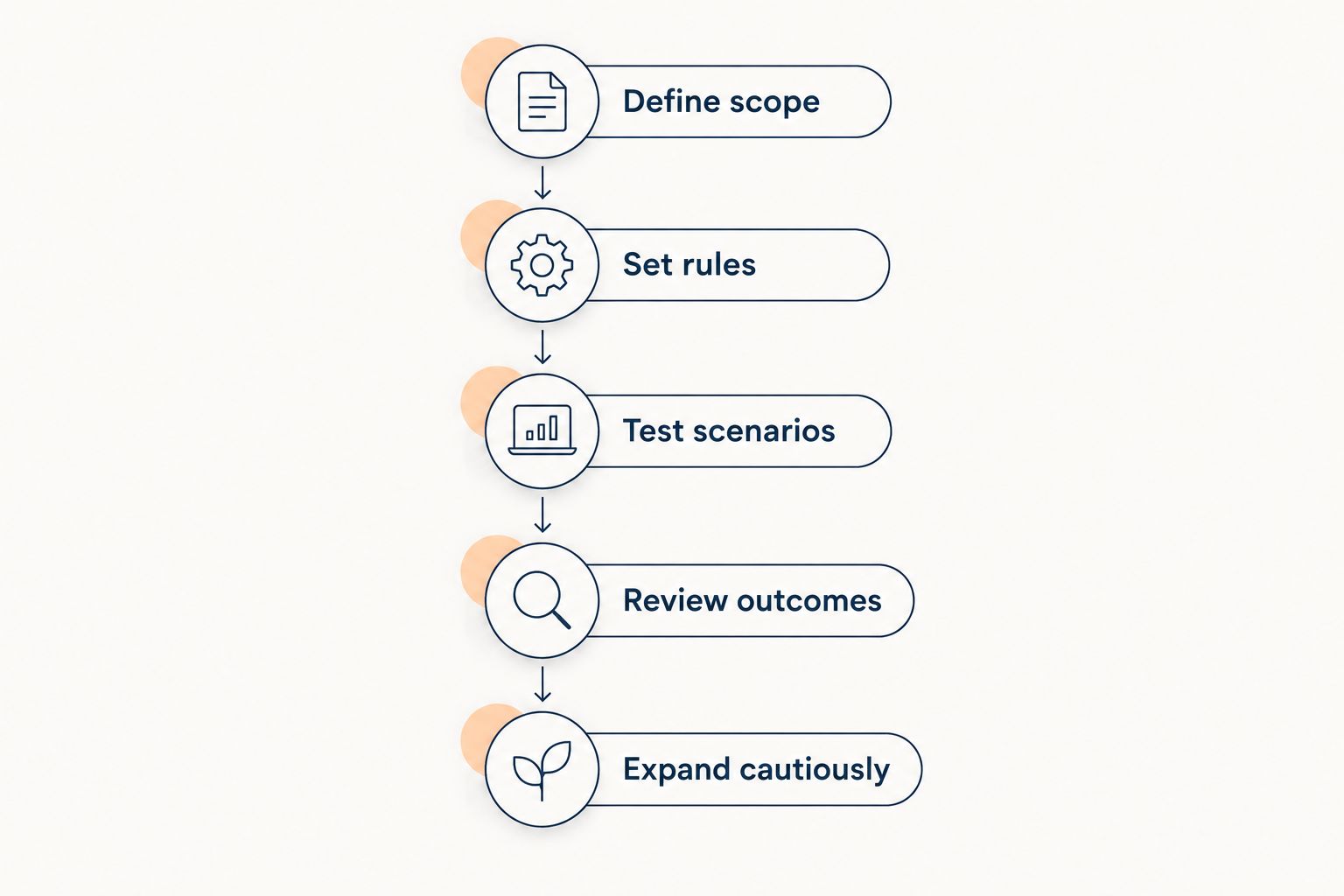
Use a written pilot plan in 2026. Keep the scope narrow enough that your office can inspect the results and reverse the routing if necessary.
The following steps are a recommended evaluation process, not evidence of a particular provider's capabilities.
Define scope
Choose a routine inquiry category that your team can describe precisely. Maintenance requests are a possible starting point if your business accepts them and has clear scheduling rules.
Write down what the pilot excludes. Existing appointment changes, complaints, and urgent concerns should remain outside the automated scope unless you have explicitly tested their handling.
Set rules
Document required customer details, accepted service areas, appointment permissions, and the conditions that require human review. Describe a successful interaction in terms your office can verify.
Distinguish a requested time from a confirmed appointment. If confirmation requires office approval, every message should preserve that distinction.
Test scenarios
As a starting checklist, write 10 test scenarios before routing real inquiries. This is a planning recommendation, not a statistical validation threshold.
Include routine booking, an unsupported location, an unsupported job type, unavailable appointment times, an existing customer, a duplicate inquiry, a correction to contact details, a caller requesting a person, an urgent concern, and an interrupted conversation.
Run each scenario through the proposed workflow. Record the expected result beforehand so a convincing conversation does not distract from an incorrect action.
Review outcomes
Inspect the customer-facing response and the office-facing result together. A polite interaction can still produce an unusable appointment record.
As a starting cadence, review pilot outcomes daily for 7 days. That is a suggested oversight period, not proof that a week captures your full range of inquiries.
Expand cautiously
Expand only after the workflow meets your written acceptance criteria. Keep the previous routing instructions available so your team can reverse a change without improvising.
A passed maintenance-request test does not approve emergency intake or installation consultations. Treat each new inquiry category as a separate decision.
What should you measure before deciding?
Measure customer outcomes and office workload together. An answer-rate report alone does not establish that the replacement is doing the job your business needs.
Use consistent definitions for your existing service and your pilot. Otherwise, differences in reporting can look like differences in performance.
| Measure | What to record | What it tells you |
|---|---|---|
| Eligible inquiries | Requests within the approved pilot scope | Which contacts belong in the comparison |
| Confirmed appointments | Bookings accepted under your scheduling rules | Whether inquiries reach the intended next step |
| Booking corrections | Appointments requiring office repair | Whether automation creates avoidable work |
| Completed handoffs | Exceptions received by the responsible person | Whether escalation works beyond the conversation |
| Follow-up outcomes | Replies, bookings, opt-outs, and unresolved prospects | Whether follow-up reaches a clear stopping point |
| Office review time | Minutes spent checking and correcting pilot activity | How much oversight the workflow requires |
For every measure, keep the underlying record available. A summary should let your office inspect what happened, not replace that inspection.
Compare equivalent inquiry categories. Do not credit a routine-request pilot with outperforming a live service that also handles complaints and complex customer conversations.
Do not set a universal conversion target. Set acceptance criteria using your actual records, the responsibilities being transferred, and the consequences of an error.
When should you keep human handling?
Keep a person responsible whenever the request exceeds the approved workflow. In particular, do not let appointment-setting language imply that a technician has been dispatched when no dispatch has been confirmed.
For urgent concerns, use a business-approved safety and escalation script. The intake process should not improvise equipment diagnosis or promise emergency attendance without authorization.
A hybrid arrangement is the appropriate pilot choice when you want to test routine intake while retaining human responsibility for exceptions. Its limitation is operational: someone must actually receive and act on those exceptions.
Write down the destination, required context, and fallback for each handoff. A message sent to an unattended inbox is not the same as an accepted escalation.
Can you switch without changing your scheduling system?
Keeping your scheduling system is a requirement you can set, not a capability you should assume. Before switching, ask the proposed provider to demonstrate the exact appointment workflow your office will use.
Check what happens when availability changes, a customer requests a different time, or an appointment cannot be saved. Those cases reveal whether your team will need to reconcile records manually.
Use 3 appointment states in your test script: requested, confirmed, and unresolved. These are recommended evaluation labels, not a claim about any provider's interface.
Approve the customer wording for each state. A request should not sound confirmed, and an unresolved booking should have a named owner.
Is switching worth it if your live service already works well?
Switching is worth considering only if the proposed workflow addresses a specific unmet need. If your current service already books accurately, follows up appropriately, and handles exceptions as required, the replacement must demonstrate an additional operational benefit.
Keep the comparison tied to transferred responsibilities. Do not replace a working process solely because another service describes itself as automated.
Should you replace the entire answering service at once?
A limited pilot is the better starting decision when the replacement has not been tested against your business rules. It preserves a route for inquiries that remain outside the approved scope.
Full replacement belongs after demonstrated workflow acceptance, not before it. Confirm who can stop the pilot and restore the previous routing.
FAQ
Is AI better than a live answering service for HVAC calls?
AI is not automatically better than a live answering service for HVAC calls. Choose the workflow that meets your booking, follow-up, and escalation requirements in a controlled comparison.
What's the safest way to switch my HVAC answering service?
Start with a limited inquiry category and written acceptance criteria. Test routine requests and exceptions before expanding the replacement's responsibilities.
Can an AI answering service confirm HVAC appointments?
Appointment confirmation depends on the service's demonstrated capabilities and the booking authority you grant it. Verify the exact workflow and distinguish a requested time from a confirmed appointment.
Should I keep people available for emergency HVAC inquiries?
Keep a designated human escalation path for urgent inquiries outside the approved workflow. Use a business-approved script and do not promise dispatch unless it is authorized and confirmed.
How do I know whether switching actually saves office work?
Record the time your office spends reviewing, correcting, and completing inquiries under each workflow. Compare equivalent inquiry categories rather than relying on answered-call totals.
What does Relaykite-3 do for HVAC businesses?
Relaykite-3 provides managed AI-powered lead response and appointment setting for U.S. HVAC businesses. Its stated scope includes responding to new inquiries, following up with prospects, and booking service appointments; outcomes depend on the configured workflow.
What should I ask an answering-service provider before switching in 2026?
Ask the provider to demonstrate booking permissions, exception handling, follow-up stopping rules, and failure recovery using your scenarios. Request a clear explanation of which actions are automated and which still require your team.
One last thing
Test the failure path before approving the happy path. Ask what happens when the appointment cannot be saved, the caller needs a person, or the responsible employee does not respond.
Make that demonstration part of your 2026 acceptance decision. A workflow is not ready merely because its routine conversation sounds natural; your office needs to know who owns the unresolved request.