

HVAC companies measure AI answering service ROI by comparing the additional contribution from completed, paid jobs and verified labor savings against the full cost of the service. Count only results above a credible baseline, subtract implementation and oversight costs, and do not treat answered calls or booked appointments as profit.
- How to measure ROI on HVAC AI answering service coverage: track incremental job contribution, not just bookings.
- Count completed, paid HVAC jobs and verified labor savings against all program costs.
- Relaykite-3 fits U.S. HVAC businesses seeking managed lead response and appointment setting; ROI requires separate financial measurement.
- Separate after-hours inquiries, daytime overflow, and follow-up so results remain attributable.
How do HVAC companies measure ROI on AI answering services?
Measure the financial change caused by the service, not the activity passing through it. An answering service can participate in a job without causing that job to happen.
For a managed service such as Relaykite-3, which provides lead response, prospect follow-up, and appointment setting for U.S. HVAC businesses, keep service activity separate from financial attribution. Booking support is the service; additional retained contribution is the result you need to establish.
Use this calculation:
ROI = (incremental job contribution + realized labor savings − total program cost) ÷ total program cost × 100%.
Here, job contribution means collected revenue minus the incremental costs of fulfilling the work. Calculate it consistently with your accountant rather than substituting total invoice revenue.
| Measurement | What it establishes | What it does not establish |
|---|---|---|
| Answered inquiries | The service handled an interaction | The inquiry became additional business |
| Booked appointments | The interaction produced a scheduling outcome | The visit happened or generated payment |
| Completed, paid jobs | Work was delivered and payment collected | The service caused the job |
| Incremental job contribution | Additional work retained value after fulfillment costs | The program covered its own costs |
| Net program return | Measured benefit exceeded or fell short of program costs | The result will repeat under different conditions |
These measures serve different purposes. Keep the activity metrics for diagnosis, but use the financial calculation for the buying decision.
Why this matters
A full appointment calendar is not a financial result. Cancellations, duplicate inquiries, unpaid invoices, and work your office would have booked anyway belong outside the incremental-benefit total.
Your 2026 evaluation should answer a narrower question: did this particular answering arrangement produce more retained contribution than it consumed? That question prevents a busy dashboard from becoming a substitute for evidence.
Keep two reporting views. Operations needs response, qualification, booking, and handoff information; ownership needs attributable contribution, realized savings, and total program cost.
Build the measurement process before evaluating results
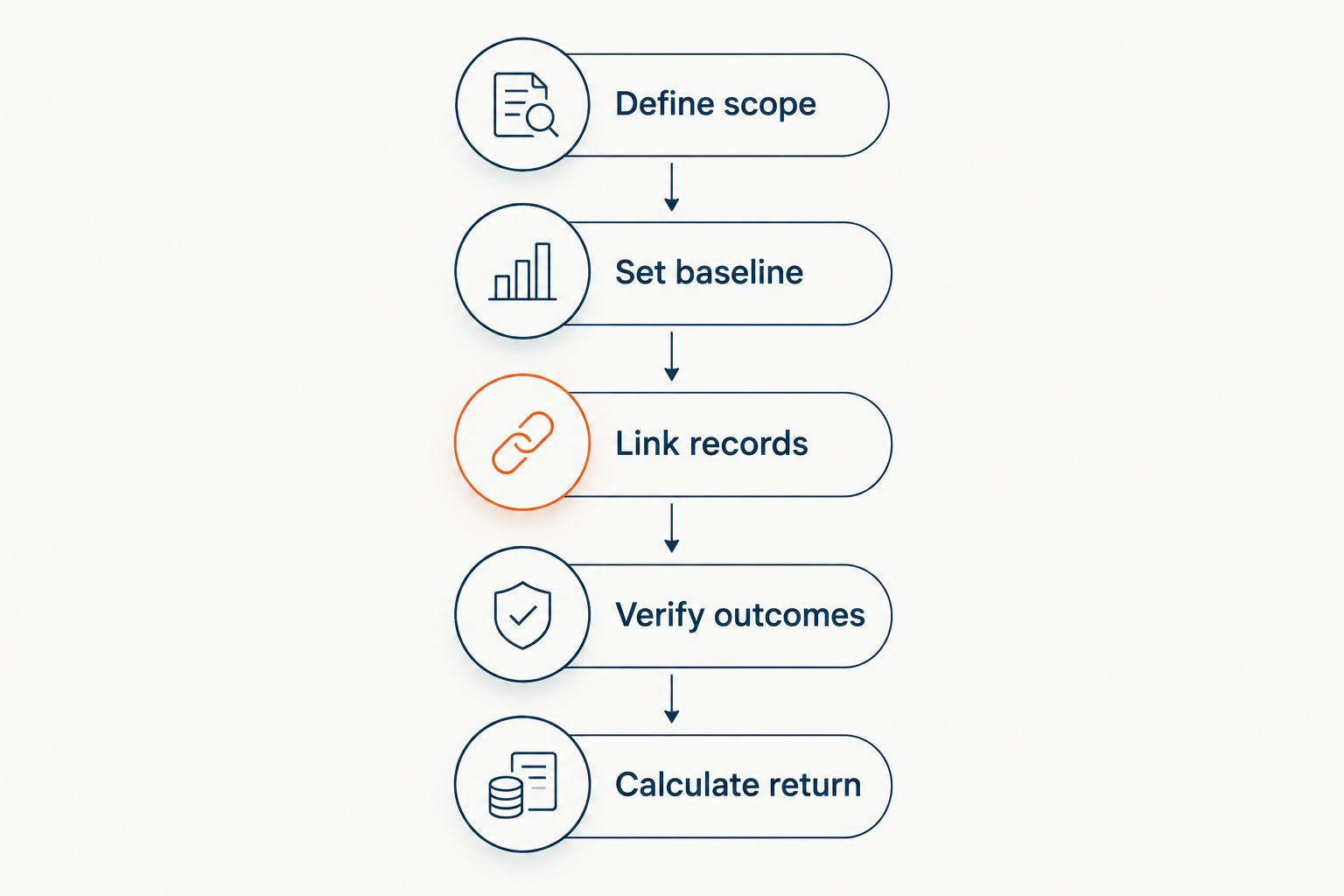
1. Define scope
Write down which inquiries enter the evaluation: new prospects, existing customers, daytime overflow, after-hours contacts, or a defined combination. Record the covered channels and business locations as well.
Do not silently expand that scope during the comparison. If coverage changes, label the change and report the affected periods separately.
2. Set baseline
Record what happened under your existing process before judging a replacement. Capture eligible inquiries, completed jobs, collected revenue, fulfillment costs, and staff effort using the same definitions you will use afterward.
A 2026 baseline should preserve relevant operating context: lead source, service type, coverage hours, and available appointment capacity. Comparing dissimilar workloads produces a change figure, not a clean attribution result.
3. Link records
Connect each eligible inquiry to its appointment, completed job, and payment record. Keep repeat calls and follow-up messages attached to the original opportunity rather than counting each interaction as another lead.
Use the systems you already maintain when possible. The HVAC call tracking software guide covers a related measurement category, but call attribution alone does not establish financial return.
4. Verify outcomes
Classify each opportunity by its actual outcome: unresolved, booked, canceled, completed, paid, or otherwise closed. Keep the definitions consistent across staff and reporting periods.
A booked installation consultation is not a paid installation. Keep those outcomes separate until the later work is completed and its financial contribution can be established.
5. Calculate return
Estimate the contribution above the baseline, add verified labor savings, and subtract the full program cost. Keep uncertain opportunities outside the realized result.
Report the measurement period and the treatment of open jobs beside the calculation. A result without those boundaries is difficult to reproduce.
Establish what would have happened without the service
A service-handled job is not automatically an incremental job. Start with the existing process as the counterfactual: what would your staff, voicemail workflow, or current answering arrangement have produced?
A matched comparison is useful when you can keep lead sources, coverage windows, staffing, and job mix comparable. A before-and-after comparison is easier to operate, but changes in demand and capacity must remain visible.
| Comparison approach | Best for | Advantage | Limitation |
|---|---|---|---|
| Concurrent matched groups | Operations able to route comparable inquiries separately | Reduces dependence on different calendar periods | Routing and group differences require control |
| Before-and-after baseline | Teams with consistent historical records | Uses an existing operating history | Other business changes complicate attribution |
| Individual recovered opportunities | Reviewing specific missed or abandoned inquiries | Makes the customer journey inspectable | Does not prove every recovered job was otherwise lost |
Choose the strongest comparison your operation can maintain accurately. Do not describe an uncontrolled before-and-after change as proof that the answering service caused the entire difference.
For a 2026 pilot, document changes to advertising, service territory, staffing, and scheduling rules alongside the results. Those changes belong in the interpretation, not buried outside the report.
Separate the work before combining the return
After-hours inquiries
Measure after-hours contacts against the actual after-hours baseline. Include jobs booked through later office callbacks when establishing what the old process already recovered.
The benefit is additional contribution from work that the comparison supports as incremental. The limitation is attribution: an unanswered evening inquiry is not proof that the customer would never have booked the next morning.
Daytime overflow
Measure overflow inquiries separately from calls your office already answers. Track whether additional appointments become completed, paid jobs without displacing other profitable work.
The benefit is additional coverage during the defined overflow window. The limitation is fulfillment capacity: accepting another appointment does not establish that your team can complete additional work.
Prospect follow-up
Attach follow-up activity to the original inquiry and compare outcomes against your existing follow-up process. Count the opportunity once, even when it generates several calls or messages.
The benefit is a traceable route from an unresolved inquiry to a financial outcome. The limitation is shared credit: advertising, office staff, estimators, and follow-up can all participate in the same sale.
Include the costs that a booking report leaves out
Build the cost ledger from actual agreements, invoices, payroll records, and implementation work. Do not replace those records with a generic industry estimate.
Include these categories where they apply:
- Service charges: Record the charges associated with the evaluated coverage.
- Implementation work: Include paid setup work and internal staff time devoted to launch.
- Connected systems: Include additional communication, tracking, or scheduling expenses caused by the program.
- Ongoing oversight: Record time spent reviewing conversations, correcting records, and maintaining business rules.
- Exception handling: Include incremental staff work needed to resolve handoff or scheduling problems.
- Transition overlap: Include overlapping arrangements when they are part of the evaluation period.
Separate one-time implementation costs from recurring operating costs, but show both. Your 2026 launch result and a recurring-cost view answer different questions; neither should conceal the other.
Do not count technician labor twice. If fulfillment labor is already deducted when calculating job contribution, do not subtract that same labor again as a program expense.
Why HVAC answering service ROI varies
The calculation stays the same; the underlying inputs change. Use these drivers to explain differences rather than assuming the service performs identically across all work.
- Baseline recovery: Existing callbacks and office follow-up affect how much improvement is genuinely additional.
- Inquiry eligibility: Spam, duplicate contacts, existing jobs, and out-of-area requests should not inflate the opportunity count.
- Job mix: Apply each completed job's recorded contribution rather than assigning every appointment the same value.
- Appointment capacity: Distinguish more bookings from more work your operation can actually fulfill.
- Collection status: Keep unpaid invoices separate from collected results when using a cash-based measurement.
- Configuration and oversight: Measure the costs and outcomes of the workflow configured for your business, including its exceptions.
Use these categories to explain your own results. They are not a claim about the size or direction of any particular business's return.
How should you interpret the ROI percentage?
0% ROI means measured benefits equal measured program costs. It is the break-even point under the costs, attribution rules, and measurement period you selected.
100% ROI means the net measured benefit equals the program cost. Gross measured benefits therefore equal twice the program cost under this formula; that is arithmetic, not a service-performance benchmark.
A positive result still needs a quality check. Confirm that the calculation excludes existing business, includes required operating costs, and does not depend on treating unfinished jobs as collected revenue.
How do you test whether the result depends on optimistic assumptions?
A 1 percentage point change in the incremental completed-job rate is a sensitivity test, not an observed improvement. Recalculate the result with that lower rate to see whether the decision changes.
Also remove disputed attribution and uncollected work from the result. If the return changes sign, resolve those uncertainties before treating the investment as financially established.
Should you count staff time saved as ROI?
Count staff time as financial savings only when you can show what changed economically. Reduced paid overtime or an avoided expense is different from time that became available while payroll stayed unchanged.
If staff use the released time for other work, report that operational benefit separately unless you can substantiate its financial effect. Do not count both labor savings and added contribution from the same redeployed hours without reconciling the overlap.
Use the result to make an operating decision
Keep the financial decision separate from the service-quality decision. Positive measured return does not excuse incorrect appointments, poor handoffs, or behavior outside your approved business rules.
Relaykite-3 is best suited to U.S. HVAC businesses seeking managed lead response and appointment setting. Evaluate that fit separately from financial return: managed handling does not itself establish incremental jobs or eliminate your need to verify outcomes.
For your 2026 decision, retain the baseline, attribution rules, cost ledger, and completed-job records together. Continue, adjust, or stop the evaluated workflow based on those records rather than the booking total alone.
Review managed lead response
Assess the service against your inquiry workflow, appointment rules, and measurement requirements.
FAQ
What's the best metric for HVAC AI answering service ROI?
Net incremental contribution after program costs is the decision metric. Answered calls and bookings help diagnose the workflow, but they do not establish financial return.
Can I count every appointment booked by the answering service?
No. Count appointments as activity, then establish which completed, paid jobs were additional to your baseline before including their contribution in ROI.
What does 0% ROI mean for an answering service?
0% ROI means measured benefits equal measured program costs. That conclusion depends on including all relevant costs and using consistent attribution rules.
Does 100% ROI mean revenue doubled?
100% ROI means net measured benefit equals program cost, not that company revenue doubled. The percentage describes the return on the evaluated program expenditure.
How long should an HVAC answering service ROI test run?
Run the evaluation long enough for the included opportunities to reach their relevant financial outcomes. State the cutoff date and keep unresolved jobs separate rather than choosing a universal duration.
Should I include time saved by office staff?
Include time saved as financial benefit only when you can substantiate an economic change. Otherwise, report released staff capacity separately from cash savings.
Does Relaykite-3 guarantee a positive ROI?
A positive ROI cannot be assumed from managed lead response and appointment setting. Measure incremental paid-job contribution and verified savings against the actual costs of your configured workflow.
One last thing
Audit the denominator before celebrating the percentage. Leaving implementation and oversight out of program cost makes the same business result look better without adding a single completed job.
Freeze your definitions before reviewing the next reporting period. A consistent calculation is more useful than a larger percentage produced by changing the rules.