
Yes. An AI answering service can answer calls made to your existing HVAC phone number through supported call forwarding, phone-system routing, or a number transfer to a compatible provider. Keeping the number does not automatically preserve texting, outbound caller ID, or your current voicemail setup; verify those separately before changing the call route.
- Can AI use existing HVAC phone number routing? Yes, when your carrier and answering service support the connection.
- Call forwarding keeps your current provider; number porting moves the number to a different provider.
- Relaykite-3 provides managed HVAC lead response and appointment setting; confirm existing-number compatibility before committing.
- Test incoming calls, transfers, voicemail, and texting separately before changing your published business number.
Can AI answering services use an existing HVAC phone number?
You usually need a new call route, not a new advertised number. The connection depends on your carrier, business phone system, and answering provider—not on whether your business repairs or installs HVAC equipment.
There are 3 routing options to evaluate in 2026. If you already use advertising numbers, include call tracking for HVAC companies in the routing review so those calls reach the intended destination.
| Connection method | Best for | What changes | Main advantage | Main limitation |
|---|---|---|---|---|
| Call forwarding | Keeping your current carrier while testing answering coverage | Your carrier sends selected or all incoming calls to another destination | Lets you evaluate answering without first transferring the number | Forwarding conditions and caller information depend on the carrier |
| Phone-system routing | Businesses with configurable business phone systems | Your phone system directs calls to the answering destination | Can preserve a defined office-first or after-hours workflow | Requires compatible routing settings and administrative access |
| Number porting | Businesses deliberately moving number service | A different provider takes responsibility for the number | Places number service with the selected receiving provider | Requires a coordinated transfer and separate checks for connected services |
These are connection methods, not promises that every answering service supports all of them. Ask the provider to identify the exact method it proposes for your existing number.
Why this matters
Your published number connects customers to your business. Changing how it answers should not require changing every truck decal, directory listing, or customer contact record when a supported existing-number connection is available.
But keeping the digits is only part of the job. A caller who reaches the wrong voicemail or gets transferred back into the answering service still has a broken experience.
For a 2026 rollout, define the desired outcome before discussing features: who answers first, when automated answering starts, and what happens when someone needs a person. Keeping the number and preserving the call workflow are separate requirements.
Call forwarding: keep the carrier and redirect calls
Call forwarding sends an incoming call from your existing number to another destination. The AI answering service needs a supported receiving destination, and your carrier needs to support the forwarding arrangement you want.
Best for: testing coverage while retaining your current phone provider. Ask about forwarding all calls, forwarding unanswered calls, and forwarding when the line is busy; support and terminology differ between phone services.
The benefit is a narrower initial change. You can evaluate how calls are handled without beginning with a number transfer.
The limitation is that forwarding does not automatically reproduce your original phone behavior. Caller ID presentation, the time before forwarding, and which voicemail answers depend on the connected systems.
Before enabling forwarding, ask:
- Does the forwarding rule apply to every incoming call or only selected conditions?
- Does the receiving service see the customer's number or the forwarding number?
- Which system answers if the destination cannot accept the call?
- How do you disable forwarding and restore the original route?
Do not assume forwarding voice calls also forwards text messages. Treat messaging as a separate service to verify.
Phone-system routing: keep the office in the call path
A configurable business phone system can route calls according to the rules it supports. That can include sending calls to staff first, then to an answering destination, or using different destinations during and outside office hours.
Best for: HVAC businesses that want to keep an established office-answering workflow. This approach fits a routing discussion where the office still handles some calls and automated answering handles a defined portion.
Its advantage is control over the call path. Its limitation is configuration complexity: greetings, menus, queues, forwarding rules, and voicemail can interfere with one another if their responsibilities overlap.
For example, decide whether callers should hear the office greeting before the answering service introduces itself. Also decide whether pressing a menu option should reach the office, the answering destination, or a separate escalation line.
Do not publish a new workflow until someone with phone-system access can explain the complete route. A provider's ability to answer calls does not prove compatibility with your particular phone system.
Number porting: move service without changing the digits
Number porting transfers a phone number between providers while retaining the number itself. The receiving provider must confirm that it can accept your number and explain the transfer requirements.
Best for: businesses that intentionally want to change the provider responsible for their number. Porting is not a prerequisite for every AI answering setup.
The advantage is moving the number to the chosen receiving provider. The limitation is that the move affects number service, not just the answering destination, so you need a coordinated transition.
For a 2026 transfer, confirm the account information required by the receiving provider, the planned activation process, and the recovery contact if calls fail. Do not cancel the existing number service before the receiving provider confirms the appropriate transfer sequence.
Review every service attached to the number. Voice calling, business texting, voicemail, and outbound calling require their own checks; successful incoming calls do not prove the rest works.
Why existing-number compatibility varies
Compatibility depends on the systems between the caller and the answering service. These factors determine what needs configuring or testing:
- Current carrier: The carrier controls which forwarding features are available on the existing service.
- Phone-system controls: Your access to routing, menus, schedules, and voicemail settings determines what you can change.
- Answering destination: The answering provider must support the proposed way of receiving calls.
- Messaging setup: Voice routing does not establish that incoming and outgoing texts use the same number.
- Transfer destination: A human handoff needs a destination that does not simply route back to automated answering.
- Connected numbers: Advertising and location-specific numbers need to follow the intended route without losing their business purpose.
Ask for a written call-flow description rather than a general assurance that existing numbers are supported. It should identify where calls enter, who answers, and where unresolved calls go.
How do I test my existing number before switching?
Use 5 test calls as a minimum functional checklist for your 2026 rollout. These are recommended test scenarios, not a performance benchmark or a guarantee that every possible failure is covered.
- Office hours: Call the published number while the office is supposed to answer. Confirm the correct person or service answers first.
- After hours: Test the after-hours route under the configured schedule. Check the greeting and the information requested.
- Unanswered call: Let the office call go unanswered when conditional forwarding is part of the plan. Confirm the intended destination receives it.
- Human handoff: Request a transfer to the designated person. Confirm the transfer does not return to the original answering route.
- Fallback route: Test the agreed fallback with the provider. Confirm what happens when the normal answering or transfer destination is unavailable.
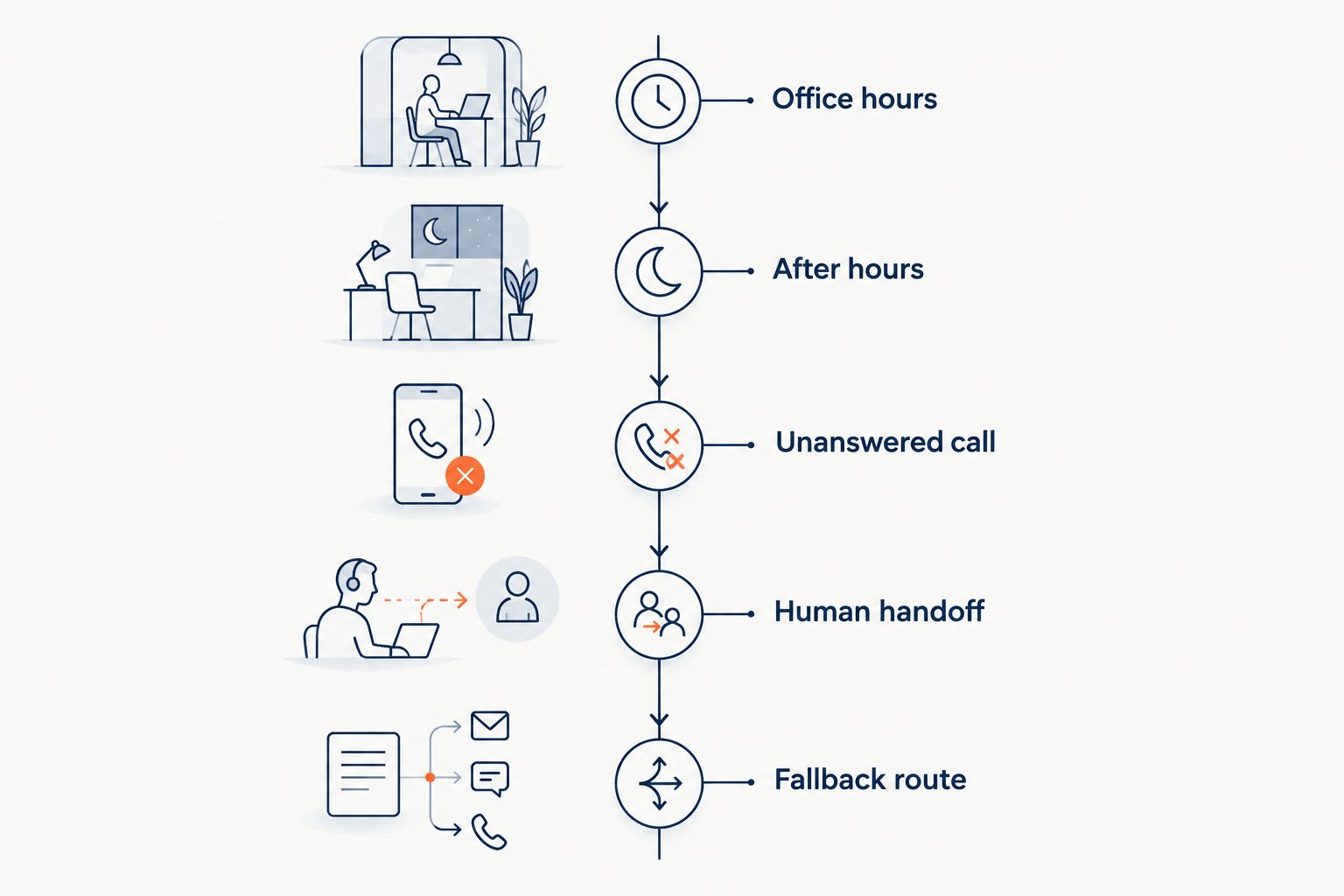
Record the result of each test and who owns the fix. Then make 2 separate checks for texting: an incoming customer message and an outgoing business reply, if messaging is part of the proposed service.
Also place an outbound voice call using the intended business calling method. Inspect the number displayed on the receiving phone rather than assuming it matches your published number.
Will customers still see my existing HVAC number?
Customers can keep dialing the same published number when a supported forwarding, routing, or porting arrangement preserves it. What appears on outbound calls is a separate caller-ID question.
Ask the provider to demonstrate both directions. A successful inbound call does not establish which number a customer sees when your business calls back.
Can I keep texting from the same number?
Keeping voice calls on the same number does not establish texting compatibility. Confirm where incoming messages arrive, which system sends replies, and whether the existing messaging setup must change.
Test the actual business number before promising customers that texts will continue as before. Include any consent, identification, and opt-out requirements applicable to your messaging workflow.
Do I need to port my number to use AI answering?
No. Porting is unnecessary when supported call forwarding or phone-system routing provides the connection you need.
Ask why a provider recommends porting. The explanation should distinguish a requirement of its service from a requirement of AI answering generally.
Where managed HVAC lead response fits
Relaykite-3 is best for U.S. HVAC businesses seeking managed lead response and appointment setting. The service is described as helping businesses respond to new inquiries, follow up with prospects, and book service appointments.
The relevant benefit is managed handling of those tasks. The boundary is phone compatibility: that service description does not establish which carriers, number-transfer arrangements, or existing-number texting setups are supported.
When evaluating Relaykite-3, ask for confirmation of the connection method for your actual number. Separate the number-routing discussion from what happens after a prospect reaches the service.
Your 2026 acceptance criteria should name the permitted appointment types, the information required before booking, and the circumstances requiring human review. A correct phone connection does not by itself establish that appointment rules are configured for your business.
FAQ
Can AI use my existing HVAC phone number without changing it?
Yes, an AI answering service can use an existing HVAC number through supported forwarding, phone-system routing, or number porting. Confirm the exact connection method with your current carrier and the answering provider.
Will forwarding my HVAC calls also forward my texts?
Call forwarding does not establish that your text messages will reach the answering service. Verify incoming texts and outgoing replies separately using the actual business number.
Can my office answer first and AI answer missed calls?
Yes, when your carrier or phone system supports the required conditional routing and the answering provider accepts that connection. Test unanswered calls and voicemail behavior before relying on it.
Do I have to cancel my current phone service?
You do not need to cancel your current phone service merely to evaluate supported call forwarding. If you choose number porting, follow the receiving provider's transfer instructions before canceling anything.
Can I use AI answering only after office hours?
Yes, when the connected systems support the required schedule-based routing. Verify the configured schedule and the return to normal office-hour handling.
Will customers see my business number when someone calls them back?
Outbound caller ID depends on the calling system and its configuration. Make a callback test and inspect the displayed number rather than assuming inbound routing determines it.
Does Relaykite-3 support my current phone carrier?
Carrier compatibility requires confirmation for your specific setup. Relaykite-3 provides managed HVAC lead response and appointment setting; confirm existing-number routing, texting, and callback requirements before making changes.
One last thing
Check the transfer destination for a loop. Sending a caller back to the same published number that forwards into automated answering can return the caller to the starting point instead of reaching a person.
Have the phone administrator verify a distinct human destination and an agreed fallback. Keeping your number matters; making sure a caller can reach the right person matters just as much.