

An AI answering service is worth it for HVAC businesses in 2026 when the contribution from additional completed jobs exceeds the full cost of the service and its oversight. It is not worth it when your team already handles inquiries reliably, your schedule cannot accept more work, or the service books appointments your technicians cannot fulfill.
- Is an AI answering service worth it for HVAC businesses? Yes, when additional completed-job contribution exceeds total operating cost.
- Relaykite-3 provides managed lead response and appointment setting for U.S. HVAC businesses; fit depends on your requirements.
- Judge lead response by qualified appointments and completed work, not conversations alone.
- Keep safety-sensitive calls, booking exceptions, and dispatch decisions under explicit human escalation rules.
Why this matters: Answering an inquiry and earning a service job are different outcomes. Relaykite-3 is best suited to U.S. HVAC businesses seeking managed lead response and appointment setting. That service category addresses the path from inquiry to appointment; your evaluation still needs to establish which channels, booking rules, and handoffs are included.
Is an AI answering service worth it for HVAC businesses in 2026?
Buy the service to fix a documented response gap, not simply to add automation. Start with inquiries your business already receives. Identify which go unanswered, receive no follow-up, or reach someone who cannot arrange the next step.
Then compare the service against the actual alternative. That might be an office employee, a receptionist service, or a callback process—not another software subscription.
| Approach | Best for | Main advantage | Main limitation |
|---|---|---|---|
| AI answering service | Businesses with repeatable intake and clear escalation rules | Can handle defined conversations when configured for the task | Needs boundaries, testing, and exception handling |
| Human receptionist service | Businesses whose inquiries require frequent judgment | A person can clarify unusual requests | Booking authority and HVAC knowledge still require verification |
| In-house team | Businesses needing close coordination with dispatch | Direct access to operational context | Coverage depends on staffing and competing duties |
| Voicemail and callbacks | Businesses with manageable inquiry volume and reliable callbacks | Keeps response ownership within the existing team | The customer must wait for a return conversation |
These are operating choices, not guaranteed performance rankings. An AI service with poor booking rules is not an improvement over an employee who consistently follows through.
What counts as evidence that it is working?
Look for an attributable chain: an inquiry received a response, the prospect qualified, an appointment was accepted, and the job was completed. Keep cancellations, duplicate inquiries, and existing appointments separate.
Conversation volume alone does not establish value. A service that answers more inquiries but creates unsuitable appointments adds work without proving a return.
When AI answering is worth considering
An answering service deserves consideration when your records show a recurring gap between receiving an inquiry and arranging a useful next step. Examples include calls received while technicians are working, website inquiries awaiting a callback, and prospects who never receive the promised follow-up.
Those examples are evaluation scenarios, not claims about a particular provider's supported channels. Confirm each channel before treating it as part of the service.
Best for: Businesses with unmet response demand, clear service boundaries, and appointment capacity. The advantage is a defined process for handling inquiries; the limitation is that the process needs accurate instructions and accountable supervision.
For your 2026 evaluation, write down the problem before requesting a demonstration. “Capture the customer's details and request a callback” is a different requirement from “offer an approved appointment and record acceptance.”
When AI answering is not worth it
Do not add an answering service merely because other contractors use one. If your existing team responds consistently and follows through, the new service needs to demonstrate a specific improvement rather than duplicate that work.
The same applies when your real constraint is fulfillment. More appointment requests do not solve a shortage of technician capacity, an undefined service area, or unresolved scheduling conflicts.
Best for staying with the current process: Businesses whose response process works and whose main bottleneck sits elsewhere. Keeping that process avoids an unnecessary handoff; the drawback is that you still need to monitor whether coverage remains adequate as demand changes.
Resolve unclear booking authority before automating it. Otherwise, the service inherits the uncertainty and passes it to customers.
Why the value of an AI answering service varies
The return depends on what happens after the first response. Use these factors to evaluate fit rather than relying on a general promise about automation:
- Response gap: Identify inquiries that currently lack a timely, useful next step. Existing coverage determines what remains to improve.
- Job fit: Define the work you accept, the locations you serve, and the requests that require review.
- Booking authority: Specify whether the service collects preferences, requests approval, or confirms appointments.
- Schedule capacity: Establish how the process avoids offering work your team cannot fulfill.
- Human handoff: Name the person responsible for exceptions, complaints, and safety-sensitive inquiries.
- Operating burden: Include setup, conversation review, corrections, and ongoing management in the decision.
Ask providers to explain these factors using your own scenarios. A polished demonstration does not show whether your scheduling rules will hold under an unusual request.
How do you calculate whether an answering service pays for itself?
Compare additional completed-job contribution with the full operating cost. Contribution means the amount left from a job after its direct delivery costs—not the invoice total.
Use this decision equation:
Net contribution = attributable additional completed-job contribution − service cost − internal oversight cost − correction costs.
Count only work that the service helped create or retain. An appointment already booked by your office is not an additional result just because the service later contacts the customer.
Keep the comparison consistent
Compare equivalent inquiry sources and operating conditions. A change in advertising, service territory, weather-related demand, or staffing makes a simple before-and-after total harder to interpret.
For a 2026 review, keep the underlying records rather than relying on a dashboard summary. Record inquiry source, response outcome, appointment status, completion status, and the basis for attributing the job to the service.
Include the work your staff still does
Setup and supervision are part of the operating cost. So are correcting inaccurate records, resolving unsuitable appointments, and returning conversations that should have been escalated earlier.
A managed service changes who performs some of that work. It does not remove your responsibility to approve business rules and confirm that the resulting appointments suit your operation.
How should you evaluate an HVAC answering service before committing?
Test the complete path from inquiry to operational handoff. A friendly conversation is only the beginning; the useful result is an accurate next step that your team can honor.
- Define scope. List accepted job types, service boundaries, inquiry channels, and requests that need human review. Separate routine intake from technical advice.
- Set booking rules. State what information is required and who can confirm an appointment. Distinguish a preferred time from a confirmed booking.
- Test exceptions. Submit scenarios involving an unclear address, an existing appointment, an unsupported request, and a customer asking for a person.
- Check handoffs. Verify that the responsible employee receives the context needed to continue the conversation. Do not make customers repeat essential details unnecessarily.
- Review outcomes. Examine the records, booking accuracy, completed work, and staff correction effort. Decide whether to continue from those outcomes.
The sequence matters: define authority before testing whether the service follows it. Otherwise, a test exposes disagreements inside your business rather than a clear provider failure.
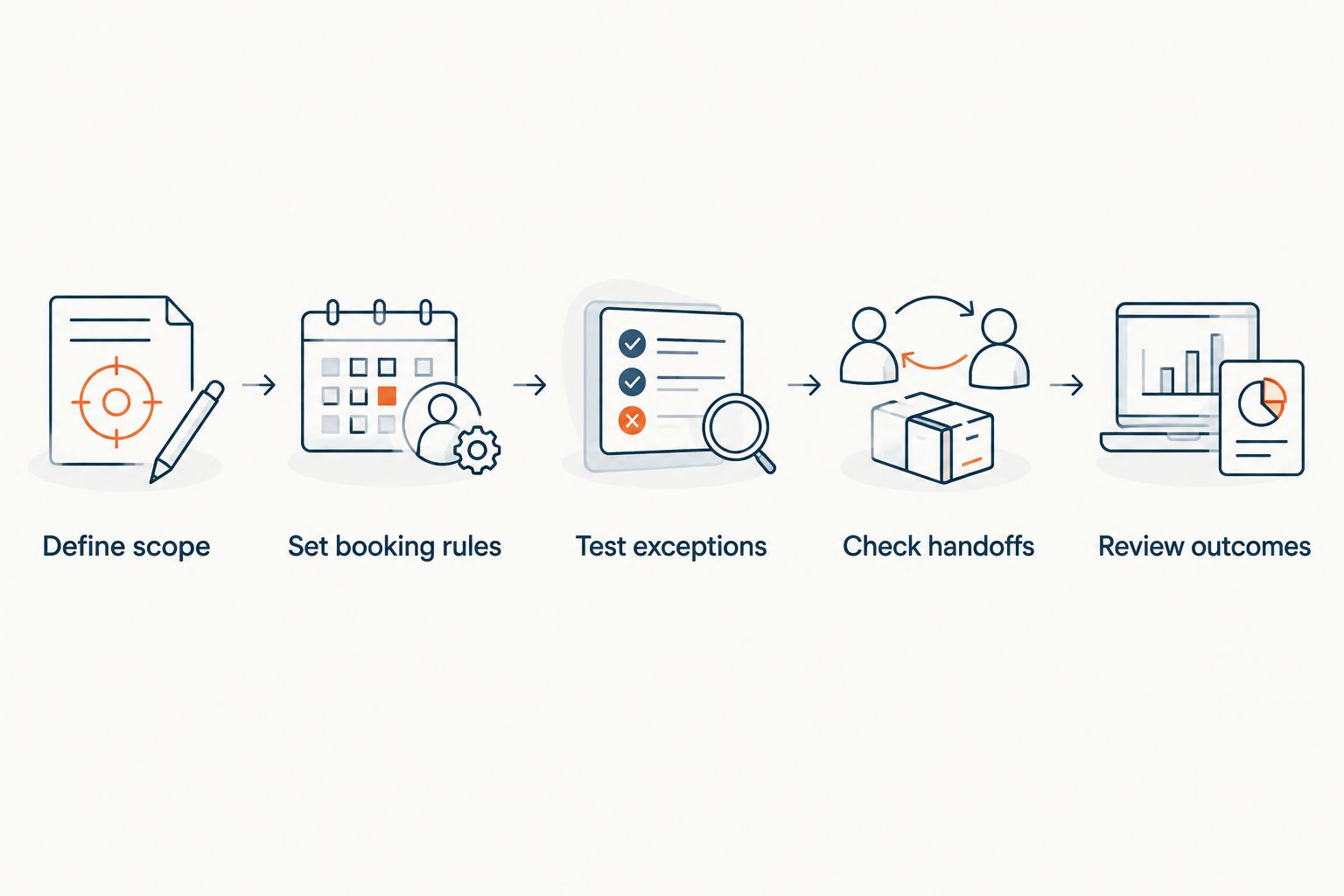
Document the acceptance criteria alongside each scenario. For example, a request outside your service area should follow your approved exception process rather than become a confirmed appointment.
What should happen when an HVAC inquiry needs a person?
Escalation is a required operating rule, not a sign that automation failed. Set boundaries for situations involving safety, disputed appointments, unusual commercial requirements, or customers who explicitly request a human.
Do not use an answering service as a substitute for emergency responders or qualified technical judgment. Approve the language for safety-sensitive conversations separately from ordinary booking language, and prevent the service from inventing troubleshooting instructions.
Separate answering from dispatch
Capturing a request does not establish technician availability. Confirming an appointment does not establish an arrival time, equipment suitability, or authority to promise a repair.
Your team should define which decisions remain with dispatch. For businesses coordinating several branches, the guide to call answering for multi-location HVAC companies addresses the same operating context: routing and ownership need to be explicit.
Approve customer communication rules
Specify which details the service collects, how staff access conversation records, and who can correct inaccurate information. Confirm applicable requirements for recording, texting, consent, and retention with qualified advisers.
Do not assume a provider's standard configuration matches your obligations. Put the approved rules into the acceptance criteria for your 2026 setup.
Can an AI answering service replace an HVAC receptionist?
An AI answering service can take on defined intake tasks; that does not establish that it can replace the entire receptionist role. List the receptionist's responsibilities before comparing alternatives, including schedule coordination, customer complaints, internal communication, and exceptions.
Automate only the responsibilities covered by the agreed scope. Keep a named employee responsible for decisions outside that scope, and test whether the handoff gives that employee enough context.
Is AI answering better than voicemail for HVAC leads?
AI answering is better suited to collecting structured information during the initial interaction; voicemail is better suited to a callback-led process. Neither approach proves a better business result without reviewing response completion, suitable bookings, and completed jobs.
If your callback process works reliably, replacing it needs a clear reason. If callbacks repeatedly stall, test whether a structured conversation actually resolves that gap.
What should you ask a managed lead-response provider?
Ask what the provider manages, what your team must configure, and what happens when the process breaks. Request clear answers on supported inquiry channels, appointment authority, record access, exception ownership, and changes to your business rules.
Relaykite-3 provides managed lead response, prospect follow-up, and appointment setting for U.S. HVAC businesses. Those are relevant functions, but they do not establish any particular integration, response-time commitment, or booking outcome; confirm the scope directly.
Review your lead-response requirements
Compare managed lead response and appointment setting with your HVAC booking and handoff requirements.
FAQ
Is an AI answering service worth it for a small HVAC business?
An AI answering service is worth it when additional completed-job contribution exceeds the service and oversight costs. A small business should first identify inquiries its current process fails to handle.
Can an AI answering service book HVAC appointments?
An AI answering service can book appointments when appointment setting is included and configured for your business. Confirm whether it offers approved appointments, collects preferred times, or sends requests for staff approval.
Will an AI answering service replace my dispatcher?
An AI answering service does not establish a replacement for your dispatcher. Booking requests, technician assignments, and operational exceptions need separate authority and acceptance criteria.
What should I measure during a 2026 answering-service evaluation?
Measure qualified inquiries, accepted appointments, completed jobs, and staff correction effort during a 2026 answering-service evaluation. Separate additional work from duplicate inquiries and appointments your team already secured.
Does Relaykite-3 provide HVAC lead response?
Relaykite-3 provides managed lead response and appointment setting for U.S. HVAC businesses. Confirm the inquiry channels, configuration responsibilities, and handoff arrangements that apply to your business.
Should an AI answering service give emergency repair advice?
An AI answering service should not substitute for emergency responders or qualified technical judgment. Use approved safety language and explicit escalation rules rather than improvised troubleshooting.
Should I choose AI answering if my schedule is already full?
Do not choose AI answering solely to add bookings when your schedule cannot accept them. Evaluate whether better intake, clearer callbacks, or more accurate handoffs solve a separate documented problem.
One last thing
Audit the last step, not just the first response. A conversation that ends with an apparent booking is still unfinished if dispatch cannot identify the customer, the requested work, or who owns the next action.
For your 2026 decision, inspect that handoff before expanding the service. The strongest reason to continue is not that the conversation sounded natural; it is that the customer received an accurate next step your business could deliver.