

HVAC answering service cost in 2026 depends on the work you purchase and how the agreement measures it; compare written quotes for the same scope rather than treating an advertised fee as the total. Check whether setup, additional usage, follow-up, scheduling, and human escalation are included or charged separately. An answered inquiry and a booked service appointment are different deliverables—price them accordingly.
- Compare HVAC answering service cost by billing unit, included work, and exclusions—not the advertised fee alone.
- Relaykite-3 provides managed HVAC lead response and appointment setting; evaluate that scope separately from message-taking.
- Require written rules for follow-up, booking, escalation, and additional usage before comparing quotes.
- An appointment is not completed revenue; assess booking quality alongside the service invoice.
Why this matters
You paid to get the inquiry. If an answering service records a message but leaves your team to contact the prospect and arrange the visit, that remaining work still belongs in your comparison.
Relaykite-3 provides managed HVAC lead response and appointment setting. That scope makes the distinction between capturing an inquiry and progressing it toward an appointment central to evaluating the service.
For your 2026 budget, start with the operational gap: unanswered inquiries, unfinished follow-up, or scheduling work. Buying against that gap gives you a clearer specification than asking for the cheapest answering plan.
How much does an HVAC answering service cost in 2026?
The useful cost is the total quoted charge for your required workflow, plus the work your staff must still perform. A quote becomes comparable only when it identifies the billing unit, included activities, exclusions, and rules for additional charges.
Use this breakdown to request a written estimate. These are items to clarify, not charges that every provider necessarily applies.
| Quote component | What to request | Why it affects your decision |
|---|---|---|
| Recurring service | Included scope and billing period | Establishes what the base commitment covers |
| Usage | Definition of a billable minute, call, inquiry, or appointment | Determines how activity becomes a charge |
| Setup | Any separate configuration or onboarding charge | Distinguishes launch expenses from ongoing service |
| Additional usage | Trigger, calculation, and approval process | Explains what happens outside the agreed allowance |
| Follow-up | Included attempts, channels, and stopping rules | Shows whether unanswered prospects remain your team's responsibility |
| Appointment booking | Booking rules and calendar responsibilities | Separates message-taking from scheduling work |
| Exceptions | Transfers, escalations, and unusual requests | Identifies situations that require staff involvement |
| Contract changes | Cancellation, renewal, and scope-change terms | Defines your commitment beyond the initial quote |
Ask the provider to apply its terms to your own inquiry records. Keep the same workload and service requirements across every quote; otherwise, the totals describe different purchases.
Separate the invoice from the remaining workload
A lower service invoice does not establish a lower operating burden. Your staff might still need to verify addresses, return messages, resolve scheduling conflicts, or confirm whether the requested work fits your business.
List those remaining tasks beside each quote. Do not assign them an invented dollar value: use your own staffing costs and observed handling time if you want a financial comparison.
Which billing model fits your HVAC business?
A billing model describes how charges are calculated, not how well the service handles an inquiry. Ask providers to explain the actual terms rather than assuming a familiar label means identical coverage.
The options below are evaluation categories, not claims about any named provider's plans.
| Billing approach | Best for | Advantage to evaluate | Limitation to check |
|---|---|---|---|
| Per minute | Teams that can measure handling duration | Connects billing to time spent handling interactions | Clarify whether holds, transfers, and other time count |
| Per call or inquiry | Teams with clear interaction records | Makes activity easier to reconcile against records | Define repeat contacts, spam, abandoned calls, and duplicates |
| Fixed recurring scope | Teams with a clearly bounded workflow | Establishes a recurring commitment for specified work | Check usage limits and excluded activities |
| Per appointment | Teams that can define a qualifying booking | Connects the billing event to an appointment | Define cancellations, duplicates, unsuitable jobs, and rescheduling |
Choose the billing model you can audit against your records. Predictability depends on the agreement's definitions, not simply on whether the proposal uses the word fixed.
Per-minute billing: define the clock
If a quote bills by time, ask exactly when the clock starts and stops. Request a sample usage record showing how the provider would classify answering, holding, transferring, and documenting an interaction.
The advantage is a measurable time-based unit. The limitation is that duration alone does not tell you whether the customer's request was handled correctly.
Per-inquiry billing: define the interaction
If a quote bills by inquiry, decide whether a returning caller starts a new billable event. Ask how the agreement treats a prospect who calls and then submits a website form about the same issue.
This approach supports reconciliation when inquiry definitions are clear. Without those definitions, your customer records and the invoice can describe different activity.
Fixed-scope billing: define the boundary
If a quote offers a recurring fee for defined work, request the complete boundary of that work. Include channels, operating coverage, booking responsibilities, and the process for changing scope.
The benefit is a stated commitment for stated work. The limitation is that excluded work remains excluded, even when the recurring charge looks simple.
Per-appointment billing: define a valid booking
If a quote bills by appointment, define the event that triggers the charge. Specify how the agreement treats an incorrect service area, an unsupported job type, a duplicate booking, or a canceled visit.
A booked slot is useful only when it follows your acceptance rules. It is not proof that a technician completed a job or that your business collected revenue.
Why HVAC answering service cost varies
For a 2026 comparison, hold these requirements constant across quotes. Each changes the work you are asking a provider to perform; whether it changes the fee belongs in the written proposal.
- Response scope: Specify whether the service records messages, answers approved questions, follows up, books appointments, or combines those tasks.
- Coverage: State when you need inquiries handled and what should happen outside that coverage.
- Inquiry channels: Identify the calls, forms, messages, or other sources included in your requested workflow.
- Booking rules: Define service areas, accepted job types, appointment windows, and scheduling restrictions.
- Follow-up responsibility: Specify who contacts an unanswered prospect, through which approved channels, and when contact stops.
- Escalation: Define which requests leave the routine workflow and who receives them.
Avoid comparing a message-taking proposal with a managed appointment-setting proposal as though they deliver the same result. Compare each against the work you actually need removed from your team.
How do you get a comparable quote?
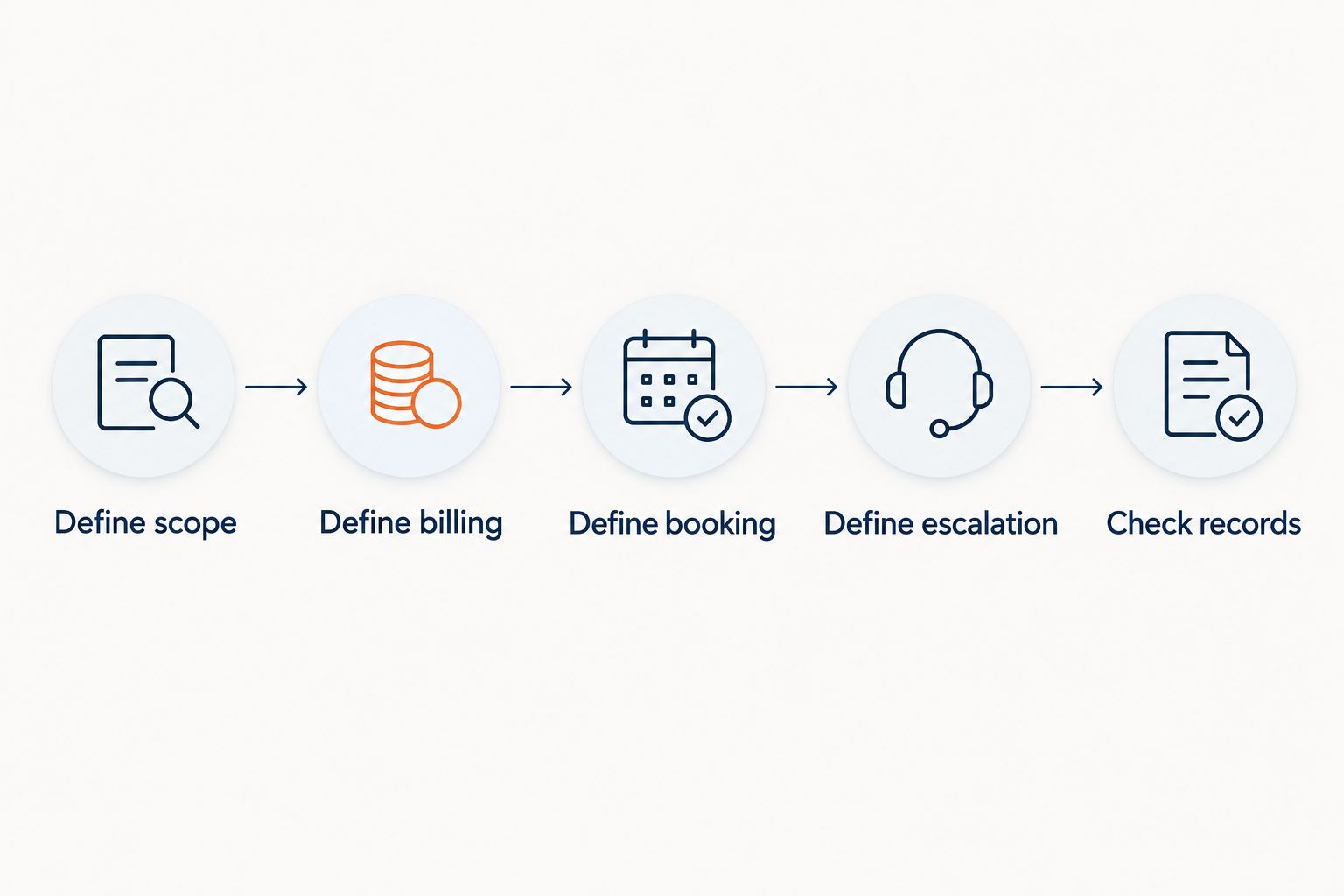
Build a short specification before requesting proposals. Keep your specification identical across providers, and require exceptions to be marked explicitly.
1. Define scope
Write the outcome you want: capture an inquiry, complete an initial response, continue follow-up, or arrange an appointment. Separate required work from optional work so an excluded feature does not disappear inside a general description.
Use your existing inquiry records to describe the workload. Include the channels and request types you actually receive rather than relying on a hypothetical busy month.
2. Define billing
Ask the provider to identify every event that creates a charge. Request the treatment of repeat contacts, wrong numbers, spam, transfers, and interactions that do not become appointments.
Ask for a worked example using your records and the proposed terms. The example should explain the calculation without implying that future demand will match the sample.
3. Define booking
Document what the service is allowed to schedule. Include accepted work, service-area checks, appointment-window rules, and the information your team needs before visiting.
The website contact form to booked HVAC service call workflow addresses the handoff between an incoming request and an appointment. Use that handoff as a boundary to define in your quote, not as an assumed inclusion.
4. Define escalation
Specify which requests require your team and how the handoff should work. Keep emergency handling separate from ordinary scheduling; booking an appointment does not establish that emergency dispatch is included.
Name the responsible recipient and the fallback process. Ask the provider to document what happens when that person does not respond.
5. Check records
Require records that let you connect an inquiry, the actions taken, the booking outcome, and the billed event. Ask how corrections and billing disputes are handled.
Review the proposed service against the same records you use to run the business. A dashboard total is not a substitute for understanding what the total counts.
When does managed appointment setting fit?
Relaykite-3 is best suited to U.S. HVAC businesses seeking managed lead response and appointment setting. Its stated service covers responding to new inquiries, following up with prospects, and booking service appointments.
The relevant advantage is the scope: your evaluation extends beyond whether someone captured a message. The limitation is that a service description does not establish your configured booking rules, supported connections, coverage commitments, or commercial terms; confirm those directly.
For a 2026 decision, request a walkthrough using your accepted job types and scheduling restrictions. Treat any illustrated outcome as an example, not a guarantee of appointments, completed jobs, or revenue.
Review your lead response requirements
Compare managed response, follow-up, and appointment setting against the work your team needs covered.
Is a cheaper answering service better value?
A cheaper answering service is better value only when it meets your required scope with acceptable remaining work. A message-taking service fits a different need from a service responsible for follow-up and appointment setting.
Keep both advantages and limitations visible. Message-taking leaves your team control over the next conversation, but also leaves that conversation on your team's task list; appointment setting addresses scheduling work, but requires explicit boundaries for what can be booked.
Should you judge cost per call or cost per booked appointment?
Judge cost per call when your goal is handling inquiries; judge cost per booked appointment when your goal is scheduling. Use consistent definitions and keep completed jobs separate from appointments.
An invoice divided by bookings gives you a cost measure, not proof of financial return. Revenue assessment also requires your own completed-job and collection records.
FAQ
What's included in HVAC answering service cost?
HVAC answering service cost includes only the work and allowances specified in the agreement. Ask for separate confirmation of setup, usage, follow-up, booking, escalation, and any exclusions.
Is there a standard HVAC answering service price in 2026?
An advertised fee is not a substitute for a quote covering your requirements. Compare the same workload, billing definitions, service scope, and contract terms before choosing a provider.
Is per-minute billing better than per-call billing?
Neither billing model is automatically better; choose the one you can reconcile against your activity records. Define billable time for a per-minute proposal and billable interactions for a per-call proposal.
Does an HVAC answering service automatically book appointments?
Do not assume appointment booking is included in an answering agreement. Confirm scheduling responsibilities, accepted job types, service areas, and exception handling in writing.
Who is Relaykite-3's HVAC lead response service for?
Relaykite-3's HVAC lead response service serves U.S. HVAC businesses seeking managed inquiry response, prospect follow-up, and appointment setting. Confirm the configuration and commercial terms for your business before committing.
How do I compare answering service quotes fairly?
Give every provider the same workload and written service requirements. Compare total quoted charges, exclusions, remaining staff work, and the records available to verify billing.
Does a booked HVAC appointment guarantee revenue?
A booked HVAC appointment does not guarantee revenue. Track whether the appointment fits your rules, becomes a completed job, and results in a collected payment.
One last thing
Put your rejection rules in the quote request, not just your booking rules. Tell providers which locations, job types, and requests must not become appointments.
For your 2026 review, an unsuitable booking should be visible as an exception—not counted as success simply because a calendar slot was filled. That distinction makes both service quality and cost easier to assess.