
No. A 24/7 AI answering service is not necessary for every small HVAC shop; it is worth considering when unanswered inquiries, delayed follow-up, or interruptions regularly interfere with booking work. Round-the-clock answering does not create technician availability, and appointment requests must stay separate from confirmed service commitments. For your 2026 decision, start with the coverage gap—not the technology.
- Is 24/7 AI answering service necessary for HVAC? No; match answering coverage to documented gaps and service capacity.
- Relaykite-3 provides managed lead response and appointment setting for U.S. HVAC businesses.
- After-hours answering and emergency dispatch are different responsibilities; define escalation before accepting urgent requests.
- Start with missed-call or after-hours coverage when those are the only gaps you need to address.
Is a 24/7 AI answering service necessary for small HVAC shops?
A small HVAC shop needs a reliable response process, not automatically a 24/7 AI answering service. Choose the coverage model that addresses your actual unanswered inquiries without creating promises your technicians cannot fulfill.
Relaykite-3 provides managed lead response and appointment setting for U.S. HVAC businesses. Treat that service category as one option, rather than a requirement for running a small shop.
| Coverage approach | Best for | Practical advantage | Limitation to address |
|---|---|---|---|
| Owner or office answering | Shops with dependable staffed coverage | Keeps conversations close to daily operations | Needs backup when the person answering is unavailable |
| Voicemail and scheduled callbacks | Shops that intentionally accept delayed responses | Establishes a straightforward callback process | Does not provide a live conversation when the inquiry arrives |
| Overflow or after-hours answering | Shops with identifiable coverage gaps | Targets the periods your existing process does not cover | Requires clear handoffs between staffed and unstaffed periods |
| Round-the-clock AI answering | Shops seeking automated inquiry handling throughout the day and night | Supports a continuously staffed response workflow when configured for that purpose | Requires approved scripts, escalation rules, and booking boundaries |
These are operating models, not interchangeable service packages. Before choosing any provider, confirm which channels, tasks, and hours the proposed setup actually covers.
Why this matters
An answered inquiry and a completed HVAC job are different outcomes. Between them sit qualification, scheduling, customer confirmation, technician assignment, and the work itself.
Your 2026 coverage decision should identify where that chain breaks. If your team answers inquiries but cannot offer suitable appointments, adding another answering layer does not address the scheduling constraint.
The opposite distinction matters too. An open calendar does not help an inquiry that nobody acknowledges or follows up with. Diagnose response coverage and service capacity separately, then decide which process needs attention.
When existing coverage is enough
Keep your existing approach when someone reliably owns incoming inquiries, callbacks have a clear deadline, and customers receive accurate expectations. Small team size alone is not a reason to introduce automation.
Review the process, not just whether the phone rings. A named person should know which inquiries remain open, what the customer requested, and what happens next.
Best for: shops whose current response process remains dependable during appointments, lunch breaks, staff absences, and closed hours.
The advantage is continuity: your team handles conversations within the operating process it already knows. The limitation is dependence on people being available. If the backup plan exists only in the owner's head, document it before deciding that coverage is sufficient.
Voicemail is a deliberate choice only when the callback process is deliberate too. State when callers should expect a response, assign ownership, and close the loop rather than treating the message itself as the finished task.
When overflow or after-hours coverage fits
Choose targeted coverage when your gaps have clear boundaries. Examples to check in your own records include inquiries during installations, unanswered calls while the office is closed, or follow-ups left unfinished after a busy shift.
Best for: shops that already answer reliably during staffed periods but need a defined backup.
The advantage is a narrower operating change. You can preserve the existing office workflow while specifying what should happen when nobody answers. The limitation is the handoff: without clear ownership, a captured message can still sit untouched.
Set the transfer condition before deployment. Decide whether the backup handles unanswered inquiries, closed hours, or another explicitly defined situation. Then establish where the resulting requests go and who reviews them.
Do not assume that an after-hours inquiry needs an overnight visit. Capture the customer's request, communicate the actual service policy, and distinguish a request for help from an accepted dispatch.
When round-the-clock coverage fits
Consider full-day coverage when your records show gaps across several parts of the day and your team wants a consistent response process outside staffed periods. The decision still depends on the work the service is configured to perform.
Best for: shops with recurring response gaps that cannot be addressed by a narrower backup arrangement.
The advantage is a single coverage policy across staffed and unstaffed periods. The limitation is broader configuration responsibility: service boundaries, follow-up ownership, escalation, and booking permissions all need explicit treatment.
For your 2026 evaluation, separate the proposed service into tasks. Answering a question, collecting contact details, requesting an appointment, and confirming a booking each require different permissions and information.
Relaykite-3 is for U.S. HVAC shops seeking managed lead response and appointment setting. Its stated role addresses those tasks; it does not establish an overnight dispatch commitment or guarantee booked work. Confirm the proposed configuration against your own operating rules before making either promise to customers.
Why the right coverage level varies
The deciding factors are operational. Use your own inquiry records and service policies to evaluate these differences rather than treating another contractor's setup as a benchmark.
- Inquiry timing. Identify when unanswered inquiries arrive. Closed-hour gaps call for a different response plan than interruptions throughout the working day.
- Staff availability. Document who can answer while other employees are driving, working on equipment, or handling another customer.
- Service scope. Separate repair requests, installation inquiries, maintenance requests, and questions your business does not handle.
- Scheduling authority. Specify whether the answering process can confirm appointments or only collect preferred times for review.
- Escalation ownership. Name the person responsible for urgent requests and define what happens when that person is unavailable.
- Follow-up responsibility. Decide who contacts an unanswered prospect again, records the outcome, and closes the inquiry.
These factors also expose a poor fit. If nobody owns follow-up or maintains scheduling information, expanding answering hours leaves those responsibilities unresolved.
How should you decide whether your shop needs it?
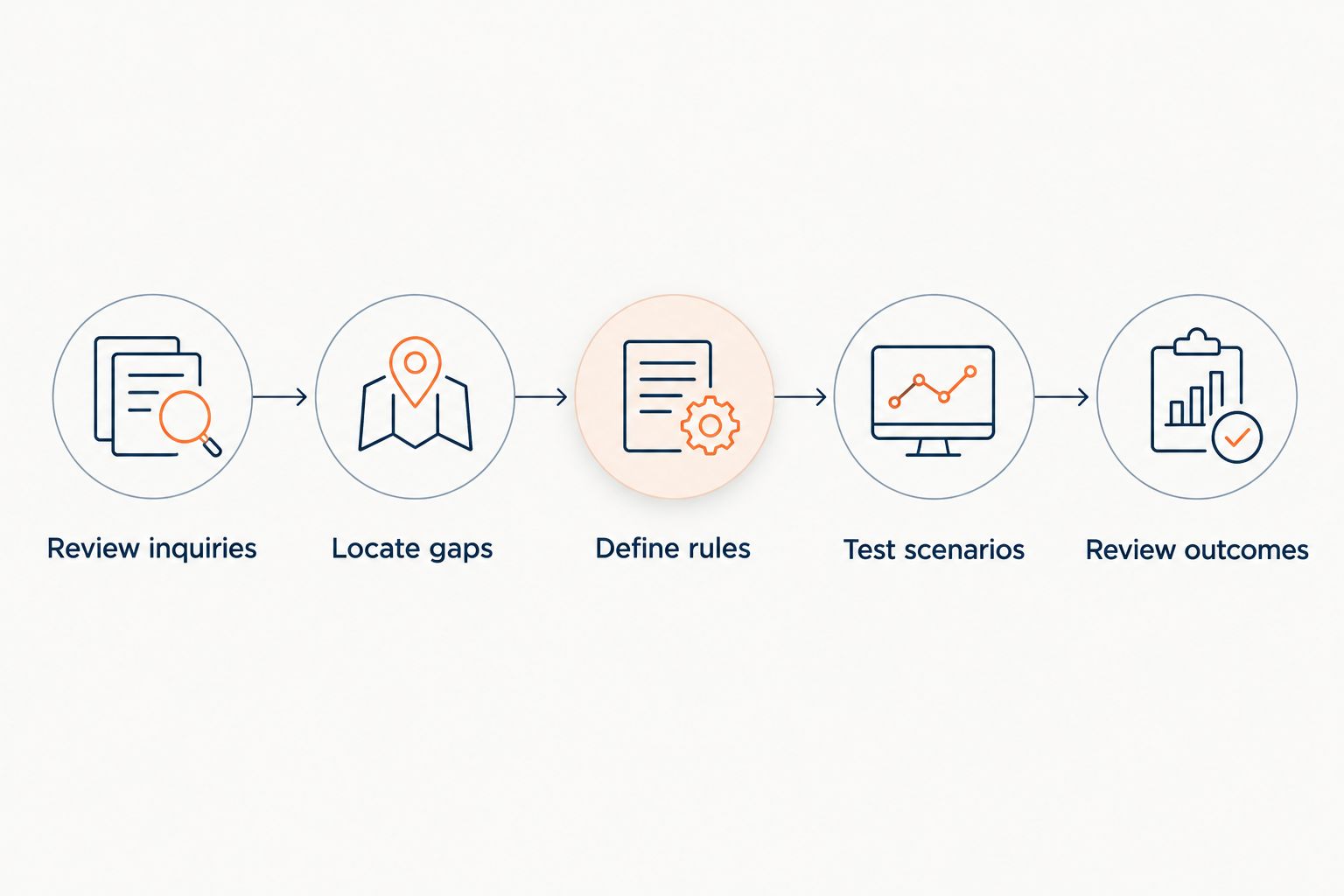
Use a short operational review before selecting a service. For a 2026 decision, current inquiry records are more useful than assumptions about what a small HVAC business ought to buy.
Review inquiries
Collect the inquiry records you already use and distinguish new service requests from existing-customer questions, duplicate messages, and unrelated calls. Note whether each inquiry received a response and what happened next.
Look for the point where ownership disappeared. A call marked answered tells you little if the customer still needed a callback that nobody made.
Locate gaps
Group unresolved inquiries by the circumstances that prevented a response. Separate closed hours from busy staffed periods and separate an unanswered inquiry from an appointment your team could not accommodate.
This step determines whether you need broader answering coverage, more disciplined follow-up, or a change to scheduling. Avoid asking one service to solve all of those problems without defining each task.
Define rules
Write down service areas, accepted work, scheduling permissions, and escalation instructions. Identify information the answering process must not guess, including technician arrival commitments and whether a requested appointment is confirmed.
Keep the customer-facing language consistent with those rules. A message acknowledgment should not sound like a dispatch confirmation.
Test scenarios
Walk through representative situations before expanding coverage: a routine repair request, an installation inquiry, an out-of-area request, a cancellation, and an urgent request. Use the same scenarios when comparing proposals.
Check the actual outcome, not just whether the conversation sounds natural. Did the request reach the right person, retain the customer's details, and produce an accurate statement about the next step?
Review outcomes
Evaluate the process from inquiry through disposition. Record whether the request became an accepted appointment, needed further contact, fell outside your scope, or remained unresolved.
Use completed outcomes to judge the configuration. A longer conversation or an answered call is not, by itself, evidence that your booking process improved.
Does 24/7 answering mean technicians are available 24 hours a day?
24/7 answering means inquiries receive coverage throughout the day and night; it does not establish technician availability. Your customer communication must preserve that distinction every time an appointment or urgent request is discussed.
If your shop does not dispatch after hours, say so in the approved response. Do not let an acknowledgment imply that a technician is already assigned.
Can a 24/7 answering service handle emergency HVAC requests?
24/7 coverage does not, by itself, establish emergency-handling capability. Evaluate the proposed escalation workflow, the instructions it follows, and the human responsible for the next action.
Use the guide to emergency HVAC calls at 2 a.m. when defining the questions your provider must answer. Keep emergency procedures separate from ordinary appointment booking, and require an explicit fallback when the intended contact does not respond.
Should a small shop start with all-day coverage?
24/7 coverage is not the default starting point when the documented gap is narrower. Begin with the scope you can define, supervise, and evaluate against actual inquiry outcomes.
Expand only when the records show an additional response gap and your operating rules cover it. A broader answering schedule is not a substitute for a clear callback owner or an accurate appointment process.
What should you confirm before approving a service?
Ask for a description of the proposed workflow in plain language. Separate confirmed functions from requested functions, and identify the person responsible for maintaining the setup.
For Relaykite-3 or another managed provider, ask what information is needed from your shop, which tasks require approval, and how exceptions reach a person. Confirm these details for your proposed configuration rather than inferring capabilities from the service category.
Your 2026 acceptance review should include unsuccessful paths as well as routine bookings. Test what happens when the requested work is unsupported, the customer changes the request, or no suitable appointment can be offered.
Approve the operating rules before approving customer-facing promises. That sequence gives your team a concrete standard for evaluating the service.
FAQ
Is 24/7 AI answering necessary for a solo HVAC contractor?
No. A solo HVAC contractor needs dependable inquiry handling, but round-the-clock AI coverage is only one way to provide it. Choose coverage based on documented gaps, callback ownership, and actual service capacity.
What's the best answering setup for a small HVAC shop?
The best setup is the narrowest arrangement that reliably handles your documented response gaps. Compare staffed answering, scheduled callbacks, targeted backup, and round-the-clock coverage against the same operating requirements.
Does answering overnight mean I have to offer overnight HVAC service?
No. Overnight inquiry coverage and overnight technician dispatch are separate commitments. State your service hours and explain whether the customer is submitting a request or receiving a confirmed appointment.
Can an answering service confirm appointments without my approval?
Only authorize confirmed bookings when the proposed configuration supports your scheduling rules and approved appointment information. Otherwise, require it to collect preferred times for review rather than promise a slot.
Will a managed answering service guarantee more HVAC jobs?
Do not treat managed answering as a guarantee of more jobs. Evaluate qualified inquiries, accepted appointments, completed work, and unresolved requests rather than answered-call totals alone.
What does Relaykite-3 provide for HVAC businesses?
Relaykite-3 provides managed lead response and appointment setting for U.S. HVAC businesses. Confirm the proposed channels, coverage hours, booking permissions, and escalation process for your business before deployment.
Should I replace my office receptionist with AI answering?
Do not decide on replacement from answering coverage alone. List the receptionist's other responsibilities and determine which still need a person; overflow coverage is a separate decision from replacing an office role.
One last thing
The most revealing test is not a successful booking. It is a request your shop must decline.
Before approving any 2026 answering setup, submit an out-of-area request and a request for an appointment your team cannot honor. The response should preserve your boundaries without inventing availability or leaving the customer unsure what happens next. A system that accepts everything has not demonstrated a sound booking process.