Yes—AI can capture a caller’s ZIP code for HVAC dispatch by asking for it, repeating it back, and checking it against your configured service territory. It should not infer the service location from caller ID alone: the caller’s phone number does not establish where the HVAC equipment is located. Use a confirmed service address to route the request; treat ZIP code recognition as an intake step, not permission to dispatch.
- Can AI detect ZIP code for HVAC dispatch? Yes, through caller confirmation—not reliable location inference from caller ID.
- Confirm the equipment’s service address before applying territory rules or offering appointments.
- A recognized ZIP code does not establish technician availability, job eligibility, or a confirmed booking.
- Relaykite-3 provides managed HVAC lead response and appointment setting; confirm ZIP-based routing requirements before choosing a service.
Why this matters: A correctly transcribed ZIP code can still send an inquiry to the wrong branch if it belongs to the caller’s billing address rather than the property needing service. For territory ownership across branches, see the guide to call answering for multi-location HVAC companies.
Can AI detect a caller’s ZIP code for HVAC dispatch routing?
Yes, when the answering workflow supports spoken address collection and your business supplies the routing rules. In 2026, the useful distinction is between collecting location information, checking service eligibility, and assigning work. Those are separate decisions.
A U.S. ZIP code contains 5 digits. The ZIP+4 format adds 4 digits for more detailed postal addressing, but neither format tells you whether a technician is available or qualified for the request.
| Location source | Best for | Advantage | Limitation | Recommended use |
|---|---|---|---|---|
| Caller-confirmed service address | New service requests | Establishes which property needs work | Requires clarification when speech is unclear | Use as the routing basis after checking coverage |
| Existing customer address | Returning customers | Provides a starting point for confirmation | A customer can own multiple properties or have moved | Read back and confirm before using |
| Caller ID or area code | Identifying a possible customer record | Helps begin a record lookup | Does not establish the service property’s location | Do not use alone for territory decisions |
A phone number’s 3-digit area code is part of its numbering information, not proof of the equipment’s address. Ask where service is needed, not where the caller is calling from. That wording matters when a landlord, tenant, property manager, or family member makes the call.
How should AI collect and confirm the service location?
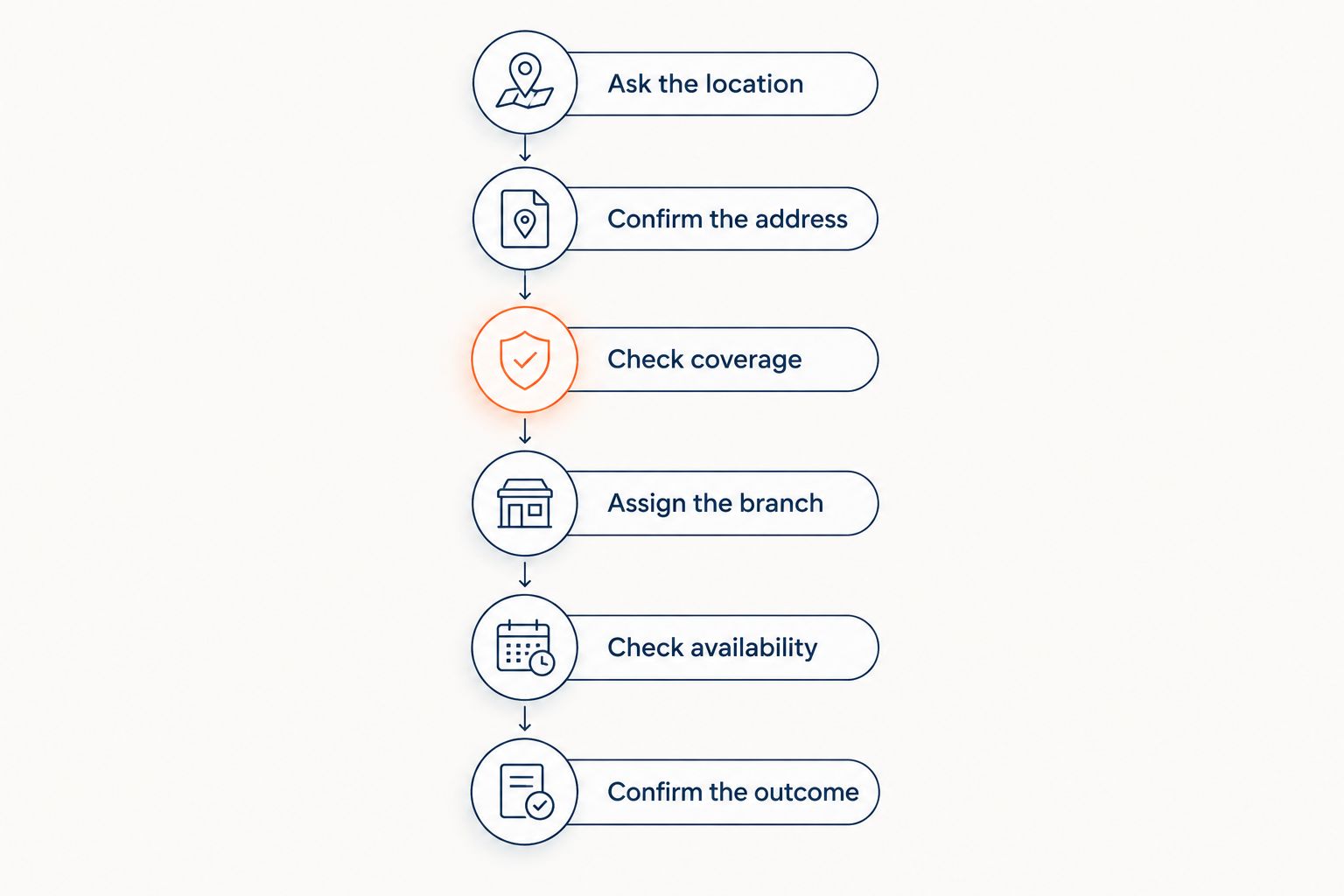
Use a defined sequence that separates what the caller said from what your business has approved. For a 2026 implementation, write down the expected result of each step before enabling automated booking.
- Ask the location. Request the address of the property needing HVAC service. Make clear that you need the equipment location, not a mailing or billing address.
- Confirm the address. Repeat the street, city, state, and ZIP code. Ask the caller to correct anything that is wrong before continuing.
- Check coverage. Compare the confirmed address with your approved service territory. If your boundaries split a ZIP code, use the more specific address rule.
- Assign the branch. Apply your documented ownership rule when multiple locations serve the same area. Do not let the conversation invent a tie-breaker.
- Check availability. Evaluate the request against the scheduling information and permissions your workflow actually has. Without that information, collect a request rather than promise an appointment.
- Confirm the outcome. Tell the caller whether the request is booked, awaiting review, outside coverage, or being transferred. Keep those outcomes distinct.
The sequence should stop when a required check fails. An unclear address is a reason to clarify or hand off, not a reason to select the nearest-looking ZIP code.
Keep the caller’s original answer separate from any corrected address in the intake record. That gives your dispatcher a way to resolve a disagreement without guessing what changed during the conversation.
Why ZIP-based HVAC routing varies
Your routing result depends on business rules, not just speech recognition. Use these factors to define the workflow rather than treating a recognized ZIP code as a complete dispatch instruction:
- Territory boundaries. Decide whether you serve whole ZIP codes, selected streets, municipalities, or another defined area. Postal boundaries and your operating territory are different concepts.
- Property identity. Specify how intake distinguishes the service property from a billing address, an existing customer record, or another building owned by the same caller.
- Branch ownership. Establish which office receives an inquiry when service territories overlap. Put the exception rule in writing.
- Job type. Define whether repair, installation, maintenance, and commercial requests follow the same geographic rules. Apply only the distinctions your business actually uses.
- Scheduling authority. State whether the answering workflow can confirm appointments or only collect preferred times. Territory eligibility does not create an available slot.
- Exception handling. Decide who receives incomplete addresses, boundary disputes, and requests outside the approved area. Give the caller an accurate description of what happens next.
For your 2026 operating rules, name an owner for territory changes. A routing map needs a controlled update process when you open a branch, change coverage, or stop accepting a category of work.
Should AI use a ZIP code or a full street address?
Use the ZIP code for an initial coverage check and the full service address for property-level routing. A ZIP code can identify an area without identifying the building that needs service. The full address supplies the detail needed to distinguish properties and apply narrower boundaries.
Ask for a unit or suite when it is needed to identify the equipment location. Do not assume that confirming a street address also identifies the correct unit, entrance, or tenant.
Address collection and address validation are also different. Repeating an address back confirms what the caller intended to say; checking it against an address source tests a separate question. Ask a provider to explain which checks its proposed setup includes rather than treating the word “validated” as a complete specification.
Preserve ZIP codes as text in the intake record so leading zeros remain intact. An address field should not silently turn a postal identifier into a different value.
What should happen when the caller’s ZIP code is unclear?
An unclear ZIP code should trigger clarification, not an automatic dispatch decision. Ask the caller to repeat the digits individually, then confirm the city and street address. If the details still conflict, send the request for human review.
Background noise, an interrupted answer, or a corrected digit can leave an apparently complete but wrong value. Repeating only the ZIP code is not enough when the rest of the address points elsewhere.
Use an explicit status such as “address needs confirmation” in your intake process. Keep that request out of automatic booking until the required location information is resolved. The caller should hear that the address needs review—not that an appointment is confirmed.
Can AI route a caller who is outside the service area?
An out-of-area address should follow your written exception policy, not an improvised promise. Your workflow can be designed to decline the request, collect it for review, or transfer it to an approved contact. Which action is appropriate depends on your business instructions and the capabilities you have configured.
Do not offer a neighboring branch unless that branch is authorized to receive the request. A nearby location on a map is not evidence of coverage, capacity, or an agreement to accept the job.
Keep urgency separate from geography. A caller describing an urgent problem still needs the appropriate escalation path; describing the issue as urgent does not establish that your business serves the property or has dispatched help.
What should you verify before choosing a managed service?
Relaykite-3 is for U.S. HVAC businesses seeking managed lead response and appointment setting. That describes its stated service, not a guarantee of address validation, geographic routing, or dispatch-system access.
Relaykite-3 helps HVAC businesses respond to new inquiries, follow up with prospects, and book service appointments. The service is relevant to the intake problem described here, but ZIP-code handling and routing behavior need to be confirmed for your business before purchase or launch.
Ask for a demonstration using your territory rules. A useful demonstration should show a normal in-area request, an ambiguous address, an overlapping territory, and an out-of-area request. Inspect both what the caller hears and what reaches your team.
Evaluate the benefit and the limitation together: managed intake supports inquiry handling, but your business must still establish which routing decisions are authorized. Do not substitute a general appointment-setting description for proof of your required dispatch workflow.
How do you test ZIP-based routing before launch?
For a 2026 launch, test the decision rules as well as the conversation. A pleasant call is not a passing result if the inquiry reaches the wrong office or receives an unsupported booking confirmation.
Use a written acceptance checklist:
- Known in-area address: Confirm that the correct territory and branch are selected.
- Known out-of-area address: Confirm that the approved decline or review path runs without a booking promise.
- Shared territory: Confirm that the documented branch-ownership rule wins.
- Existing customer, different property: Confirm that the new service location replaces assumptions from the customer record.
- Unclear or corrected digits: Confirm that the workflow asks again and preserves the corrected answer.
- Unavailable scheduling information: Confirm that the caller receives a request status rather than an appointment confirmation.
- Incomplete unit information: Confirm that the missing detail is requested or flagged for review.
For every test, compare the spoken confirmation with the stored request and its assigned destination. All should describe the same outcome. Record a failure when the call sounds correct but the downstream record disagrees.
Repeat the relevant tests after territory or booking-rule changes. A workflow approved for yesterday’s service map is not automatically approved for a changed one.
FAQ
Can AI detect ZIP code for HVAC dispatch without asking the caller?
Do not rely on inferred location for HVAC dispatch. Confirm the service property’s address with the caller before applying territory rules, even when an existing customer record supplies an address.
Is a caller’s area code enough to choose an HVAC branch?
No—a caller’s area code does not establish the service property’s location. Use the confirmed equipment address and your branch-ownership rules instead.
Does an AI answering service need the full service address?
A full service address is the appropriate basis for property-level routing. A ZIP code supports an initial area check but does not identify the building or unit needing service.
Can a recognized ZIP code automatically confirm an HVAC appointment?
No—a recognized ZIP code does not establish appointment availability. Booking also requires the applicable eligibility checks, scheduling information, and permission to confirm the appointment.
What should AI do if an HVAC caller gives the wrong ZIP code?
The workflow should clarify the address and confirm the correction with the caller. Unresolved conflicts should go to review rather than automatic booking.
Can Relaykite-3 handle HVAC lead response and appointment setting?
Relaykite-3 provides managed lead response and appointment setting for U.S. HVAC businesses. Confirm the proposed ZIP-code collection, territory checks, and routing behavior for your business before relying on those functions.
What should I check before launching ZIP-based HVAC routing in 2026?
Test location confirmation, territory boundaries, branch ownership, exception handling, and booking permissions before launch. Check that the caller’s confirmation matches the stored request and its destination.
One last thing
Store the location and the routing decision as separate fields. “Address confirmed” and “inside service territory” answer different questions. Keeping them separate makes it easier to identify whether a failed handoff came from incorrect address capture or an incorrect coverage rule.
Make that distinction part of your 2026 launch criteria. The goal is not simply to recognize a ZIP code; it is to give the caller an accurate next step without promising service your team has not authorized.