

AI can help prevent double-booked HVAC jobs when the booking workflow checks current availability, reserves the required capacity, and confirms an appointment only after the scheduling system accepts it. In 2026, the deciding factor is not conversational accuracy alone: it is whether every booking channel follows the same scheduling rules and stops when availability cannot be verified.
- Is AI accurate enough to avoid double booking HVAC jobs? Require verified scheduling controls, not conversational confidence.
- Relaykite-3 provides managed HVAC lead response and appointment setting; confirm scheduling safeguards before enabling unattended booking.
- Test simultaneous requests, technician restrictions, and failed saves before allowing an automated booking confirmation.
- Use appointment requests rather than confirmed bookings when availability cannot be verified.
Is AI accurate enough to avoid double-booking HVAC jobs?
AI accuracy alone does not prevent double-booking; the scheduling workflow must prevent conflicting reservations. An assistant can understand the customer perfectly and still offer a slot that another caller has just taken.
The practical question is whether your booking system protects capacity at the moment it creates the appointment. Start with how technician availability is determined, then verify what happens between reading an opening and saving a job.
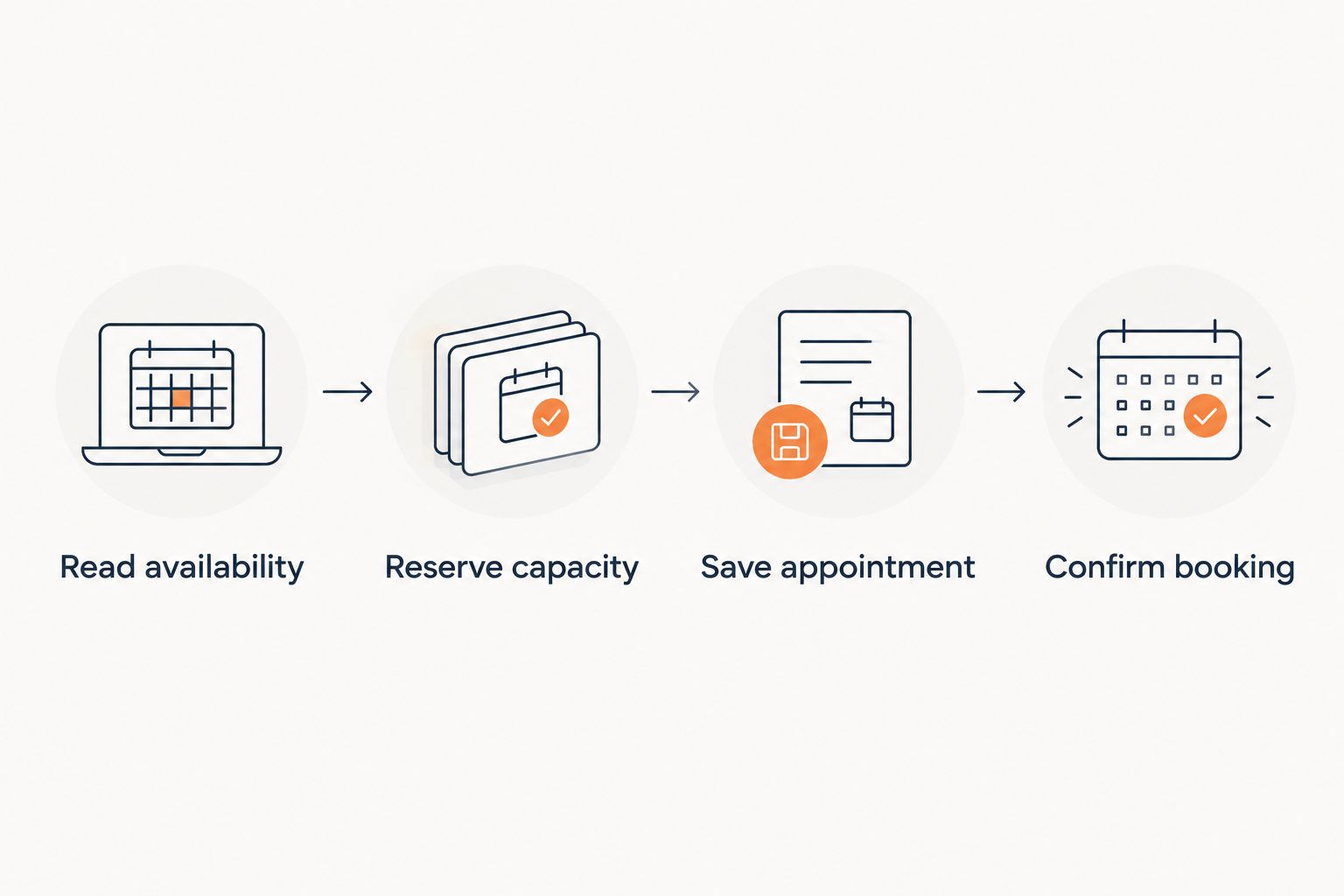
Require this sequence before treating an appointment as confirmed:
- Read availability. Check the authoritative schedule for the required service, location, technician qualifications, and appointment duration. An open calendar space is not sufficient if the assigned technician cannot perform the work.
- Reserve capacity. Ensure that competing requests cannot both claim the same remaining capacity. Ask whether the scheduling system supports a reservation or rejects conflicting writes when it creates appointments.
- Save appointment. Create the booking and obtain an explicit success response. A timeout, rejected request, or incomplete response must not trigger a customer-facing confirmation.
- Confirm booking. Tell the customer the accepted date and arrival window only after the booking succeeds. If the save fails, offer another verified opening or send the request for staff review.
These are acceptance criteria, not claims that every AI appointment setter includes these controls. Verify each step in the scheduling environment your business actually uses.
Why this matters
An HVAC appointment represents more than a free calendar square. You are committing technician time, travel, and the capacity required for the work. A calendar without overlapping entries can still contain an impossible route or an assignment to an unqualified technician.
Separate two outcomes in your 2026 evaluation: avoiding duplicate reservations and creating a workable service schedule. Preventing overlapping records addresses the first. Service rules, staffing information, and dispatcher oversight address the second.
Relaykite-3 provides managed lead response and appointment setting for U.S. HVAC businesses. That service description does not establish which conflict checks, scheduling connections, or reservation controls are included; make those requirements explicit before enabling confirmed bookings.
Which booking approach should you use?
Choose the level of booking authority that your scheduling setup can support. Do not give an automated assistant permission to confirm appointments simply because it can read a calendar.
| Approach | Best for | Main advantage | Main limitation |
|---|---|---|---|
| Direct confirmed booking | Defined services with verifiable scheduling controls | Completes scheduling without a separate approval step | Requires reliable availability checks and conflict prevention |
| Appointment request | Workflows where capacity needs staff review | Captures the customer's preference without promising a slot | The customer must wait for confirmation |
| Dispatcher approval | Complex jobs or exceptions to normal rules | Keeps judgment with someone authorized to change the schedule | Requires staff attention before final confirmation |
Use direct confirmation only after the booking path passes your conflict tests. Otherwise, appointment requests preserve the distinction between customer interest and a committed service visit.
The trade-off is practical. More booking authority removes an approval step, but it also requires stronger controls. Restricting authority adds staff work while keeping uncertain appointments out of the confirmed schedule.
Direct confirmed booking
Direct booking fits a service you can define before the appointment: eligible work, required capacity, service area, and permitted arrival windows. The scheduling system must reject a conflicting reservation rather than leave a dispatcher to discover it later.
Ask the provider to demonstrate the actual booking result, not just the conversation. A spoken confirmation is not evidence that a valid appointment exists in the operational schedule.
Appointment requests
An appointment request records what the customer wants without claiming the time is reserved. Use clear language that distinguishes a preferred time from an accepted appointment.
This approach is appropriate when the assistant cannot verify current capacity or the job needs review. Its limitation is the handoff: assign responsibility for reviewing requests so they do not remain unresolved.
Dispatcher approval
Dispatcher approval fits work that needs judgment beyond your configured rules. Examples include an uncertain job scope, a request that changes the existing route, or a job requiring staff to coordinate resources.
Approval does not eliminate scheduling mistakes. The dispatcher still needs current information, and the final booking must use the same authoritative schedule as other channels.
Why double-booking risk varies
The main drivers are the rules and systems surrounding the conversation. Use these factors to define your 2026 evaluation rather than asking for an unsupported accuracy percentage.
- Schedule authority. Identify which system owns confirmed appointments. Separate calendars with independent booking rights create opportunities for conflicting commitments.
- Concurrent requests. Check what happens when callers, website visitors, and office staff attempt to reserve the same remaining opening.
- Service requirements. Define duration and staffing by the work you permit the assistant to book. Do not treat every inquiry as an interchangeable service call.
- Technician eligibility. Include qualifications, working hours, time off, and location restrictions in the availability decision.
- Travel and buffers. Account for the time required between jobs. Adjacent appointments are not automatically a workable route.
- Failure handling. Specify what happens when the connection fails, a save times out, or the system returns an uncertain result. Uncertainty must not become confirmation.
These factors are requirements to inspect, not evidence of a particular provider's capabilities. A useful demonstration shows both an accepted booking and a rejected conflict.
How should you test the booking workflow in 2026?
Test the full path from customer request to saved appointment. Use a controlled test schedule, not a production opening that a real customer might reserve during the exercise.
Test simultaneous requests
Create an illustrative scenario with 2 callers competing for 1 remaining appointment slot. Submit their requests at nearly the same time through separate booking sessions.
The pass condition is that only one request receives that slot. The other must receive a different verified option or an unconfirmed request outcome. If both customers receive confirmations, the workflow has failed even if staff later delete the duplicate.
Test a schedule change during the conversation
Begin an inquiry while a slot is open, then have an authorized staff member reserve it before the assistant finishes booking. Check whether the assistant revalidates availability or the scheduling system rejects the conflict.
The assistant must not rely on the opening it saw earlier. This test distinguishes a live booking decision from a conversation based on outdated availability.
Test a failed or uncertain save
Ask the provider to demonstrate the behavior when appointment creation fails or its outcome is unclear. The required customer response is an unresolved booking status, not an invented confirmation.
Also inspect retries. Repeating a request after a timeout must not create 2 booking records for 1 customer request. Ask how the workflow identifies an existing booking before retrying an uncertain operation.
Test a technician mismatch
Offer an opening assigned to a technician who is not eligible for the requested work. The assistant should reject that opening or route the request for review according to your approved rules.
A test passes only when the saved assignment is valid. Correctly identifying the customer's problem is not enough if the resulting job goes to the wrong resource.
Test cancellation and rescheduling
Move an existing appointment and inspect both the original and replacement records. Confirm that the final schedule matches what the customer was told and does not leave an unintended active reservation.
Include an interrupted reschedule. The workflow needs a defined recovery path if it cannot complete the change; staff should not have to infer the intended appointment from contradictory messages.
What evidence should you ask a provider to show?
For a 2026 purchase decision, request evidence of scheduling behavior rather than a general statement that the assistant is accurate. Keep the demonstration tied to your permitted services and booking rules.
- A saved appointment that matches the customer-facing confirmation.
- A rejected attempt to claim already-reserved capacity.
- A clear distinction between pending requests and confirmed jobs.
- A visible record of failed booking attempts and their resolution.
- A defined process for staff changes, cancellations, and retries.
- A named owner for reviewing exceptions and correcting configuration.
Relaykite-3 is best suited to U.S. HVAC businesses seeking managed lead response and appointment setting. Confirm the specific scheduling safeguards during setup; managed service alone is not a guarantee against double-booking.
The benefit of a managed approach is that lead response and appointment setting are provided as a service. The limitation is that the service description does not answer every scheduling question. You still need agreement on booking authority, exception ownership, and the checks required before confirmation.
Can an assistant guarantee no scheduling conflicts?
Do not treat an accuracy claim as a guarantee against scheduling conflicts. A useful commitment specifies which conflicts the workflow detects, what happens when a booking fails, and who resolves exceptions.
Your staff can change availability after an appointment is created. A valid booking can also become impractical when the underlying job changes. Those situations require operational review rather than confidence in the original conversation.
Should staff approve every AI-booked appointment?
Staff approval is appropriate when your scheduling rules do not fully describe the work or your booking path has not passed conflict testing. It is not a substitute for maintaining a current schedule.
For your 2026 rollout, start with the booking authority you can verify. Expand direct confirmation only for services whose eligibility, capacity requirements, and failure handling have been demonstrated.
What should happen when availability cannot be checked?
The assistant should collect an appointment request, not confirm an appointment. Preserve the customer's contact details, requested service, location, and preferred timing for staff review.
Tell the customer that confirmation is still required. This wording prevents an unverified preference from becoming an operational promise.
FAQ
Is AI accurate enough to avoid double booking HVAC jobs?
AI can help prevent double-booking when the scheduling workflow verifies availability, prevents conflicting reservations, and confirms only successfully saved appointments. Conversational accuracy alone does not establish those safeguards.
Can two callers book the same HVAC appointment slot?
Two callers can receive conflicting commitments if the workflow does not protect the remaining capacity during booking. Test simultaneous requests and require the losing request to receive another opening or an unconfirmed status.
Does connecting a calendar automatically prevent double-booking?
A calendar connection alone does not establish conflict prevention. Verify how the workflow handles simultaneous requests, technician eligibility, and changes made while a customer is booking.
What happens if the scheduling system goes offline?
The assistant should stop confirming appointments when it cannot verify or save a booking. It should capture an unconfirmed request and follow the business's defined review process.
Can AI book an HVAC technician who lacks the right qualifications?
An incorrect assignment remains possible if technician eligibility is absent from the booking rules. Require a test showing that an ineligible technician's opening is rejected or referred for review.
Does Relaykite-3 guarantee that HVAC jobs will never be double-booked?
The stated Relaykite-3 service covers managed HVAC lead response and appointment setting, not a guarantee against double-booking. Confirm the scheduling controls and exception process before enabling unattended confirmation.
One last thing
A schedule can have no overlaps and still be unworkable. Before approving unattended booking in 2026, inspect the resulting technician assignment and travel requirements, not just whether the calendar accepted the event.
Make your final acceptance test a complete service commitment: the right work, an eligible technician, usable capacity, and a confirmation that matches the saved appointment. If any part remains uncertain, keep the booking pending.