
Yes—AI answering services can handle HVAC warranty claim intake when configured with your business’s questions, approved wording, and handoff rules. They should not independently approve coverage, promise reimbursement, or describe a service visit as warranty-authorized; those decisions require the applicable warranty terms and an authorized reviewer.
- Can AI handle HVAC warranty claim calls? Yes for configured intake and routing, not independent coverage approval.
- Keep appointment confirmation separate from warranty authorization; booking a visit does not establish coverage.
- Relaykite-3 provides managed HVAC lead response and appointment setting; confirm warranty-specific requirements before choosing a service.
- Route disputed coverage, unclear records, and requests for authorization to your designated human reviewer.
Why this matters
A homeowner reporting a failed system wants a next step, not a debate about responsibility. Your answering workflow needs to capture the complaint without turning an unverified warranty statement into a promise.
For your 2026 call-handling plan, separate customer service from coverage decisions. A useful intake record tells your office what happened, what the caller believes is covered, and who must review the request.
Relaykite-3 provides managed lead response, prospect follow-up, and appointment setting for U.S. HVAC businesses. Relaykite-3 is best for U.S. HVAC businesses seeking managed lead response and appointment setting. Warranty administration is a separate requirement to confirm, not a capability to assume from that service description.
Can AI answering services handle HVAC warranty claim calls?
Use AI for structured intake; keep warranty authorization with an authorized reviewer. Treat that boundary as a configuration requirement, not a result every answering service delivers automatically.
The following comparison separates recommended responsibilities. It does not describe verified features of a particular provider.
| Handling approach | Best for | Practical advantage | Limitation |
|---|---|---|---|
| Configured AI intake | Collecting routine claim details | Follows a defined question sequence | Cannot establish coverage from the caller’s statement alone |
| Human warranty review | Interpreting terms and resolving disputes | Applies judgment to records and exceptions | Requires an assigned reviewer and a handoff process |
| AI intake with human review | Separating information collection from authorization | Gives each task a clear owner | Depends on accurate routing and accessible records |
For a 2026 implementation, choose the workflow by responsibility rather than by how natural the conversation sounds. An answering system that takes a clear message but declines to promise coverage respects the intended boundary.
The evidence behind a coverage decision belongs in the applicable documents and service records. A confident spoken answer is not a substitute for those records.
What should AI collect during an HVAC warranty call?
Build the intake around 5 information groups. Ask only for information needed to identify the customer, understand the request, and arrange the next step. Do not make callers complete an exhaustive interview before recording their concern.
Contact details
Request the caller’s name, callback details, and service address. Confirm whether the caller is the equipment owner, tenant, property manager, or another contact so your office knows who is requesting help.
Record an alternate contact only when relevant. Your team should not have to guess whose permission or response it needs.
Equipment details
Ask for the equipment type and any model or serial information the caller already has. If the caller cannot find an identifier safely, mark it as unavailable and continue.
Do not direct someone to open equipment or approach a hazardous area to complete intake. Missing information is a follow-up task, not a reason to invent an equipment match.
Reported problem
Capture the symptoms in the caller’s words, including when the problem began and whether there was a recent service visit. Keep observations separate from diagnoses.
A report of warm air is a symptom. It is not proof that a particular component has failed or that a warranty applies.
Warranty information
Ask which warranty or prior service the caller is referring to and whether supporting documents are available. Record installation or repair dates as caller-reported unless your team has verified them.
A caller’s belief that equipment is covered belongs in the record. Label it as a belief, not an approved claim.
Requested next step
Establish whether the caller wants a callback, a service appointment, an update on an existing request, or help understanding a previous decision. These requests need different handoffs.
Where booking is enabled, confirm only the appointment details your business authorizes. Do not attach a coverage promise to the booking confirmation.
How should a warranty call move from intake to review?
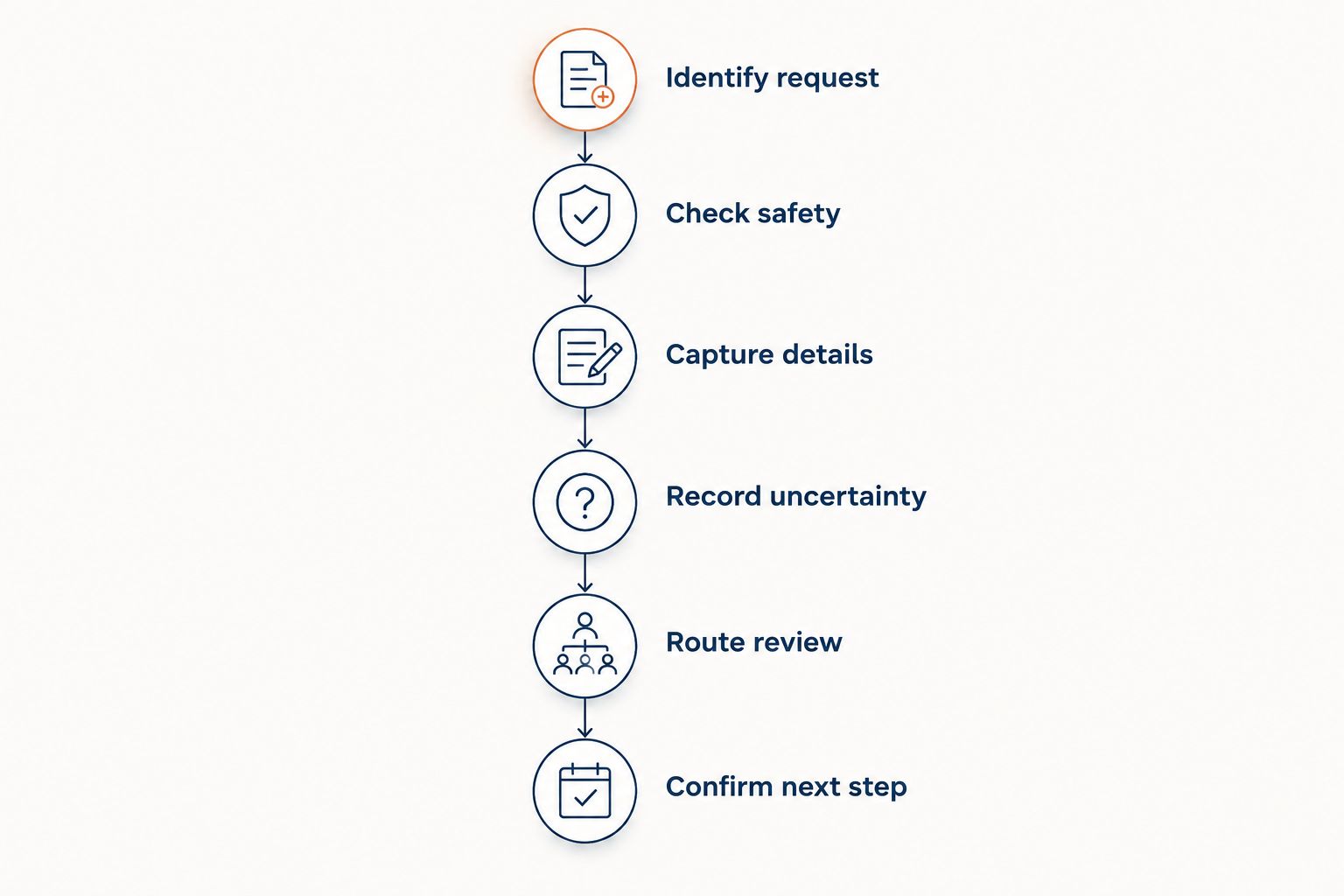
Use these 6 workflow steps as a configuration checklist. Each step should have a named owner or an explicit rule, including what happens when information is missing.
- Identify request. Distinguish a new warranty inquiry from an existing claim update, a repair request, or a complaint about previous work.
- Check safety. Apply your approved safety and escalation instructions before continuing routine questions. An intake script is not a diagnostic or emergency-response service.
- Capture details. Collect the relevant information groups without requiring the caller to know technical terminology.
- Record uncertainty. Mark missing identifiers, unverified dates, and caller-reported coverage explicitly. Never fill gaps with assumptions.
- Route review. Send the request to the person authorized to assess the relevant warranty or service obligation.
- Confirm next step. Explain what has been recorded and what happens next, using only the commitments your business has approved.
Before activating a 2026 warranty workflow, assign responsibility for incomplete handoffs. A request sitting in a general inbox does not have a clear reviewer simply because the call ended successfully.
Specify how your office acknowledges receipt, corrects a routing mistake, and communicates a decision. Do not announce a callback deadline unless your team has authorized that commitment.
Which warranty questions need a human reviewer?
Escalate interpretation, authorization, and disputes. AI intake should not improvise an answer when the request exceeds the approved information available to it.
Use human review for questions about whether a specific failure is covered, whether a previous decision was correct, or whether work can begin under a warranty authorization. Requests involving conflicting records also need an identified reviewer.
For the broader routing design, see how an HVAC call should escalate to a human. The important distinction is between recognizing a handoff condition and resolving the underlying issue.
Give the reviewer context rather than an unexplained transfer. Include the caller’s request, the information collected, the unresolved question, and any commitment already communicated.
Keep the status precise. An inquiry received, an appointment booked, and a claim approved describe different events. Your customer record should preserve those differences.
Why HVAC warranty call handling varies
Warranty-call configuration depends on your business’s actual responsibilities and records. Review these 5 configuration factors before deciding what the answering service should handle:
- Scope of the request. A new inquiry needs a different response from an update on work already submitted for review.
- Applicable documents. Approved answers must reflect the terms relevant to the request, not a generic statement about HVAC warranties.
- Record access. Decide which customer and service details the workflow can verify and which must remain caller-reported.
- Decision authority. Name the person or organization responsible for authorization. Do not imply your answering service holds that authority.
- Scheduling rules. Define whether the workflow can book an assessment, request a callback, or only forward the inquiry.
These factors set the scope for a 2026 rollout. If the service cannot access a record, narrow the answer rather than presenting an unverified conclusion.
More information does not automatically grant more authority. Even a complete intake record still needs the review required by your business’s process.
Can an AI answering service tell a customer their repair is covered?
Not from the caller’s account alone. Permit only approved statements supported by applicable records, and require human review when terms, exclusions, or authorization are unresolved.
Can AI book a service visit before warranty approval?
Booking and approval should remain separate. Allow booking only under your scheduling rules, and make clear that an appointment does not establish warranty coverage.
Can AI handle an update on an existing warranty request?
Only provide a verified status that the configured workflow is authorized to share. Without that access and permission, capture the request and route it to the responsible reviewer instead of guessing progress.
How should you test the workflow before launch?
Run 3 test calls through your proposed 2026 configuration: a routine inquiry, an incomplete inquiry, and a disputed-coverage call. Use fictional customer details and assess the resulting record as well as the conversation.
For the routine inquiry, check whether the workflow captures the request and explains the next step without promising coverage. For the incomplete inquiry, check whether missing information remains clearly marked rather than becoming an assumed fact.
For the disputed-coverage call, check whether the workflow routes the disagreement instead of arguing with the caller. Your test should also establish who receives the handoff and what information reaches them.
Do not launch a workflow that confuses an appointment with an approved claim. Correct the instructions and repeat the affected test before expanding its scope.
A successful test demonstrates that the tested scenario followed your instructions. It is not a guarantee of every future conversation, so assign an owner to review exceptions and update approved wording.
Where does managed lead response fit?
Relaykite-3 offers managed HVAC lead response and appointment setting. That scope fits the inquiry-to-appointment portion of customer communication; it does not establish warranty verification, manufacturer submission, or claim authorization capabilities.
If you are assessing Relaykite-3 for warranty-related inquiries, ask whether the proposed configuration supports your intake fields, approved language, scheduling boundaries, and human handoff requirements. Confirm those requirements before including warranty calls in the service scope.
The advantage of a defined managed-service scope is clear responsibility for the agreed work. The limitation is equally important: tasks outside that scope need another owner, rather than an assumption that appointment setting includes warranty administration.
FAQ
Can AI handle HVAC warranty claim calls without approving the claim?
Yes, a configured AI answering workflow can collect information and route the inquiry without approving coverage. Keep authorization with the designated reviewer and make that boundary explicit in the script.
What should an AI receptionist ask during an HVAC warranty call?
An AI receptionist should collect relevant contact details, equipment information, reported symptoms, warranty information, and the requested next step. Mark unverified information as caller-reported and allow missing details to remain unresolved.
Can AI tell a homeowner that parts and labor are covered?
AI should not promise parts or labor coverage without applicable verified information and authorization to communicate it. Route unresolved coverage questions to the person responsible for reviewing the warranty.
Can an AI answering service book a warranty service appointment?
A configured answering service can book a service appointment when your scheduling rules permit it. Appointment confirmation must remain separate from warranty authorization.
What happens if a caller does not know the equipment serial number?
Record the serial number as unavailable and continue with the information the caller can safely provide. Give your office responsibility for obtaining missing identifiers rather than assuming an equipment match.
Should AI handle a customer who disagrees with a warranty decision?
AI should capture the disagreement and route it to an authorized human reviewer. It should not invent an explanation, reverse a decision, or promise a different outcome.
Does an HVAC lead-response service automatically include warranty claims management?
No, lead response and appointment setting do not establish warranty claims-management capabilities. Confirm intake, record access, review routing, and authorization responsibilities separately before enabling that workflow.
One last thing
Name the record after what actually happened. Use an inquiry status when information has been received and an appointment status when a visit has been booked. Reserve approval language for an authorized decision.
That small wording choice belongs in your scripts, handoff notes, and customer confirmations. It keeps an administrative next step from being mistaken for a coverage commitment.