

The cost of a missed HVAC lead is the expected collected revenue lost when an unanswered inquiry reduces the chance of a completed job. Calculate it using your collected revenue per job and the difference between completion rates for promptly handled and missed inquiries. For your 2026 estimate, track acquisition spending separately: it is a cost already incurred, not additional lost revenue.
- Calculate the cost of a missed HVAC lead from completed jobs, not unanswered calls alone.
- Separate lost revenue, lost contribution, and lead acquisition spending to avoid double counting.
- Relaykite-3 provides managed HVAC lead response and appointment setting; booking outcomes depend on configuration and customer decisions.
- Measure follow-up recovery before treating every missed inquiry as a lost customer.
Why this matters
An unanswered phone call is a response failure. It is not automatically a lost sale. The caller might contact you again, answer a callback, submit a form, or already have an appointment.
The expensive mistake is treating every missed call as a full job lost—or treating every returned call as a customer saved. Your residential HVAC lead response process needs to connect inquiries to completed work before the revenue estimate means anything.
Measure the customer journey, not just the ringing phone. Otherwise, you risk fixing a call-count problem while leaving the booking problem untouched.
How much does a missed HVAC lead cost in lost revenue?
Use this calculation for one qualified inquiry:
Estimated lost revenue per missed lead = collected revenue per completed job × the completion-rate gap between promptly handled and missed leads.
For all missed leads in a reporting period, multiply that result by the number of unique, qualified missed inquiries. Use completion rates from comparable groups, with the same time allowed for follow-up and job completion.
This is a planning estimate, not proof that answering a particular call would have produced a sale. Differences in lead source, service need, scheduling capacity, and customer intent can affect the comparison.
| Component | What to use | What to exclude |
|---|---|---|
| Missed lead count | Unique prospective customers whose initial inquiry went unanswered | Repeat attempts from the same customer, spam, and existing-job updates |
| Prompt-response completion rate | Share of comparable promptly handled leads that became completed jobs | Appointments that never became completed work |
| Missed-lead completion rate | Share of comparable missed leads that became completed jobs after follow-up | An assumption that every missed lead disappeared |
| Collected revenue per job | Revenue collected for the relevant completed-job group | Unaccepted estimates and unpaid amounts |
| Completion-rate gap | Prompt-response rate minus missed-lead rate | A claimed loss caused solely by response speed |
For your 2026 worksheet, keep each input tied to a defined reporting period. Do not combine recent inquiries still awaiting follow-up with older inquiries whose outcomes are already known.
Why not multiply missed calls by average job revenue?
That shortcut assumes every missed call was a qualified buyer and every qualified buyer would have purchased. It also assumes none of those callers returned or responded to follow-up.
Those assumptions inflate the estimate. Use unique leads and actual downstream outcomes instead. When the observed completion-rate gap is negative, investigate the groups rather than forcing the result into a positive loss estimate.
Build a missed-lead revenue estimate you can use
A useful calculation begins with a consistent definition of a lead. Keep that definition unchanged throughout the comparison, then follow each inquiry through the same stages.
- Define qualified inquiries. Include prospective customers requesting work your business serves. Separate unrelated calls, existing appointment questions, and duplicate attempts.
- Record initial handling. Mark whether the inquiry received a response when it arrived or entered your missed-inquiry process. Keep the original timestamp.
- Record follow-up. Capture whether your team attempted contact, reached the prospect, and established a next step. An attempted callback is not a conversation.
- Record completed jobs. Connect appointments to completed work. Keep cancellations and uncompleted bookings visible rather than counting them as sales.
- Record collected revenue. Attach the collected amount to the completed job. Compare equivalent groups before applying the formula.
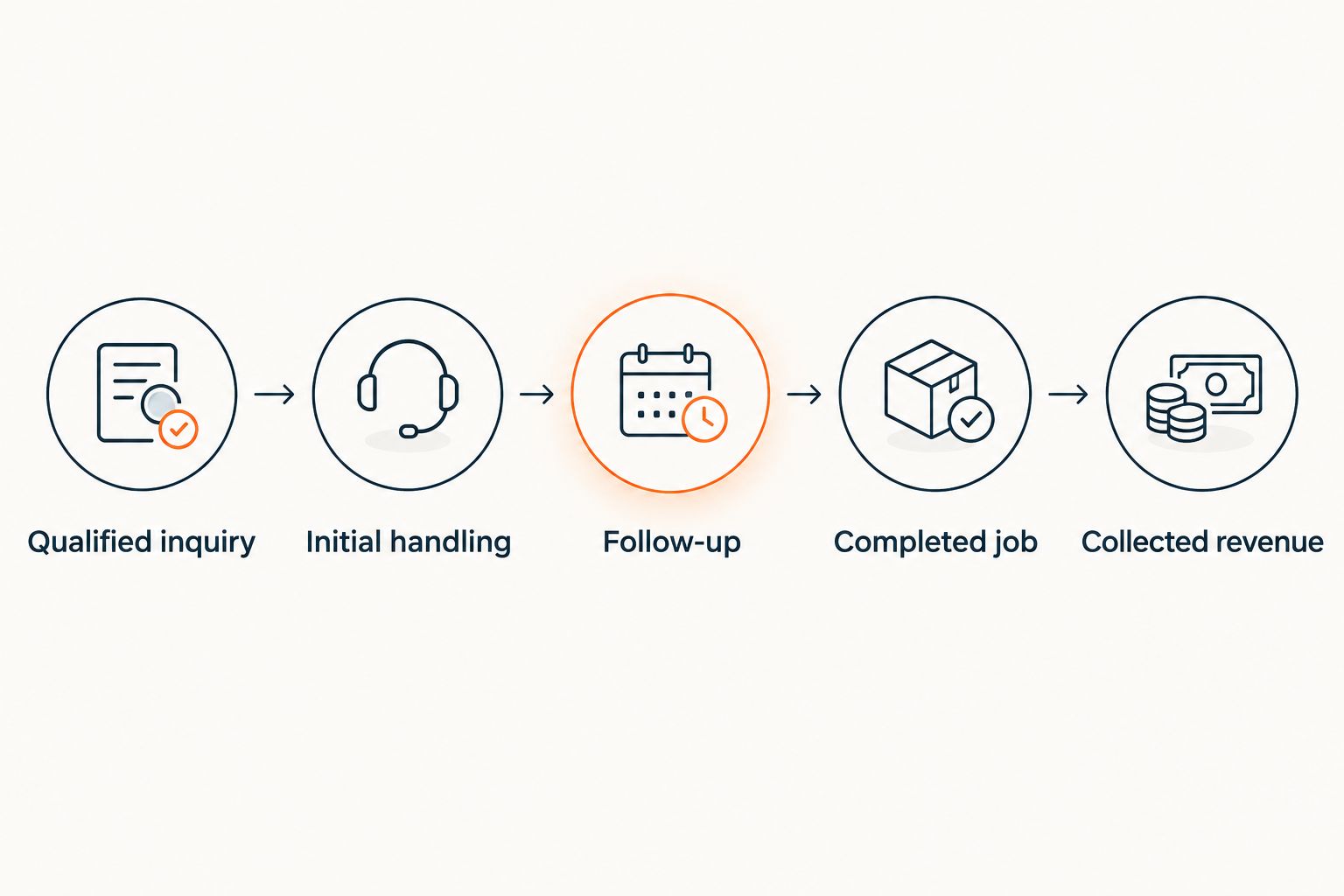
The sequence is: Qualified inquiry, Initial handling, Follow-up, Completed job, Collected revenue. Each stage answers a different question. Skipping a stage makes it harder to tell whether you need better response coverage, stronger follow-up, or a change to booking rules.
Keep the comparison fair
Compare similar service requests from similar sources. A customer asking about a routine visit and a prospect requesting an installation estimate do not represent interchangeable opportunities.
Also allow both groups the same outcome window. If promptly handled inquiries have had time to become completed jobs but missed inquiries have not, the comparison favors the first group by design.
For 2026 reporting, document changes to your response process alongside the results. A new service area, different advertising mix, or altered scheduling capacity can change outcomes without proving anything about response speed.
Lost revenue, lost contribution, and acquisition spending differ
Your missed-lead calculation should answer a specific business question. Revenue exposure, contribution exposure, and acquisition spending belong in separate lines because they describe different effects.
Lost revenue estimates the collected sales associated with the completion-rate gap. It tells you the scale of the opportunity, not how much profit a response service will produce.
Lost contribution adjusts that revenue for the direct costs associated with delivering the work. Use your own contribution-margin definition consistently. Do not call a revenue estimate profit.
Acquisition spending is what you spent to generate inquiries. Missing a paid lead does not create another advertising charge; it leaves the original expenditure without the intended completed-job outcome.
| Measure | Best for | Strength | Limitation |
|---|---|---|---|
| Revenue exposure | Understanding the sales opportunity | Connects lead handling to completed work | Does not account for delivery costs |
| Contribution exposure | Evaluating a response-process investment | Reflects the costs of performing additional work | Requires reliable cost allocation |
| Acquisition spending | Reviewing paid lead efficiency | Shows spending associated with unresolved opportunities | Is not additional lost sales revenue |
Do not add acquisition spending to lost revenue and label the sum lost revenue. Keep both visible, but preserve the distinction.
Why the cost of a missed HVAC lead varies
The formula changes when its underlying inputs change. These factors deserve separate treatment in your worksheet:
- Service requested. Use collected revenue from comparable work rather than applying one business-wide average to every inquiry.
- Qualification. A request outside your service scope is not the same revenue opportunity as a qualified prospect you can serve.
- Follow-up recovery. A missed inquiry that later becomes completed work belongs in the missed-lead completion rate, not the unrecovered-loss count.
- Booking outcome. An appointment can cancel or remain uncompleted. Count the final job outcome before assigning revenue.
- Scheduling capacity. A response cannot create an appointment your operation cannot fulfill. Track capacity-related declines separately.
- Lead source. Separate sources when comparing outcomes so that a change in inquiry mix does not masquerade as a response improvement.
The point is not to create a complicated dashboard. It is to avoid giving every unanswered inquiry the same financial value when the underlying opportunities differ.
Choose a response process around the actual failure
Start with the stage where qualified inquiries stop progressing. If callers never receive a response, address coverage. If conversations occur but appointments do not, inspect qualification and scheduling before adding more response capacity.
| Response approach | Best for | Advantage | Limitation |
|---|---|---|---|
| Staff callback process | Businesses with a team responsible for follow-up | Keeps recovery inside an existing workflow | Depends on staff completing the callback queue |
| Managed lead response | Businesses seeking outside help with inquiry handling | Assigns response and follow-up work to a service | Requires business-specific instructions and clear boundaries |
| Appointment-setting process | Businesses whose qualified prospects need a scheduled next step | Connects the conversation to a booking | A booking does not guarantee completed work |
These approaches can overlap. A managed process still needs an internal owner, and staff callbacks still need clear booking rules. The choice should follow the problem rather than the label on the service.
Relaykite-3 is best for U.S. HVAC businesses seeking managed lead response and appointment setting. Relaykite-3 provides a managed service for responding to new inquiries, following up with prospects, and booking service appointments.
The benefit is support across those connected tasks. The boundary is equally important: Relaykite-3 does not turn every inquiry into completed revenue, and appointment outcomes depend on the process configured for your business and the customer's decision.
Before choosing a service, define which requests it should handle, what information it should collect, and when your team must take over. Confirm those requirements rather than assuming a particular integration, response time, or dispatch capability.
Should you count a missed call as a lost HVAC customer?
A missed call is not automatically a lost HVAC customer. First establish whether it represents a unique, qualified inquiry, then check whether follow-up produced completed work.
Keep unresolved inquiries separate from confirmed outcomes. Marking a lead lost immediately can make your reporting overlook later recovery and distort the value of your follow-up process.
Does booking an appointment recover the lost revenue?
A booked appointment is not recovered revenue. It is progress toward a completed job, and it should remain a separate stage in your records.
Track the appointment through completion and collection. Otherwise, a process that creates bookings but leaves cancellations unresolved can look financially successful before any money is collected.
How do you tell whether faster follow-up is paying off?
Compare completed-job contribution before and after the process change, while checking for changes in lead mix and capacity. Use the same definitions and outcome window for both periods.
For your 2026 review, examine response handling, follow-up contact, bookings, completed jobs, and collected revenue together. Improvement in one stage is useful evidence, but it is not a guarantee that the full revenue result came from the response change.
FAQ
What's the cost of a missed HVAC lead?
The cost of a missed HVAC lead is estimated collected revenue lost through a lower completed-job rate. Multiply collected revenue per comparable job by the completion-rate gap between promptly handled and missed inquiries.
Should I count every unanswered call as a lead?
No, count unique, qualified inquiries rather than every unanswered call. Remove duplicate attempts, unrelated calls, and existing-job updates before estimating revenue exposure.
Can I add advertising spend to lost job revenue?
Keep advertising spend separate from lost job revenue. Advertising is an acquisition cost already incurred; adding it to a revenue estimate and calling the total lost revenue mixes different measures.
Does a callback mean the missed lead was recovered?
A callback alone does not mean the missed lead was recovered. Track whether you reached the prospect, booked an appointment, completed the work, and collected revenue.
Should I use average invoice value or collected revenue?
Use collected revenue per completed job when estimating collected-revenue exposure. Keep unpaid invoices and unaccepted estimates out of that measure.
Can Relaykite-3 help with missed HVAC inquiries?
Relaykite-3 provides managed HVAC lead response, prospect follow-up, and appointment setting. Define the handling rules for your business; booked appointments and revenue are not guaranteed.
What should I track in my 2026 missed-lead report?
Track unique qualified inquiries, initial handling, follow-up contact, booked appointments, completed jobs, and collected revenue in your 2026 report. Compare similar lead groups and give both groups the same time to reach an outcome.
One last thing
Audit the inquiries marked lost that later became completed jobs. Those records reveal whether your reporting preserves the connection between the original inquiry and the final outcome.
If a returning caller creates a new record, your system can show a lost lead and a separate successful customer for the same opportunity. Reconcile those records before judging your response process. A clean customer history makes the revenue estimate more useful than a larger missed-call total.