Yes—AI can follow up with HVAC leads who do not answer calls by sending permitted messages, handling replies, and helping arrange appointments when those functions are configured for your business. An unanswered call is not permission to contact someone through every channel, and automated follow-up does not guarantee a reply or a booked job.
- Can AI follow up unanswered HVAC leads? Yes, with permitted outreach, clear stopping rules, and a defined booking process.
- Relaykite-3 provides managed HVAC lead response and appointment setting for businesses seeking a service rather than software alone.
- Choose follow-up channels around customer permission and preferences, not simply because a phone call went unanswered.
- Separate unanswered, replied, and booked leads so automation stops or hands off at the right point.
Why this matters
Your HVAC business needs a next step after an unanswered callback—not an endless retry sequence. The useful outcome is a conversation that identifies the service request and moves it toward an appropriate appointment or human handoff.
Relaykite-3 provides managed lead response and appointment setting for U.S. HVAC businesses. Whether you choose a managed service or operate your own workflow, decide who owns the lead after the initial call fails.
For your 2026 follow-up plan, document that ownership before choosing messages or software. Otherwise, an office employee and an automated system can act on different versions of the same inquiry.
Can AI follow up with HVAC leads who don't answer calls?
Yes. AI can support follow-up after an unanswered HVAC callback, but each channel needs its own permission, message, and stopping rules. It should continue the customer's inquiry rather than treat silence as agreement to more contact.
The options below describe workflow choices, not confirmed features of any particular provider. Verify channel support and configuration before relying on them.
| Follow-up option | Best for | Practical advantage | Limitation |
|---|---|---|---|
| Another phone call | Leads who requested a callback | Supports a direct conversation when answered | Another attempt can still go unanswered |
| SMS follow-up | Leads with appropriate permission for texting | Lets the customer respond without answering a call | Requires permission checks, reply handling, and opt-out handling |
| Email follow-up | Leads who supplied an email address for the inquiry | Provides space for appointment context and next steps | Sending an email does not establish that it was read |
| Human handoff | Ambiguous requests, complaints, and exceptions | Lets staff resolve issues outside the automated workflow | Requires a named owner and a usable conversation record |
The strongest setup is not the one that contacts a lead through every available channel. It is the one that selects an appropriate next action, recognizes a reply, and stops when the lead no longer needs follow-up.
Does an unanswered call mean the lead is not interested?
An unanswered call does not establish that the HVAC lead is uninterested. Record it as an unanswered attempt, not a rejection, and use the customer's stated preferences to decide what happens next.
Can AI book the appointment after the lead replies?
AI can help book an HVAC appointment when the workflow has the required scheduling access and business rules. Treat collecting a preferred time, requesting an appointment, and confirming a booking as different actions.
Should AI keep calling until someone answers?
No—use a defined follow-up policy rather than an unlimited retry loop. Stop or hand off when the customer declines, opts out, books, or asks for something outside the approved process.
Build the follow-up process before writing messages
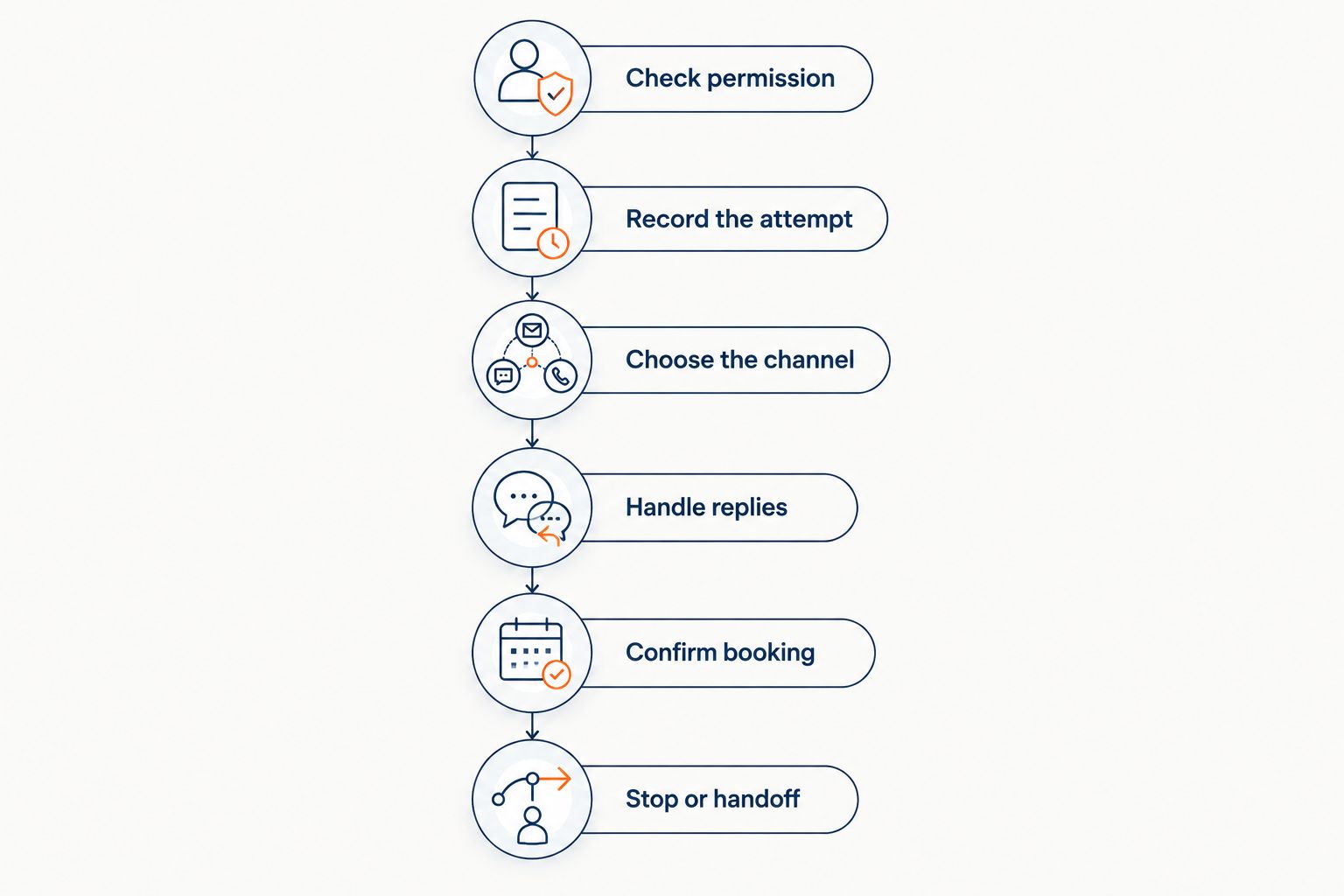
Use the following sequence as a planning checklist for your 2026 setup. These are recommended workflow steps, not a claim that every service includes them automatically.
- Check permission. Identify where the inquiry came from, what the customer requested, and which contact methods are appropriate. A phone number in a record does not, by itself, settle the rules for automated calls or texts.
- Record the attempt. Preserve the unanswered callback alongside the original inquiry. The next person or system needs to know that contact was attempted, not assume the lead is untouched.
- Choose the channel. Select an approved next action based on the request and the customer's preferences. Do not add channels merely because the first call failed.
- Handle replies. Define what happens when the customer asks a question, requests a different time, declines service, or describes an urgent concern. A reply should change the workflow.
- Confirm booking. Distinguish a suggested time from an accepted appointment. Confirmation should reflect your actual scheduling process, not an assumption that capacity exists.
- Stop or handoff. End unanswered-lead outreach when its purpose has been fulfilled or when a person needs to take over. Assign ownership rather than leaving an exception in a queue.
This sequence makes the transition from contact attempt to appointment explicit. It also gives your office a practical way to inspect failures: identify the step where the lead stopped moving instead of treating every unbooked inquiry as the same problem.
Phone follow-up: best for requested callbacks
Use another call when it fits the customer's request and your contact policy. Keep the original service context available so the conversation does not start from scratch if the customer answers.
The advantage is direct discussion. Your team can clarify the problem, check the service location, and explain the next appointment step during the conversation.
The limitation is unchanged: a call attempt is not a conversation. Do not mark a lead as reached because a number was dialed, or as qualified because the phone rang.
For your 2026 process, define how an unanswered attempt differs from voicemail, a connected conversation, and a declined request. Those distinctions make the lead record useful to the next person handling it.
SMS follow-up: best for permitted text conversations
Use SMS when texting is appropriate for that inquiry and the required permissions are in place. A useful message identifies the HVAC business, connects to the customer's request, and asks for a clear next action.
Keep the request narrow. Asking whether the customer still needs help is different from asking for scheduling details, and neither should be presented as an appointment confirmation.
The advantage is that the customer can reply without taking a call. The limitation is that the workflow must handle replies, opt-outs, and exceptions—not just send an initial message.
Your SMS follow-up software guide is a separate resource for evaluating that channel. Before selecting a system, ask who owns incoming replies and how a customer request stops the existing sequence.
Email follow-up: best for written appointment context
Use email when the inquiry includes an appropriate email contact and the message serves that request. Email gives you room to explain what information is needed before an appointment can be arranged.
Keep the action obvious. Ask for the missing detail or explain how the customer can continue the conversation, rather than combining scheduling, promotional content, and unrelated offers.
The advantage is space for context. The limitation is that an email being sent does not establish customer intent, acceptance, or a confirmed appointment.
Do not treat email as a workaround for a customer's request to stop contact. Have your compliance adviser review the contact policy across channels, including how preferences and opt-outs are recorded.
Why the right HVAC follow-up approach varies
There is no universal sequence for every unanswered lead. Configure your 2026 workflow around the inquiry and your business rules, using these factors:
- Original request. A request for an installation discussion needs different qualification from a request for a service visit. Keep the follow-up tied to what the customer actually asked for.
- Contact permission. Review the basis for each channel and the applicable requirements. Do not infer unrestricted permission from an unanswered call.
- Customer preferences. A request to call later, use email, or stop contact should change the next action. Preserve that preference for staff as well as automation.
- Scheduling authority. Decide whether the workflow can confirm appointments or only collect preferences. Customer wording must match that authority.
- Exception handling. Define which requests need office staff, a dispatcher, or another responsible person. Urgent concerns should not remain in an ordinary unanswered-lead sequence.
- Lead status. Booked, declined, opted-out, and unresolved leads need different treatment. Make status changes part of the workflow rather than an optional cleanup task.
These factors are configuration decisions, not promises of higher conversion. Review them against your actual operating process before approving automated outreach.
What to verify with a managed service
Relaykite-3 is best for U.S. HVAC businesses seeking managed lead response and appointment setting rather than software alone. Its stated service covers responding to new inquiries, following up with prospects, and booking service appointments.
That service description does not establish which communication channels, integrations, or scheduling permissions apply to your business. Confirm those details before making them part of your customer-facing process.
When evaluating Relaykite-3, ask for a walkthrough of an unanswered-lead scenario. Follow the inquiry from the failed callback through a reply, a scheduling request, an opt-out, and a human handoff.
The benefit of the managed-service model is its fit for a buyer seeking a service rather than a software-only purchase. The constraint is that you still need to provide and approve business rules: automation cannot determine your service boundaries or appointment authority on your behalf.
Test outcomes, not just outgoing messages
Before approving a 2026 launch, run sample inquiries through the process. These are test scenarios, not performance benchmarks or expected results.
- No response: The workflow follows the approved contact policy and reaches its defined stopping point.
- Customer replies: The next action reflects the reply rather than continuing unchanged.
- Customer declines: Further lead-chasing stops according to the approved policy.
- Customer requests booking: The system distinguishes available options from a confirmed appointment.
- Customer needs help: The assigned person receives the conversation context and knows they own the next action.
Keep the review focused on observable events. A sent message proves an attempt; a customer reply proves engagement; a booking confirmation records an appointment. None of those alone proves that a service visit was completed.
FAQ
Can AI follow up with HVAC leads who don't answer calls?
Yes, AI can support follow-up after an unanswered HVAC call through configured, permitted contact methods. The workflow needs rules for replies, scheduling, stopping contact, and human handoff.
Can AI text an HVAC lead after an unanswered callback?
AI can send follow-up texts when the system supports texting and the required permissions and rules are satisfied. An unanswered call alone is not enough to determine whether automated texting is appropriate.
What's the best follow-up channel for an unanswered HVAC lead?
The best follow-up channel matches the customer's request, preferences, and contact permissions. Choose calls, texts, or email for that inquiry rather than automatically using every channel.
Can AI confirm an HVAC service appointment without office approval?
AI can confirm an appointment only when the configured workflow grants that authority and has the necessary scheduling information. Otherwise, it should collect preferences or hand the request to staff.
Will automated follow-up guarantee more booked HVAC jobs?
Automated follow-up does not guarantee more booked HVAC jobs. It supports contact attempts and appointment handling, while the customer still decides whether to reply and proceed.
When should automated HVAC lead follow-up stop?
Automated follow-up should stop or change when the customer declines, opts out, books, or needs a human response. Your approved policy should also define what happens when there is no reply.
Can AI follow-up replace an HVAC dispatcher?
AI lead follow-up is not the same function as dispatching technicians. Keep appointment handling, field assignment, and exception ownership clearly defined rather than assuming one workflow covers them all.
One last thing
Test a refusal before you test another sales message. A workflow that books correctly but ignores a request to stop is not ready for customers.
Your acceptance check should include both a successful appointment and a clean exit. Reliable follow-up respects the customer's answer—even when that answer is no.