

Yes—an AI answering service can communicate contractor-approved HVAC pricing over the phone when it is configured to use that information and explain its limits. It should not turn a caller’s description of a problem into a diagnosis or guaranteed repair total; parts, labor, and work outside the approved scope still need confirmation.
- Can AI quote HVAC prices on the phone? Yes, with approved pricing rules—not invented repair estimates.
- Separate a visit charge, a conditional estimate, and a confirmed quote in your call instructions.
- Relaykite-3 provides managed HVAC lead response and appointment setting; confirm pricing permissions before enabling price discussions.
- When the scope is unclear, capture the inquiry and arrange the next step instead of guessing.
Can AI answering services quote HVAC prices over the phone?
An answering service should communicate your pricing decisions, not make them. For your 2026 setup, distinguish between reading an approved charge and calculating what an unknown repair will cost. Those are different responsibilities.
Before enabling either, define what the service is allowed to say, when it must stop, and who handles exceptions. Treat those decisions as part of setting up AI answering for HVAC, not as details to resolve after callers start asking about money.
| Pricing approach | Best for | Benefit | Limitation | Recommendation |
|---|---|---|---|---|
| Approved visit charge | Explaining a clearly defined service visit | Answers a narrow question directly | Does not establish the final repair total | Permit only with current terms and exclusions |
| Conditional estimate | A job category with contractor-approved boundaries | Gives context before an inspection | Depends on facts the caller might not know | Permit only when the conditions are explicit |
| Inspection-first response | Undiagnosed repairs or unclear installation scope | Avoids presenting a guess as a commitment | Leaves the caller without a firm total | Use when the information does not support a quote |
These are recommended operating approaches, not a claim that every answering service supports them. Confirm the exact behavior before assigning pricing responsibility.
Why this matters
A caller asking about cost is often asking a narrower question: what happens next, what commitment am I making, and what remains undecided? Your answer should separate those questions rather than compress them into a single total.
A correctly repeated visit charge can still mislead if the caller understands it as the complete repair cost. The issue is not just numerical accuracy. It is whether the explanation matches the scope of the promise.
For a 2026 call script, define the service being discussed before discussing its charge. If the scope is unresolved, make the next step clear without pretending the job has already been assessed.
Approved visit charges: explain exactly what they cover
A published visit charge is a narrower subject than an undiagnosed repair. If your business authorizes an answering service to communicate it, the instructions should identify the visit type, applicable conditions, and exclusions.
Do not assume callers understand your terminology. A diagnostic visit, a maintenance appointment, and completed repair work describe different scopes; the answering instructions should not treat them as interchangeable.
Before permitting this response, answer these questions:
- What service does the approved charge cover?
- Which location or service area does it apply to?
- Does the caller’s requested timing change the applicable policy?
- What work requires separate authorization?
- Who handles a question the approved wording does not answer?
Keep each answer attached to its conditions. A charge copied without its exclusions is not a complete pricing instruction.
Best for clearly defined visits: allow the service to explain an approved charge only when it can also explain its boundaries. Otherwise, have it capture the inquiry for confirmation.
Conditional estimates: keep the assumptions attached
An estimate communicates uncertainty about scope. It should not become a firm commitment merely because an automated voice delivers it confidently.
If your business permits conditional estimates, define the job category and the assumptions that make the estimate applicable. Also define the facts that disqualify the caller from that response.
For example, a caller describing poor cooling has supplied a symptom, not a confirmed repair scope. Do not instruct an answering service to select a repair category solely because the symptom sounds familiar.
An illustrative response can explain that the final repair scope requires evaluation and offer to arrange the next step. This is a recommended response pattern, not a statement about any provider’s configured capabilities.
Best for tightly bounded work: use a conditional estimate only when your business has approved both the estimate and the conditions. If the conditions cannot be established during the call, stop short of quoting.
Inspection-first responses: give the caller a useful next step
An inspection-first response is appropriate when the information does not establish what work is needed. That includes calls where the symptom is clear but the cause is not.
Avoid a flat refusal that leaves the caller with nowhere to go. Explain what remains unknown, collect the information your team needs, and arrange an appointment or human follow-up according to your business rules.
Use a practical response structure:
- Acknowledge the caller’s cost question.
- Explain why the total cannot be confirmed from the information provided.
- Clarify any approved visit terms separately.
- Offer the appropriate next step.
Best for unresolved scope: answer the process question even when you cannot answer the total-cost question. The limitation is real—the caller does not receive a firm repair total—but the conversation still advances toward an informed decision.
Why HVAC phone quotes vary
A phone quote depends on what the business has authorized and what the call actually establishes. These factors should determine which response is permitted, rather than becoming excuses to improvise a figure.
- Confirmed scope. A stated symptom does not establish the required repair. Separate what the caller reports from what a technician has verified.
- Included work. Define whether the approved statement concerns a visit, an evaluation, maintenance, or completed work.
- Equipment details. Collect relevant information without treating an unverified model or description as a diagnosis.
- Service location. Apply the correct business rules for the address instead of assuming every inquiry has identical terms.
- Requested timing. Confirm which approved scheduling and service policies apply before describing a charge.
- Authorization. Establish whether the requested work fits existing instructions or needs a person to approve an exception.
For your 2026 pricing policy, write a permitted action for each factor. A list of caveats is not enough; the service needs a clear boundary between answering, asking, and handing off.
How should you configure pricing conversations?
Use a 5-step setup checklist. The goal is not to make the answering service sound certain; it is to make each statement traceable to a decision your business has approved.
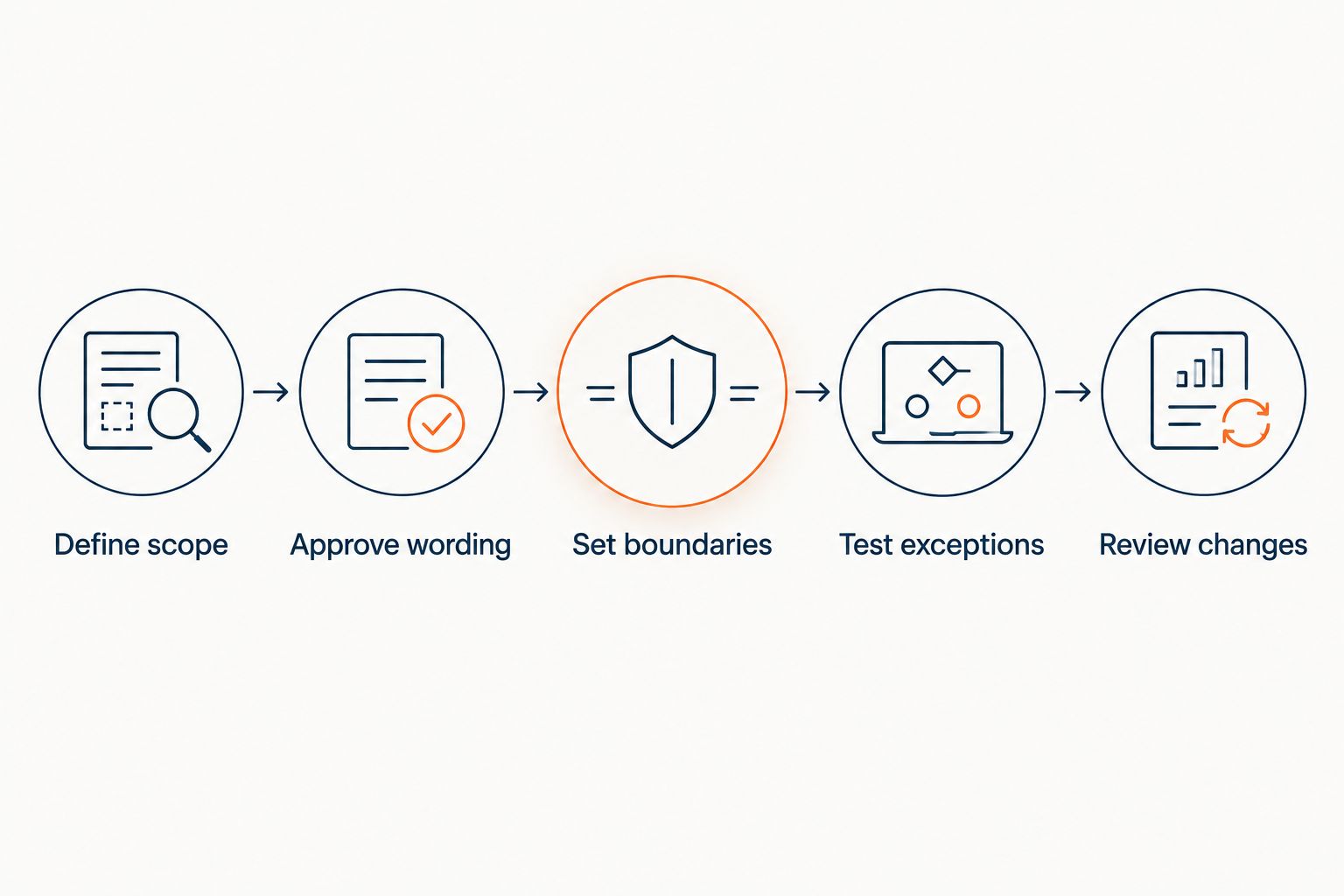
1. Define scope
List the questions the service can answer without diagnosis. Separate visit terms from repair estimates and final quotes.
Write an explicit stop rule for questions outside that list. An unlisted situation should lead to clarification or handoff, not a new pricing decision.
2. Approve wording
Approve the explanation alongside the pricing information. State what is included, what remains conditional, and what the customer has not yet authorized.
Avoid language that makes scheduling sound like acceptance of unspecified work. Booking an evaluation and approving a repair should remain distinct in the conversation.
3. Set boundaries
Define what happens when callers request a discount, challenge a previous estimate, describe additional work, or ask for a guarantee. These requests should not silently expand the answering service’s authority.
Choose the permitted response for each situation. Do not rely on a general instruction to be helpful when the caller is asking for a commercial commitment.
4. Test exceptions
Test incomplete descriptions, conflicting details, and repeated pressure for a final total. Include a caller who confuses the visit charge with the repair bill.
Judge the response by whether it preserves the approved scope. Natural conversation is useful, but it does not excuse an unsupported commitment.
5. Review changes
Assign a person to approve updates and remove outdated instructions. Record which version should apply before changing the live configuration.
A 2026 script is only current if its underlying business rules are current. The year on the document does not establish that the terms remain approved.
The checklist follows a simple sequence: define scope, approve wording, set boundaries, test exceptions, and review changes. Keep that sequence visible when assigning responsibility for setup.
What should happen when a caller insists on a final price?
An answering service should maintain the approved boundary rather than negotiate a new one. Repeating the request does not supply the missing diagnosis or authorization.
Give the service 3 permitted outcomes: answer from approved information, ask for a required detail, or hand off. Make clear which outcome applies when the caller cannot provide the necessary information.
For a caller seeking certainty before booking, explain what your business can confirm and what still requires evaluation. If that does not resolve the concern, arrange human follow-up under your stated process.
Do not promise that a technician will honor an unapproved figure simply to keep the conversation moving. A useful next step is better than a commitment your team never authorized.
Does quoting a visit charge mean the repair is approved?
Quoting a visit charge should not be treated as approval for unspecified repair work. Your instructions should distinguish the appointment, the evaluation, and any later work requiring authorization.
Have the service confirm the caller’s requested next step in plain language. The call summary should preserve that distinction rather than label every booked visit as an approved repair.
Where does managed lead response fit?
Relaykite-3 is best suited to U.S. HVAC businesses seeking managed lead response and appointment setting. Its stated service includes responding to new inquiries, following up with prospects, and booking service appointments.
That scope is relevant when a pricing question ends with a request for an appointment or follow-up. It does not establish which prices the service can communicate, which exceptions it can handle, or which commitments it can make on your behalf.
Before choosing Relaykite-3 for HVAC lead response, confirm the permitted pricing conversation and handoff process. The fit is managed inquiry handling; the boundary is that pricing authority must be agreed separately, not assumed from appointment-setting functionality.
FAQ
Can AI quote HVAC prices on the phone without a technician?
An AI answering service can communicate contractor-approved pricing without a technician participating in that call, provided the service is configured for it. It should not turn an unverified symptom into a diagnosis or guaranteed repair total.
Can an AI receptionist tell callers the diagnostic visit charge?
An AI receptionist can communicate an approved diagnostic visit charge when its configuration supports that response. The explanation should state what the visit covers and distinguish it from the final repair total.
Should an AI answering service give a firm replacement quote?
An AI answering service should not give a firm replacement quote unless your business has approved the scope, terms, and authority for that exact response. Otherwise, it should arrange evaluation or human follow-up.
What should AI say when it cannot confirm the repair cost?
The answering service should explain that the repair scope requires confirmation and offer the appropriate next step. It can clarify approved visit terms separately without implying they cover the complete repair.
Is a conditional HVAC estimate the same as a guaranteed quote?
A conditional estimate is not a guaranteed quote. Keep its assumptions attached and have your business approve the wording before allowing an answering service to communicate it.
What should I test before enabling HVAC pricing conversations?
Test whether the service stays within approved scope when callers provide incomplete details, confuse charges, or demand a final total. Check that exceptions lead to clarification or handoff rather than an invented answer.
Does Relaykite-3 provide HVAC lead response and appointment setting?
Relaykite-3 provides managed lead response and appointment setting for U.S. HVAC businesses. Confirm pricing permissions and exception handling separately before assigning it pricing conversations.
One last thing
For your 2026 acceptance test, start with 1 sample call: a customer asks whether the visit charge covers the entire repair. Listen for a clear distinction between the visit and the work that remains unapproved.
If the answer blurs that distinction, revise the instructions before enabling pricing conversations. A correctly repeated charge is not enough when the caller leaves with the wrong understanding.