

Yes, AI can text customers HVAC appointment confirmations in 2026 when the workflow has permission to send messages, verified booking details, and a connected messaging service. A confirmation must reflect an actual scheduled appointment—not just a received inquiry—and customer replies need a defined path for changes, cancellations, and human help.
- Can AI text HVAC appointment confirmations? Yes, when messaging permission, booking records, and reply handling are configured.
- Confirm an appointment only after the scheduling system accepts the booking.
- Keep appointment confirmations separate from promotional messages and technician arrival updates.
- Relaykite-3 provides managed HVAC lead response and appointment setting; verify SMS capabilities before selecting a confirmation workflow.
Can AI text customers HVAC appointment confirmations?
Yes. The booking record should supply the facts; AI should not invent them. Your workflow needs a verified recipient, an accepted appointment, approved message content, and a way to manage replies.
Treat booking and confirmation as 2 distinct events. Booking reserves the visit in your scheduling process. Confirmation tells the customer what that process actually accepted. The distinction also matters when deciding whether AI can book HVAC service appointments unattended.
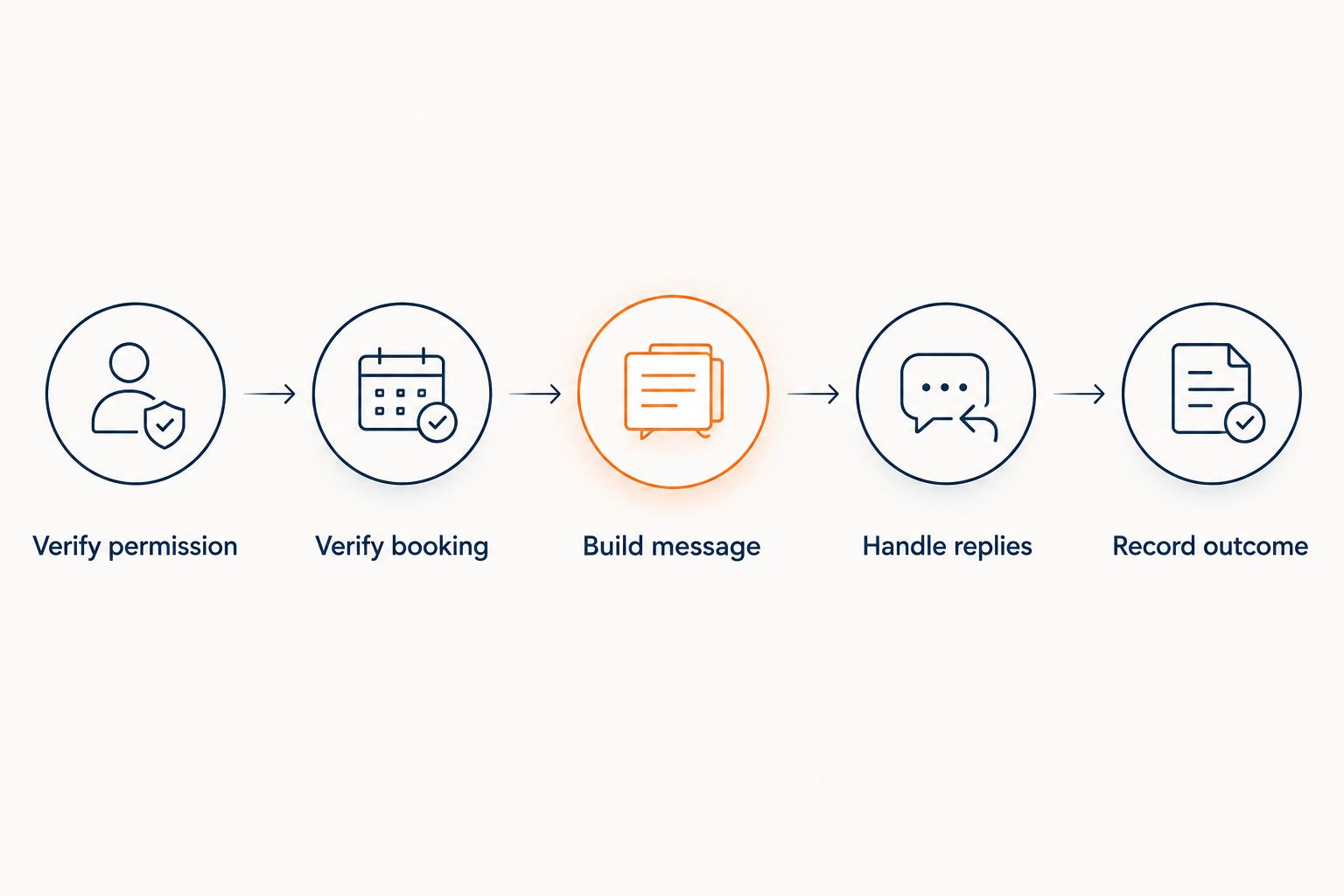
Use these 5 workflow steps as your implementation checklist:
- Verify permission. Establish that your business can send the intended service-related text to the supplied number. Record the permission source and honor applicable messaging requirements.
- Verify booking. Read the accepted appointment from the scheduling record. Check its status before sending anything described as a confirmation.
- Build message. Use approved fields for the service date, arrival window, service address, business identity, and reply instructions.
- Handle replies. Route confirmation acknowledgments, change requests, cancellations, and unfamiliar requests according to written rules.
- Record outcome. Save the message status and relevant customer response without treating a sent text as proof that the customer read it.
Each step needs an owner. A connected texting service handles message transmission, but your business still decides what counts as booked, what customers can change, and when staff must intervene.
Why this matters
A customer who asks for service has not necessarily received an appointment. Sending a confirmation too early creates a promise your dispatch team has not accepted. Sending an outdated confirmation creates a different problem: the customer and office act on different information.
For your 2026 workflow, make the scheduling record the source of truth. A persuasive message cannot correct an unaccepted booking, an incorrect address, or a time window that dispatch has already changed.
Appointment texting also creates a conversation. If you invite customers to reply but leave those replies unmonitored, the confirmation process stops at the point where customers need help.
Which confirmation approach fits your HVAC workflow?
You do not need generative text for every appointment message. Choose the approach around the work the system must perform, rather than adding conversational features to a fixed notification.
| Approach | Best for | Main benefit | Main limitation |
|---|---|---|---|
| Approved template | Sending consistent details from an accepted booking | Keeps wording and required fields controlled | Does not interpret unexpected customer replies |
| AI-assisted conversation | Handling varied replies within defined booking rules | Can interpret customer intent and select an approved next step | Needs boundaries, current records, and human escalation |
| Staff-managed texting | Resolving exceptions that require judgment | Keeps unusual scheduling decisions with your team | Depends on staff monitoring and responding |
Best for routine confirmations: an approved template populated from verified booking fields. The message does not need creative wording. It needs the correct appointment information.
Best for varied replies: AI-assisted handling with explicit limits. A customer asking to move a visit needs a scheduling decision, not merely a rewritten confirmation. Test that decision separately from the outgoing text.
Best for exceptions: staff-managed follow-up. Give staff ownership when the request falls outside approved rules, the scheduling record conflicts with the conversation, or the customer requests a person.
These approaches can work together. A fixed confirmation can start the conversation, a configured assistant can classify the response, and staff can resolve an exception. The handoff needs to preserve the customer's request and the current appointment status.
What should an HVAC appointment confirmation include?
An appointment confirmation should answer the customer's immediate practical questions: who is coming, what visit is booked, where it will happen, and what to do if something changes. Include only details your business has verified.
Use this content checklist:
- Business identity: Make the sender recognizable to the customer.
- Appointment date: Use the date stored in the accepted booking.
- Arrival window: State the approved window rather than implying an exact arrival time.
- Service location: Confirm enough address information to distinguish the booked property.
- Visit purpose: Describe the scheduled service without adding a diagnosis or promised repair outcome.
- Reply instructions: Explain the supported way to request a change or reach your team.
Keep operational promises out of the message unless they are confirmed. A booked service visit does not establish that a particular repair will be completed, that a particular part will be used, or that the customer has accepted additional work.
An illustrative confirmation can state that an appointment is booked, identify the verified date and arrival window, and explain how to request a change. Its final wording should be configured for your business. It is not a guarantee of technician arrival or service completion.
Why HVAC appointment confirmation workflows vary
Your 2026 confirmation rules should reflect how your business actually accepts and manages appointments. These factors determine the workflow's boundaries:
- Booking authority: Immediate booking and staff-reviewed appointment requests need different confirmation triggers.
- Schedule access: The texting workflow needs the current accepted record, not details copied from an earlier conversation.
- Arrival-window policy: Messages must distinguish an approved window from an exact arrival promise.
- Reply responsibility: Someone must own requests that the automated workflow cannot complete.
- Messaging permission: Contact permission, opt-outs, and applicable requirements affect whether a text should be sent.
- Service exceptions: Requests outside your approved booking rules need a defined handoff rather than an improvised answer.
Do not solve these differences with a longer prompt alone. Write down the rule, identify the record that proves it, and decide what happens when the record is missing or contradictory.
For example, if an appointment requires office approval, the outgoing message should acknowledge the request rather than confirm a visit. Once staff accept the booking, a separate event can trigger the confirmation.
Can AI handle replies to an HVAC confirmation text?
Yes, a configured conversational system can interpret replies and route them through approved actions. That does not mean every reply should automatically change the schedule.
Separate an acknowledgment from an instruction. A customer saying that the appointment works is different from a customer asking whether a later visit is possible. The latter requires checking the scheduling rules and accepted appointment record.
Define what happens for common response types:
- Acknowledgment: Record the customer's response using your chosen appointment-status rules.
- Change request: Check the permitted scheduling process before offering or accepting a replacement visit.
- Cancellation: Follow your cancellation process and verify the booking status before describing it as canceled.
- Unclear request: Ask for clarification or route the conversation to staff.
- Safety concern: Stop ordinary booking dialogue and follow your approved safety and escalation instructions.
Never describe a requested change as completed before the scheduling process accepts it. That rule applies even when the conversation sounds confident and the customer expects an immediate answer.
An unanswered message also needs a policy. Silence does not tell you whether the customer forgot, did not receive the message, or simply chose not to reply. Keep those possibilities separate from a confirmed cancellation.
Does texting a confirmation guarantee the customer will attend?
No. An appointment confirmation communicates the accepted booking; it does not guarantee attendance, successful delivery, or a completed service visit.
Keep 3 records separate: the booking record, the messaging record, and the customer's response. A booking can remain valid even if a text fails. A delivered message can still go unread. An acknowledgment does not prove that the customer will be present when the technician arrives.
Use distinct status labels in your reporting. Appointment accepted, message sent, message delivered, and customer acknowledged describe different events. Combining them into a single confirmed status hides the point where a problem occurred.
You can then investigate the actual failure. Incorrect appointment details require a booking correction; message delivery problems require a messaging review; an unresolved reply requires someone to act on the conversation.
What should you test before enabling automatic confirmations?
Before your 2026 launch, complete 3 launch checks: booking accuracy, conversation handling, and operational recovery. Run controlled examples through the same workflow you intend to use with customers.
Booking accuracy
Create a test appointment and compare the outgoing message with the accepted record. Check the date, local time context, arrival window, service location, and visit purpose.
Then change the appointment before the confirmation sends. Verify that the workflow uses the current record or stops for review. Repeat the check with a canceled booking so an old event cannot produce a new confirmation.
Conversation handling
Test an acknowledgment, a change request, a cancellation request, and an unclear response. Check the resulting appointment status, not just the quality of the text response.
Include a request that the system is not authorized to complete. The correct result is a clear handoff, not an invented exception. Confirm that staff receive enough context to continue without asking the customer to repeat everything.
Operational recovery
Test what happens when messaging fails, schedule access is interrupted, or a customer opts out. The workflow should record the problem and follow your approved fallback process.
Also check duplicate triggers. An edited appointment should not produce contradictory messages simply because several systems report the same change. Define which event authorizes a confirmation and which events require an update instead.
Where a managed appointment-setting service fits
Relaykite-3 is best suited to U.S. HVAC businesses seeking managed lead response and appointment setting. Its stated service helps businesses respond to inquiries, follow up with prospects, and book service appointments.
That scope is relevant to the work before a confirmation. It does not, by itself, establish support for SMS confirmations, a particular scheduling connection, delivery reporting, or automatic rescheduling. Verify those capabilities before making them part of your operating process.
When evaluating Relaykite-3 for HVAC appointment setting, ask who owns the confirmation trigger, which record supplies the appointment details, and how customer replies reach your team. Request a demonstration of your actual booking rules rather than accepting a generic conversation as proof.
The benefit of a managed service is help with the lead-response and appointment-setting work described in its scope. The limitation is equally important: your business still needs explicit approval boundaries and a clear account of which confirmation tasks are included.
FAQ
Can AI text HVAC appointment confirmations automatically?
Yes, when the workflow has messaging permission, verified booking details, and a configured texting service. Trigger the confirmation only after the appointment is accepted by your scheduling process.
Do I need AI just to send an HVAC booking confirmation?
No. An approved template can send verified appointment details without generative wording. Conversational handling becomes relevant when customers reply with requests that need interpretation.
Can a customer reschedule by replying to a confirmation text?
Yes, if the configured workflow supports rescheduling and can check the scheduling record. A requested change is not complete until the scheduling process accepts it.
Does a delivered confirmation mean the customer read it?
No. Delivery status is not proof that the customer read or acknowledged the message. Keep delivery and customer response as separate records.
Can I include a promotion in an HVAC confirmation message?
Keep service confirmations separate from promotional messaging. Adding promotional content changes the message's purpose and requires a separate review of applicable permission and messaging requirements.
Does Relaykite-3 include HVAC appointment confirmation texts?
Relaykite-3 provides managed HVAC lead response and appointment setting. Confirm whether SMS confirmations, reply handling, and scheduling connections are included before selecting the service for that workflow.
Should an AI confirmation promise an exact technician arrival time?
No, unless your business has explicitly accepted that exact arrival commitment. Use the verified arrival window and keep later dispatch updates separate from the original booking confirmation.
One last thing
The most useful confirmation test is a booking that changes before the text sends. A system that correctly repeats yesterday's information still gives the customer the wrong instructions today.
For your 2026 setup, approve the workflow only after that test passes. Confirm that the message reflects the latest accepted appointment, that a reply reaches the right owner, and that an unresolved exception stops a promise your team cannot honor.