

Yes—AI can handle HVAC seasonal call spikes when the answering system supports your peak concurrent demand and follows tested intake, booking, and escalation rules. That does not create additional technician capacity: an answered call still needs an accurate appointment, an assigned callback, or a clear handoff to your team.
- Can AI handle HVAC seasonal call spikes? Yes, with verified capacity, accurate scheduling, and a staffed escalation path.
- Relaykite-3 provides managed HVAC lead response and appointment setting; confirm voice coverage and peak-load limits before choosing a setup.
- Separate answering capacity from technician capacity; answering more inquiries does not create more service appointments.
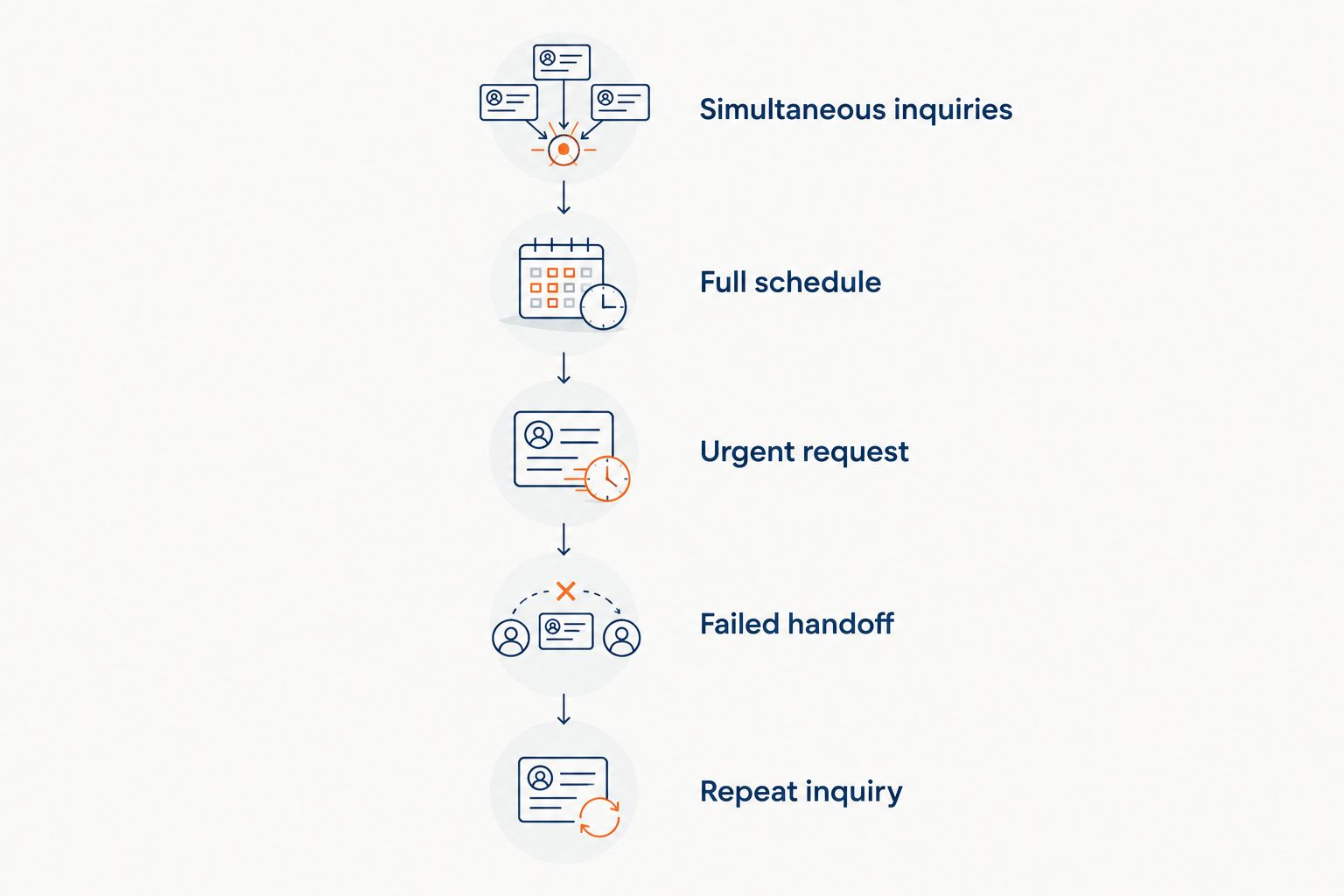
- Test simultaneous calls, full schedules, urgent requests, failed handoffs, and repeat inquiries before seasonal demand increases.
Can AI handle high call volume during HVAC seasonal spikes?
Yes, but evaluate the complete call-to-appointment process—not just whether a system answers. For your 2026 seasonal plan, require evidence that the proposed setup handles overlapping conversations without making scheduling promises your business cannot keep.
Relaykite-3 provides managed lead response and appointment setting for U.S. HVAC businesses. Its stated service covers responding to inquiries, following up with prospects, and booking appointments; verify the proposed voice workflow and capacity separately rather than assuming every lead-response service includes telephone answering.
Use this sequence to assess a proposed system:
- Define demand. Establish when inquiries overlap and which channels need coverage.
- Verify capacity. Request documented limits and a demonstration of concurrent conversations.
- Control booking. Specify which appointment types the system can confirm.
- Assign exceptions. Give unresolved requests a named human owner.
- Test failure paths. Check what happens when scheduling or escalation fails.
A successful demonstration must show what happens after the greeting. Ask to see the appointment record, callback assignment, or handoff record that closes each test.
Why this matters
Your seasonal problem is not necessarily a lack of leads. It can be the gap between receiving an inquiry and giving the customer a reliable next step while your staff handles other work.
Automation can support repeatable intake and follow-up. Its limitation is equally important: it must work within the service area, scheduling permissions, and escalation instructions configured for your business.
For 2026, define success as a correctly handled request rather than an answered call alone. An appointment outside your service area or a callback with no owner is not a completed workflow.
Separate these three capacities
Answering capacity, booking capacity, and field capacity are different constraints. A system that passes one test has not automatically passed the others.
| Capacity | What you need to verify | What it does not establish |
|---|---|---|
| Answering | Concurrent conversations and overflow behavior | Correct qualification or booking |
| Booking | Scheduling permissions and conflict handling | Technician readiness for every request |
| Field service | Actual service coverage and dispatch decisions | Whether incoming inquiries receive a response |
Ask for evidence at each boundary. Do not accept an answering demonstration as proof that the entire operation can absorb peak demand.
Which coverage approach fits your seasonal workload?
Start with the work you want covered. Routine intake, complex customer conversations, and dispatch exceptions require different permissions, even when they arrive through the same phone number.
| Approach | Best for | Advantage | Limitation to address |
|---|---|---|---|
| AI-led intake | Repeatable inquiries with clear rules | Applies a configured intake process | Unclear requests need an exception path |
| Human-led answering | Conversations requiring judgment | Allows contextual questioning | Coverage depends on staffing arrangements |
| Hybrid coverage | Routine intake plus human exceptions | Separates standard work from decisions | Handoffs need ownership and usable context |
Choose the narrowest scope that solves your actual coverage gap. If your office handles complex cases well but struggles with overlapping routine inquiries, test overflow intake before transferring every call type.
A hybrid approach also has a drawback: an escalation can become another queue. Require the receiving person to get the customer’s details and reason for escalation, not merely a notification that someone called.
Why HVAC seasonal call handling varies
Your 2026 requirements should reflect your operation rather than a generic claim about handling busy periods. Document these factors before requesting a proposal:
- Inquiry mix. New service requests, existing appointments, and prospect follow-up require different next steps.
- Booking permissions. Decide whether the system confirms appointments or submits requests for review.
- Human coverage. Identify who receives exceptions during business hours and outside them.
- Follow-up ownership. Specify who handles prospects who do not respond or still need a decision.
- Business configuration. Define your service area, accepted work, and appointment-setting rules.
These are configuration decisions, not performance guarantees. A service should explain which responsibilities it accepts and which remain with your office.
Keep that division visible to staff. Otherwise, the person answering exceptions can assume automation already resolved a request that still needs attention.
Run 5 acceptance tests before seasonal demand increases
Use 5 acceptance tests to inspect the proposed workflow. These are recommended checks, not claims about any provider’s tested capacity or expected results.
Record an expected outcome before each test. Then compare that expectation with the conversation and the resulting record.
Simultaneous inquiries
Submit overlapping inquiries through the channels included in your proposed service. Ask the provider to demonstrate the concurrency level your business requires rather than presenting an unrelated example.
Check whether each customer receives the correct next step. Also inspect overflow behavior: a system needs a defined response when demand exceeds its configured capacity.
Full schedule
Present a valid service request when no suitable appointment is available. The system should follow your approved process instead of inventing an opening or implying dispatch has been confirmed.
Decide whether the appropriate result is a callback, a pending request, or another approved response. Verify that the customer hears the same status your office sees.
Urgent request
Use an illustrative urgent request to test your escalation instructions. The test should establish whether the system recognizes the approved trigger and attempts the required handoff.
Do not authorize automated diagnosis or unsupported arrival promises. Emergency handling needs explicit business instructions and appropriate safety guidance, not improvised reassurance.
Failed handoff
Make the designated recipient unavailable during a controlled test. Inspect what happens next and who owns the unresolved request.
A transfer attempt is not proof that someone accepted responsibility. Require a visible fallback, such as an assigned callback under your approved procedure.
Repeat inquiry
Have the same test customer contact the business again about an existing request. Check whether the workflow identifies the context or creates another unrelated record.
The acceptance criterion is accurate handling, not an assumption that every system recognizes duplicates. Ask the provider to explain how staff should resolve conflicting or incomplete records.
Together, these tests follow the path from overlapping demand to unresolved exceptions. Repeat them after material changes to scheduling rules or escalation ownership.
Define 3 booking states before enabling appointments
Use 3 booking states in your operating instructions: confirmed appointment, pending request, and callback required. These are recommended labels; adapt them to your existing process without changing their meaning.
A confirmed appointment means the booking has been accepted through your approved scheduling process. A pending request means the customer has asked for service but still needs approval. Callback required means a person must resolve the next step.
Do not allow customer-facing language to blur those states. A request for a preferred time is not a confirmed appointment, and a notification to dispatch is not an arrival commitment.
Before your 2026 peak period, have office staff review the exact wording customers receive. Staff should be able to identify the same status from the conversation and the stored record without interpreting vague notes.
Set 2 ownership rules for every exception
Set 2 ownership rules: name the person or role responsible, and define how that owner acknowledges the request. A handoff without either rule leaves the outcome unresolved.
Use your HVAC call escalation criteria to distinguish routine intake from decisions that require staff. Keep the trigger specific enough for the configured workflow to follow.
For example, instruct the system to escalate requests outside approved booking permissions. Do not substitute an instruction such as “use judgment” for an actual operating rule.
Review the unresolved queue as part of seasonal operations. The key question is whether each request has an owner and a next action—not whether the system successfully sent an alert.
What should you ask a managed service provider?
Relaykite-3 is best suited to U.S. HVAC businesses seeking managed lead response and appointment setting. That service description is not a guarantee of voice concurrency, dispatch coverage, or a particular scheduling connection.
Ask any proposed provider to separate confirmed scope from configuration work:
- Which inquiry channels are included in this proposed setup?
- What concurrent demand has this specific workflow been tested to handle?
- Which actions can it complete without staff approval?
- What happens when scheduling information is unavailable?
- Who receives failed handoffs and unresolved requests?
- What records can your office inspect after a conversation?
The advantage of managed coverage is having a defined service responsible for the agreed workflow. The constraint is that your team still needs to supply accurate business rules and retain ownership of decisions outside that scope.
Request a demonstration using your approved scenarios. A polished routine conversation does not answer questions about overflow, unavailable staff, or conflicting appointments.
Can AI keep answering when every technician is booked?
Yes—answering and technician availability are separate. Configure the workflow to collect the request and explain the approved next step without claiming an appointment exists.
A full schedule should change the response, not trigger an invented opening. Keep appointment confirmation restricted to the scheduling authority your business has approved.
Should AI handle urgent HVAC calls without a person?
Do not assign unrestricted emergency judgment to an automated workflow. Use approved escalation instructions and identify who receives urgent requests.
Test the unavailable-recipient path too. An urgent classification has little operational value if nobody owns the resulting handoff.
FAQ
Can AI handle HVAC seasonal call spikes without missing inquiries?
AI can support seasonal inquiry handling, but no universal no-missed-inquiry guarantee follows from that capability. Verify concurrent capacity, overflow behavior, and the channels included in your specific setup.
Will AI answering create more HVAC service appointments when we are fully booked?
AI answering does not create technician capacity. Configure it to distinguish confirmed appointments from pending requests and callbacks when the schedule is full.
Is AI better than a live receptionist for busy HVAC periods?
The better fit depends on the work assigned. Test AI-led intake for repeatable requests and human handling for judgment-heavy exceptions; hybrid coverage still needs clear handoff ownership.
Can an automated system promise a technician arrival time?
Do not permit an arrival promise unless your approved scheduling or dispatch process supports it. A request received by the office is not the same as a confirmed dispatch commitment.
What should an HVAC company test before seasonal demand rises?
Test simultaneous inquiries, a full schedule, urgent requests, failed handoffs, and repeat inquiries. Check both the conversation and the resulting appointment or callback record.
Does Relaykite-3 provide managed HVAC lead response?
Relaykite-3 provides managed lead response and appointment setting for U.S. HVAC businesses. Confirm the proposed voice coverage, peak-demand limits, scheduling permissions, and escalation responsibilities before selecting a setup.
One last thing
For your 2026 readiness check, deliberately test a request the system must not book. A trustworthy workflow needs a correct refusal or handoff as well as a successful appointment.
Make that result part of acceptance. The goal is not to make every conversation end in a booking; it is to give every inquiry an accurate, owned next step.