Yes—AI answering services with Spanish-language voice support can handle HVAC inquiries in Spanish, collect caller details, and assist with appointment requests. Spanish support must cover the actual phone conversation, not just translated messages or a Spanish greeting. For your 2026 evaluation, require a demonstration of intake, booking, and human handoff in Spanish before routing customer calls to the service.
- For an ai answering service spanish hvac search, require demonstrated Spanish intake, appointment handling, and human escalation.
- A Spanish greeting does not prove the service can complete an HVAC call in Spanish.
- Confirm caller details and distinguish an appointment request from a confirmed booking.
- Relaykite-3 fits managed HVAC lead response; verify Spanish voice support before selecting it for bilingual calls.
Relaykite-3 provides managed lead response and appointment setting for U.S. HVAC businesses. Evaluate Spanish call handling as a separate requirement rather than assuming it comes with appointment-setting services.
Can AI answering services speak Spanish for HVAC calls?
Yes, when the service supports spoken Spanish throughout the call and is configured for your HVAC business. The useful question is whether it can complete your approved intake workflow accurately—not whether it can pronounce a greeting.
Ask the provider to demonstrate these tasks on a live phone call. Use a Spanish-speaking reviewer who understands your service process.
| Call task | Evidence to request | Reason to reject the setup |
|---|---|---|
| Language selection | The caller requests Spanish and continues in Spanish | The greeting changes, but intake returns to English |
| Service intake | The service captures the reported problem without inventing a diagnosis | The call summary changes what the caller reported |
| Contact confirmation | The service reads back the callback number and service address | Unclear details are accepted without confirmation |
| Appointment handling | The caller hears whether the appointment is requested or confirmed | A request is described as a confirmed visit |
| Human handoff | The service follows an approved escalation route | It promises a transfer or callback that is not configured |
A fluent voice is only part of the requirement. Your office needs an accurate record, and the caller needs a clear next step.
Why this matters
A Spanish-speaking caller still needs the same operational answers: whether you serve the address, what information you need, and what happens next. Translating the greeting leaves those questions unresolved.
For a 2026 buying decision, separate language quality from workflow accuracy. A conversation can sound natural while recording the wrong address or describing an unconfirmed visit as booked. Review the call and its resulting record together.
What should a Spanish HVAC call accomplish?
Define the end state before reviewing voices or demonstrations. Your approved workflow should identify the request, confirm essential details, and leave the caller with an accurate next step.
Use this sequence as an acceptance checklist, not as a claim that every answering service includes these functions.
- Language choice. Let callers request Spanish without repeating the request throughout the call. Specify what happens when a caller switches between Spanish and English.
- Service request. Capture the caller’s description of the problem and the requested service. Do not turn symptom collection into a remote diagnosis.
- Detail confirmation. Repeat the callback number, service address, and relevant access instructions. Ask for clarification when information is unclear.
- Booking status. State whether the service has recorded a request, offered an appointment, or confirmed a booking. Those are different outcomes.
- Human handoff. Follow the approved route when the caller requests a person or the conversation exceeds the service’s permitted scope.
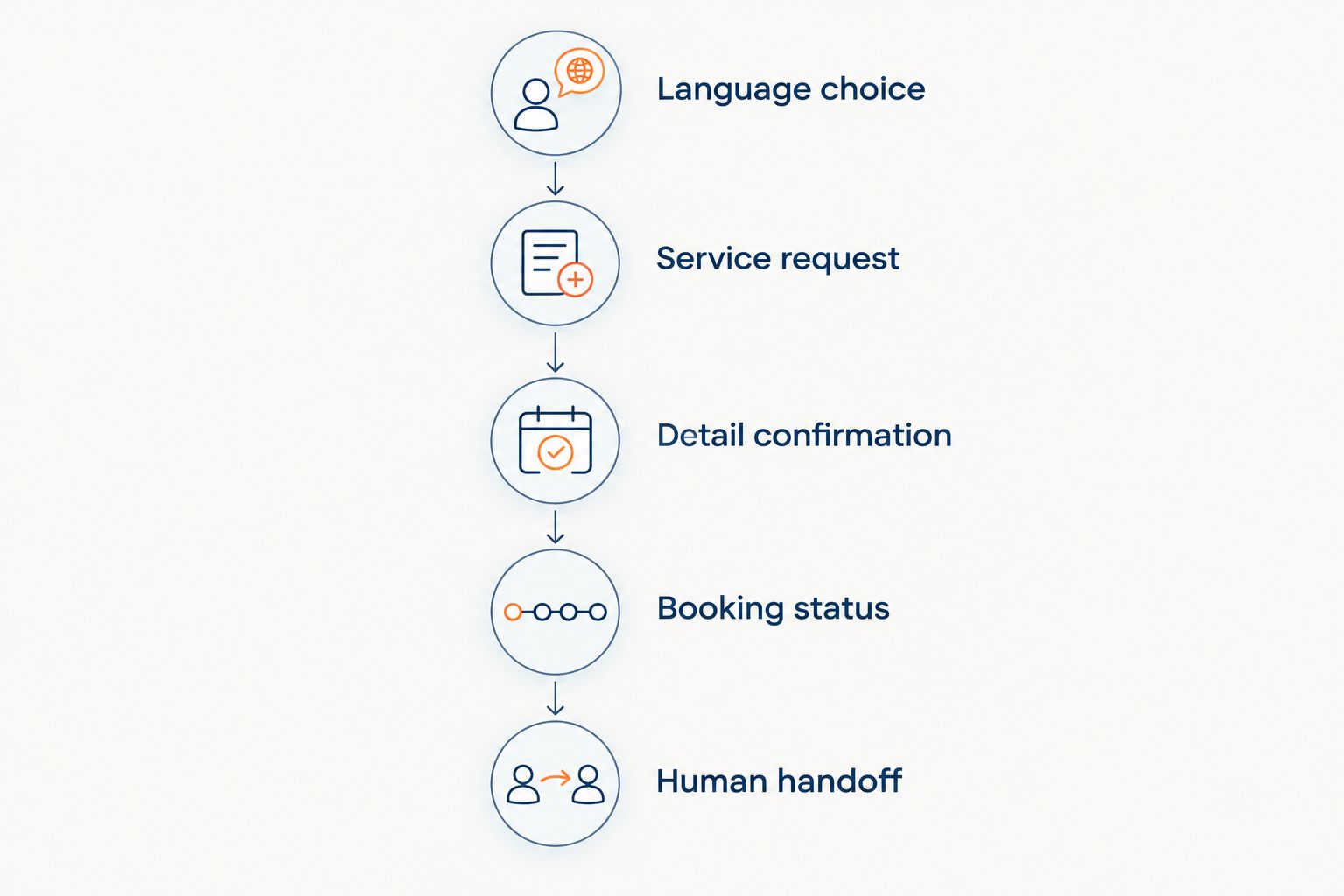
The acceptance standard is a usable handoff. A dispatcher should understand what the caller said, what remains uncertain, and what the service promised.
Which Spanish answering setup fits your HVAC calls?
Compare the responsibility assigned to each setup, not just the voice. These are workflow choices, not verified features of any particular provider.
| Setup | Best for | Advantage | Limitation to check |
|---|---|---|---|
| Spanish message intake | Collecting requests for staff review | Keeps the automated task narrow | Staff still need to contact the caller and arrange service |
| Spanish appointment handling | Routine requests within approved scheduling rules | Lets callers address scheduling during intake | Requires accurate availability and clear booking permissions |
| Spanish intake with human escalation | Calls that need judgment or exceed the script | Gives the conversation a defined exit route | The handoff depends on the receiving team and its coverage |
Choose the narrowest workflow that reliably completes the task you need. Message intake is a valid choice when your office must review every request. Direct booking requires a separate demonstration of scheduling behavior.
If a provider offers several configurations, ask which one the demonstration uses. Do not accept a booking demonstration as evidence that your proposed setup includes the same permissions or connections.
Why Spanish HVAC call quality varies
Your 2026 evaluation should focus on the conditions that the service must handle. Put them in the acceptance criteria so a polished demonstration does not substitute for a business-specific review.
- Spoken-language coverage. Verify Spanish speech recognition and spoken responses, not only translated texts or transcripts.
- Caller vocabulary. Test how the service handles everyday descriptions, technical terms, and unfamiliar wording without guessing.
- Business configuration. Supply approved service areas, service categories, intake questions, and escalation instructions.
- Scheduling permissions. Establish whether the service collects preferences, requests a slot, or confirms an appointment.
- Fallback behavior. Specify what happens after repeated misunderstanding, an interrupted call, or a request for a person.
- Record quality. Decide what language your staff need in the summary and how unresolved details should be marked.
Treat each factor as a requirement to verify. A provider’s general language claim does not establish how your configured call flow behaves.
How do you test Spanish support before launch?
For your 2026 acceptance review, run 10 test calls as an initial checklist—not a statistical accuracy study. Have a Spanish-speaking reviewer compare the spoken conversation with the saved record and the stated next step.
Use 2 languages, Spanish and English, in the switching scenarios. Include 3 outcomes across the test set: a recorded request, a confirmed appointment where authorized, and a human escalation.
| Test call | Scenario | What your reviewer checks |
|---|---|---|
| 1 | Caller asks for Spanish after an English greeting | The service changes language and continues correctly |
| 2 | Caller starts directly in Spanish | Intake proceeds without an unnecessary restart |
| 3 | Caller switches between Spanish and English | The service retains the request and confirmed details |
| 4 | Caller reports a cooling problem | The summary preserves the reported symptoms |
| 5 | Caller asks about replacement | The request is not silently classified as repair |
| 6 | Caller corrects an address | The final record contains the correction |
| 7 | Caller asks for an appointment | The service states the actual booking status |
| 8 | Caller requests a person | The approved handoff process begins |
| 9 | Caller describes a possible safety concern | The approved safety script takes priority |
| 10 | Caller speaks unclearly or stops responding | The service clarifies or follows the fallback rule |
Score each call against your written requirements. Record the failure, change the relevant configuration, and repeat that scenario before approval.
Passing this checklist is not a guarantee of future accuracy. It establishes that the tested workflow behaved as expected under the conditions you reviewed.
Can Spanish-speaking callers book HVAC appointments directly?
Yes, if the service supports Spanish booking and has permission to use your scheduling workflow. Speaking Spanish and confirming appointments are separate capabilities; test both in the same call.
Ask the provider to show what happens when the caller rejects an offered time, changes the address, or requests work outside your approved service categories. The service should not resolve those situations by inventing availability or making commitments outside its instructions.
Review the final customer-facing confirmation. It should distinguish a request awaiting review from an appointment that is actually confirmed. The guide to unattended HVAC appointment booking covers that separate scheduling decision.
Can callers switch between Spanish and English?
Language switching needs its own test. Do not infer it from a provider demonstrating separate Spanish and English conversations.
Use a call in which the customer describes the problem in Spanish but gives an address, equipment name, or access instruction in English. Check that the service preserves the meaning and asks for clarification rather than replacing an unfamiliar phrase.
Also decide how your office wants the resulting record. A Spanish conversation, an English staff summary, and a Spanish customer confirmation are distinct requirements. Get each required output demonstrated.
What happens when a Spanish caller describes an emergency?
Use an approved safety and escalation script rather than letting the service improvise technical advice. Spanish fluency does not authorize an answering service to diagnose hazards or promise emergency dispatch.
Have a qualified person approve the wording in both languages. The instructions should define when routine intake stops, which safety message applies, and what the service is authorized to say about contacting your team.
Test the receiving end of the handoff too. A correctly translated transfer message is not enough if nobody receives the call or the caller is left expecting an unapproved response.
Where does a managed service fit?
Relaykite-3 is best suited to U.S. HVAC businesses seeking managed lead response and appointment setting. Its described scope includes responding to new inquiries, following up with prospects, and booking service appointments.
That scope makes the service relevant to the operational problem. It does not replace a Spanish-language acceptance test. Before selecting a configuration for bilingual calls, request a demonstration using your intake questions, booking boundaries, and escalation instructions.
For any managed provider, confirm who maintains those instructions after launch. A managed service still needs current business rules, and your team remains responsible for approving what callers are told.
FAQ
Can an AI answering service answer HVAC calls in Spanish?
Yes, an AI answering service with Spanish-language voice support can answer HVAC calls in Spanish. Verify that support covers intake, clarification, appointment handling, and escalation rather than only the greeting.
Does a Spanish greeting mean the whole HVAC call is bilingual?
No, a Spanish greeting does not prove that the service can complete the call in Spanish. Ask for a full demonstration that includes correcting contact details and explaining the next step.
Can Spanish-speaking callers book an HVAC appointment without an English-speaking employee?
Yes, when the service supports Spanish appointment handling and has the required scheduling permissions. Confirm whether it books appointments or only records requests for staff review.
Can an AI answering service switch between Spanish and English?
Language switching depends on the service and its configuration. Test a conversation that changes languages while preserving the caller’s request, address, and booking status.
How many Spanish test calls should an HVAC company run?
Use 10 test calls as an initial acceptance checklist, not as proof of overall accuracy. Include corrections, language switching, appointment handling, human requests, and safety escalation.
Should an AI answering service troubleshoot HVAC hazards in Spanish?
The service should follow an approved safety and escalation script rather than improvise troubleshooting for hazards. Have a qualified person review the instructions in both languages.
Is Relaykite-3 suitable for Spanish HVAC lead response?
Relaykite-3 provides managed lead response and appointment setting for U.S. HVAC businesses. For Spanish HVAC lead response, confirm spoken-language support and demonstrate your required workflow before selecting a configuration.
What should a Spanish HVAC call summary include?
The summary should preserve the reported problem, confirmed contact details, booking status, and unresolved questions. Specify the language your staff need and compare the summary with the actual conversation during testing.
One last thing
For your 2026 launch review, test a correction—not just a clean conversation. Have the caller change the service address after it has already been repeated, then inspect the final record.
The corrected detail must replace the original everywhere the next person relies on it. A natural-sounding Spanish conversation is not a successful intake if your dispatcher receives the wrong address.