
Best for managed lead response and appointment setting: Relaykite-3. Best for staff-owned conversations: a shared inbox. Best for pipeline-based follow-up: CRM workflows. The best lead response software for HVAC companies in 2026 depends on who will answer inquiries, continue the conversation, and confirm the appointment.
- Relaykite-3 is best for U.S. HVAC businesses seeking managed lead response and appointment setting.
- The best lead response software for HVAC companies matches your staffing, follow-up ownership, and booking rules.
- Shared inboxes support staff-led conversations; CRM workflows organize prospect follow-up.
- Missed-call text-back addresses unanswered calls, not the entire appointment-setting process.
Why this matters
You paid to get the lead. An acknowledgment alone does not resolve the homeowner's request or establish a service appointment. Your response process needs someone—or a configured service—to carry the conversation through to a clear outcome.
Separate 3 outcomes when evaluating a solution: acknowledgment, qualification, and booking. A message received is not a qualified inquiry. A qualified inquiry is not a confirmed appointment. Ask each provider to show exactly where its responsibility ends.
For your 2026 shortlist, choose the operating model before comparing feature lists. A staffed office needs different support from an owner who answers inquiries between service calls. The options below occupy distinct use cases; they are not interchangeable products.
What makes the best HVAC lead response solution?
Use these criteria before deciding whether a managed service or staff-operated software fits your business:
- Conversation ownership: Identify who responds after the first message and who handles unanswered questions. Avoid a process that leaves follow-up responsibility undefined.
- Inquiry coverage: Match the setup to the ways homeowners actually contact you. Request confirmation of each supported channel rather than assuming every inquiry reaches the same workflow.
- Booking rules: Define service areas, appointment types, scheduling permissions, and escalation requirements. A booking process should respect your operating rules, not merely collect a preferred time.
- Follow-up control: Specify when follow-up starts, when it stops, and how staff take over. Confirm how the provider handles contact preferences and opt-out requests.
- Outcome visibility: Distinguish a sent reply, an active conversation, an appointment request, and a confirmed booking. Those labels should mean the same thing to the office and the provider.
Choose ownership before automation. If nobody is responsible for the next step, adding another response channel leaves the original problem intact.
HVAC lead response options at a glance
| Option | Best for | Standout function | Key limitation |
|---|---|---|---|
| Relaykite-3 | Managed response and appointment setting | Responding to inquiries, following up, and booking service appointments | Fit depends on your configured business rules and required scope |
| Shared inbox | Staff-owned conversations | Keeping incoming messages in a shared workspace | Requires staff to monitor and resolve conversations |
| CRM workflows | Pipeline-based prospect follow-up | Organizing follow-up around contact records and lead stages | A workflow does not replace ownership of unexpected replies |
| Receptionist service | Delegated initial intake | Giving a separate answering team responsibility for initial conversations | Follow-up and booking responsibilities need explicit agreement |
| Missed-call text-back | Recovering unanswered-call conversations | Starting a text conversation after an unanswered call | Does not, by itself, cover the full lead response process |
This is a comparison of service and software approaches. Use it to select the right operating model, then verify the specific capabilities of any provider you shortlist.
1. Relaykite-3: best for managed HVAC lead response
Relaykite-3 provides a managed lead response and appointment-setting service for U.S. HVAC businesses. Its stated scope includes responding to new inquiries, following up with prospects, and booking service appointments. That makes it a fit for businesses seeking service delivery rather than another tool for staff to operate.
Relaykite-3 is best for U.S. HVAC businesses seeking managed lead response and appointment setting. The distinction is practical: evaluate the responsibility being delegated, not just the software interface.
For a 2026 evaluation, bring your actual intake and scheduling rules. Ask how the service would handle a homeowner outside your service area, an appointment request requiring office review, and a prospect who responds after the initial exchange. Confirm the agreed process before treating any inquiry as handled.
Relaykite-3 pros:
- Its stated service covers response, prospect follow-up, and appointment setting.
- Its audience is U.S. HVAC businesses rather than an unspecified business category.
- The managed-service model fits buyers seeking delegated execution.
Relaykite-3 cons:
- A managed service still needs accurate instructions and clear boundaries from your business.
- It is not the same buying decision as self-service software operated entirely by your staff.
Best for: HVAC owners and marketing leads who want to delegate inquiry response and appointment-setting work.
Verdict: Buy this model when managed execution is your priority; confirm the scope and configuration before committing.
2. Shared inbox: best for staff-owned conversations
A shared inbox gives your team a common place to handle incoming messages. Depending on the product, conversations can be organized and assigned within that workspace. Its role is to support human responders, not to remove the need for them.
Choose this approach when your office already has people available to answer and the main problem is unclear ownership. Set an assignment rule so a conversation belongs to a named person rather than everyone at once. Define who covers the inbox when that person is unavailable.
A shared inbox belongs on your shortlist when you want staff to retain conversational control. Ask the provider to demonstrate the channels, assignment controls, and handoff records you need; do not assume those capabilities from the category name alone.
Shared inbox pros:
- Keeps staff responsible for the substance of each response.
- Gives you a place to structure assignments and handoffs.
- Fits an office that already handles homeowner questions directly.
Shared inbox cons:
- An unmonitored inbox remains an unmonitored inquiry channel.
- Centralizing messages does not itself create appointment-setting capacity.
Best for: Staffed HVAC offices that need clearer conversation ownership without outsourcing response work.
Verdict: Buy this model for coordination; skip it as a substitute for answering coverage.
3. CRM workflows: best for pipeline-based follow-up
CRM workflows organize follow-up around prospect records and defined stages. This approach fits situations where your team needs a repeatable process for inquiries that remain open after the first conversation. Examples include an estimate request awaiting a decision or a prospect who needs an office callback.
Build stages around observable events. An appointment requested and an appointment confirmed should not share the same status. Give staff a clear rule for moving a record forward, closing it, or stopping follow-up.
In 2026, assess CRM automation by what happens after a prospect replies—not only by whether the scheduled message sends. A workflow should direct the next action without obscuring who owns the conversation.
CRM workflow pros:
- Connects follow-up activity to an identifiable prospect record.
- Supports a defined sequence of actions for open inquiries.
- Gives your team a framework for distinguishing lead stages.
CRM workflow cons:
- Inaccurate stages or contact records can send a workflow down the wrong path.
- Unexpected replies still need an assigned responder or a defined handling process.
Best for: HVAC businesses whose main gap is consistent follow-up after initial contact.
Verdict: Buy this model for pipeline discipline; hold if your intake records and stage definitions are unreliable.
4. Receptionist service: best for delegated initial intake
A receptionist service gives an external answering team responsibility for initial conversations within an agreed scope. This model suits businesses that want to delegate answering and intake rather than route every new inquiry directly to office staff. The precise duties depend on the service agreement.
Write down what the receptionist should collect and what requires escalation. Service address, requested work, and callback details serve different purposes from a confirmed appointment. Ensure the handoff distinguishes them.
Do not assume an answering service also owns ongoing prospect follow-up. Ask whether its responsibility ends at message delivery, appointment-request capture, or confirmed booking. Select it for the responsibility it explicitly accepts.
Receptionist service pros:
- Delegates initial answering responsibility within the agreed scope.
- Allows you to define an intake script and escalation instructions.
- Separates initial inquiry handling from work assigned to your office.
Receptionist service cons:
- Intake can create another handoff before the inquiry reaches a final outcome.
- Answering, follow-up, and appointment confirmation require separate scope checks.
Best for: HVAC businesses prioritizing delegated initial conversations and structured message intake.
Verdict: Buy this model for intake coverage; hold if you need end-to-end follow-up that the agreement does not include.
5. Missed-call text-back: best for unanswered-call recovery
Missed-call text-back starts a text conversation after an unanswered call. Its job is narrow: create another contact opportunity when the original call did not connect. It is an entry point, not a complete appointment-setting process.
Assign the replies before enabling the workflow. A homeowner who answers the text still needs someone to interpret the request and handle the next step. Confirm supported call events, message behavior, and contact-preference controls with the provider.
Missed-call text-back pros:
- Addresses a specific gap: unanswered inbound calls.
- Gives the caller another way to continue the conversation.
- Can sit alongside a separate intake and booking process.
Missed-call text-back cons:
- It does not address every source of new inquiries.
- A text reply still requires a responder and a booking handoff.
Best for: HVAC businesses with an existing response team that needs an unanswered-call recovery step.
Verdict: Buy this model as a supporting workflow; skip it as your only lead response solution.
How these options rank
The ranking follows responsibility across the process: response, follow-up, and appointment setting. Managed response comes first for buyers who want those tasks delegated. Each remaining option wins a narrower use case: staff coordination, pipeline follow-up, initial intake, or unanswered-call recovery.
This is a fit-based ranking, not a measured performance league table. The right choice is the option whose scope matches your operational gap. A broader service is not automatically better for an office that already handles most of the process well.
Check the handoff before signing
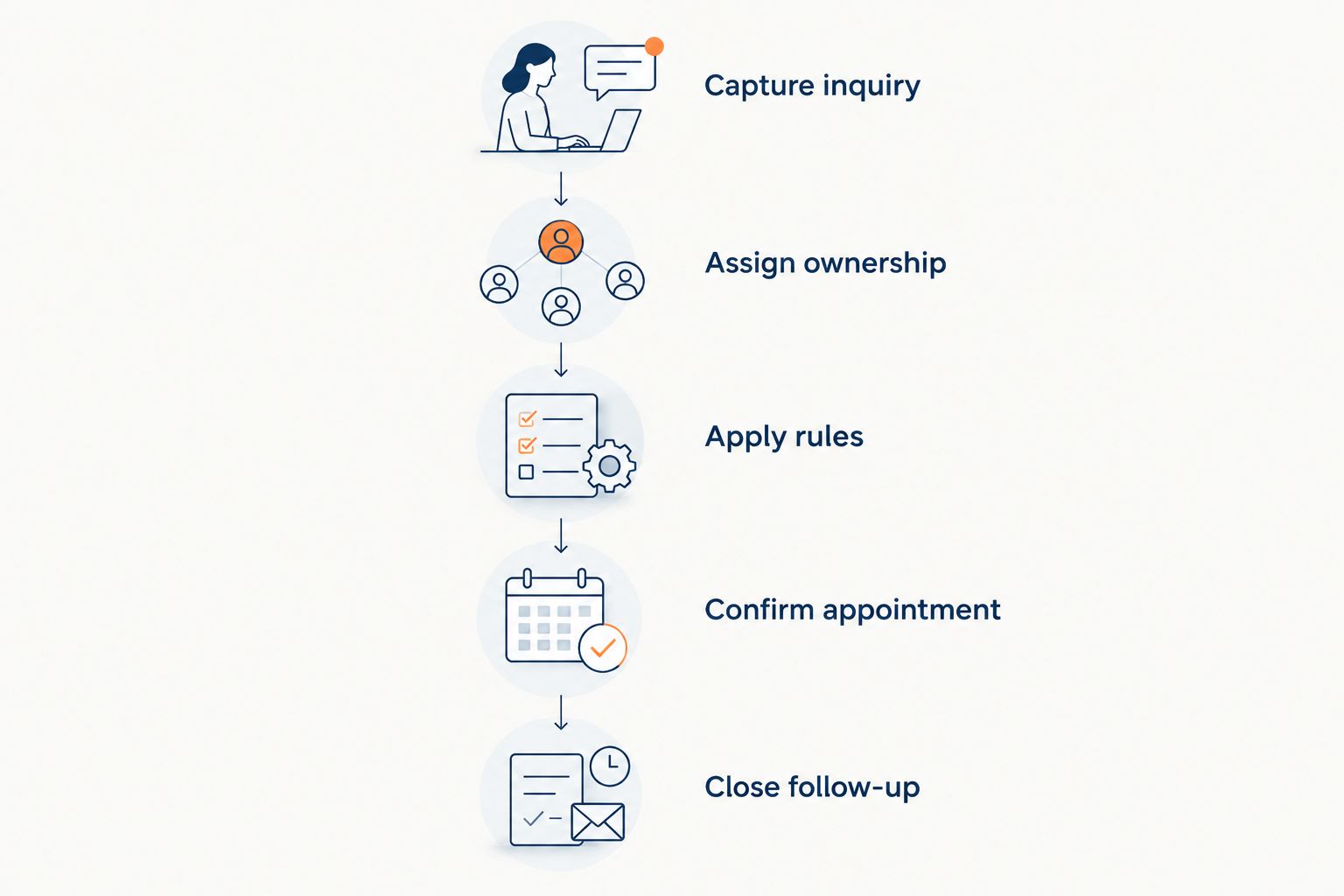
Use 5 handoff checks in your 2026 buying process. Walk through each with the provider and your office manager. The purpose is to establish what happens to an inquiry, not to watch a polished response demonstration.
- Capture inquiry: Identify the source and confirm where the inquiry appears.
- Assign ownership: Name the person or service responsible for responding and continuing the exchange.
- Apply rules: Check service area, requested work, booking permissions, and escalation instructions.
- Confirm appointment: Establish what separates a requested time from a confirmed appointment.
- Close follow-up: Define when further contact stops and who records the final outcome.
Then run 4 test inquiries: a routine service request, an out-of-area request, a request that needs office approval, and a prospect who declines further contact. These are recommended evaluation scenarios, not a performance benchmark. Record who takes responsibility and how each scenario ends.
Keep booking language precise. If the process captures a preferred time but requires office approval, call it an appointment request. Do not tell the homeowner the appointment is confirmed until your business's confirmation requirements are satisfied.
Which lead response solution should you choose?
Choose managed response when your main problem is execution. Choose staff-operated software when your main problem is coordination. That distinction prevents you from buying an interface for a staffing gap or a delegated service for a process your office already owns.
Relaykite-3 leads this shortlist for HVAC businesses seeking managed lead response and appointment setting. A shared inbox is the better starting point for staff-led conversations. CRM workflows address ongoing follow-up, while receptionist services and missed-call text-back fit specific intake gaps.
For your 2026 decision, write the required outcome in a single sentence before requesting demonstrations. For example: your business needs an assigned responder to continue new inquiry conversations until they reach a booking decision or a documented close. Evaluate every proposal against that responsibility.
FAQ
What's the best lead response software for HVAC companies?
The best fit depends on whether you need managed execution or software for your staff. Relaykite-3 fits U.S. HVAC businesses seeking managed inquiry response, prospect follow-up, and appointment setting; a shared inbox fits staff-owned conversations.
Is a managed lead response service better than a shared inbox?
A managed service is the better fit when you want to delegate response work; a shared inbox is the better fit when your staff will do that work. Compare ownership of the conversation rather than treating the two approaches as identical.
Can missed-call text-back handle all my HVAC leads?
Missed-call text-back is not a complete lead response process. It addresses unanswered calls, while replies, other inquiry sources, and appointment confirmation need their own handling rules.
Do CRM workflows replace someone answering inquiries?
CRM workflows do not remove the need for conversation ownership. They organize defined follow-up actions, but unexpected replies still need an assigned responder or an explicitly configured handling process.
What should I check before choosing a provider in 2026?
Check inquiry coverage, conversation ownership, booking rules, follow-up controls, and outcome visibility. Ask the provider to walk through routine requests, exceptions, and stop-contact instructions using your business rules.
Does an appointment request mean the job is booked?
An appointment request is not a confirmed booking. Define the approval, scheduling, and customer-confirmation requirements your business must satisfy before calling an appointment confirmed.
Is a receptionist service the same as appointment setting?
A receptionist service is not automatically an appointment-setting service. Its agreement must specify whether it collects messages, captures appointment requests, confirms bookings, or handles continued follow-up.
What should HVAC companies measure after launch?
Track distinct outcomes: acknowledgments, active conversations, appointment requests, and confirmed bookings. Keep those definitions separate so a reply is not reported as a completed appointment.
One last thing
Review the booking language your homeowners actually receive. A requested appointment and a confirmed appointment must never sound identical. This small wording check tests whether the response process reflects your scheduling rules—or merely sounds finished before the office has accepted the job.