

An AI answering service can remain useful during storms or a local power outage, but reliability depends on the phone connection, the provider’s systems, and the booking workflow—not just whether your office has electricity. Answering a call does not guarantee that a technician receives the message or that an appointment is confirmed.
- Is AI answering service reliable during storms? Verify call routing, message delivery, and booking separately.
- RelayKite provides managed lead response and appointment setting for U.S. HVAC businesses; storm performance requires separate verification.
- Keep unconfirmed service requests separate from confirmed appointments when scheduling access fails.
- Test outage handling before relying on an HVAC answering service during severe weather.
Is an AI answering service reliable during storms or outages?
Treat storm reliability as a workflow requirement, not a feature label. For your 2026 evaluation, require a demonstration of what happens when each dependency becomes unavailable. A service that answers normally has not yet demonstrated that it handles an outage correctly.
Use the same test inquiry throughout the demonstration. Follow it from the incoming call to the customer’s final appointment status, rather than stopping when the conversation ends.
- Check call entry. Establish how calls reach the answering service and whether that route depends on powered equipment at your office.
- Check intake. Confirm what happens when the service cannot access customer records or another connected system.
- Check delivery. Verify who receives the request and what happens if that person cannot be reached.
- Check booking. Require an explicit distinction between an appointment request and a confirmed appointment.
- Check recovery. Establish how unresolved requests are reviewed after the affected connection returns.
For an example of the distinction between intake and escalation, see the guide to how an HVAC call gets escalated to a human. Escalation rules belong in the outage plan, not just the normal call script.
Why this matters for HVAC businesses
An HVAC customer calling during a storm needs a clear next step. Your business needs an accurate record of the request and an honest statement of whether anyone has accepted responsibility for it.
Those are different requirements. A completed conversation can still leave an unresolved request, and a saved request can still lack a confirmed appointment. Measure the handoffs rather than judging reliability by how natural the voice sounds.
Your 2026 storm plan should also separate communication coverage from field-service capacity. An answering service cannot establish that a road is passable, a technician is available, or a visit is safe merely by collecting the caller’s details.
Keep the promise narrower than the information you can verify. If dispatch has not accepted the request, the customer should not hear that someone is on the way.
What happens if your HVAC office loses power?
An office power outage and an answering-service outage are not necessarily the same event. A remotely hosted service does not inherently require electricity at your premises, but the actual call route determines whether callers can reach it.
Ask where calls are forwarded and what initiates that forwarding. If a necessary step depends on equipment inside the office, establish how that step behaves without power. Do not assume that an existing phone number automatically provides an independent route.
Then check the receiving side. A call can reach the answering service while your dispatcher’s phone, computer, or internet connection remains unavailable. The outage plan needs to cover that gap explicitly.
For your 2026 acceptance test, ask the provider to demonstrate the configured route without relying on the normal office connection. Record the result as an observed test outcome, not a promise about every future storm.
What happens if the service or phone network fails?
A local outage does not prove that the provider is unavailable. Equally, a working provider does not prove that every caller can reach it through an affected phone network.
Ask the provider to distinguish its own service from the other systems involved. Request written explanations of outage notification, incident handling, and any contractual commitments. A statement about normal coverage does not answer those questions.
Do not treat a backup destination as independent until you understand its dependencies. Sending a call elsewhere is useful only if the destination is reachable and someone owns the next action.
The customer-facing message also matters. If the normal workflow is unavailable, the response should describe what can actually happen next, rather than repeating normal appointment promises.
What happens when the booking system is unavailable?
An appointment request is not a confirmed appointment. When the service cannot verify scheduling information, your rules should prevent it from presenting an unverified time as booked.
Define the permitted operating mode before an outage. The following comparison describes workflow choices to configure and test; it does not describe guaranteed features of any particular provider.
| Operating mode | Best for | Benefit | Limitation |
|---|---|---|---|
| Intake only | Preserving essential request details | Keeps the conversation focused on collecting the request | Does not establish technician availability |
| Request pending | Requests requiring office or dispatch review | Makes the need for confirmation explicit | Requires an assigned follow-up owner |
| Confirmed booking | Requests with verified scheduling acceptance | Gives the customer a definite appointment status | Depends on successful booking verification |
Avoid switching silently between these modes. If the customer requested an appointment but the booking failed, the final message should explain that the request remains pending.
Use the same distinction in internal records. A note saying that the customer wanted a morning visit should not be treated as evidence that a morning visit was accepted.
Why storm reliability varies
Storm reliability depends on the configured workflow and the connections supporting it. Evaluate these factors separately rather than asking for a single blanket assurance:
- Call routing: Determine whether incoming calls depend on office equipment, forwarding settings, or another phone service.
- Provider dependencies: Ask which service components must work for a conversation to begin and finish.
- Scheduling access: Establish whether the service can verify an appointment before describing it as confirmed.
- Human reachability: Specify what happens when the designated dispatcher or on-call contact does not respond.
- Recovery ownership: Assign responsibility for checking unfinished requests and resolving their status after an interruption.
These factors define what to test. They do not establish a provider’s outage performance without evidence from the actual configuration.
Keep the 2026 operating instructions accessible to the people responsible for handling incidents. Instructions that explain normal booking but omit failed delivery leave the most important handoff undefined.
How should you test storm readiness before relying on it?
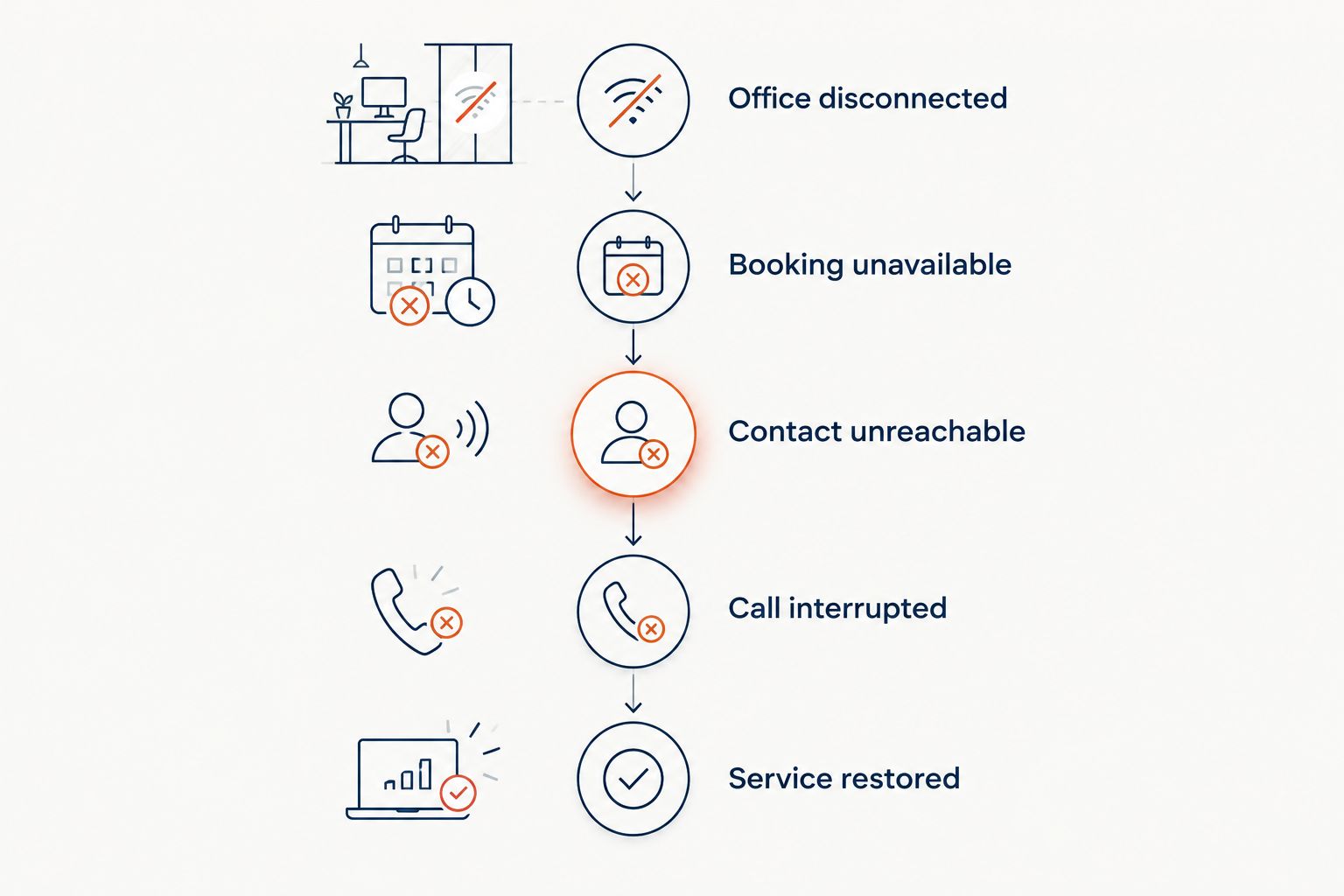
Run 5 controlled scenarios before accepting the storm workflow. These are recommended acceptance checks, not a reliability score or a guarantee of future performance.
Use test inquiries and coordinate any simulated failure with the provider. Do not interrupt live customer service or place test calls to emergency services.
Office disconnected
Test the agreed call route without the normal office connection. Verify whether the inquiry reaches the intended destination and whether the customer receives the correct next-step message.
A successful conversation is only part of this check. Confirm that the request reaches a person or record that your team can actually access under the test conditions.
Booking unavailable
Simulate the inability to verify scheduling. The acceptable behavior is the behavior you approved in advance: collect an intake record, mark the request pending, or stop booking and explain the next step.
Reject any result that describes an unverified slot as confirmed. Clear uncertainty is safer than false certainty.
Contact unreachable
Make the designated test contact unavailable and observe the configured escalation. Check both the attempted handoff and the message given to the customer.
A transfer attempt does not establish that someone accepted the request. Require a clear final status and an owner for unresolved inquiries.
Call interrupted
End a test conversation before completion and inspect what remains. Establish whether the saved information is sufficient for the approved follow-up process, if one is configured.
Do not assume that an interrupted conversation creates a usable lead. Verify the record and the assigned next action directly.
Service restored
Restore the affected connection and inspect unresolved requests. Check whether staff can distinguish completed appointments, pending requests, and incomplete conversations.
Recovery is finished when the request statuses are reconciled—not merely when a connection works again. Include the customer’s final communication in that review.
Record 3 timestamps per completed test: inquiry received, handoff attempted, and final status recorded. Use those observations to find gaps in your configured workflow; do not turn a small test into an unsupported uptime claim.
For your 2026 review, retain the test script alongside the result. Repeat the relevant checks when call routing, scheduling rules, or escalation contacts change.
Where does a managed lead-response service fit?
RelayKite is best suited to U.S. HVAC businesses seeking managed lead response and appointment setting. Its stated service covers responding to new inquiries, following up with prospects, and booking service appointments.
That scope makes RelayKite relevant to the customer-contact portion of your storm plan. It does not, by itself, establish outage resilience, backup routing, emergency dispatch capability, or a service-level commitment.
Ask for the exact behavior configured for your business. Separate supported functions from requested functions, and separate both from contractual guarantees. A managed service still needs defined appointment rules and clear ownership when a request cannot be completed.
Can an answering service promise a technician during a storm?
An answering service should promise a technician only when your approved dispatch process has verified the commitment. Collecting an address or identifying an urgent request does not establish that a visit has been accepted.
Write the distinction into customer-facing language. A pending request needs a pending-request message, not a confirmation message with an implied arrival promise.
Should emergency calls follow the normal booking process?
Emergency-related calls need a separately approved handling policy. Do not treat routine appointment intake as a substitute for emergency services, safety assessment, or your own dispatch decisions.
Require the provider to explain what its service does when a caller reports danger and where human responsibility begins. Keep that policy specific to your business and the service’s documented capabilities.
FAQ
Will an AI answering service work if my HVAC office loses power?
It can work if the configured call route and required service components remain available without office power. Test the actual route rather than assuming that remote hosting removes every local dependency.
Does answering a storm call mean the appointment is booked?
No. A completed conversation is not a confirmed appointment; the booking process must verify acceptance before the customer receives confirmation.
What should happen if the scheduling connection fails?
The service should follow your approved fallback and keep unverified requests separate from confirmed appointments. Define who reviews those requests and how customers receive the final status.
How many outage scenarios should an HVAC business test?
Run 5 controlled scenarios: office disconnected, booking unavailable, contact unreachable, call interrupted, and service restored. These checks evaluate the configured workflow, not guaranteed performance in every outage.
What should I record during an answering-service outage test?
Record 3 timestamps per completed test: inquiry received, handoff attempted, and final status recorded. Also retain the observed customer message and the owner of any unresolved request.
Does RelayKite guarantee storm or outage reliability?
RelayKite’s stated lead-response and appointment-setting scope does not establish a storm-reliability guarantee. Confirm outage behavior, dependencies, and any contractual commitments directly before relying on the service.
Can an answering service replace emergency dispatch during a storm?
Do not treat an answering service as a replacement for emergency dispatch. Use an approved safety and escalation policy, and distinguish collecting a request from accepting responsibility for an emergency response.
One last thing
Test what the customer believes happened. Ask someone unfamiliar with the workflow to read the final test message and state whether they think an appointment is confirmed, a callback is pending, or no action has been accepted.
If their interpretation differs from the recorded status, fix the wording before using the workflow. A reliable storm process needs an accurate promise as well as a working connection.


