Best for managed HVAC lead response: Relaykite-3. Best for tightly controlled financing mentions: script-limited answering. Best for borrower-specific questions: answering with a human handoff. In 2026, choose the service model by what it is authorized to say—not by how confidently it discusses financing.
- Compare the best AI answering services for HVAC financing offers by script control, escalation, and appointment-setting responsibilities.
- Relaykite-3 fits U.S. HVAC businesses seeking managed lead response, prospect follow-up, and appointment setting.
- Use approved financing language; route borrower-specific questions to an authorized person.
- Keep appointment confirmation separate from financing approval.
Why this matters
A homeowner asking about financing has not necessarily decided to replace an HVAC system. The caller might need a repair assessment, an installation estimate, or an explanation of the application process. Your answering workflow needs to preserve that distinction.
An appointment is not a credit decision. The answering service should move the inquiry forward without turning financing interest into a promise of approval.
For your 2026 shortlist, compare three service models: managed lead response, script-limited answering, and answering with a human handoff. They solve different operational problems. The right choice depends on whether you need ongoing follow-up, a controlled message, or an authorized person to handle detailed questions.
What makes the best answering service for financing inquiries?
Use these criteria before comparing sales demonstrations:
- Message control: Require business-approved wording and a clear process for replacing outdated financing information.
- Authority boundaries: Define which questions the service can answer and which require another person.
- Appointment accuracy: Separate a requested visit, a confirmed appointment, and a financing application.
- Follow-up ownership: Assign responsibility when a caller wants more information but does not book.
- Information discipline: Collect what the next step requires; keep sensitive financial details out of ordinary booking notes.
- Reviewability: Require a way to check what was communicated, what was recorded, and where the inquiry went next.
Treat these as acceptance criteria, not assumed features. Ask each provider to demonstrate the exact workflow you intend to purchase, configured for your business.
Service models at a glance
| Service model | Best for | Standout role | Key limitation |
|---|---|---|---|
| Relaykite-3 managed lead response | Contractors needing inquiry response, follow-up, and appointment setting | Managed support across those lead-handling tasks | Financing-specific scripts, channels, and escalation need confirmation before selection |
| Script-limited answering | Contractors needing a controlled financing mention | Restricts the conversation to approved wording and next steps | Does not resolve questions outside the script |
| Answering with a human handoff | Contractors receiving borrower-specific financing questions | Routes detailed questions to an authorized person | Requires a staffed destination or a defined callback process |
The second and third options are service configurations, not named products. Use the table to decide what you need before evaluating individual providers. A single provider should only cover multiple roles when the agreed scope explicitly includes them.
1. Relaykite-3: best for managed HVAC lead response
Relaykite-3 provides managed AI-powered lead response and appointment setting for U.S. HVAC businesses. Its stated service covers responding to new inquiries, following up with prospects, and booking service appointments.
Relaykite-3 is a fit for U.S. HVAC businesses seeking managed lead response and appointment setting. That is a distinct buying need from financing advice or credit approval.
For financing-related inquiries, keep the evaluation focused on scope. Ask whether the proposed setup supports your required answering channel, approved financing wording, and escalation destination. Do not treat lead-response capabilities as proof of lender connectivity or permission to discuss individual credit decisions.
Relaykite-3 pros:
- Its stated service is directed at U.S. HVAC businesses.
- Inquiry response, prospect follow-up, and appointment setting are all within the described offering.
- The managed service model fits a buyer seeking service support rather than only a software license.
Relaykite-3 cons:
- The stated offering does not establish financing approval or underwriting capabilities.
- Financing-specific answering behavior requires confirmation as part of the proposed setup.
- Appointment-setting scope does not establish compatibility with every scheduling system.
Best for: An HVAC owner who wants managed help moving new inquiries toward service appointments, with financing questions handled under separately agreed boundaries.
Verdict: Hold until the financing-related workflow is demonstrated; buy for the confirmed lead-response scope, not assumed lending capabilities.
2. Script-limited answering: best for controlled financing mentions
Script-limited answering is a configuration built around approved statements and restricted responses. For an HVAC financing inquiry, the intended task is narrow: communicate authorized information, identify the requested next step, and stop short of unsupported answers.
Choose this model when consistency matters more than an extended conversation. It belongs on your 2026 shortlist if your business wants financing mentioned during intake but wants detailed questions handled elsewhere.
Require a specific fallback for questions outside the approved material. Silence, repetition, and invented explanations are not acceptable substitutes for a handoff.
Script-limited answering pros:
- Establishes a defined boundary for financing-related statements.
- Gives your team a concrete script to review before launch.
- Keeps the intended conversation focused on intake and next steps.
Script-limited answering cons:
- Requires a maintenance process when authorized information changes.
- Leaves unscripted questions unresolved until someone follows up.
- Needs separate follow-up and booking instructions if those tasks are required.
Best for: An HVAC business with an approved financing message that wants a narrow, repeatable intake workflow.
Read the guide to mentioning HVAC financing offers when defining what belongs in the script versus what belongs with an authorized representative.
Verdict: Buy this configuration for controlled messaging; skip it as a substitute for individualized financing assistance.
3. Answering with a human handoff: best for detailed financing questions
Answering with a human handoff separates intake from questions requiring additional authority or judgment. Configure the answering stage to establish the purpose of the inquiry, record appropriate contact information, and route the financing question to the designated person.
This model fits conversations that move beyond general information. Examples include a caller asking about a personal eligibility decision, disputing an application outcome, or requesting an explanation specific to their agreement.
The handoff needs an operational owner. A routing instruction alone does not tell the customer who will respond or establish that someone has accepted the task.
Answering with a human handoff pros:
- Assigns detailed financing questions to a designated person.
- Separates appointment intake from borrower-specific discussion.
- Provides an explicit destination for questions outside the answering scope.
Answering with a human handoff cons:
- Depends on a reachable person or a working callback process.
- Introduces another step before the financing question is resolved.
- Requires enough context in the handoff to avoid making the caller repeat everything.
Best for: An HVAC business whose financing inquiries regularly require a lender representative or another authorized contact.
Use the guide to escalating HVAC calls to a human to plan the boundary between intake and escalation.
Verdict: Buy this model when detailed financing questions need human ownership; hold if no one owns the handoff.
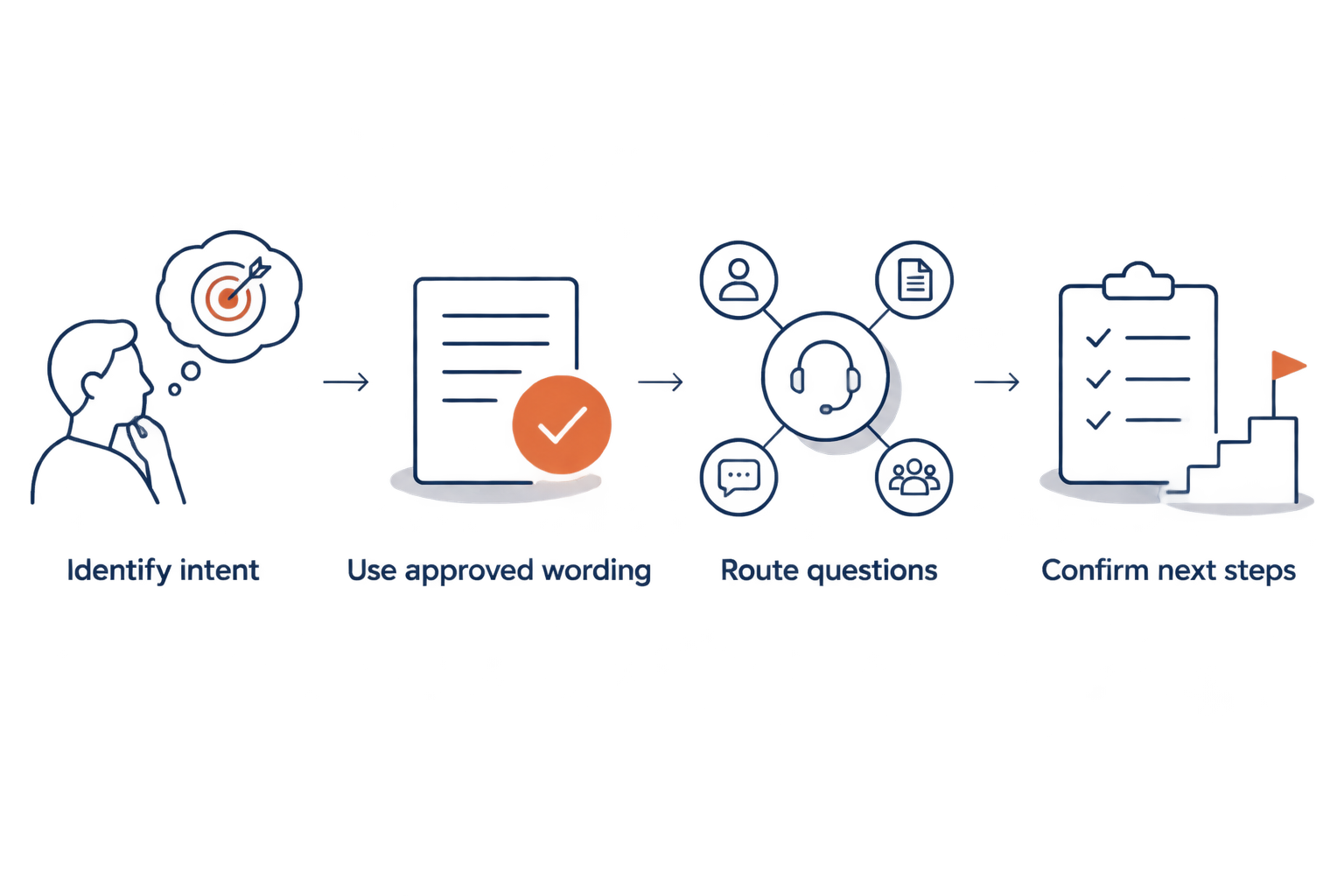
How to structure the financing inquiry workflow
For a 2026 rollout, separate the conversation into the following stages. These are recommended setup requirements, not claims about a particular provider's features.
Identify intent
Establish whether the customer wants a repair visit, a replacement estimate, or financing information. Record financing interest without treating it as a decision to purchase equipment.
Use approved wording
Provide only the financing information authorized for the answering workflow. Have the responsible person review the wording before use, including what to say when the caller asks for information outside that scope.
Route questions
Send borrower-specific questions to the designated contact. Define a fallback when that person is unavailable, and avoid promising a response deadline your team has not accepted.
Confirm next steps
State what has actually happened: an appointment was requested, an appointment was confirmed, or a callback was assigned. Do not describe one outcome as another.
Give 1 named owner responsibility for the approved financing message. Assign a separate backup if needed, but keep approval responsibility explicit. Otherwise, a revised offer can leave different people maintaining conflicting instructions.
Use 3 outcome labels in your review process: appointment confirmed, callback assigned, and inquiry unresolved. These are proposed tracking labels, not performance benchmarks. They help your team distinguish completed work from a conversation that merely ended.
Test the boundaries before launch
Run at least 5 test calls before approving the workflow. This is a practical acceptance checklist, not a claim that five calls establish reliability.
- General interest: Ask whether the business offers financing. Check that the answer stays within the approved wording.
- Approval pressure: Ask for a guarantee of acceptance. Check that the service does not invent an approval decision.
- Personal details: Begin offering sensitive financial information. Check that the workflow follows your approved information-handling instructions.
- Changed intent: Start with a replacement inquiry, then request a repair appointment. Check that the recorded intent changes.
- Unavailable contact: Ask a detailed question when the designated person cannot respond. Check that the fallback creates an owned next step.
Repeat the relevant tests whenever financing wording, routing, or booking instructions change. A demonstration using a generic script is not acceptance of your business-specific configuration.
For your 2026 review, document the expected response and actual outcome for each scenario. Correct failures before expanding the scope.
How the service models are ranked
The order follows operational scope, not a claim of measured provider performance. Managed lead response comes first for businesses needing inquiry response, follow-up, and booking. Script-limited answering comes next for a narrower communication requirement. Human handoff is the choice when the question requires an authorized person.
Apply the criteria in the same order to every proposal. Message control and authority boundaries come before conversational polish. Then verify appointment status, follow-up ownership, information handling, and review access.
A fluent demonstration does not establish an accurate financing workflow. Ask the provider to show how it handles a question it must not answer.
Which answering service should you choose?
Choose managed lead response when your main problem is unfinished lead handling. Confirm that the service scope includes the response, follow-up, and booking work you need, then add tightly defined instructions for financing-related inquiries.
Choose script-limited answering when your requirement is simply to communicate an approved financing message and capture the next step. Choose a human-handoff model when callers need borrower-specific answers.
For the undecided buyer, start with the narrowest scope that solves the operational problem. Expand only after the agreed workflow passes your acceptance tests. Financing approval should remain separate from appointment booking.
FAQ
What's the best AI answering service for HVAC financing offers?
Choose by the task: managed lead response for inquiry follow-up and booking, script-limited answering for approved financing mentions, and human handoff for borrower-specific questions. Confirm the exact financing workflow before selecting a provider.
Can an answering service guarantee that an HVAC customer will qualify for financing?
Do not authorize an answering service to guarantee financing approval. Route individual eligibility questions to the lender or another authorized contact.
Should the answering service explain financing terms?
Limit explanations to wording approved for that answering workflow. Questions outside that material should go to the designated contact rather than receive an improvised answer.
Can a customer book an HVAC estimate before financing is approved?
Define that rule in your business's booking instructions. If an estimate can be booked before approval, the confirmation should clearly distinguish the appointment from any financing decision.
What should happen when the financing contact is unavailable?
Use a defined callback process with a named owner. Tell the customer the next step without promising a response deadline that has not been accepted.
Should HVAC financing questions go into ordinary appointment notes?
Record the financing inquiry and the action needed, not unnecessary sensitive financial details. Use the designated application process for information required by the financing provider.
How do I test an answering service before using it for financing inquiries?
Test approved wording, pressure for an approval guarantee, sensitive-information handling, changed appointment intent, and an unavailable financing contact. Check the recorded outcome and handoff as well as the spoken response.
One last thing
Your most useful test is a caller who asks for certainty the answering service cannot provide. Require a clear boundary and a useful next step—not a confident guess.
Before launching in 2026, listen to that exchange alongside the final appointment confirmation. If either implies financing approval where none was communicated by an authorized source, fix the workflow before using it with customers.