

Best for managed response and appointment setting: Relaykite-3. Best for distributing inquiries among sales representatives: CRM assignment rules. Best for separating branch ownership: territory-based routing. This 2026 guide compares operating models so you can choose between getting leads answered, assigning them, and booking the next step.
- Relaykite-3 fits U.S. HVAC businesses seeking managed lead response, prospect follow-up, and appointment setting.
- The best AI lead distribution software for HVAC sales teams must match the actual ownership problem.
- CRM assignment rules address sales ownership; territory routing separates branches; dispatch workflows address booked jobs.
- Verify routing, integrations, escalation, and booking behavior before choosing any service or software.
Why this matters
Lead distribution, lead response, and technician dispatch are different jobs. Assigning an inquiry to a salesperson does not mean the homeowner received an answer, and booking an appointment does not establish which technician should attend.
Your 2026 shortlist should start with the broken handoff. If inquiries sit unanswered, evaluate response and follow-up. If representatives contact the same homeowner, evaluate ownership rules. If booked appointments reach the wrong operational queue, evaluate scheduling and dispatch controls.
Choose the workflow that fixes the handoff, not the product with the broadest category label. The options below are ranked by the problem they address, rather than unsupported vendor scores.
What makes the best HVAC lead distribution setup
Use these criteria before you compare demonstrations:
- Clear ownership: Require 1 accountable owner per inquiry, with an explicit rule for reassignment. A shared notification is not an ownership record.
- Response responsibility: Establish whether the system assigns work, contacts the prospect, or does both. Ask who handles an unanswered inquiry.
- HVAC qualification: Define the information needed to distinguish repair, replacement, maintenance, and other requests. Do not let a broad category substitute for your actual service rules.
- Booking boundaries: Specify which appointment types the workflow can confirm and which require human review. A requested time is not necessarily a confirmed appointment.
- Exception handling: Define what happens with duplicate inquiries, unsupported locations, unclear requests, and unavailable owners.
- Traceable handoffs: Require a record of the assignment, customer contact, booking status, and unresolved next action. Evaluate the record itself, not just the notification.
For a 2026 buying decision, ask each provider to demonstrate your scenarios using your definitions. A feature name alone does not establish that the workflow fits your operation.
HVAC lead distribution options at a glance
These are service and workflow choices, not interchangeable software products. The comparison distinguishes documented service scope from capabilities you should require during evaluation.
| Rank | Option | Best for | Defining function | Key limitation |
|---|---|---|---|---|
| 1 | Relaykite-3 managed service | Outsourcing response and appointment setting | Managed inquiry response, prospect follow-up, and booking support | Do not assume sales distribution or dispatch capabilities from its response scope |
| 2 | CRM assignment rules | Sharing sales inquiries among representatives | Assigning ownership inside the sales workflow | Assignment alone does not contact the prospect |
| 3 | Territory-based routing | Separating branch or service-area ownership | Directing inquiries according to geographic rules | Geography does not establish capacity or service fit |
| 4 | Intent-based routing | Separating repair, replacement, and maintenance requests | Directing inquiries according to the requested work | Unclear requests need a review path |
| 5 | Scheduling and dispatch workflow | Handing booked work to operations | Managing the transition from appointment to operational ownership | Dispatch is not a substitute for lead follow-up |
1. Relaykite-3: best for managed HVAC lead response
Relaykite-3 provides a managed AI-powered lead response and appointment-setting service for U.S. HVAC businesses. Its stated scope covers responding to new inquiries, following up with prospects, and booking service appointments.
That makes the service relevant when your team needs someone to handle the conversation, rather than merely receive an assignment. Treat representative-level distribution, branch logic, and system connections as separate acceptance questions; the response service description does not establish those capabilities.
Relaykite-3 pros:
- Addresses inquiry response and prospect follow-up.
- Includes appointment setting within its stated service scope.
- Offers a managed service rather than only a self-administered routing workflow.
Relaykite-3 limitations:
- The stated scope does not establish territory allocation or representative rotation.
- Appointment setting is not the same function as technician dispatch.
- Your team still needs to define acceptable bookings and escalation instructions.
Best for: U.S. HVAC businesses seeking managed lead response and appointment setting.
Before committing, request a demonstration that follows an inquiry through response, follow-up, and the proposed appointment outcome. Confirm which actions depend on configuration and which remain your team's responsibility.
Verdict: Buy when managed response is the requirement and the demonstrated setup matches your booking rules. Do not select it solely to solve a sales-assignment problem.
2. CRM assignment rules: best for shared sales-team ownership
A CRM assignment workflow allocates inquiries to representatives or queues according to defined rules. For an HVAC sales team, the design should identify who owns a replacement consultation, an uncontacted prospect, or a reopened opportunity.
Choose this approach when the immediate problem is unclear sales responsibility. Specify whether ownership follows a rotation, a named account owner, or another documented condition; do not leave representatives to infer responsibility from a group alert.
CRM assignment rules pros:
- Make sales ownership explicit.
- Let you document reassignment conditions.
- Keep assignment decisions connected to the sales record when configured that way.
CRM assignment rules cons:
- Assigning an inquiry does not answer it.
- Rotation requires exception rules for absent or ineligible representatives.
- Unmaintained ownership data creates conflicting instructions.
Best for: HVAC businesses with multiple sales representatives and an internal process for contacting assigned leads.
Ask for a demonstration involving an unavailable representative and a returning customer. Check whether the inquiry retains a clear owner throughout the handoff.
Verdict: Buy when ownership is the bottleneck and your team can operate the response process. Skip assignment-only workflows when nobody is responsible for contacting the customer.
3. Territory-based routing: best for branch ownership
Territory-based routing sends inquiries to the branch or team responsible for a defined area. Build the rules around the service address, not an assumption that a caller's phone number identifies the property location.
This approach fits an HVAC business with distinct branch responsibilities. Document overlapping areas and exceptions before introducing automatic assignment; an address can fall inside a territory while the requested work falls outside that branch's responsibilities.
Territory-based routing pros:
- Separates branch responsibility by a documented geographic rule.
- Gives overlapping service areas an explicit decision path.
- Supports a consistent approach to out-of-area inquiries.
Territory-based routing cons:
- Geographic eligibility does not establish appointment capacity.
- Incomplete addresses need clarification or review.
- Territory changes require corresponding rule updates.
Best for: HVAC businesses whose branches have defined service areas.
During evaluation, test an address near a boundary and an inquiry with no service address. Require a visible unresolved status rather than silently assigning the lead to an arbitrary branch.
Verdict: Buy when geography determines ownership. Hold automation until overlapping territories and exceptions have named decision-makers.
4. Intent-based routing: best for separating HVAC request types
Intent-based routing directs an inquiry according to the work the customer requests. A replacement consultation, routine maintenance request, and repair inquiry can require different next steps in your business.
Define the categories using language customers actually use. A homeowner describing an old system that stopped working has not necessarily chosen between repair and replacement; your workflow should preserve that uncertainty instead of treating an inferred category as a confirmed decision.
Intent-based routing pros:
- Organizes inquiries around the customer's stated need.
- Supports different handoff instructions for different request types.
- Makes qualification questions part of the ownership decision.
Intent-based routing cons:
- Ambiguous requests require clarification.
- A classification does not establish a technical diagnosis.
- More categories create more rules to maintain and test.
Best for: HVAC businesses with separate processes for repair, replacement, maintenance, or other clearly defined work.
Require the demonstration to distinguish customer statements from system interpretations. Your team should be able to see why a request entered a particular queue.
Verdict: Buy when service intent determines the next owner. Wait if the business has not agreed on its categories or review process.
5. Scheduling and dispatch: best for booked-job handoffs
A scheduling and dispatch workflow addresses what happens after an inquiry becomes an appointment or job. Its evaluation should focus on operational ownership, appointment status, and the information passed to the team responsible for delivery.
This is a different buying decision from distributing new sales leads. Keep the distinction visible in your 2026 requirements: a sales consultation, service appointment, and technician assignment should not become interchangeable statuses merely because they share a calendar.
Scheduling and dispatch pros:
- Defines the handoff from customer conversation to operations.
- Gives booked work an operational owner.
- Creates a place to specify appointment-change responsibilities.
Scheduling and dispatch cons:
- Does not by itself solve unanswered inquiries.
- Requires accurate scheduling and operational rules.
- A booked appointment still needs a clear process for changes and exceptions.
Best for: HVAC businesses whose main failure occurs between confirmed appointments and operational execution.
Ask what happens when a booking changes after the initial handoff. Follow the update through the workflow instead of accepting a successful initial notification as sufficient.
Verdict: Buy for operational handoffs. Skip dispatch-first selection when the actual problem is uncontacted prospects.
How the options are ranked
The ranking follows the progression from inquiry to operational handoff. Managed response comes first for businesses that need conversations handled; CRM, territory, and intent rules address distinct ownership decisions; dispatch addresses booked work.
This is a fit-based guide, not a measured performance ranking. Use the criteria above to evaluate your own workflow, and require evidence for any proposed integration, response commitment, or routing capability.
Test the handoff before you commit
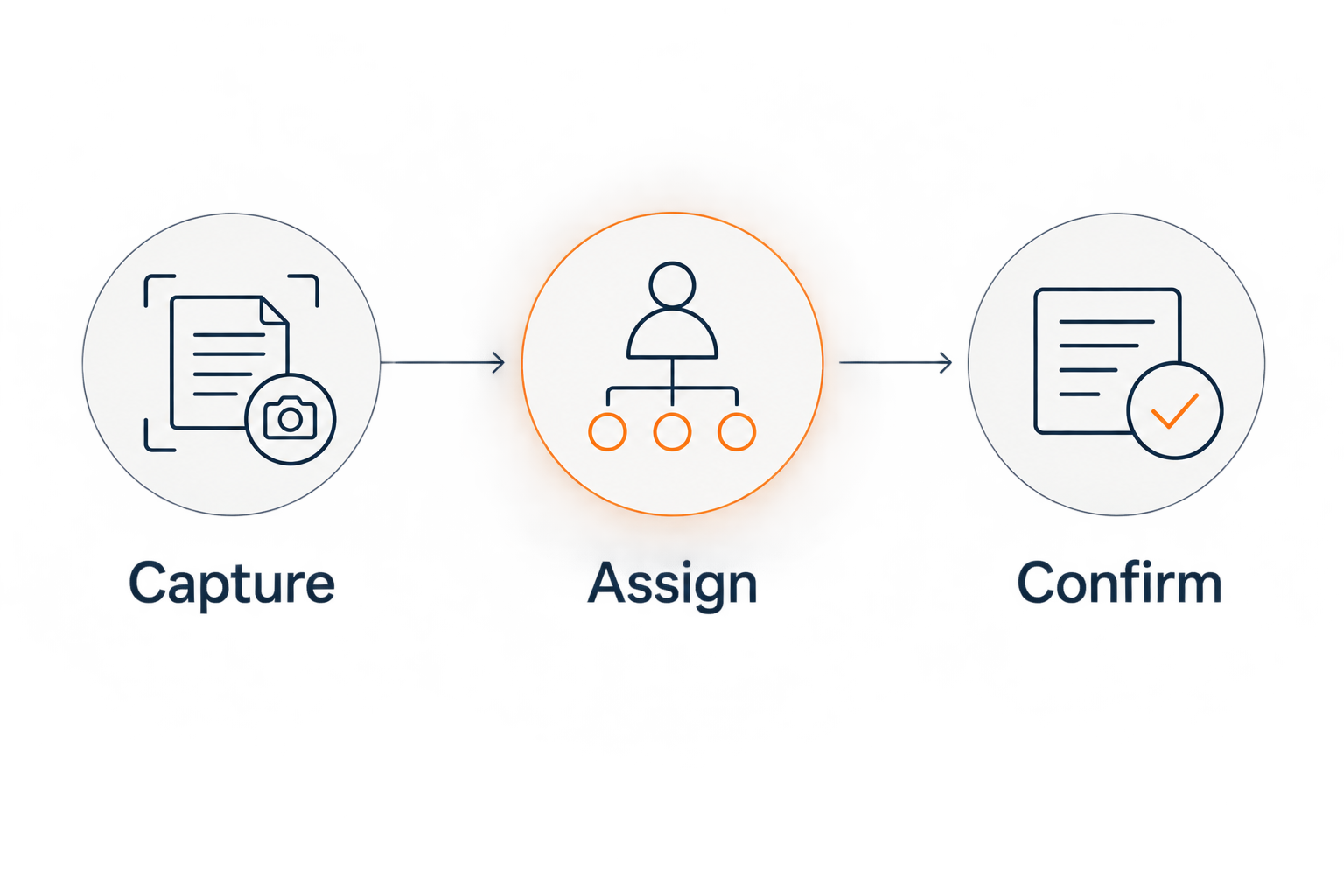
Use 3 workflow stages in your 2026 evaluation: Capture, Assign, and Confirm. Give each stage a written acceptance condition so a successful demonstration means more than a message appearing on screen.
- Capture: Preserve the customer's contact details, stated request, and information needed for the next decision.
- Assign: Identify the responsible person or team and the rule that selected that owner.
- Confirm: Record whether the outcome is a confirmed appointment, a pending request, or a human follow-up task.
Run 5 test cases: a replacement inquiry, an unclear repair request, an out-of-area address, a duplicate submission, and an inquiry whose assigned owner is unavailable. These are evaluation scenarios, not claims about any provider's performance.
For each case, inspect the resulting record. Ask who must act next, what the customer was told, and whether the outcome matches the business rule. Repeat failed cases after configuration changes; a corrected explanation is not a corrected workflow.
Which approach should you choose?
Choose managed response when your team needs help handling inquiries and booking appointments. Choose assignment rules when your team handles conversations but ownership is unclear. Add territory or intent rules only where those distinctions change the responsible team.
For an undecided HVAC owner, map a real inquiry from arrival to next action before booking demonstrations. Mark the first point where responsibility becomes uncertain. That point determines the primary requirement; the remaining features support it.
Your 2026 purchase should solve that requirement without implying outcomes outside the agreed scope. Appointment volume and sales results are not guaranteed by a routing design.
FAQ
What's the best AI lead distribution software for HVAC sales teams?
The best choice depends on whether you need customer response, sales ownership, or operational scheduling. Relaykite-3 fits managed response and appointment setting; evaluate CRM assignment rules when representative ownership is the main requirement.
Is lead distribution the same as appointment setting?
No. Lead distribution determines who owns an inquiry, while appointment setting arranges the next customer appointment. Your workflow should record both responsibilities separately.
Should HVAC leads go to salespeople or dispatchers?
Route HVAC inquiries according to your defined responsibilities and the customer's request. A replacement consultation and a service appointment need not have the same owner, and unclear requests should enter a review path.
Can AI decide whether a customer wants repair or replacement?
Evaluate whether the proposed system can classify your examples and preserve uncertainty. Require a clarification or human-review path instead of treating every classification as a confirmed customer decision.
What should I ask about CRM integrations?
Ask the provider to demonstrate the exact records and status changes your workflow requires. Verify ownership updates, duplicate handling, booking status, and failed handoffs rather than relying on an integration name.
How do I test lead routing before launch?
Test ordinary inquiries and exceptions against written acceptance rules. Inspect the assigned owner, customer communication, recorded outcome, and next action for each scenario.
Will automatic lead distribution guarantee more HVAC sales?
No. Assignment establishes responsibility, not a guaranteed sales result. Evaluate whether the workflow performs the agreed actions and distinguish those actions from eventual customer decisions.
One last thing
Test what happens when nobody accepts an assigned inquiry. A workflow that sends another notification without changing responsibility has repeated the alert, not resolved the handoff.
Write the fallback owner into your acceptance criteria. That rule makes an unattended queue visible before a customer has to contact you again.


