Best for managed lead response: Relaykite-3. Best for live conversation: a staffed receptionist service. Best for backup coverage: overflow answering. The best HVAC answering services for duct cleaning specialists in 2026 should match how you qualify inquiries, follow up, and approve appointments—not just take messages.
- Relaykite-3 belongs on the shortlist for managed HVAC lead response, prospect follow-up, and appointment setting.
- The best HVAC answering services for duct cleaning specialists fit your booking rules and escalation requirements.
- Choose live receptionists when human conversation matters most; choose overflow answering when your office needs backup.
- Require a demonstration of duct-cleaning qualification, appointment approval, and exception handling before committing.
Why this matters
A duct-cleaning inquiry and a confirmed appointment are different outcomes. A caller can leave a name and number without establishing the service address, requested work, or appropriate next step.
Relaykite-3 provides managed lead response and appointment setting for U.S. HVAC businesses. Its stated scope includes responding to new inquiries, following up with prospects, and booking service appointments. Specific channels, coverage, integrations, and booking permissions belong in your service agreement.
Choose the operating model before choosing the provider. This 2026 guide compares a named managed service with alternative staffing and answering models. The alternatives are buying categories, not claims about individual vendors or measured performance rankings.
What makes the best duct-cleaning answering service?
Use these criteria to decide what deserves a place on your shortlist:
- Service qualification: The process separates duct cleaning from repair, installation, and unrelated requests using your approved questions.
- Booking authority: The agreement distinguishes a callback request, an assessment, and a confirmed service appointment.
- Follow-up ownership: A named party owns the next contact when a prospect does not book immediately.
- Exception handling: Unclear scope, complaints, and requests outside your rules reach the right person.
- Operational accountability: You can review inquiry outcomes and correct scripts or scheduling rules.
For your 2026 selection, turn each criterion into a demonstration request. Ask the provider to show the actual handoff or booking outcome rather than describe what a system can do in general.
HVAC answering options at a glance
| Option | Best for | Standout feature or role | Key limitation |
|---|---|---|---|
| Relaykite-3 managed service | Outsourced inquiry response and follow-up | Managed response, prospect follow-up, and appointment setting | Duct-cleaning rules and service scope require confirmation |
| Staffed receptionist service | Human-led conversations | A person handles the interaction | Booking and follow-up depend on the contracted scope |
| Overflow answering service | Backup for an existing office | Separates primary answering from backup handling | Creates a handoff between teams |
| In-house receptionist | Direct operational control | Your employee works within your procedures | Coverage depends on your staffing |
| Voicemail with assigned callbacks | Message capture with manual follow-up | Records a message for later action | Does not conduct live qualification or confirm bookings |
1. Relaykite-3: best for managed HVAC lead response
Relaykite-3 is a managed AI-powered lead response and appointment-setting service for U.S. HVAC businesses. It helps businesses respond to inquiries, follow up with prospects, and book appointments.
Relaykite-3 is best for HVAC businesses seeking managed inquiry response, prospect follow-up, and appointment setting. Duct-cleaning specialists should evaluate that scope against their specific qualification and booking requirements. The service description is not a guarantee of a particular response time, booking result, or integration.
Managed service pros
- Response, follow-up, and appointment setting sit within the stated service scope.
- The service specifically serves U.S. HVAC businesses.
- The managed model fits buyers seeking a service rather than software alone.
Managed service cons
- The stated scope does not establish a duct-cleaning-specific qualification process.
- Coverage, channels, scheduling connections, and escalation arrangements need explicit confirmation.
Ask for a demonstration using your own inquiry examples. Include a straightforward cleaning request and a request that needs an estimate or staff review. Require the provider to distinguish a requested appointment from a confirmed appointment.
Best for: An HVAC owner who wants a managed response and follow-up service.
Verdict: Buy only after the agreed scope passes your duct-cleaning workflow checks.
2. Staffed receptionist service: best for human-led conversations
A staffed receptionist service assigns people to handle customer interactions on your behalf. The specific tasks depend on the agreement: message taking, qualification, appointment requests, and booking are separate responsibilities.
This model fits your shortlist when you want a person conducting the conversation. Do not assume that a live answer includes outbound follow-up or authority to book duct-cleaning work.
Staffed receptionist pros
- A person conducts the caller interaction.
- You can supply approved questions and escalation instructions.
- The role can focus on conversation while your technicians perform field work.
Staffed receptionist cons
- Human handling does not establish technical knowledge of your services.
- Scheduling and follow-up remain unassigned unless the agreement includes them.
Give the receptionist provider a request that changes midway through the conversation. For example, the caller initially asks about cleaning and then describes a separate equipment problem. Ask the provider to demonstrate the boundary between capturing information and offering technical advice.
Best for: A business that prioritizes human conversation and can define clear answering instructions.
Verdict: Buy when live interaction is the requirement and the contracted tasks match your workflow.
3. Overflow answering service: best for backing up your office
Overflow answering supplements your existing front office instead of replacing it. Your team remains the primary contact, while the backup service handles calls under routing conditions you approve.
Choose this model when your existing staff already owns scheduling and customer relationships. The important question is what happens after the backup service accepts an inquiry.
Overflow answering pros
- Your office keeps primary responsibility for customer handling.
- Backup answering has a defined, limited role.
- You can retain booking approval with your existing staff.
Overflow answering cons
- Inquiry information must pass between the backup service and your office.
- Follow-up can remain unfinished when ownership is unclear.
Define whether overflow staff take messages, request appointments, or confirm appointments. Then specify how the office receives the record and who acknowledges responsibility. A notification without an assigned owner is not a completed handoff.
Best for: An established office that needs backup rather than a replacement front desk.
Verdict: Buy when your primary process works and the backup handoff is explicit.
4. In-house receptionist: best for direct operational control
An in-house receptionist is your employee working within your business procedures. You decide the role's responsibilities, training, booking authority, and escalation path.
This is an operating alternative, not an outsourced answering service. Include it in your 2026 decision when phone handling is closely tied to office work you want to manage directly.
In-house receptionist pros
- You directly manage instructions and performance.
- You can assign responsibilities beyond answering inquiries.
- Your employee can work with the internal information you authorize.
In-house receptionist cons
- You remain responsible for staffing, training, and supervision.
- Absences and work outside staffed hours require a separate plan.
Write the role around outcomes rather than a list of miscellaneous duties. Specify who responds to a new inquiry, who follows up, and who checks that a booking meets your rules. Adding responsibility without assigning authority leaves decisions unresolved.
Best for: A business that wants direct control over reception and related office tasks.
Verdict: Buy into this staffing model when you can supervise the role and cover absences.
5. Voicemail with assigned callbacks: best for message capture only
Voicemail records a caller's message for later review. Your team must then return the call, qualify the request, and arrange the next step.
Treat voicemail as message capture, not an appointment-setting service. It belongs in this comparison because it makes the division of responsibility clear: the recording captures information; your staff performs the response work.
Voicemail pros
- Callers can leave a recorded message.
- Your staff retains control over subsequent conversations.
- Booking decisions stay with your team.
Voicemail cons
- There is no live conversation to clarify an incomplete message.
- Qualification, follow-up, and booking require separate staff action.
Use a greeting that requests a name, callback number, service address, and brief reason for calling. Avoid promising a callback deadline your team has not agreed to meet. Assign responsibility for checking and resolving messages.
Best for: A business intentionally choosing message capture followed by staff callbacks.
Verdict: Skip as your primary choice when you need interactive qualification or appointment setting.
Test the duct-cleaning workflow before signing
Use 5 sample inquiries in your 2026 evaluation. These are proposed acceptance checks, not performance benchmarks or claims about any provider.
- A homeowner asks to arrange routine duct cleaning.
- A caller requests work outside your approved service area.
- A prospect asks for an immediate estimate without enough scope information.
- A customer mentions both cleaning and an equipment fault.
- A previous prospect returns after leaving the conversation unfinished.
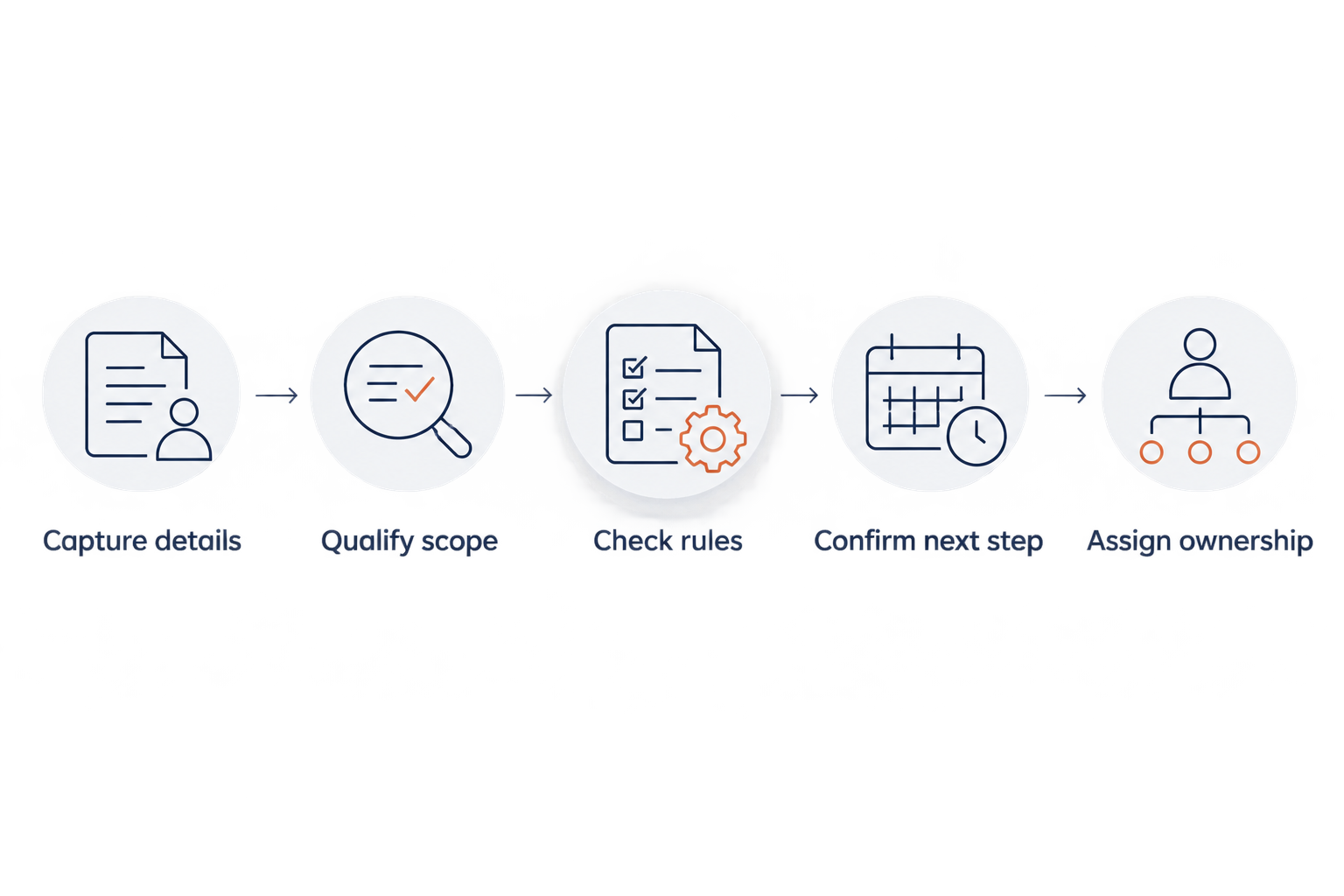
For each inquiry, inspect the same sequence:
- Capture details: Record the contact information and service address needed for follow-up.
- Qualify scope: Establish the requested work using your approved questions.
- Check rules: Apply your service-area, booking, and escalation instructions.
- Confirm next step: State whether the outcome is a callback, assessment, or confirmed appointment.
- Assign ownership: Identify who handles anything left unresolved.
Test scheduling with 2 appointment windows: an approved window and a blocked window. Require the demonstration to preserve the blocked window and correctly describe the permitted next step. Do not accept a verbal promise in place of the actual result.
Finally, require 1 named handoff owner for every unresolved inquiry. Your duct-cleaning lead response workflow should connect the initial conversation to that person's next action.
How these options are ranked
The order prioritizes response, follow-up ownership, and appointment progression, followed by the alternatives for human conversation, backup coverage, direct control, and message capture. It is a fit-based comparison—not a tested ranking of uptime, accuracy, or conversion performance.
Use the criteria above to change the order for your business. If human conversation is mandatory, evaluate staffed reception first. If your office only needs backup, start with overflow answering rather than replacing the entire process.
Which answering option should you choose?
Start with a managed lead-response service when you want responsibility for inquiry response, follow-up, and appointment setting in the service scope. Relaykite-3 belongs on that shortlist because those functions are explicitly part of its offer.
Choose staffed reception when human-led conversations are your priority. Keep overflow answering focused on backup, and use in-house reception when direct supervision matters most. Voicemail remains a message-capture option, not an equivalent booking service.
Before signing a 2026 agreement, document who can confirm appointments, which requests require review, and who owns unanswered follow-up. Configuration and execution determine the outcome; selecting a service category does not guarantee bookings.
FAQ
What's the best HVAC answering service for a duct-cleaning business?
The best fit is a service that matches your qualification, follow-up, and booking requirements. Start with managed lead response when you want those responsibilities in the service scope, or staffed reception when human conversation is your priority.
Does an answering service automatically book duct-cleaning jobs?
No. Answering, taking appointment requests, and confirming bookings are separate responsibilities. Require written booking authority and a demonstration using your approved scheduling rules.
Is a live receptionist better than automated lead response?
A live receptionist is the better fit when human-led conversation is your primary requirement. Compare the actual qualification, follow-up, and booking scope rather than choosing solely by the interaction method.
What should an answering service ask a duct-cleaning caller?
Use approved questions covering contact details, the service address, and the requested work. Add only the scope questions your business needs to determine the next step, and route technical uncertainty to authorized staff.
Can I keep my office staff and add an answering service?
Yes, overflow answering is a model designed to supplement your primary answering process. Define the routing conditions, information handoff, booking authority, and person responsible for unresolved inquiries.
How should I test a duct-cleaning answering service before signing?
Use sample inquiries that include routine requests, service-area exceptions, unclear scope, mixed service needs, and returning prospects. Inspect the resulting records and next steps rather than relying only on a demonstration script.
What should the service agreement specify?
The agreement should specify channels, coverage, qualification rules, follow-up ownership, booking permissions, and escalation responsibilities. Confirm any scheduling connections separately and avoid treating a general service description as a performance guarantee.
One last thing
An appointment request is not a confirmed appointment. Require those labels to remain distinct in customer messages and internal records. That distinction gives your office a practical check: every confirmed appointment must have the authorization and information your booking rules require.