
Yes—AI can track which marketing channel generated an HVAC lead when the lead arrives with source data from tagged links, call tracking, or a connected lead form. AI cannot reliably reconstruct a missing source from a caller’s request alone, so your 2026 setup needs to capture attribution before lead response and appointment booking begin.
- AI track marketing channel HVAC lead: yes, when source data reaches the lead record.
- Tagged links support website attribution; call tracking supports phone attribution. Neither proves every earlier interaction.
- Keep recorded sources separate from customer-reported sources, and preserve an unknown category.
- Relaykite-3 suits U.S. HVAC businesses seeking managed lead response and appointment setting; attribution requires separate verification.
Why this matters
A booked appointment tells you that lead handling produced a booking. It does not tell you which advertisement, listing, referral, or website visit brought the customer to your business. Treating those as the same measurement makes channel reporting difficult to trust.
Relaykite-3 provides managed HVAC lead response and appointment setting. Those services address what happens after an inquiry arrives; channel attribution needs its own source-capture and record-matching process. Do not assume that appointment booking includes marketing attribution.
For your 2026 reporting, keep the original acquisition source beside the appointment outcome. That gives your marketing lead and office team a shared record without asking either team to guess where the customer came from.
Can AI track which marketing channel generated an HVAC lead?
Yes, provided the system receives evidence of the source and retains it through the booking workflow. AI can organize supplied information or extract a customer’s stated source from a conversation. The tracking mechanism—not the conversational answer—establishes the recorded acquisition source.
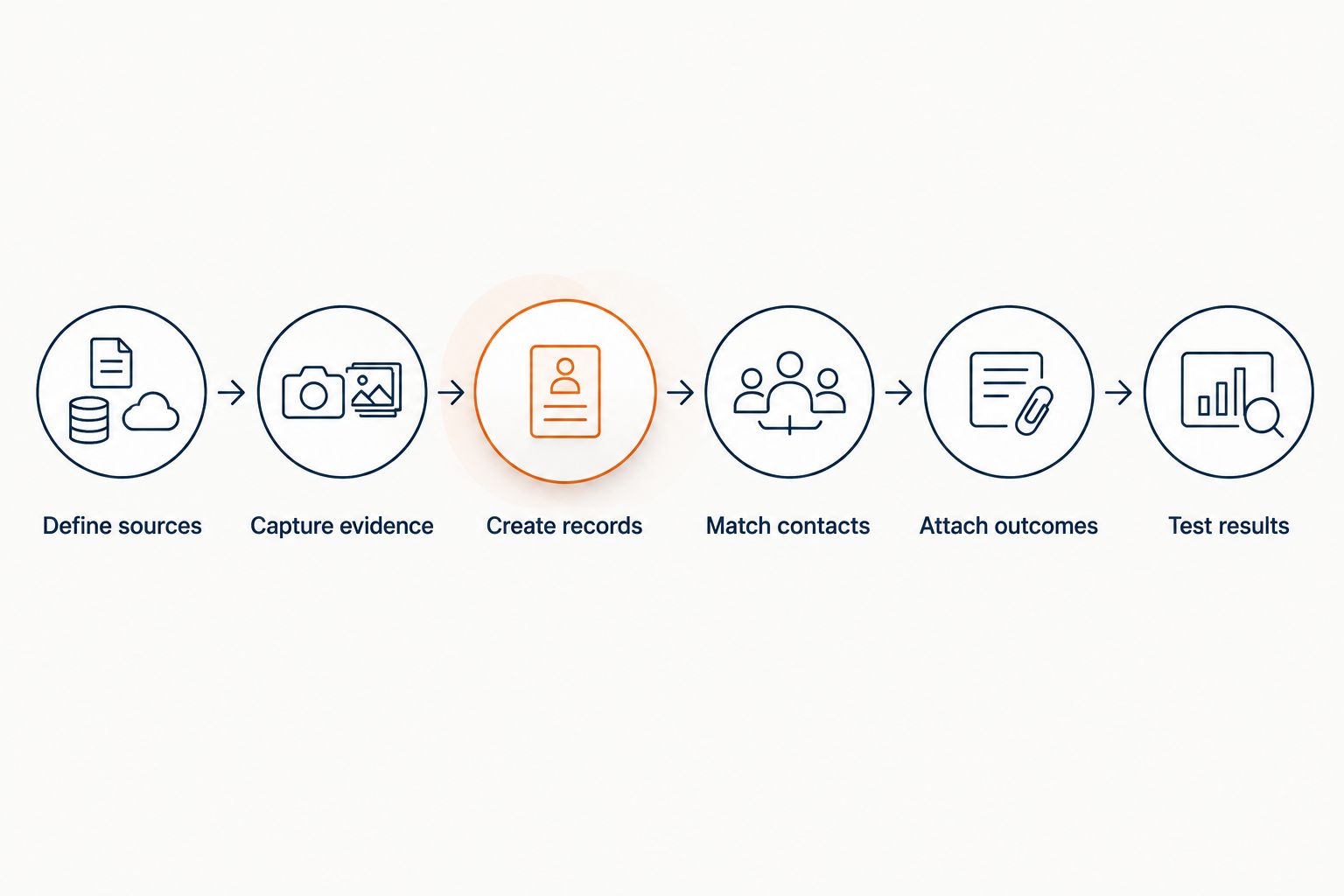
Use these 6 setup steps to connect an inquiry to its origin and eventual outcome:
- Define sources. Decide how you will label paid search, organic search, paid social, business listings, referrals, and unknown inquiries. Use consistent names across reports.
- Capture evidence. Use tagged destination links, configured call-tracking numbers, or source fields supplied by lead forms. Record what the incoming event actually contains.
- Create records. Save the inquiry with a lead identifier, contact details, timestamp, and source evidence. Preserve the original values rather than replacing them with a summary.
- Match contacts. Check whether the inquiry belongs to an existing prospect. Keep later calls attached without automatically changing the original acquisition source.
- Attach outcomes. Connect the appointment, cancellation, or other disposition to the same lead record. A booking without that connection cannot support a channel-to-appointment report.
- Test results. Submit controlled inquiries through each configured route. Confirm that the recorded source survives response, follow-up, and appointment creation.
The sequence matters. If source information disappears before the lead record exists, a later conversation summary cannot restore the missing evidence.
Which tracking method fits each HVAC lead channel?
Different entry points need different evidence. A website submission, a telephone call, and a customer’s recollection do not establish the same kind of source information.
| Method | Best for | What it contributes | Limitation |
|---|---|---|---|
| Tagged links and captured form fields | Website inquiries following tagged campaigns | Campaign labels carried into a submission | Tags must reach the form record; they do not reveal every earlier visit |
| Configured call tracking | Phone inquiries from measured placements | A connection between a tracked number or session and a call | Shared or incorrectly assigned numbers weaken source detail |
| Lead-form source fields | Inquiries submitted through advertising forms | Source information included with the incoming lead | Available detail depends on the form and connection |
| Customer-reported source | Referrals and inquiries without technical source evidence | The customer’s stated explanation | Recall is not equivalent to a recorded click or tracked call |
These methods complement one another. Keep the evidence type visible, rather than presenting every source label as equally certain.
Tagged links: best for campaign-linked website inquiries
UTM parameters are labels added to a destination URL to identify campaign information. To use them for lead attribution, your website workflow must capture the relevant values and include them with the submission.
Their advantage is explicit campaign labeling. Their limitation is continuity: a visitor can return through a different route, and a form can fail to retain the original tags. Test the stored lead record, not just the destination page.
Call tracking: best for measured phone entry points
Call tracking connects incoming calls to configured tracking numbers or website-session assignments. The useful detail depends on how those assignments distinguish your marketing placements.
A number shared across unrelated campaigns cannot distinguish those campaigns by itself. For your 2026 phone setup, review the tracking configuration separately from the answering workflow; the guide to call tracking software for HVAC companies addresses that category.
Customer-reported source: best for filling documented gaps
Asking how a customer heard about your business can capture referrals and offline discovery. An AI conversation workflow can record that answer when configured to ask and retain it.
Keep the answer in a separate field. A customer saying they found you through search does not establish whether the visit came from a paid advertisement, an unpaid result, or a business listing.
What source information should stay on the lead record?
Use 3 distinct fields for the source label, evidence type, and customer-reported source. This recommended structure separates what the tracking system captured from what the customer remembers.
- Source label: The channel or campaign supported by the incoming record.
- Evidence type: The basis for that label, such as captured campaign tags or a tracked telephone number.
- Customer-reported source: The customer’s answer, preserved without replacing technical evidence.
Also retain the lead identifier and the timestamps needed to connect subsequent activity. Keep original campaign values available for checking; a simplified dashboard label should not be the only surviving record.
For example, a customer can arrive through a tagged advertisement and later say a neighbor recommended the company. Those statements describe different interactions. Preserve both instead of forcing one to erase the other.
An unknown source is an acceptable result. It identifies a gap you can investigate. A confident label without supporting evidence hides that gap and makes later comparisons less useful.
First touch and last touch answer different questions
First-touch attribution credits the earliest recorded interaction within the measurement system’s scope. Last-touch attribution credits the latest eligible interaction before the measured conversion. Neither definition means the system observed every interaction the customer had.
| Reporting approach | Best for | Main benefit | Main limitation |
|---|---|---|---|
| First touch | Reviewing recorded discovery channels | Preserves the earliest captured source | Misses discovery that happened outside tracking |
| Last touch | Reviewing the recorded interaction before conversion | Shows the final eligible source | Can obscure earlier acquisition activity |
| Customer-reported attribution | Understanding remembered influences | Includes explanations unavailable from click records | Depends on recall and interpretation |
Choose a model before comparing campaigns. Otherwise, the same customer journey can receive different channel credit simply because reports use different rules.
Your 2026 reporting specification should state the conversion event as well. An inquiry, a booked appointment, and a completed job are different outcomes; a report labeled only as conversions leaves that distinction unresolved.
Why HVAC lead attribution varies
Attribution quality varies with the evidence captured and the rules used to interpret it. More detailed conversation summaries do not fix missing campaign identifiers or disconnected appointment records.
- Entry route: Telephone calls, website submissions, and advertising forms carry different source information. Verify each route independently.
- Tracking configuration: Reused numbers, inconsistent campaign tags, and uncaptured fields reduce the distinctions your report can make.
- Repeat contact: An existing prospect can call again through another channel. Define whether that creates another inquiry or updates an existing opportunity.
- Attribution rules: First-touch and last-touch reporting assign credit differently. Keep the chosen rule consistent within a comparison.
- Record continuity: Source information must survive handoffs between intake, follow-up, scheduling, and job records. Disconnected records interrupt outcome reporting.
- Privacy and consent controls: Browser restrictions, visitor choices, and your collection practices affect which information is available. Do not bypass those controls to fill a reporting gap.
These factors explain why attribution is a configured measurement process, not a guaranteed result of adding AI answering.
How do you verify attribution before relying on it?
Run a controlled inquiry through each route you intend to measure. Use an identifiable test contact, then inspect the resulting lead record and booking record. Do not stop when an incoming call is answered or a confirmation arrives.
Check these points during each test:
- Does the expected source appear on the original inquiry?
- Is the supporting evidence still available?
- Does a follow-up retain the original source?
- Does the appointment point to the correct lead?
- Does a repeat inquiry avoid creating misleading acquisition credit?
- Does an untracked inquiry remain unknown instead of receiving a guessed label?
For 2026 implementation acceptance, require a demonstration of the complete path rather than a dashboard screenshot. Ask the provider to show an inquiry entering through a known source and the resulting appointment retaining that connection.
A successful demonstration establishes that the tested route works under the tested configuration. It is not a guarantee that every channel, browser, repeat caller, or future configuration behaves identically.
Can AI identify the source if the caller only says “Google”?
“Google” identifies a customer-reported source, not a verified acquisition channel. The answer does not distinguish paid search, organic search, or a business listing without additional evidence.
Preserve the customer’s wording. Use a more specific channel label only when the incoming tracking record supports it.
Can AI connect the marketing source to a booked HVAC appointment?
A booked HVAC appointment can retain its marketing source when the appointment and originating inquiry share a reliable record connection. Booking alone does not establish attribution.
Relaykite-3 provides managed HVAC lead response and appointment setting, making that handoff a relevant evaluation point. Ask for a demonstration of source retention; do not infer tracking features or specific integrations from the service description.
Does tracking a lead prove that a channel generated revenue?
Tracking a lead does not prove revenue. A source-to-revenue report also needs connected job outcomes and the financial records used to define revenue.
Keep 3 outcome stages distinct: inquiry, booked appointment, and completed job. This recommended reporting structure prevents appointment totals from being presented as completed work or collected payments.
FAQ
Can AI tell whether an HVAC lead came from an ad or organic search?
Yes, when the incoming record contains evidence that distinguishes paid advertising from organic search. A customer saying search or Google does not establish that distinction by itself.
Do I need call tracking if AI already answers my HVAC calls?
AI answering does not replace call-source tracking. To attribute phone inquiries to specific placements, you need a configured source-capture method and a way to retain that information with the lead.
Can AI track a lead that calls back on a different number?
A different telephone number requires additional matching evidence before the inquiry can be confidently attached to an existing lead. Uncertain matches should remain separate or receive review rather than silently inheriting a source.
Is asking how a customer heard about us enough?
Asking provides customer-reported attribution, not a complete technical record. Keep the answer alongside captured campaign or call evidence instead of using it to overwrite those records.
What should happen when an HVAC lead has no source data?
Keep the source unknown unless additional evidence supports a label. Record the customer's stated source separately and investigate the capture gap without inventing attribution.
Does Relaykite-3 automatically include marketing attribution?
The stated Relaykite-3 service covers managed lead response, prospect follow-up, and appointment setting for U.S. HVAC businesses. Confirm source capture, attribution reporting, and record retention separately before treating them as included capabilities.
Should I use first-touch or last-touch attribution for HVAC leads?
Use first touch to examine the earliest recorded discovery source and last touch to examine the final eligible interaction before conversion. State the model and conversion event whenever you compare results.
One last thing
A repeat call is not automatically a newly acquired customer. Before shifting budget toward a channel with more calls, check whether the report counts inquiries, unique prospects, or booked appointments.
Make that definition visible beside the report. Otherwise, accurate call-source tracking can still produce a misleading answer to the business question you actually care about: which channels bring new opportunities that become work?


