

An HVAC business can switch to AI lead response once its inquiry routing, booking rules, and human handoffs pass testing—not simply when an account is activated. For a 2026 rollout, set the launch date around those checks, and keep your existing response process available until the new workflow handles the agreed scope correctly.
- How quickly can an HVAC business switch to AI lead response? Launch readiness depends on routing, booking rules, and tested handoffs.
- Relaykite-3 provides managed HVAC lead response and appointment setting; confirm the configured scope before setting a launch date.
- Start with one defined inquiry source, then expand after reviewing actual outcomes.
- A captured inquiry is not a confirmed appointment; test both outcomes separately.
Why this matters
You paid to get the lead. A rushed switch defeats the purpose if an inquiry reaches the new service but never reaches the person responsible for the next action.
Treat the switch as an operational handoff, not a software activation. Your launch decision should cover what customers hear, what gets recorded, and who handles exceptions. The Relaykite-3 managed service covers lead response, prospect follow-up, and appointment setting for U.S. HVAC businesses; agree on how those activities will work for your business before routing inquiries into it.
How quickly can an HVAC business switch to AI lead response?
The launch date should follow successful end-to-end testing of your chosen workflow. Begin with a narrow scope rather than moving every inquiry channel and appointment type at once. Broader coverage belongs in a later release if it introduces rules you have not yet checked.
Use these 5 steps to establish a launch date:
- Define scope. Choose the inquiry source, operating window, service area, and job types included at launch.
- Approve rules. Write down what the service can answer, what it can schedule, and what requires human review.
- Connect routing. Confirm that an inquiry reaches the intended workflow and that its outcome reaches your team.
- Test outcomes. Check ordinary inquiries, scheduling exceptions, and human handoffs against the approved rules.
- Authorize launch. Assign a person to approve the switch, review early activity, and restore the previous process if necessary.
Ask the provider to attach an owner and completion condition to each step. A proposed date without those details does not tell you whether your business is ready.
For the distinction between configuration work and operational approval, see how long HVAC AI onboarding takes before it goes live.
Choose the scope before choosing the date
A limited pilot and a broad cutover are different projects. For your 2026 launch plan, compare the responsibilities included in each—not just the date written beside them.
These are rollout approaches to discuss with a provider, not a statement that every service supports every configuration.
| Rollout approach | Best for | Advantage | Trade-off |
|---|---|---|---|
| Limited pilot | Owners who want to verify a defined workflow first | Keeps the initial approval scope narrow | Leaves other inquiries on the existing process |
| Response with review | Teams that want staff to approve appointments initially | Preserves a human booking decision | Requires staff to complete the handoff |
| Response and booking | Teams with documented scheduling rules | Includes appointment creation in the tested workflow | Requires checks on booking authority and exceptions |
| Broad cutover | Teams with consistent rules across the intended scope | Moves the agreed workflow together | Requires testing across more situations before approval |
Recommend a limited pilot when your rules are still being clarified. Its disadvantage is operational overlap: your staff must know which inquiries remain theirs and which have moved. Write that boundary down so customers do not receive conflicting follow-up.
A broad cutover is appropriate only after you have checked the broader scope. Do not use a successful routine inquiry as evidence that rescheduling, out-of-area requests, and urgent situations also work correctly.
What must be ready before you switch?
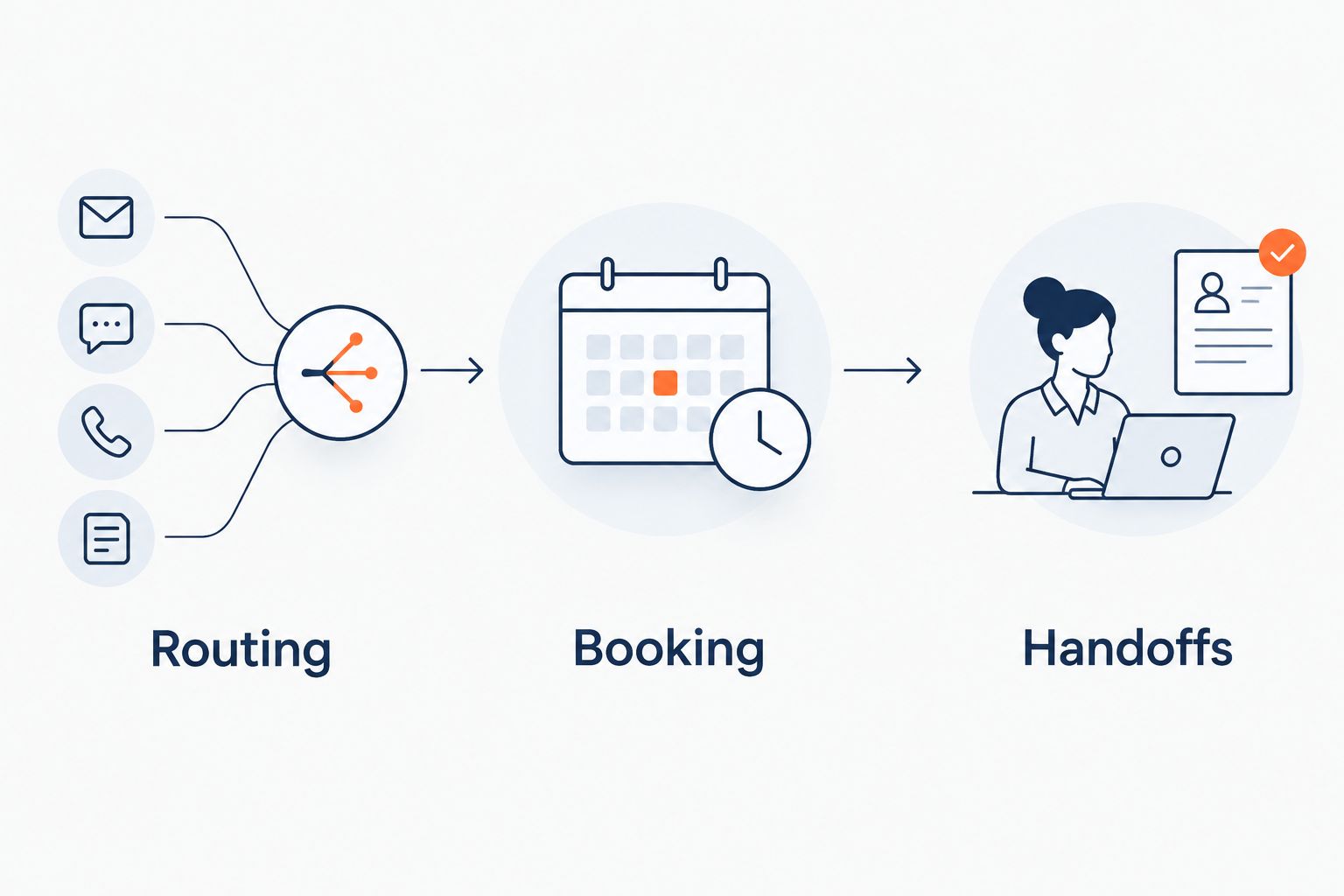
Use 3 launch checkpoints: routing, booking, and handoffs. These are recommended approval categories, not a promised implementation duration or a provider performance claim.
Routing: the inquiry reaches the right workflow
Identify where the inquiry starts and where it should finish. That means naming the selected source, the person responsible for configuration, and the destination for the resulting lead record.
Test from the customer's starting point rather than only inside a provider dashboard. Check that contact details and the service request arrive where your team expects them. An apparently successful conversation is insufficient if nobody can retrieve its outcome.
Booking: the appointment matches your rules
Separate a request for service from a confirmed appointment. Decide which job types qualify for booking, what information is required, and whether the workflow offers a confirmed slot or requests staff review.
Check the calendar record and the customer-facing message against each other. A customer should not receive a confirmation when your team has only received a request to call back.
Handoffs: an exception has an owner
Define what happens when a request falls outside the approved scope. Name the receiving role, the information that accompanies the handoff, and the fallback if that person is unavailable.
Do not describe a handoff as complete merely because a notification was sent. Your acceptance check should establish that the responsible person can find the inquiry and understand the next action.
Why the switching timeline varies
The switching timeline depends on the work included in your launch. Put these factors into the implementation discussion, and ask who resolves each one before agreeing to a date.
- Inquiry sources. Identify each source included at launch. Each needs a defined route, outcome, and fallback.
- Scheduling authority. Decide whether the service captures preferences, requests approval, or confirms appointments. Test the authority you actually intend to grant.
- Job categories. Document how repair, installation, and other accepted requests should be handled. Do not leave different appointment requirements implicit.
- Service boundaries. Provide the approved service area and exclusions. Establish a response for requests outside those boundaries.
- Human escalation. Name the people responsible for exceptions and the conditions that trigger review. Agree on a fallback for an unanswered handoff.
- Approval ownership. Assign someone who can resolve questions about routing, scheduling, and customer-facing wording. Leave no launch-critical decision unowned.
For a 2026 implementation, put these decisions into a shared acceptance document. The useful question is not simply whether setup has started; it is which launch conditions remain open and who will close them.
What should you test before the first live inquiry?
Run 5 test scenarios before approving the chosen launch scope. These are recommended checks, not a claim that five tests cover every situation your business will encounter.
Routine repair request
Submit an inquiry that fits your service area and an approved job category. Check whether the workflow captures the details your team needs and gives the customer the correct next step.
Inspect the resulting record rather than relying on a conversational impression. If booking is included, compare the appointment with the approved scheduling rules.
Installation inquiry
Submit an installation request and check that it follows the path you approved. If your business requires an assessment before scheduling further work, the response must preserve that distinction.
Do not allow general appointment language to imply that the requested installation itself is confirmed. The wording should match the actual appointment being offered.
Out-of-area request
Use a location outside your approved service boundary. Confirm that the response follows your instructions instead of creating an appointment your team cannot fulfill.
Decide whether the inquiry should be declined or sent for review. Either approach needs explicit instructions and an understandable customer response.
No suitable appointment
Test an inquiry for which the approved booking rules produce no suitable opening. Check that the workflow offers only the next steps your business has authorized.
A full schedule must not become an invented appointment. If the result is a callback request, both your team and the customer should see that status clearly.
Urgent or safety-related concern
Test your approved escalation wording without asking the service to improvise technical safety advice. Confirm what the customer is told and where the inquiry goes.
Keep emergency-service promises separate from ordinary appointment booking. Only approve language that matches your actual operating procedures and available human response.
Can you switch without replacing your office team?
You can plan a switch around a defined inquiry workflow rather than an office role. Keep responsibilities such as dispatch decisions, exceptions, and customer disputes assigned explicitly instead of assuming they transfer with lead response.
Relaykite-3 is best for U.S. HVAC businesses seeking managed lead response and appointment setting. That service description is not a promise to replace every receptionist or dispatcher task. Confirm which responsibilities are included in your configuration and which stay with your team.
The benefit of this boundary is accountability: staff know which inquiries they must handle. The trade-off is that a partial rollout still requires coordination, especially when a customer contacts your business through different channels.
When should you expand beyond the pilot?
Expand after the initial workflow meets its written acceptance conditions and your team can review its outcomes. Add a new source or appointment category deliberately, with its own rules and checks.
For a 2026 rollout, keep a change log that records what changed, who approved it, and what was retested. A change to scheduling authority deserves another booking check; a change to escalation instructions deserves another handoff check.
Do not equate an unanswered complaint channel with successful operation. Review actual inquiries and their resulting records. Check whether customers received the right next step and whether staff completed work that remained their responsibility.
What should remain under human review at launch?
Keep unclear requests and exceptions under human review until you have approved a reliable handling rule. That is a scope decision, not a failure to complete the switch.
For example, separate permission to collect information from permission to make commitments. A workflow can record a customer's preferred visit window without being authorized to promise that window. Your customer-facing wording should make the distinction clear.
Ask for a practical way to pause the affected workflow when a problem appears. Assign responsibility for reviewing the issue, correcting the rule, and authorizing a retest before it returns to service.
FAQ
Can my HVAC business switch to AI lead response immediately?
Activate live coverage only after the intended workflow passes routing, booking, and handoff checks. Account activation alone does not establish that customer inquiries will reach the correct outcome.
Do I need to move every lead source at once?
No; you can define a launch around a selected inquiry source if the provider supports that configuration. Keep the remaining sources assigned to your existing process and document the boundary.
Can I keep my receptionist during the switch?
Yes; retaining your receptionist is a valid rollout choice. Define which inquiries the service handles and which tasks remain with your office team.
What information should I prepare before onboarding?
Prepare your approved service area, job categories, scheduling rules, customer-facing instructions, and escalation contacts. Also identify who can approve changes and authorize the launch.
Should AI confirm appointments during the pilot?
Allow appointment confirmation only when the booking workflow has passed your acceptance checks. Otherwise, use an explicitly approved review process that distinguishes a requested appointment from a confirmed one.
What should happen if the new workflow fails?
Your launch plan should identify how to pause the affected workflow and restore the previous response process. Assign a person to own that decision and verify the correction before restarting.
What does Relaykite-3 provide for HVAC businesses?
Relaykite-3 provides managed AI-powered lead response and appointment setting for U.S. HVAC businesses. Confirm the inquiry sources, follow-up scope, booking permissions, and handoff arrangements configured for your business.
One last thing
Test the recovery path before launch, not after the first mistake. Submit a test inquiry, follow its record through the workflow, and ask your team to show how they would take over if the expected outcome failed.
Your final 2026 launch approval should confirm both the normal path and the fallback. That gives you a more useful readiness standard than an activation date alone.


