

HVAC AI needs business-specific instructions and realistic call testing to sound natural; there is no universal training-hour requirement that proves readiness. The work includes more than voice tuning: you must define what the service can say, what it can book, and when it must hand the conversation to a person.
- How much training does HVAC AI need to sound natural? Judge tested behavior, not training hours.
- HVAC appointment setting needs clear service boundaries, booking permissions, and human handoff instructions.
- Relaykite-3 serves U.S. HVAC businesses seeking managed lead response and appointment setting.
- A natural voice does not prove accurate scheduling or safe handling of unfamiliar questions.
How much training does HVAC AI need to sound natural?
Use demonstrated call handling—not an elapsed training period—as your acceptance standard in 2026. A useful conversation must acknowledge the caller, collect relevant details, and explain the next step without inventing an answer. A polished greeting proves little about those tasks.
Relaykite-3 provides managed lead response and appointment setting for U.S. HVAC businesses. That service category makes business configuration central to the discussion: sounding conversational and following your operating rules are separate requirements.
Use this sequence to evaluate readiness:
- Define the scope. Identify which inquiries the service should handle and which belong with your office.
- Supply approved facts. Document your service area, supported work, appointment rules, and escalation instructions.
- Test realistic conversations. Include interruptions, unclear requests, corrections, and unavailable appointments.
- Review the outcome. Check whether the conversation produced an accurate record and an authorized next step.
- Correct and retest. Repeat the failed scenario after changing the relevant instruction.
Ask providers to separate their onboarding schedule from their evidence of readiness. A launch date is a project milestone, not proof that the service handles your calls correctly.
Why this matters
Your customer does not judge a call only by the voice. The customer also needs the business to understand the request and explain what happens next.
An answer can sound confident while getting the job type wrong. A cautious answer can be more useful when it clearly explains that your office must confirm availability. Accuracy and clear boundaries belong in the definition of natural conversation.
For a 2026 evaluation, listen past the demonstration greeting. Test the point where a caller changes direction, asks an unsupported question, or challenges an appointment detail. Those moments reveal whether the configured conversation still makes sense.
Voice behavior and business setup solve different problems
The word training can refer to several different activities. Ask the provider which activity it means before accepting an estimate or comparing proposals.
| Setup layer | What to evaluate | Benefit | Limitation | Best for |
|---|---|---|---|---|
| Voice behavior | Pronunciation, pacing, pauses, and interruptions | Makes spoken exchanges easier to follow | Does not establish business facts | Improving listening comfort |
| Business instructions | Approved services, coverage, terminology, and boundaries | Keeps responses relevant to your company | Requires accurate source information | Answering business-specific questions |
| Booking rules | Authorized appointment types and confirmation conditions | Defines what the service can promise | Does not create technician capacity | Controlling appointment commitments |
| Human handoff | Triggers, destination, and fallback instructions | Gives unresolved calls a defined next step | Depends on an available operational process | Handling exceptions and uncertainty |
These are evaluation categories, not claims that every provider offers the same controls. Request a demonstration of the controls included in the service you are considering.
Voice behavior: evaluate more than pronunciation
Listen for whether the voice pauses at sensible points and stops speaking when the caller interrupts. Check the pronunciation of local place names and the HVAC terms your customers actually use.
Avoid treating a particular accent or cheerful delivery as proof of competence. A clear, restrained voice that follows the conversation is more useful than an expressive voice that ignores a correction.
Business instructions: supply facts, not a sales script
Give the service approved answers and explicit limits. A long marketing document does not replace a clear statement about which requests your business accepts.
Separate confirmed facts from questions that require office review. For example, the service should not infer that your company handles a particular equipment type simply because it handles other HVAC work.
Booking rules: distinguish a request from a confirmation
Define the language that means an appointment is confirmed. Also define what the service should say when it has only collected a preferred time.
A requested appointment and a confirmed appointment must not sound interchangeable. Test the closing summary carefully, because that is where an otherwise useful conversation can create an unsupported commitment.
What should you prepare before call testing?
Prepare a short operating brief that your office can approve. The goal is not to anticipate every sentence a caller might say; it is to make the permitted decisions explicit.
Service scope
List the work you accept, the work you decline, and the requests that need review. Include the distinctions that affect routing, such as repair inquiries versus installation inquiries.
Describe those distinctions in customer language. A caller should not need to know technical terminology to reach the appropriate next step. The guide to how AI identifies repair or installation requests addresses that qualification problem separately.
Conversation language
Provide examples of acceptable explanations, acknowledgments, and clarification questions. Keep them short enough to speak comfortably.
Use examples as guidance rather than requiring identical wording throughout a call. Test whether the service responds to what the caller just said instead of returning to an unrelated scripted question.
Scheduling permissions
Specify what information is required before a booking action. State which decisions need office approval and what happens when the requested appointment cannot be confirmed.
Do not leave the fallback implicit. Collecting a callback request is a different action from promising that a technician will attend.
Escalation instructions
Define when the conversation must leave the booking workflow. Include unfamiliar requests, disputes, and safety-related concerns in your review with the provider.
Keep technical diagnosis outside a lead-response script unless you have separately established an appropriate process. Natural-sounding language is not a substitute for qualified judgment.
A practical call-testing process for 2026
Build your test around the full conversation, not isolated answers. Start with a straightforward inquiry, introduce a change, and check the final record against what the caller actually requested.
The following sequence is a recommended evaluation process, not a guaranteed onboarding timeline.
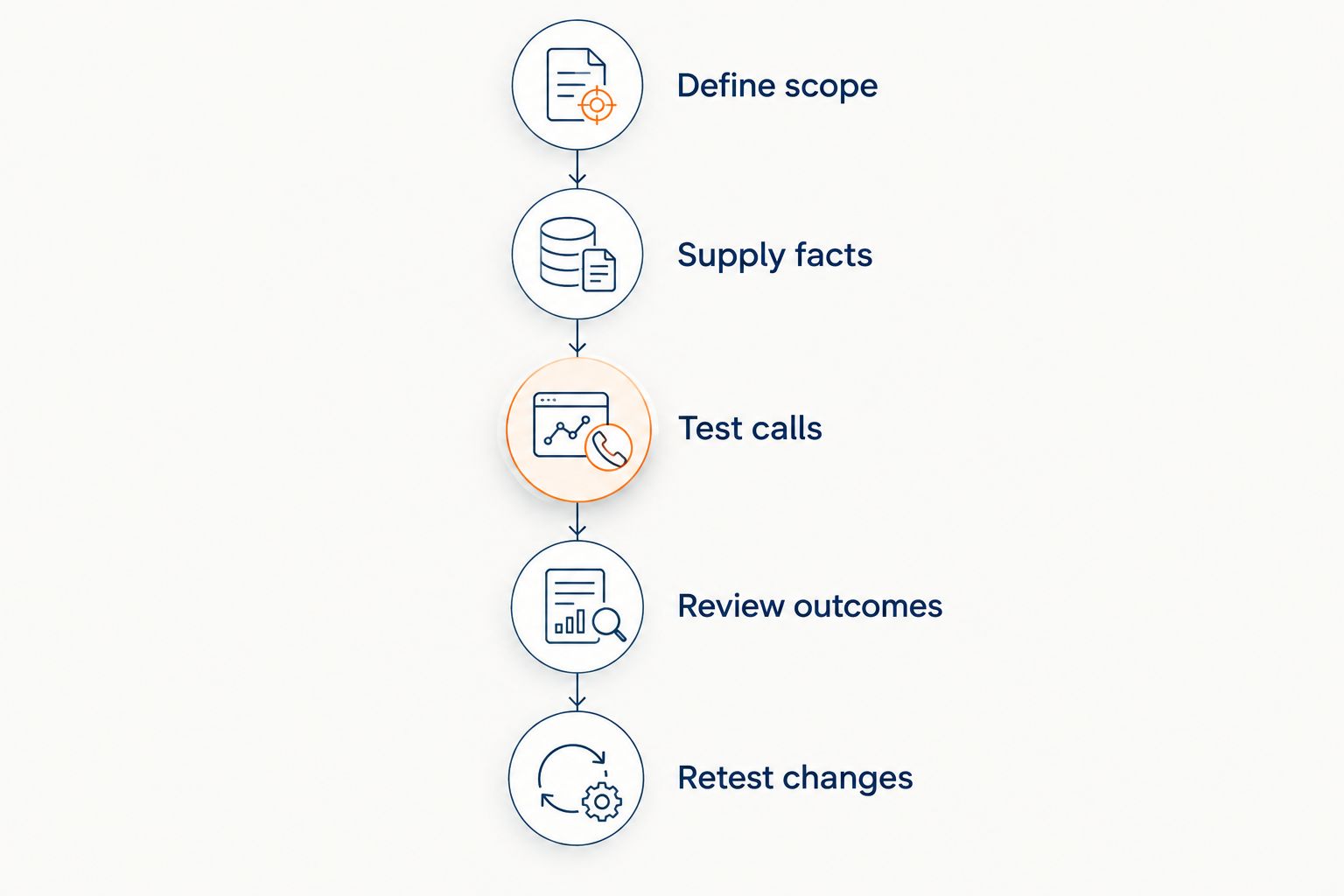
- Define scope. Choose a supported inquiry and write down the authorized outcome before the test starts.
- Supply facts. Provide the approved information needed to handle that inquiry correctly.
- Test calls. Play the customer and introduce an interruption, correction, or unanswered question.
- Review outcomes. Compare the call summary and next step with your written acceptance criteria.
- Retest changes. Repeat the scenario after revising the relevant instruction, then check an unaffected scenario too.
Keep a record of what failed and what changed. Distinguish a voice issue from an incorrect fact, a booking-permission problem, or an unclear handoff rule. Different failures need different corrections.
For your 2026 acceptance review, require the provider to demonstrate the corrected behavior. A written assurance that an issue was addressed does not show how the next conversation will unfold.
Why the amount of setup varies
The relevant variable is the complexity of your approved workflow, not simply how much text you supply. Use these factors to discuss scope with a provider:
- Inquiry variety. Repair requests, installation inquiries, and existing appointment questions require different next steps.
- Booking authority. Collecting a preferred time requires different instructions from confirming an appointment.
- Business boundaries. Your service area and accepted work determine which inquiries should continue through qualification.
- Exception handling. Unclear requests and questions outside the approved information need explicit fallback instructions.
- Human ownership. A handoff needs a destination and a process for handling an unanswered transfer or callback request.
- Information changes. Updated operating rules require corresponding updates to the configured service and relevant tests.
Ask the provider to explain which factors affect its proposed onboarding work. Do not accept a longer training period as evidence of better results without seeing what that work covers.
What should a natural HVAC call sound like?
A natural call acknowledges the information already given and asks for the next missing detail. It does not make the customer repeat an answer simply because a script expects it later.
Use the following situations as test prompts. They are illustrative evaluation scenarios, not reported performance results.
- The caller interrupts. Check whether the service stops, addresses the interruption, and resumes at a sensible point.
- The caller corrects an address. Check whether the final record contains the corrected address rather than the original one.
- The caller is unsure what service is needed. Check whether the service asks a useful clarification question without presenting a diagnosis.
- The caller asks an unsupported question. Check whether the service acknowledges the limit and gives an approved next step.
- The caller requests an unavailable time. Check whether the service avoids presenting a preference as a confirmed appointment.
Listen for relevant responses, not conversational decoration. Repeated expressions of empathy do not repair a misunderstood request.
Do you need recordings of previous HVAC calls?
Previous call recordings are not automatically a requirement for business configuration. Ask the provider whether it needs recordings, written examples, approved answers, or another source—and what purpose each source serves.
If you plan to share recordings, establish the appropriate permission, access, and retention process before transferring them. Do not assume that sharing customer conversations is necessary just because the provider uses the word training.
Does more training always make the service sound better?
More training is not a useful promise unless the provider identifies what changes and how it will test the result. Additional instructions can also conflict with existing instructions, so review changes for consistency.
Ask for the specific correction: pronunciation, turn-taking, business facts, booking permissions, or handoff behavior. Then repeat the scenario that exposed the problem.
Where a managed service fits
Relaykite-3 is best suited to U.S. HVAC businesses seeking managed lead response and appointment setting. Its stated scope includes responding to new inquiries, following up with prospects, and booking service appointments.
That scope is relevant when you want help managing the lead-response process rather than evaluating a voice in isolation. It does not, by itself, establish a training duration, a particular integration, or a guaranteed call outcome. Confirm the configuration, responsibilities, and acceptance criteria before launch.
For a Relaykite-3 HVAC lead-response evaluation in 2026, bring your operating brief and ask how the proposed setup will be demonstrated. Keep the decision tied to your approved workflow.
FAQ
How much training does HVAC AI need to sound natural?
HVAC AI needs business-specific instructions and realistic call testing; a universal training-hour figure does not establish readiness. Evaluate whether it understands the request, follows approved rules, and explains the next step accurately.
Do I need to train an HVAC voice model from scratch?
Do not assume you need to train a voice model from scratch. Ask the provider to distinguish its existing voice system from the business configuration and testing required for your service.
Can a natural-sounding HVAC answering service still make booking mistakes?
A natural-sounding voice does not establish booking accuracy. Test appointment permissions, unavailable times, corrections, and the difference between a request and a confirmation.
Should I give the provider my old customer call recordings?
Ask the provider why it needs recordings before sharing them. Establish the appropriate permission, access, and retention process, and ask whether approved written examples meet the configuration need.
What's the best way to test whether HVAC AI sounds natural?
Test complete conversations with interruptions, corrections, and unfamiliar questions. Review both the spoken response and the final record against your approved outcome.
Will HVAC AI automatically improve after every customer call?
Do not assume every customer call automatically updates the service. Ask what information is retained, how changes are approved, and how corrected behavior is tested.
When should an HVAC answering service hand a call to a person?
Use human handoff when the request exceeds the service's approved scope or requires a decision reserved for your staff. Define the destination and fallback process before launch.
One last thing
Test a correction near the end of a conversation. Change the address or appointment preference after the service has already summarized it, then check what the final record contains.
That test separates a pleasant exchange from a dependable workflow. Approve the service only when its final action matches the caller's corrected request and your business rules.


