

The cost to switch HVAC answering providers depends on your current contract, the replacement service’s setup requirements, and the work needed to move your call handling. Budget for the transition separately from ongoing service, and check exit obligations, overlapping coverage, and staff time before you approve a move in 2026.
- The cost to switch HVAC answering providers includes transition work, not just the replacement service’s ongoing charges.
- Check cancellation terms, phone-number control, booking rules, and overlapping coverage before setting a cutover date.
- Relaykite-3 suits U.S. HVAC businesses seeking managed lead response and appointment setting; confirm the proposed scope before switching.
- Approve the switch only after test inquiries reach the correct booking or human-handoff outcome.
How much does it cost to switch HVAC answering providers?
Your switching budget should separate contractual obligations, provider setup, and internal work. A replacement service quote is not a complete switching budget unless it also addresses the transition. Ask each provider to identify what is included, what requires separate approval, and what remains your responsibility.
For businesses evaluating Relaykite-3, the relevant scope is managed lead response, prospect follow-up, and appointment setting for U.S. HVAC businesses. Compare that scope with the work your current answering provider performs; do not assume the services are interchangeable.
Use this breakdown when requesting a written transition proposal in 2026:
| Budget component | What to verify | What belongs in your decision |
|---|---|---|
| Current contract | Cancellation notice, renewal terms, and any remaining obligations | The written terms governing your departure |
| New-service setup | Configuration, call instructions, booking rules, and testing | Included work versus separately approved work |
| Phone transition | Number control, forwarding arrangements, and any required transfer | Who changes routing and who confirms it works |
| Overlapping coverage | Whether both services remain active during testing | A defined purpose and endpoint for overlap |
| Internal work | Staff preparation, approvals, training, and corrections | The people responsible and the time they allocate |
| Ongoing scope | Answering, follow-up, booking, and human handoff | A like-for-like comparison after transition |
Do not treat every row as an automatic charge. Treat each as a question that needs a written answer before you commit.
Why this matters
An answering-service change affects more than who picks up the phone. You are changing how inquiries reach your team, what callers are told, and how appointment requests become scheduled work.
A proposal that excludes booking configuration is not equivalent to one that includes it. The same applies to follow-up ownership and human escalation: compare the actual responsibilities, not just the service labels.
Why the cost to switch varies
The transition depends on the responsibilities you move and the conditions attached to leaving. These are the factors to resolve in your own contracts and implementation plan, not assumptions about any particular provider.
- Exit terms. Check the signed agreement for notice requirements, renewal language, and obligations that survive cancellation. Request written confirmation of the intended termination date.
- Phone-number control. Establish who controls the number and whether changing providers requires forwarding changes or a transfer. Do not cancel service before the routing plan is confirmed.
- Booking scope. Distinguish taking an appointment request from placing an appointment in an approved schedule. Document which outcome the replacement service will deliver.
- Business-rule preparation. Assign responsibility for service areas, supported job types, appointment windows, and escalation instructions. Ask whether preparing those rules is included in setup.
- Overlap and testing. Define which inquiries each provider handles during the transition. An overlap period without a routing plan leaves responsibility unclear.
- Staff involvement. Identify who approves scripts, checks test outcomes, and resolves exceptions. Include that work in the decision even when it does not appear on a provider invoice.
For a 2026 switch, request current written terms rather than relying on a previous proposal. Keep the approved scope with the transition checklist so your office can distinguish an agreed requirement from a later request.
Which switching approach fits your HVAC business?
Choose the transition method around the responsibilities you need to validate. The following are planning options, not claims that any provider supports a particular arrangement.
| Approach | Best for | Advantage | Limitation |
|---|---|---|---|
| Direct cutover | A business with approved rules and a confirmed routing plan | Establishes a clear point of responsibility | Gives you less opportunity to observe live handling before the full change |
| Limited-scope trial | A business that needs to validate a defined inquiry type or coverage window | Keeps the initial evaluation focused | Does not prove performance outside the tested scope |
| Planned overlap | A business that needs continuity while checking the replacement workflow | Preserves an existing handling path during verification | Requires explicit routing ownership and a stop condition |
Use a limited-scope trial when important booking or handoff rules remain untested. Its limitation is equally important: a successful routine inquiry does not validate urgent-call handling, unusual service requests, or every scheduling exception.
A direct cutover requires a clear recovery plan. Planned overlap requires an equally clear end condition; keeping both services active is not a substitute for deciding which service owns each inquiry.
Keep answering and appointment setting separate
An answered call is not necessarily a booked appointment. Your comparison should identify whether the service records a message, requests a callback, follows up with the prospect, or books within approved scheduling rules.
For an HVAC business, specify how repair requests and installation inquiries should be handled. Ask the provider to demonstrate the agreed workflow rather than treating a feature name as proof that your requirements are covered.
How do you build a switching budget without guesswork?
Build the budget from written obligations and defined work. Keep recurring service separate so you can see what the transition itself requires.
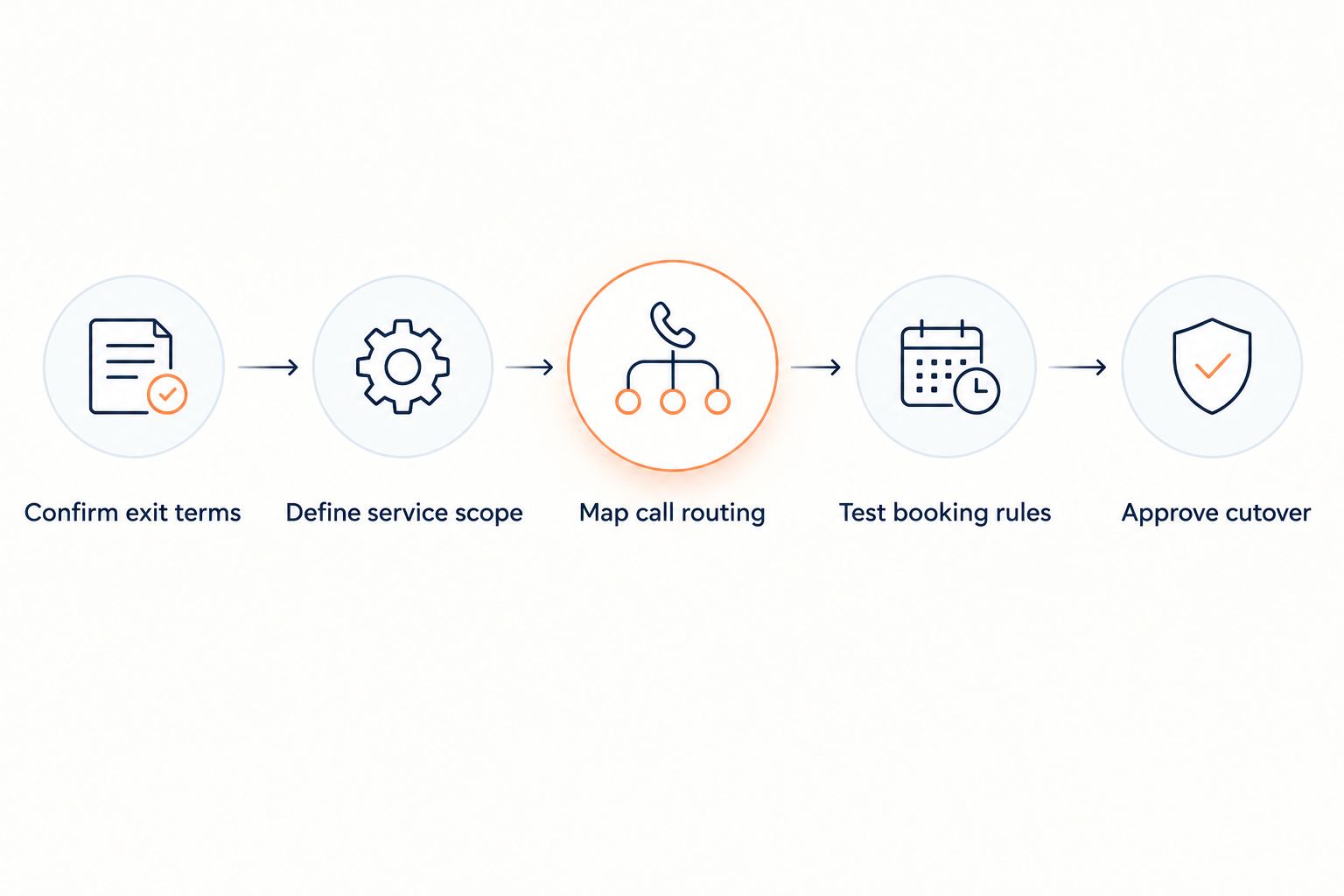
- Confirm exit terms. Obtain the cancellation procedure and intended end date in writing. Resolve any disagreement before scheduling the move.
- Define service scope. List the inquiry sources and tasks the replacement service will handle. Identify what your office will continue to do.
- Map call routing. Document the current destination, proposed destination, and person authorized to make changes. Include the recovery destination if testing fails.
- Test booking rules. Check whether the service produces the correct appointment, callback request, or human handoff for each approved scenario.
- Approve cutover. Authorize the change only after the responsible person reviews the test results and outstanding issues.
This sequence makes the budget auditable. Each task has an owner, an expected outcome, and a place in the transition rather than disappearing into a general setup description.
Ask for a scope, not just a setup label
Request a list of deliverables attached to onboarding. Useful deliverables include approved call instructions, documented booking boundaries, named escalation contacts, and a completed test record.
Then ask what happens when your instructions change. A transition proposal should distinguish corrections needed to meet the agreed scope from additional work you request later.
Give overlap a stop condition
If you choose overlapping coverage, write down exactly what ends it. Suitable conditions include approved routing, accepted booking tests, and confirmation that the office receives the required inquiry details.
Do not use the passage of time alone as evidence of readiness. A quiet period does not demonstrate that an untested call type will reach the right destination.
What should you test before ending the old service?
Use 5 test calls as an initial acceptance checklist, not as a guarantee of reliability. Expand the checklist to cover the services and exceptions your business actually handles.
| Test call | What the caller asks | What you should verify |
|---|---|---|
| Routine repair | Requests service for an equipment problem | Correct inquiry details and the approved booking or callback outcome |
| Installation inquiry | Asks about replacing equipment | Correct classification and the agreed next step |
| Outside service area | Gives an address beyond your coverage | No appointment outside your approved rules |
| Unavailable appointment | Requests a time your business cannot accept | No unsupported booking promise |
| Human handoff | Raises an issue outside the approved instructions | The agreed escalation route receives the inquiry |
Use fictional customer details for testing. Keep the scenario, observed outcome, correction, and retest result together so the person approving launch can see what changed.
Assign 1 transition owner who can approve changes and resolve conflicting instructions. During a planned overlap, maintain a responsibility map for 2 providers so neither team assumes the other owns an inquiry.
For a 2026 launch, date the final instructions and record who approved them. A dated version helps your office identify which rules were active when a disputed booking or handoff occurred.
If retaining your number is part of the plan, review the questions in using an existing HVAC phone number. Confirm your own ownership and routing arrangements before authorizing cancellation.
How do you compare managed lead response with answering alone?
Compare outcomes and responsibility boundaries. Message-taking, prospect follow-up, and appointment setting are distinct tasks; your proposal should state which tasks are included and what information each requires.
Relaykite-3 is best for U.S. HVAC businesses seeking managed lead response and appointment setting. Its stated scope covers responding to new inquiries, following up with prospects, and booking service appointments; that description is not a guarantee that every requested workflow is included.
The relevant advantage is the combination of those responsibilities in the stated service scope. The limitation is that your business still needs to confirm booking permissions, escalation rules, transition work, and any required connections before approving a switch.
Ask for a demonstration based on your instructions. A generic demonstration does not establish that the service is configured for your business.
Review your lead-response requirements
Compare managed lead response and appointment setting with the tasks your HVAC business needs covered.
Can you switch without changing your HVAC phone number?
Keeping your existing number depends on its ownership and the available routing arrangements. Verify those facts with the parties controlling the number before you schedule the change.
Ask who authorizes forwarding or transfer changes and how the destination will be tested. Treat number continuity as an acceptance requirement, not an assumption based on a sales conversation.
Is switching providers worth it just to reduce ongoing charges?
Lower ongoing charges alone do not establish that switching is worthwhile. Compare the same responsibilities and account for transition obligations, staff work, and any change in how inquiries are handled.
A narrower service can leave follow-up or booking work with your office. That trade-off can be acceptable, but it belongs in the decision rather than appearing after launch.
FAQ
What does the cost to switch HVAC answering providers include?
The cost to switch HVAC answering providers depends on exit obligations, setup scope, phone routing, overlapping coverage, and internal work. Verify each item in writing rather than assuming it is automatically charged or included.
Will my current HVAC answering provider charge me to leave?
Your signed agreement determines your departure obligations. Check cancellation notice, renewal terms, and any remaining commitments, then obtain confirmation of the termination date.
Should I cancel my old answering service before testing the replacement?
Test the replacement workflow before removing your existing handling path. Approve routing, booking outcomes, and human handoffs before authorizing the final cutover.
How many calls should I use to test a replacement answering service?
Use 5 test calls as an initial checklist covering routine repair, installation, service-area limits, unavailable appointments, and human handoff. Add scenarios for your business; this checklist is not a reliability guarantee.
Who should manage the answering-provider switch?
Assign 1 transition owner with authority to approve instructions and resolve issues. Other staff can perform tests, but final approval needs a clearly named decision-maker.
Does an answered HVAC call mean an appointment is booked?
An answered HVAC call does not necessarily mean an appointment is booked. Confirm whether the service takes a message, requests a callback, follows up, or books within your approved scheduling rules.
What should I confirm before switching to Relaykite-3?
Confirm the proposed lead-response, follow-up, and appointment-setting scope before switching to Relaykite-3. Request written transition responsibilities, booking boundaries, and escalation instructions configured for your business.
One last thing
Keep the recovery route documented until you accept the new workflow. Record who can restore the previous routing destination, what triggers that decision, and how your office will identify inquiries needing follow-up.
Your final 2026 approval should answer a practical question: if the next inquiry cannot be booked, who owns the next step? Do not close the transition while that answer remains unclear.


