

Budget an AI appointment setter for your HVAC firm from a written quote that defines setup, ongoing service, usage, and booking responsibilities—not from a headline fee alone. Include your team's work to maintain scheduling rules and resolve exceptions when assessing the full commitment. For a 2026 purchasing decision, compare providers against the same inquiry-to-appointment workflow before accepting a proposal.
- AI appointment setter cost: HVAC firms should compare written scope, usage terms, and accepted appointments—not headline fees alone.
- Relaykite-3 fits U.S. HVAC firms seeking managed lead response, prospect follow-up, and appointment setting.
- Define an accepted appointment before comparing proposals; a reply, booking request, and confirmed appointment are different outcomes.
- Use a 30-day review period to assess booking accuracy and staff intervention against your own baseline.
Why this matters
You paid to generate the inquiry. Your next decision is whether the response process can turn that inquiry into an appointment your business can actually serve. A fast reply does not establish service-area eligibility, technician capacity, or customer acceptance of a visit.
Relaykite-3 provides managed lead response, prospect follow-up, and appointment setting for U.S. HVAC businesses. Assess that service category against the work you need handled, not against a software subscription that leaves configuration and follow-up with your office.
Compare responsibility before comparing cost. A proposal is useful only when you can identify what the provider handles, what your staff handles, and what happens when the normal booking path fails.
How much does an AI appointment setter cost for HVAC firms?
The amount to budget is the amount in a written proposal for your defined workflow, with every billing condition and internal responsibility identified. For your 2026 comparison, request the same breakdown from each provider rather than treating different scopes as equivalent.
Use this checklist to separate the commercial agreement from the operational work:
| Quote component | What to ask the provider | What your office must verify |
|---|---|---|
| Setup | What configuration work is included, and what is separate? | Who supplies service areas, job types, and booking rules? |
| Ongoing service | What work continues after launch? | Who reviews exceptions and requests changes? |
| Usage | What activity is measured, and how is it counted? | Can you reconcile the count with inquiry records? |
| Scheduling | Is the outcome a request, a held slot, or a confirmed appointment? | Does the result match your dispatch process? |
| Follow-up | What follow-up scope is included? | Who stops outreach after a reply or booking? |
| Changes and exit | What terms apply to changes, cancellation, and record access? | Who owns the transition if you stop? |
These are questions for a proposal, not a statement that every provider bills each component separately. Require an explicit answer where a component is included, excluded, or your responsibility.
Put your own operating work beside the quote
A provider's invoice and your staff's workload are different things. Record the time your office spends preparing rules, correcting bookings, handling escalations, and reconciling records.
Do not assign savings to that work before measuring it. If appointment setting still requires staff review, include that responsibility in your decision rather than treating the workflow as unattended.
Which appointment-setting scope are you buying?
An acknowledgment, a booking request, and a confirmed appointment are different deliverables. Define the endpoint before asking which proposal is better for your HVAC business.
The following table compares workflow scopes, not named vendor plans or promised capabilities.
| Workflow scope | Best for | Practical advantage | Limitation to account for |
|---|---|---|---|
| Initial response | Teams that want staff to retain qualification and scheduling | Establishes contact while preserving office control | Your team still needs to move the inquiry toward a booking |
| Qualification and booking request | Teams that require office approval before scheduling | Collects information before a staff decision | A pending request is not a confirmed visit |
| Appointment setting with follow-up | Teams seeking help through the booking stage | Extends the process beyond the first reply | Requires clear scheduling, follow-up, and exception rules |
Buy the endpoint your operation needs, not the broadest feature label. If your office must approve every service visit, a well-defined booking request is a more honest deliverable than a confirmation that staff later reverse.
Ask the provider to show where ownership transfers. Your office should know whether it receives an unanswered inquiry, a qualified prospect, an appointment request, or a confirmed booking.
Why the scope behind an HVAC appointment-setting quote varies
Use these factors to explain differences between proposals. Ask providers to identify which factors affect their quoted scope or billing; do not assume they all do.
- Response responsibility: Specify whether the work starts with a new inquiry, an unanswered inquiry, or a prospect already contacted by your office.
- Qualification rules: Identify the information needed before booking, including service address, requested work, and your business's eligibility rules.
- Scheduling authority: State whether the service can confirm appointments or must request approval from your staff.
- Follow-up ownership: Define who contacts prospects again, when follow-up stops, and who handles replies outside the normal flow.
- Ongoing management: Identify who updates instructions, investigates errors, and approves changes after launch.
- Exception handling: Assign responsibility for uncertain requests, scheduling conflicts, and inquiries that require a person.
For a 2026 purchasing review, put these factors into a shared comparison sheet. A difference in responsibility is not a like-for-like difference in value until you have identified the work your team retains.
How should you request a comparable quote?
Give each provider the same written brief. Describe the outcome and its boundaries in operational terms so the proposal can be checked against actual inquiries.
- Define inquiries. List the inquiry sources you want covered. Distinguish new prospects from existing customers requesting help with an existing appointment.
- Set eligibility. Supply your service area, accepted job types, and conditions that require staff review. Keep technical diagnosis separate from appointment qualification.
- Set booking rules. Describe who controls available slots and what the customer must accept before a booking counts as confirmed.
- Assign exceptions. Name the staff role responsible when the service cannot confidently continue. Require a clear handoff rather than an unsupported promise.
- Review results. Agree on the records needed to assess inquiry handling, booking accuracy, and staff intervention.
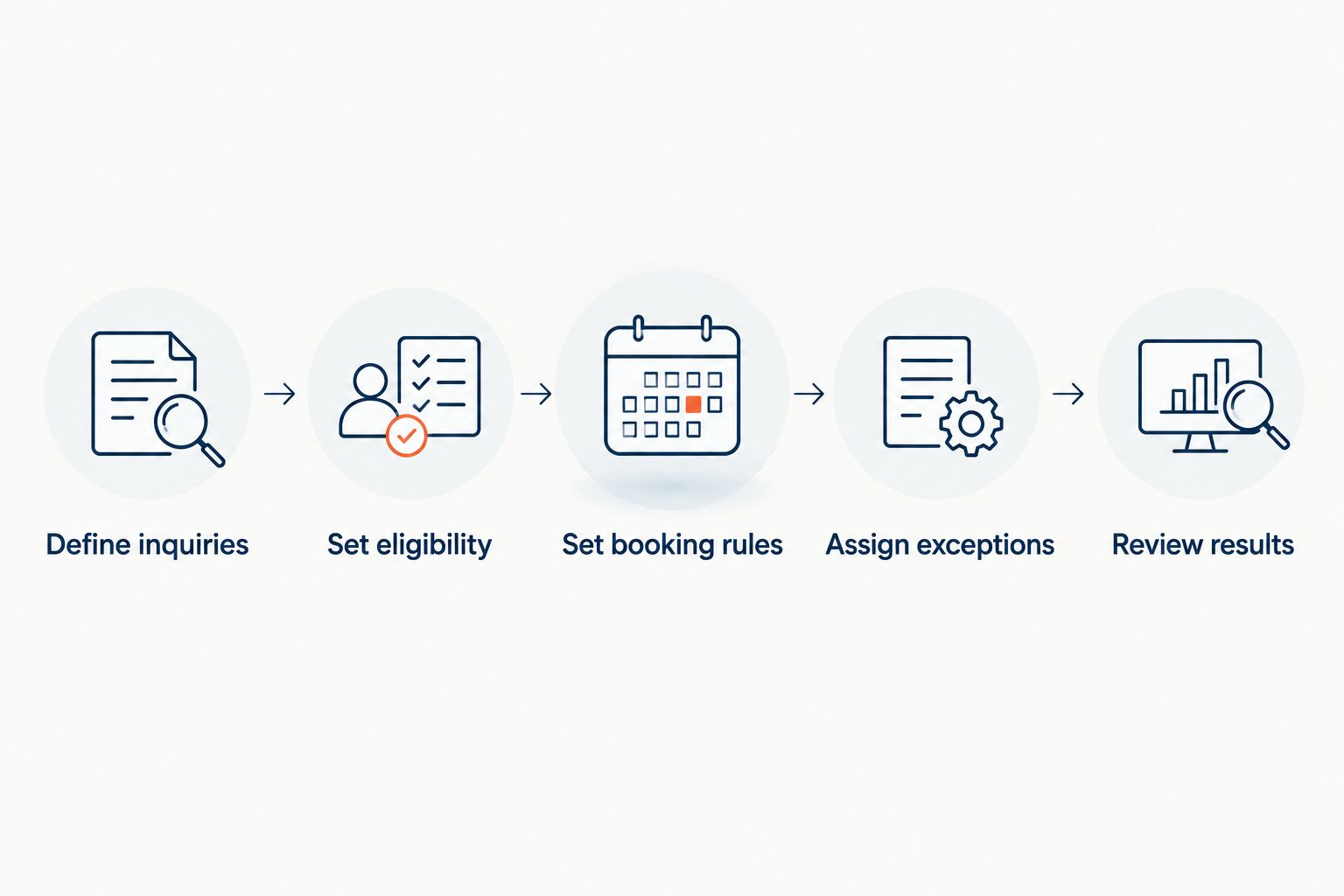
For a concrete inquiry source, use the website contact form to booked HVAC service call workflow to frame your questions. Check each transfer of information and responsibility rather than assuming a form submission becomes a confirmed visit.
Define an accepted appointment
Use 1 accepted appointment as a clearly defined review unit: an eligible request placed into an allowed slot, accepted by the customer, and recorded according to your process. Adjust that definition to your operation before evaluating results.
Keep appointment acceptance separate from completed work. A booking does not establish that a technician attended, that the customer approved repairs, or that your business collected payment.
How can you check value without relying on promised returns?
Start with your own records. Separate inquiries, qualified prospects, appointment requests, accepted appointments, cancellations, and completed jobs so that different outcomes do not get combined.
For a 2026 evaluation, use a 30-day review period as an initial observation window, not a performance guarantee. Record unusual operating conditions alongside the results, including staffing changes or periods when your schedule has no suitable openings.
Track the work that remains with your office:
- Review inquiries that needed staff intervention and identify why.
- Check whether accepted appointments follow your service-area and scheduling rules.
- Record duplicate, incomplete, or corrected bookings separately.
- Compare provider records with your own appointment records.
- Document instruction changes so results are interpreted against the rules in effect.
Do not count every appointment handled by the service as an additional appointment. Some customers would have booked through your existing process. Assess the change against a baseline before assigning financial value to the result.
What should an HVAC firm test before approving the service?
Use 5 inquiry scenarios to check the proposed workflow: an eligible service request, an out-of-area request, an unavailable appointment, an unclear request, and a customer who stops responding. These are recommended test cases, not a claim about any provider's results.
For each scenario, ask the provider to demonstrate the intended response and the handoff. Your office should be able to identify whether the result is a booking, a request for clarification, a pending decision, or a stopped conversation.
Test boundaries as carefully as the normal booking path. An unavailable slot should not become a promised visit, and an unclear technical description should not become an unsupported diagnosis.
Relaykite-3 is best for U.S. HVAC firms seeking managed lead response and appointment setting. The advantage is the service's stated focus on responding, following up, and booking; the limitation is that those activities do not, by themselves, establish technician capacity or completed-job revenue.
Is a managed service better than configuring software yourself?
A managed service fits a purchasing brief that includes ongoing help with lead response and appointment setting. A self-managed approach fits a brief in which your business accepts responsibility for configuring and maintaining the workflow.
Neither label settles the decision. Compare the exact responsibilities in the proposal, including who reviews errors, changes instructions, and handles exceptions after launch.
Does appointment setting replace your dispatcher?
Appointment setting does not establish that dispatch responsibilities are included. Booking a visit and deciding how technicians carry out the work are separate responsibilities unless the agreed scope explicitly combines them.
Keep operational authority clear. Your team should know who can change schedules, approve exceptions, and communicate a confirmed service commitment to a customer.
What should be in a 2026 appointment-setting agreement?
A 2026 agreement should identify the covered workflow, billing conditions, ownership of configuration, escalation responsibilities, and access to records. Ask for these terms in writing before treating a demonstration as an operational commitment.
Also document how changes are approved. Your service area, accepted work, and scheduling rules need an accountable owner rather than an informal assumption that someone will update them.
FAQ
How much should my HVAC company budget for an AI appointment setter?
Budget from a written proposal for your defined inquiry-to-appointment workflow. Ask what setup, ongoing work, usage conditions, and internal responsibilities the agreement includes before accepting it.
What should I ask before comparing appointment-setting quotes?
Ask each provider to define the booking endpoint and who owns every handoff. A response, a booking request, and a confirmed appointment should not be treated as the same deliverable.
Is a booked HVAC appointment the same as a completed job?
A booked HVAC appointment is not a completed job. Track accepted appointments, attendance, completed work, and collected revenue separately when evaluating results.
Can an appointment setter promise emergency HVAC service?
An appointment setter should communicate only the service commitments your business has authorized. Define escalation instructions and do not let an available calendar slot stand in for confirmed emergency capacity.
What does Relaykite-3 provide for HVAC businesses?
Relaykite-3 provides a managed lead response and appointment-setting service for U.S. HVAC businesses. Its stated scope includes responding to new inquiries, following up with prospects, and booking service appointments; confirm your specific workflow before proceeding.
How long should I review appointment-setting results?
Use a 30-day review period as an initial observation window, not a guarantee of representative performance. Review booking accuracy, staff intervention, and exceptions alongside your own baseline and operating conditions.
One last thing
Require a clear distinction between requested, pending, and confirmed appointments. Those labels determine what your office must do next and what the customer reasonably expects.
Before signing, ask what happens when a customer requests a time your business cannot accept. A clear exception path is more useful than a demonstration that only shows an uncomplicated booking.