

Yes—an AI answering service can work with an HVAC company's VoIP system when the phone provider supports a routing method the answering service accepts, such as call forwarding or a supported telephony connection. In 2026, the key caveat is that receiving a call does not establish working transfers, appointment booking, or outage coverage; each needs its own configuration and test.
- AI answering service VoIP HVAC compatibility requires tested routing, human escalation, and booking permissions.
- Call forwarding connects a call path; it does not automatically connect your scheduling system.
- Relaykite-3 is best suited to U.S. HVAC businesses seeking managed lead response and appointment setting.
- Keep your existing phone routing available until the replacement workflow passes end-to-end tests.
Does AI answering service work with a VoIP system for HVAC?
Yes, but verify the complete call journey rather than accepting a general compatibility claim. Start with using your existing HVAC phone number, then establish where calls go, what the answering service can do, and who handles exceptions.
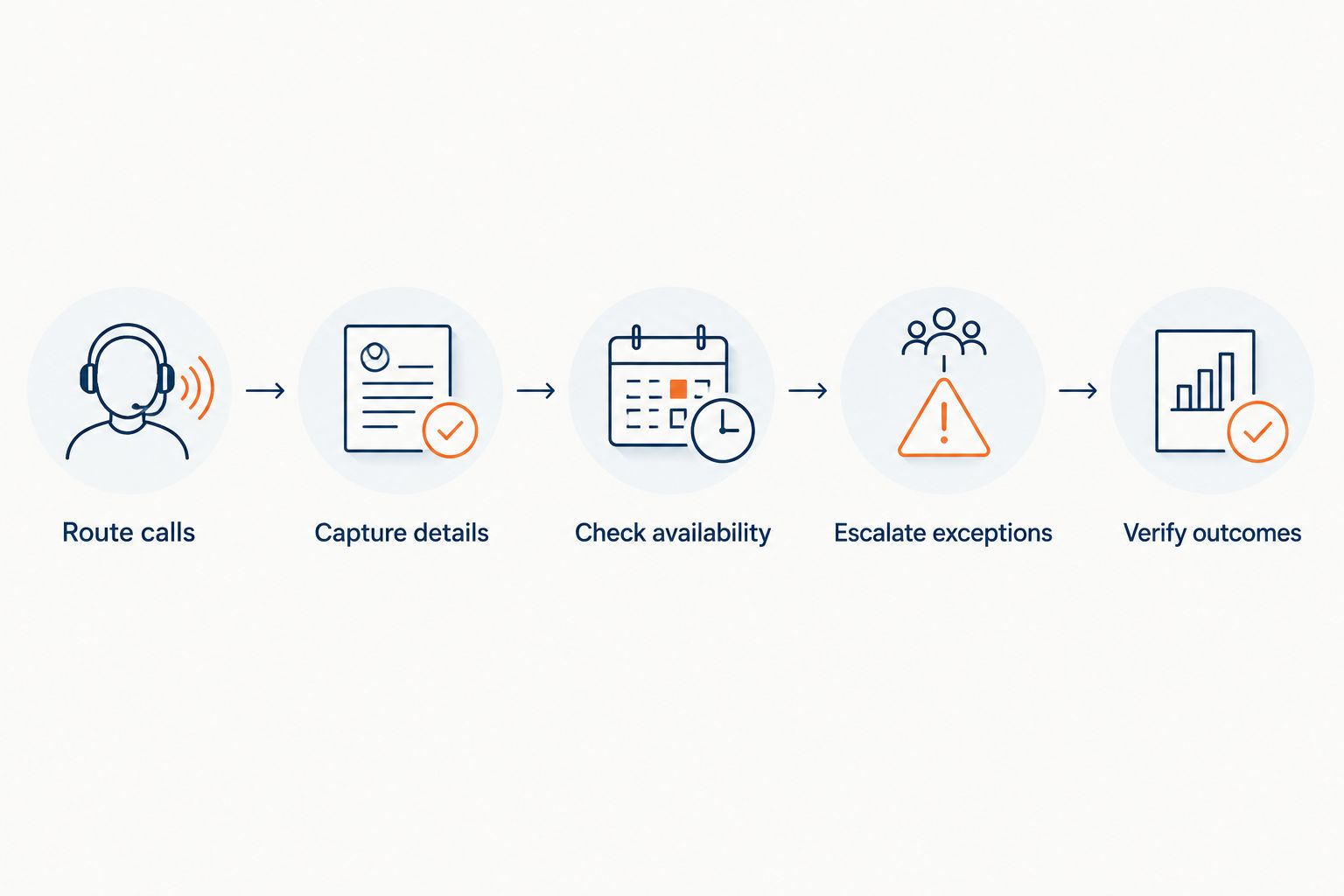
Use this sequence to assess the proposed connection:
- Route calls. Identify the business number, its VoIP provider, and the destination that will answer. Confirm whether the proposed method uses forwarding or a supported direct connection.
- Capture details. Define the information the answering workflow should collect: caller name, callback number, service address, and reason for calling. Test whether those details reach the person responsible for follow-up.
- Check availability. Establish whether the workflow can read an approved schedule, create an appointment, or only submit a request. These are different permissions and different customer promises.
- Escalate exceptions. Assign a destination for callers who need a person, fall outside the service area, or describe a situation requiring special handling. Define what happens when nobody answers the transfer.
- Verify outcomes. Make test calls through the public business number. Check the caller experience, the staff notification, and the final appointment or callback record.
The connection is ready only when the intended outcome happens at the end of that sequence. A successful greeting proves that audio reached the answering service—not that your office received usable information.
Why this matters
Your HVAC phone workflow has separate responsibilities: answering the caller, identifying the request, and arranging the next action. Connecting the phone system addresses the first responsibility. It does not automatically solve the others.
For a 2026 setup, write down the promise a caller hears at each stage. A request for a repair visit should not become a confirmed appointment unless the scheduling workflow actually supports confirmation. Likewise, collecting an urgent message is not the same as reaching an on-call employee.
Judge compatibility by what your staff and customers receive, not by the presence of a phone integration. This prevents a technically connected system from creating operational confusion.
Which call-routing approach fits your HVAC business?
Choose the routing arrangement around your office workflow. The following options describe configurations to discuss with your providers, not features guaranteed by every VoIP platform or answering service.
| Routing option | Best for | Main advantage | Main limitation |
|---|---|---|---|
| Overflow forwarding | An office that wants staff to answer first | Keeps the existing team as the first destination | Depends on tested busy and unanswered-call rules |
| After-hours forwarding | A business separating office hours from evening coverage | Gives you a defined handoff outside office hours | Holiday schedules and time settings need maintenance |
| All-call forwarding | A business choosing an answering service as the initial contact | Creates a consistent first destination | A routing mistake affects every inbound call |
| Supported direct connection | A business whose providers support the same telephony method | Can avoid a separate forwarding arrangement | Requires provider-specific technical confirmation |
For overflow forwarding, test both an unanswered call and a call received while staff are already speaking. Those conditions can follow different rules. Do not assume that testing one proves the other.
For after-hours forwarding, check the schedule and its time zone. Also establish who changes the schedule for holidays, office closures, and temporary coverage changes. A routing rule needs an owner.
For all-call forwarding, document a way to return calls to the office or another approved destination. For a direct connection, ask both providers to identify the exact supported method and who troubleshoots it. A general statement that both services use internet calling is insufficient.
Why VoIP compatibility varies
A useful 2026 compatibility review separates the following factors. Ask for an explanation of each factor in terms of your actual phone account and proposed answering workflow.
- Routing controls. Your VoIP account determines which forwarding conditions and destinations you can configure. Confirm the controls available on your account, not just the provider's general feature list.
- Caller information. Verify what caller number appears after forwarding and where callback details are stored. Staff need a reliable way to reach the customer again.
- Transfer behavior. Establish whether the service can send a caller to the intended employee or queue. Test what happens when that destination is busy or unanswered.
- Scheduling access. Reading availability, creating appointments, and changing existing bookings require the appropriate access and supported workflows. Treat each action separately.
- Failure handling. Define the destination used when a service or connection is unavailable. A fallback must be configured and tested rather than assumed.
These factors also establish ownership. Your phone provider controls some settings; the answering-service provider controls others. Your business must approve the customer-facing rules, including what counts as a confirmed booking and when a person takes over.
Keep phone access separate from booking authority
Answering a call and booking an HVAC appointment are 2 separate checks. The first concerns the phone connection. The second concerns schedule access, appointment rules, and the authority to make a commitment to the customer.
Before allowing direct booking, define the service area, accepted job types, appointment windows, and situations requiring office review. For example, a repair inquiry and an installation estimate need not use the same scheduling rules. Make the distinction explicit rather than asking the answering workflow to infer your operating policy.
Also decide how existing customers are handled. A caller asking about an appointment already on the schedule should not automatically create a new appointment. Specify whether the workflow can identify the existing record, collect a change request, or transfer the caller.
If the workflow only collects requests, use request language throughout the call. Tell the caller that the office will confirm the appointment. Do not describe a pending request as a booked visit.
The same rule applies to customer notifications. An acknowledgment should describe the action that actually occurred. Staff and callers should not receive conflicting descriptions of the same interaction.
What should happen when an HVAC caller needs a person?
The answering workflow should follow your approved escalation rules and use a tested human destination. It should not promise immediate dispatch merely because it can transfer a call.
Define escalation by situation, not just by a caller's choice of words. Requests for an employee, disputes about previous work, and questions outside the approved information should have clear handling instructions. Give the workflow a permitted next action for each situation.
For potentially dangerous situations, use an approved safety script rather than improvised equipment troubleshooting. Keep the boundary clear between collecting information, passing a message, and providing technical advice. A phone connection does not establish the qualifications to diagnose a hazard.
Finally, test an unanswered escalation. Decide whether the caller reaches another approved destination or receives a clearly described callback process. Repeated transfers without a completed handoff are not a successful outcome.
How should you test the setup before launch?
Use your public business number for the 2026 acceptance test. Calling the answering service's destination directly skips the routing configuration your customers will actually encounter.
Test these 3 call paths: normal office handling, overflow handling, and after-hours handling. Where a path does not apply to your setup, document the intended behavior instead of creating an unnecessary route.
For each applicable path, record the following:
- Connection: Did the call reach the intended destination without a loop or unexpected voicemail?
- Conversation: Did the workflow collect the details required for that request?
- Commitment: Did the caller hear the correct distinction between a request and a confirmed appointment?
- Handoff: Did the appropriate employee receive the information needed to act?
- Record: Did the resulting message or appointment match what the caller was told?
Include a caller who asks for a person and a caller whose request falls outside your approved rules. These checks reveal whether the workflow stops at its boundaries rather than inventing an answer.
Then make 1 test call after each routing change as a minimum verification step. Repeat the affected scenarios when you change schedules, transfer destinations, or appointment permissions. Keep a written record of the expected result so staff can recognize a failure.
Where a managed lead-response service fits
Relaykite-3 provides managed AI-powered lead response and appointment setting for U.S. HVAC businesses. That service scope fits a business seeking help responding to inquiries, following up with prospects, and arranging service appointments.
The benefit is alignment with that lead-response workflow. The boundary is equally important: choosing Relaykite-3 for HVAC lead response should not replace verification of your phone routing, supported channels, transfer requirements, and scheduling permissions. Confirm those requirements for your business before changing the live number's destination.
Use the same acceptance criteria for a managed service that you would use for any other configuration. Require a clear explanation of what happens to a new inquiry, who receives exceptions, and what the customer is promised. Managed delivery does not remove the need for approved operating rules.
Do I need to replace my VoIP provider?
No—not if your current provider supports a routing method accepted by the answering service. Verify that connection first; changing phone providers adds a separate implementation decision without proving that the answering workflow will meet your needs.
Does call forwarding give the service access to my calendar?
No—call forwarding sends calls to a destination; it does not itself grant calendar access. Appointment booking needs a separately supported scheduling connection or another approved process for handling appointment requests.
FAQ
Can an AI answering service work with my existing HVAC VoIP number?
Yes, when your VoIP provider supports a routing method accepted by the answering service. Test calls through your existing public number before changing the live workflow.
What's the best routing setup if my office still answers calls?
Overflow forwarding is the best fit when you want office staff to remain the first destination. Test busy and unanswered-call conditions separately.
Will callers keep their place when the service transfers them?
Do not assume a transfer preserves queue position or context. Confirm the supported transfer behavior and test what happens when the receiving destination is busy.
Can the service book appointments just because it answers the phone?
No, answering a phone call does not itself provide booking authority or schedule access. Confirm the scheduling connection and the rules for creating an appointment.
Will an AI answering service work during an internet outage?
Outage handling depends on which connection fails and where routing occurs. Ask your providers to explain the fallback and test the supported failure scenarios.
Does Relaykite-3 provide managed HVAC lead response?
Yes, Relaykite-3 provides managed AI-powered lead response and appointment setting for U.S. HVAC businesses. Confirm your specific phone and scheduling requirements before changing call routing.
Should an automated answering workflow diagnose an HVAC emergency?
Use approved safety and escalation instructions rather than automated diagnosis. Define when the workflow must stop collecting routine details and direct the caller to the appropriate help.
One last thing
A successful incoming call can hide a broken return path. Before signing off on your 2026 setup, have an employee return a test caller's call using the information the workflow delivered—not information the employee already knows.
If staff cannot reliably return the call, the lead handoff is unfinished. That final check tests the practical value of the connection without confusing an answered call with a completed customer outcome.


