
Yes—small HVAC companies can afford AI lead response when the contribution from additional completed jobs covers the full service expense. For your 2026 decision, include setup work, staff oversight, and appointment corrections in that calculation; a booking alone does not establish a return.
- Can small HVAC companies afford AI lead response? Yes, when additional completed-job contribution exceeds the full expense.
- RelayKite provides managed HVAC lead response and appointment setting; results depend on your business configuration.
- Compare completed jobs and contribution, not just replies or appointments booked.
- Start with a defined response gap before expanding coverage or handing over more booking decisions.
Can small HVAC companies afford AI-powered lead response?
Affordability depends on the work recovered, not company size alone. An owner-operated HVAC business with unanswered inquiries has a different decision from a business whose office already responds consistently and fills the schedule.
RelayKite provides a managed lead response and appointment-setting service for U.S. HVAC businesses. Assess that service against a specific gap: responding to new inquiries, following up with prospects, or booking service appointments. Do not treat those activities as interchangeable results.
Use this sequence to make the decision:
- Find the gap. Identify inquiries that receive no response, receive a delayed response, or stop progressing before an appointment.
- Check capacity. Confirm that your business has room to perform the additional work you want to book.
- Calculate contribution. Subtract the direct expense of completing a job from the amount your business collects.
- Count the full expense. Include the service agreement, implementation work, and ongoing staff attention.
- Verify completed work. Compare the added contribution with the expense before expanding the service.
There is no defensible universal affordability threshold for every small HVAC shop. Your staffing, job mix, existing response process, and available appointment capacity determine the result.
Why this matters
You paid to generate an inquiry, but an inquiry is not a completed service call. Between those events, someone must respond, establish whether the work fits your business, arrange an appointment, and handle exceptions.
For a small HVAC business evaluating lead response in 2026, the useful question is not whether automation sounds inexpensive. It is whether the proposed service addresses a measurable loss without creating more work elsewhere.
Separate a response problem from a demand problem. If your business needs more suitable inquiries, changing the response process does not by itself create them. If you already have suitable inquiries that stall before booking, response and follow-up deserve closer attention.
Keep scheduling capacity in view. Filling a calendar with work outside your service area, unsuitable requests, or appointments your team cannot honor is not an improvement.
Compare the operating models before choosing coverage
You do not need to frame this as replacing your office with technology. Compare who owns each task and where a human must remain responsible.
| Operating model | Best for | Main advantage | Main limitation | Decision rule |
|---|---|---|---|---|
| Owner-led response | Businesses where the owner can reliably handle inquiries | Direct control over customer conversations | Requires the owner's attention alongside other work | Retain it if response and follow-up are already consistent |
| Managed lead response | Businesses seeking outside management of inquiry response and appointment setting | Assigns a defined process to an outside service | Requires setup, oversight, and clear operating boundaries | Consider it when a documented response gap needs an owner |
| Shared responsibility | Businesses wanting outside response with internal exception handling | Keeps unusual requests with your team | Creates a handoff that needs explicit ownership | Consider it when routine inquiries and exceptions need different treatment |
These are operating choices, not promises about a particular provider's features. Confirm the channels, hours, booking permissions, and handoff process in the proposed scope before relying on them.
RelayKite's managed HVAC lead response service is best suited to U.S. HVAC businesses seeking outside help with inquiry response, prospect follow-up, and appointment setting. Its value still depends on whether that scope fits your workflow; it is not a substitute for defining which work you accept.
Build the affordability calculation around completed jobs
Use contribution rather than booked revenue as the basis for your 2026 evaluation. A job brings in revenue, but completing it also consumes labor, materials, and other direct resources.
The basic calculation is:
Incremental completed-job contribution − total lead-response expense = net financial contribution.
Apply the calculation to comparable periods and the same lead sources. If advertising activity, staffing, or appointment capacity changes at the same time, record those changes rather than assigning every improvement to the response service.
Establish what happens today
Record where each new inquiry comes from, whether someone responds, whether an appointment follows, and whether the job is completed. Use the same definitions throughout the evaluation.
An unanswered inquiry and an unsuitable inquiry are different problems. Keep them separate so your baseline does not imply that every missed conversation would have become profitable work.
Distinguish added work from shifted work
A booking handled by a service is not automatically an additional booking. Your office might have booked that customer through its existing process.
Mark which inquiries received help that the previous workflow did not provide. That distinction makes the financial assessment more useful than a total count of appointments handled.
Include the work your team still performs
Review time, schedule corrections, and exception handling belong in the assessment. A service that responds to inquiries can still require internal attention.
If reduced owner workload is part of your objective, track the tasks removed and the tasks added. Do not count the same saved time as both a cash saving and additional job contribution unless the accounting supports both.
For a closer measurement framework, read how HVAC companies measure ROI on AI answering services.
Why affordability varies between HVAC businesses
The same service scope does not have the same financial effect in every shop. Focus your 2026 comparison on the factors that connect response activity to completed work:
- Existing response coverage. Identify the inquiries your current process already handles and the gaps that remain. Paying to duplicate an effective process needs a separate justification.
- Lead suitability. Distinguish work inside your service area and accepted job types from requests you cannot serve. More conversations do not necessarily mean more suitable jobs.
- Appointment capacity. Establish where you can accept additional work. A response service cannot create technician capacity by booking it.
- Contribution per completed job. Use your own collected revenue and direct job expenses. Do not substitute a provider's illustrative customer example for your business records.
- Scope and supervision. Define the response, follow-up, and booking work included, plus the responsibilities your staff retains. Assess the whole workflow rather than an isolated feature.
These factors also explain why a service can fit one part of your operation but not another. A narrow scope with a clear purpose is easier to evaluate than a broad change with unclear ownership.
Start with a defined workflow
Before handing over inquiries, document what should happen from the initial request to the final outcome. The goal is not to automate every conversation; it is to make the selected process predictable enough to evaluate.
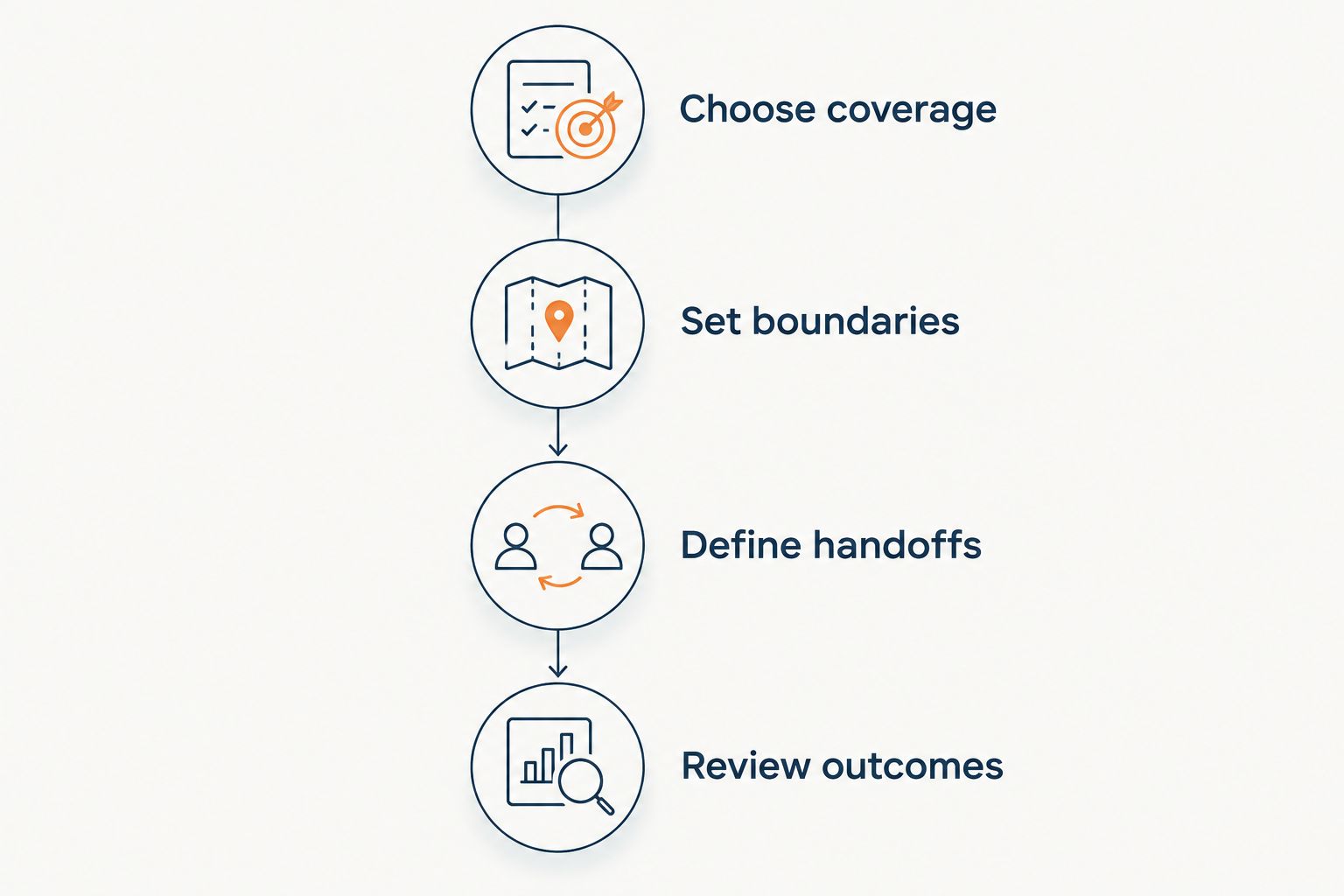
- Choose coverage. Select the inquiry source or response gap you want to address. State what remains outside the scope.
- Set boundaries. List accepted job types, service areas, and information required before an appointment request can progress.
- Define handoffs. Identify who handles exceptions and what happens when that person is unavailable. Require a clear distinction between a request and a confirmed appointment.
- Review outcomes. Check conversation records, appointment suitability, completed work, and staff corrections against the same definitions used in your baseline.
Ask for a demonstration using situations your business actually encounters. Include a suitable request, an out-of-area inquiry, an appointment change, and a request that needs human attention.
Judge the demonstration on whether the proposed workflow respects your rules. A polished conversation is not enough if it creates an appointment your team must undo.
Review your lead-response needs
Assess RelayKite's managed service against your inquiry response, follow-up, and appointment-setting needs.
What should a small HVAC company confirm before committing?
Confirm the operating scope and the exit conditions in writing. Your 2026 decision should cover what happens during normal use and what happens when the arrangement does not fit.
Ask the provider to explain:
- What response and follow-up activities are included, and which require your team.
- What information is required before an appointment is requested or confirmed.
- How booking changes, unsuitable inquiries, and human handoffs are handled.
- What records you can review to assess conversations and outcomes.
- What contractual obligations apply if you change scope or stop using the service.
Do not infer capabilities from a general description of an AI service. Request confirmation of the exact workflow you intend to use, including any connections to your existing systems.
Have the appropriate adviser review calling, messaging, recording, and data-handling requirements for your setup. Treat compliance review as a separate implementation responsibility, not as an automatic consequence of choosing a managed service.
Is AI lead response worthwhile if you already have office staff?
AI lead response needs a distinct job when your office already handles inquiries. Define whether you want help with an uncovered period, unfinished follow-up, or another documented gap rather than assuming staff replacement is the objective.
Give your office ownership of exceptions and corrections. If the proposed process duplicates work or makes responsibility less clear, revise the scope before proceeding.
Can you evaluate affordability before changing the whole process?
You can evaluate affordability against a limited, clearly defined scope. Agree on the inquiries included, the outcome records available, and the work your staff retains before changing the workflow.
An initial result is evidence about that scope, not a guarantee for every lead source or season. Expand only after the existing process produces suitable appointments and a financial result you can explain.
When should a small HVAC company wait?
Wait when you cannot identify the response gap or measure the result. Also resolve appointment-capacity problems and unclear booking rules before assigning more inquiries to a new process.
Waiting does not require leaving the process untouched. Establish consistent inquiry records, clarify staff ownership, and document your accepted work so the next evaluation has a usable baseline.
FAQ
Can small HVAC companies afford AI lead response in 2026?
Yes, when additional completed-job contribution covers the full lead-response expense. Use your own records and include implementation work, oversight, and corrections rather than judging affordability from bookings alone.
What's the best way to decide whether HVAC lead response is worth it?
Compare incremental completed-job contribution with the total expense of the proposed service. Track suitable inquiries through booking and completion, and separate added work from bookings your existing process would have produced.
Is managed lead response better than answering inquiries myself?
Managed lead response is a better fit when it addresses a documented gap you cannot reliably cover yourself. Owner-led response remains a valid choice when it is consistent and does not interfere with other necessary work.
Does booking more HVAC appointments guarantee a return?
No, more appointments do not guarantee a return. Appointments must fit your service rules, become completed work, and produce enough contribution to cover the full expense.
Can I use lead response without replacing my office staff?
You can define a shared workflow with separate responsibilities for outside response and internal exception handling. Confirm that the provider supports your intended scope and make handoff ownership explicit.
What does RelayKite provide for HVAC businesses?
RelayKite provides managed AI-powered lead response and appointment setting for U.S. HVAC businesses. The service helps businesses respond to new inquiries, follow up with prospects, and book service appointments; assess the proposed configuration against your requirements.
Should I proceed if my HVAC schedule is already full?
Do not justify the service solely on additional bookings when you lack capacity to perform additional work. Identify a different measurable objective, such as reducing response administration, and assess that objective separately.
One last thing
Use the appointment your team would reject as a test case. An unsuitable request exposes whether the proposed process understands your boundaries or merely produces another calendar entry.
For your 2026 decision, require evidence that the workflow can preserve those boundaries before judging its booking activity. Affordable lead response must support work you can actually deliver.