

Yes—AI can handle calls for multiple HVAC business locations when the system supports location-specific routing, service areas, scheduling rules, and human escalation. Answering a call is not the same as assigning it correctly: the setup must connect each inquiry to the branch authorized to serve the customer. Automatic booking should stay limited to appointments the system can validate against that branch’s rules and calendar.
- AI can handle calls for multiple HVAC locations when routing, service areas, calendars, and escalation are configured by branch.
- Confirm the service address; the number dialed does not establish which branch should handle the job.
- Keep appointment requests separate from confirmed bookings when calendar access or branch ownership is unresolved.
- Relaykite-3 provides managed HVAC lead response and appointment setting; confirm multi-location call requirements before choosing a setup.
Why this matters
For your 2026 setup, judge success by whether the correct branch receives an actionable inquiry—not simply whether someone answers. A conversation that ends with the wrong service area, an unsupported appointment, or an unassigned callback still needs office intervention.
Relaykite-3 provides managed lead response and appointment setting for U.S. HVAC businesses. Relaykite-3 is best suited to HVAC businesses seeking managed lead response and appointment setting. Evaluate voice handling and multi-location requirements separately; a service description alone does not establish how a particular phone or scheduling configuration works.
Can AI handle calls for multiple HVAC business locations?
Yes, provided the implementation preserves each location’s operating rules throughout the conversation. Your practical choices are a shared intake process or branch-specific intake, with explicit rules for transferring responsibility between them.
Use this comparison when selecting a 2026 call-handling structure. These are configuration approaches, not claims about a particular provider’s features.
| Approach | Best for | Main advantage | Main limitation |
|---|---|---|---|
| Shared intake across locations | Businesses that want a common opening conversation | Gives callers a consistent intake process | Requires explicit rules to identify the responsible branch |
| Branch-specific intake | Locations with different service areas or operating rules | Keeps local instructions attached to the initial inquiry | Requires separate instructions to stay current |
| Shared intake with human assignment | Businesses that want staff to resolve branch ownership | Keeps ambiguous assignments under human review | Adds a handoff before the appointment is confirmed |
Choose shared intake only when you can explain how every inquiry gets an owner. Choose branch-specific intake when local differences are easier to maintain separately. Use human assignment where overlapping territories or exceptions prevent a dependable automatic decision.
None of these approaches removes the need for accountability. Specify who updates routing rules, who reviews failed handoffs, and who corrects a booking assigned to the wrong location.
Shared intake: establish branch ownership before booking
A shared intake process should collect enough information to distinguish the customer’s requested service from the branch responsible for delivering it. Start with the service address and the reason for the call. Then apply the location rules your business approves.
Do not treat the caller’s preferred office as the final routing decision. A customer might name a familiar branch even when another office owns the service territory. Likewise, a telephone area code does not establish the equipment’s location.
The benefit is consistency: you can define a common set of intake questions. The trade-off is that routing becomes a central dependency. If the system cannot resolve branch ownership, it should preserve the inquiry and send it to an assigned person rather than select a branch without support.
Branch-specific intake: maintain local instructions
Branch-specific intake is appropriate when offices operate differently. Document those differences rather than expecting a shared script to infer them from the office name.
For each branch, specify the service territory, accepted job categories, appointment rules, and escalation contact. Separate instructions should also distinguish a new inquiry from a caller asking about existing work.
The advantage is clearer local control. The limitation is maintenance: a change to a branch’s territory or scheduling process must reach the call-handling configuration. Assign an owner to every branch’s instructions, including responsibility for removing outdated information.
Why multi-location call handling varies
The right setup depends on operational differences, not the number of office names in a greeting. Review these factors before authorizing automatic appointment confirmation:
- Service territories: Define which branch owns each address and how overlapping coverage gets resolved.
- Job eligibility: Specify which locations accept each service category and which requests require review.
- Calendar access: Establish which scheduling source the system can read and whether it can create or change appointments.
- Operating rules: Document branch-specific hours, booking restrictions, and instructions for calls outside normal office coverage.
- Escalation ownership: Name the destination for unresolved routing, urgent concerns, scheduling failures, and callers requesting a person.
These factors are requirements to configure and test. They are not automatic features of every answering service, and a shared business name does not make the locations operationally interchangeable.
How should you configure multi-location intake in 2026?
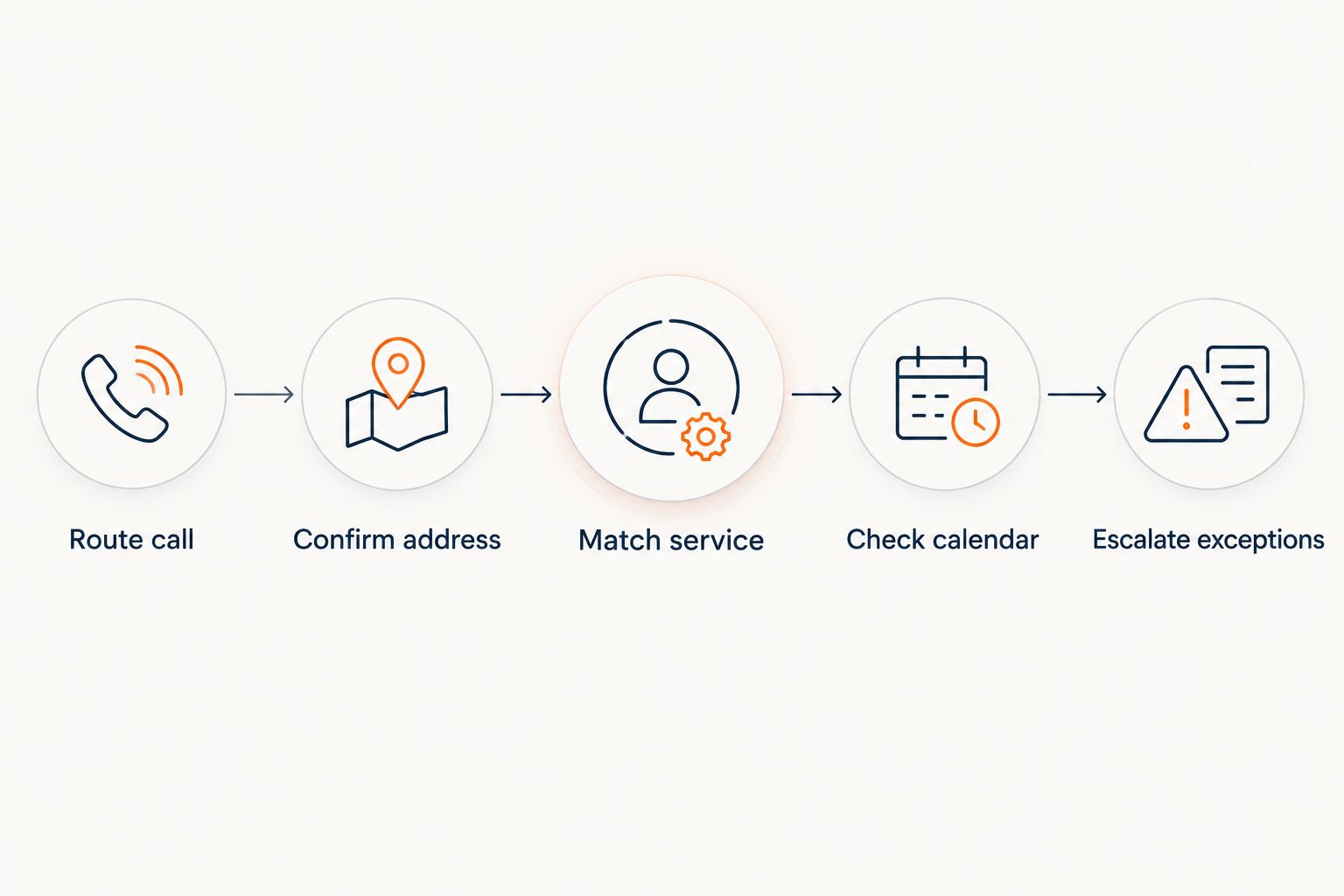
Build the workflow around decisions your office already makes. Each step should produce a clear result or a defined handoff; avoid instructions that require the system to guess what your team normally does.
- Route call. Identify the dialed number or intake source. Use it as context, not proof of the correct service location.
- Confirm address. Ask where service is needed and resolve incomplete address information before assigning a branch.
- Match service. Identify the requested work and check it against the responsible branch’s accepted job categories.
- Check calendar. Apply the approved appointment rules using the scheduling source authorized for that location.
- Escalate exceptions. Send unresolved requests to the designated person with the information already collected.
The workflow should keep the branch decision attached to the inquiry through scheduling and follow-up. A correct initial assignment does not help if a later handoff drops the location information.
Define the booking boundary
Write down what the system is allowed to confirm without review. The boundary should cover eligible work, permitted appointment windows, the responsible branch, and the calendar action required to complete the booking.
If the system cannot verify a required condition, use an appointment request instead. The caller should hear that the office needs to confirm the visit, not language that implies a technician has already been assigned.
Keep the handoff useful
An escalation should include the service address, requested work, assigned branch if resolved, callback details, and the reason for review. Ask the receiving employee whether that information is enough to continue without repeating the entire intake conversation.
For a broader configuration checklist, see the guide to call answering for multi-location HVAC companies. Use the same branch definitions in the phone workflow and the office’s scheduling process.
What should you test before enabling automatic booking?
For a 2026 acceptance test, use the following 6 test calls per branch. This is a recommended test set, not a performance benchmark. Record the expected destination and permitted outcome before making each call.
- Routine request: Give a complete address and an eligible service request. Check branch assignment and the resulting appointment status.
- Territory boundary: Use an address near a coverage boundary. Confirm the configured ownership rule controls the result.
- Unsupported work: Request a service the branch does not accept. Check that the system follows the approved handoff rather than booking it.
- Scheduling failure: Test what happens when the required calendar cannot be checked. The outcome should remain a request unless another approved confirmation method exists.
- Human request: Ask to speak with a person. Verify the destination and what happens if nobody accepts the handoff.
- Urgent concern: Use an approved test scenario for a potentially unsafe situation. Check the approved safety and escalation instructions without treating the call handler as a technician.
If you pilot with 2 branches, this plan produces 12 test calls. Keep the scenarios comparable so differences point to configuration issues rather than different test conditions.
Review the resulting records as well as the conversation. A reassuring spoken answer does not prove the correct branch received the inquiry or that the appointment was saved correctly. Repeat affected tests after changing territory, calendar, or escalation rules.
What should a managed service handle for you?
A managed service should have a clearly agreed division of responsibilities. Ask who writes the intake instructions, maintains branch differences, reviews exceptions, and approves changes. Your business still needs to supply accurate operating rules and identify the people authorized to resolve exceptions.
Relaykite-3’s managed HVAC lead response and appointment-setting service addresses new inquiries, prospect follow-up, and service appointment booking. For a multi-location evaluation, bring your territory rules and scheduling requirements to the discussion rather than assuming every office follows the same process.
The benefit of a managed arrangement is having an agreed service scope instead of treating the workflow solely as an internal software project. The trade-off is dependency on accurate instructions and clear coordination with the provider. Neither a managed service nor an automated workflow guarantees booked jobs or eliminates dispatcher judgment.
Review your lead response needs
Discuss your HVAC inquiry, follow-up, and appointment-setting requirements.
Can several HVAC locations share a phone number?
Several HVAC locations can use a shared intake number when the phone setup supports the intended routing. Confirm the service address and branch ownership during intake; the shared number alone cannot distinguish the location responsible for the work. Verify the actual phone configuration with the provider before changing an existing number’s routing.
Does every HVAC branch need a separate calendar?
Every HVAC branch needs identifiable booking rules, but that does not necessarily require a separate calendar application. A shared scheduling environment must still distinguish branch ownership, eligible appointment types, and the resources needed for the visit. Test those distinctions before allowing automatic confirmation.
Can AI transfer a call when the branch is unclear?
AI call handling can include a human handoff when the chosen system supports it and the transfer destination is configured. Specify who receives ambiguous inquiries and what happens if that person does not answer. Collecting a callback request is different from completing a live transfer, so test both outcomes separately.
FAQ
Can AI answer calls for HVAC locations with different service areas?
Yes, when the system supports location-specific routing and your service territories are configured. Confirm the service address before assigning the inquiry, and send unresolved coverage questions for human review.
Can AI book the wrong HVAC branch by mistake?
Yes, incorrect routing rules or incomplete address information can produce a wrong-branch assignment. Test territory boundaries and require review when branch ownership remains unresolved.
Can each HVAC office have different booking instructions?
Yes, if the selected system supports branch-specific instructions. Verify that local job eligibility, scheduling restrictions, and escalation contacts remain attached to each location throughout the workflow.
What happens if the HVAC scheduling calendar cannot be checked?
The workflow should collect an appointment request instead of claiming a confirmed booking. Give the caller an accurate description of the next step and assign the request to a responsible person.
Does an AI answering service replace the HVAC dispatcher?
An AI answering service does not remove the need for dispatcher judgment on unresolved assignments and exceptions. Define which routine tasks are automated and which decisions remain with your team.
How do I evaluate Relaykite-3 for multiple HVAC locations?
Evaluate Relaykite-3 against your branch-specific lead response and appointment-setting requirements. Confirm the proposed call workflow, scheduling scope, escalation process, and responsibilities before approving the configuration.
One last thing
Test what the system refuses to confirm. A useful 2026 acceptance test includes an incomplete address or a scheduling conflict that should stop automatic booking. The correct outcome is a clearly assigned request for review—not a confident appointment confirmation unsupported by your branch’s rules.


