
Yes. AI can follow up with HVAC estimate requests automatically when the service is configured to receive inquiries, use approved responses, and move prospects toward an appointment. Automation does not replace a technician’s assessment, authorize an estimate, or guarantee that a prospect will book.
- Can AI follow up HVAC estimate requests? Yes, with configured intake, follow-up rules, and human handoff.
- Relaykite-3 serves U.S. HVAC businesses seeking managed lead response and appointment setting.
- Automate approved questions and next steps, not technical assessments or unsupported promises.
- Stop follow-up when the prospect declines, books, or needs a person to resolve an exception.
Can AI follow up with HVAC estimate requests automatically?
AI can handle the communication around an estimate request: acknowledging the inquiry, collecting missing details, following up, and helping arrange the next step. Each action needs an approved workflow. An unanswered request, an appointment request, and a technical question should not receive the same response.
Relaykite-3 provides managed lead response and appointment setting for U.S. HVAC businesses. For your 2026 evaluation, distinguish that service scope from the specific channels, scheduling connections, and escalation rules you need configured.
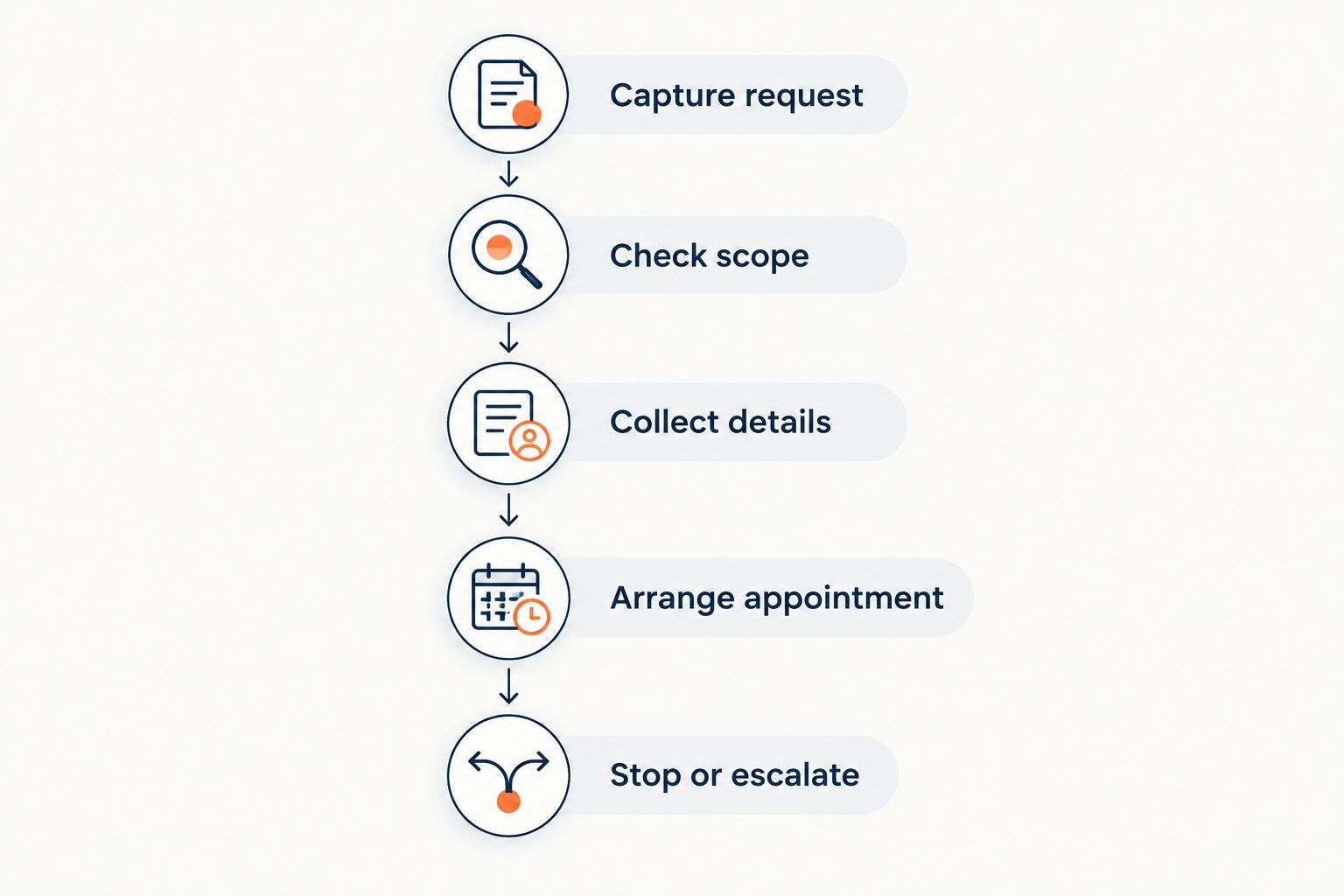
A practical workflow follows these steps:
- Capture request. Receive the inquiry and preserve the customer’s original wording.
- Check scope. Establish whether the request fits your service area and the work you accept.
- Collect details. Ask only for information needed to choose the next action.
- Arrange appointment. Offer an approved booking path or send the request to your office.
- Stop or escalate. End outreach after a clear outcome, or transfer the conversation when it exceeds approved boundaries.
These steps describe a workflow to configure and verify, not a promise that every service includes every capability. Automatic follow-up is useful only when the next action matches the customer’s actual request.
Why this matters
You paid to get the lead. If the customer asks about replacing a system while your team is on service calls, someone still needs to acknowledge the request and explain what happens next. An automatic reply alone does not complete that job.
The useful distinction is between sending a message and managing an unresolved inquiry. Follow-up should account for what the prospect has already said, whether an appointment exists, and whether a staff member has taken over.
Your 2026 operating rule should be simple: automate the approved next step, not the entire customer relationship. Keep technical judgment and business exceptions with the people responsible for them.
What should automatic estimate follow-up include?
Start with the smallest workflow that moves a suitable inquiry toward an estimate appointment. Avoid collecting information merely because the system can ask for it.
Capture request
Keep the original request available to whoever handles the conversation next. A customer asking about replacing an aging system should not have to repeat that request after receiving an acknowledgment.
Define what creates a new inquiry and what updates an existing one. If a customer submits another message about the same project, your process should check for an existing conversation before starting separate outreach.
Check scope
Use your approved service-area and job-type rules to decide where the inquiry belongs. Ask for clarification when the request does not establish whether the customer wants repair, replacement, or another service you offer.
Do not treat an uncertain answer as a confirmed qualification. Route exceptions to your team rather than silently rejecting the inquiry or promising work outside your scope.
Collect details
Choose questions that support the next decision. Depending on your process, those questions might cover the property location, the requested work, and the customer’s preferred way to continue.
Keep technical intake separate from diagnosis. Describing symptoms can help your team prepare, but a conversational response should not present an equipment recommendation as an approved assessment.
Arrange appointment
Define whether the workflow can confirm an appointment or only request one. Those are different outcomes, and the customer-facing wording must make the distinction clear.
An appointment request should remain a request until your booking process confirms it. If a scheduling connection is part of your setup, verify which appointment types and availability rules it actually supports before allowing unattended booking.
Stop or escalate
Write explicit rules for a declined inquiry, a booked appointment, a request to stop contact, and a conversation taken over by staff. Each needs a clear ending or handoff.
A customer who asks a question outside the approved knowledge should not receive an improvised commitment. Preserve the conversation and tell the responsible person what needs attention.
Which follow-up approach fits your HVAC business?
Choose the operating model before choosing features. A managed service, a workflow your staff maintains, and manual office follow-up assign responsibility differently.
| Approach | Best for | Main advantage | Main limitation |
|---|---|---|---|
| Managed follow-up service | Owners seeking managed lead response and appointment setting | Matches a need for an ongoing service rather than a tool alone | You still need to approve business rules and verify service scope |
| Staff-maintained automation | Teams that want to control workflow configuration | Keeps configuration decisions with your staff | Your team must maintain rules and resolve exceptions |
| Manual office follow-up | Inquiries requiring case-by-case judgment | Gives staff direct control of each response | Each inquiry depends on someone taking the next action |
Relaykite-3 is for U.S. HVAC businesses seeking managed lead response and appointment setting. That fit does not establish support for a particular messaging channel, calendar, or customer-management system; confirm those requirements separately.
For a 2026 decision, ask who owns configuration changes after launch. A workflow that reflects yesterday’s service area or booking policy is not ready merely because it still sends messages.
Why automatic estimate follow-up varies
The same workflow should not handle every HVAC estimate request identically. Configure the differences around these factors:
- Inquiry content. A clear replacement request needs a different next question from an unclear description of a system problem.
- Service scope. Your accepted work and service-area rules determine whether to proceed or ask for review.
- Contact channel. Confirm the channel is supported and appropriate for the customer’s contact permissions and preferences.
- Appointment authority. A workflow authorized to request a slot should not describe it as confirmed.
- Conversation status. A booked, declined, or staff-managed inquiry should not continue through the original outreach sequence.
- Unresolved questions. Technical judgments and commitments outside approved responses need a human handoff.
Turn these factors into written decisions. For each one, specify what information the system needs, what it can do with that information, and what happens when the answer is missing.
Do not evaluate follow-up solely by how many messages it sends. Review whether the workflow reaches an appropriate outcome without contradicting the customer or your office.
How do you test automatic follow-up before launch?
Use 5 test cases for your 2026 launch review. These are workflow checks, not performance benchmarks or a guarantee of results.
- A clear estimate request. Submit an inquiry that fits your accepted work. Check that the response acknowledges the actual request and asks only necessary questions.
- An incomplete request. Leave out information needed for the next step. Check that the workflow asks for clarification rather than inventing details.
- An appointment request. Ask to book an estimate visit. Verify that the response distinguishes a requested appointment from a confirmed appointment.
- A declined inquiry. Tell the workflow that you no longer want follow-up. Verify that the original sequence ends and the status reflects the response.
- A human exception. Ask for a technical judgment or commitment outside the approved script. Verify that the conversation reaches the responsible person with its context intact.
Review the full conversation, not just the first response. A correct acknowledgment can still lead to an incorrect booking statement or an unnecessary follow-up later.
Record 3 outcomes during testing: appointment confirmed, inquiry closed, or human review needed. Keep unresolved inquiries visibly unresolved; do not count an acknowledgment as a booked estimate.
For booking-specific checks, read whether AI can book HVAC service appointments unattended. Confirm the behavior in your configured workflow rather than assuming a general capability applies to your setup.
Can AI send a final HVAC estimate without a technician?
Following up on an estimate request is not the same as preparing or approving the estimate. Keep 2 boundaries explicit: the authority to communicate and the authority to commit your business to work.
The workflow can use information your business has approved for customer communication. It should not turn a customer’s description into an unsupported diagnosis, equipment selection, or installation commitment.
If your estimating process requires an inspection or staff approval, preserve that requirement in the conversation. The next step is arranging that process, not implying that the assessment is already complete.
What happens if an HVAC prospect does not reply?
An unanswered inquiry should follow a defined outreach policy, not an open-ended sequence. Set the permitted contact method, the follow-up schedule, the conditions that stop outreach, and the owner of unresolved requests.
Do not invent a universal number of attempts. Choose a policy your team can explain and review, then verify that the workflow follows it when a customer replies, declines, or books elsewhere through your office.
Should automatic follow-up replace office staff?
Automatic estimate follow-up should handle a defined communication task, not assume every responsibility of your office. Your staff still owns the business decisions you have not delegated or approved.
Separate routine intake from exceptions. A request that fits an approved path can proceed through that path; a disputed detail, technical judgment, or unusual commitment needs a person with authority to resolve it.
What should you verify with a managed provider?
Before approving Relaykite-3 for your HVAC lead-response workflow, document the service scope against your actual intake process. Ask for a demonstration using your own approved scenarios rather than relying on a general description.
For your 2026 review, require clear answers on:
- Which inquiry sources and communication channels the proposed setup supports.
- Whether appointment handling creates requests or confirmed bookings.
- How your team receives exceptions and takes over conversations.
- How changes to service scope and approved responses are handled.
- What stops outreach after a customer declines or an appointment is booked.
These are acceptance criteria, not claims that a provider includes every feature. A clear answer lets you decide whether the proposed service matches the work you need done.
FAQ
Can AI follow up with HVAC estimate requests automatically?
Yes, AI can follow up with HVAC estimate requests when intake, approved responses, and next-step rules are configured. Technical assessments and commitments outside those rules need human review.
Can automatic follow-up book an HVAC estimate appointment?
Automatic follow-up can support appointment setting when the configured service supports your booking process. Confirm whether it creates an appointment request or a confirmed booking.
Does AI follow-up mean the customer gets a final estimate?
No, following up on an estimate request does not establish a final estimate. Keep any required inspection and approval steps separate from automated communication.
Can AI keep contacting an HVAC prospect who has not replied?
Continued outreach needs a defined contact policy and stopping rules. Configure the permitted channel, schedule, and handling of replies before enabling follow-up.
What should happen when a customer asks to stop follow-up?
The workflow should stop the applicable outreach and record the customer’s request. Test that behavior before launch and verify that another sequence does not restart the same contact.
How do I know whether automatic HVAC follow-up works correctly?
Test complete conversations from inquiry through booking, closure, or human handoff. Check the final status and customer-facing wording, not just whether a response was sent.
Is managed follow-up the same as installing software?
No, a managed lead-response service and staff-maintained software assign responsibility differently. Confirm who configures the workflow, maintains approved rules, and handles exceptions.
One last thing
Test the stop before you test the sale. A workflow that acknowledges every inquiry but continues after a decline is not ready for customers.
Ask your team to close a test inquiry manually, then check whether automation recognizes that outcome. That check exposes a boundary between office activity and automated outreach that a simple new-lead demonstration does not test.


