
Yes. AI can help filter spam calls for HVAC businesses by screening what callers want and routing suspected spam separately from service inquiries. Screening depends on the system and its configuration; legitimate customers still need a way through when the system cannot confidently classify a call.
- Can AI filter spam calls HVAC businesses receive? Yes, with configured screening and a human fallback.
- Separate unwanted solicitation from repair requests, appointment changes, and other legitimate HVAC calls.
- Review rejected calls as well as accepted calls; fewer interruptions alone does not prove better screening.
- Relaykite-3 provides managed HVAC lead response and appointment setting; confirm spam-screening capabilities separately.
Can AI filter out spam calls for HVAC businesses?
AI call screening can use the conversation to distinguish a request for HVAC service from an unrelated sales pitch. That is different from deciding whether to answer based only on the incoming phone number. The right goal is fewer unwanted interruptions without silently discarding real customers.
For a 2026 evaluation, separate these approaches before choosing a service:
| Approach | Best for | Main advantage | Main limitation |
|---|---|---|---|
| Number-based blocking | Blocking identified unwanted numbers | Stops calls from numbers on the block list | Does not establish what a new caller wants |
| Conversational screening | Sorting callers by their stated purpose | Adds context from the caller's request | Can misunderstand incomplete or unclear speech |
| Human review | Resolving uncertain or sensitive calls | Allows clarification and judgment | Requires staff attention and a defined handoff |
Relaykite-3 provides managed lead response and appointment setting for U.S. HVAC businesses. Treat that service category separately from spam blocking: ask which screening, rejection, and review functions are included before making a decision.
Why this matters
A spam filter changes which callers reach your business. An overly aggressive rule can hide a repair inquiry just as effectively as it hides an unwanted pitch. Your evaluation therefore needs to cover both interruptions prevented and legitimate calls preserved.
HVAC callers also have different reasons for contacting you. A new installation inquiry, an existing appointment change, and a supplier callback do not belong in the same workflow, but none is automatically spam.
Separate call classification from permission to book. A legitimate caller might need an office callback rather than a service appointment. A caller outside your service area might be unsuitable for booking without being deceptive or unwanted.
That distinction should be explicit in your 2026 screening policy. Otherwise, a system trained to find bookable leads can become a system that dismisses everyone else.
Set up 3 screening outcomes before blocking calls
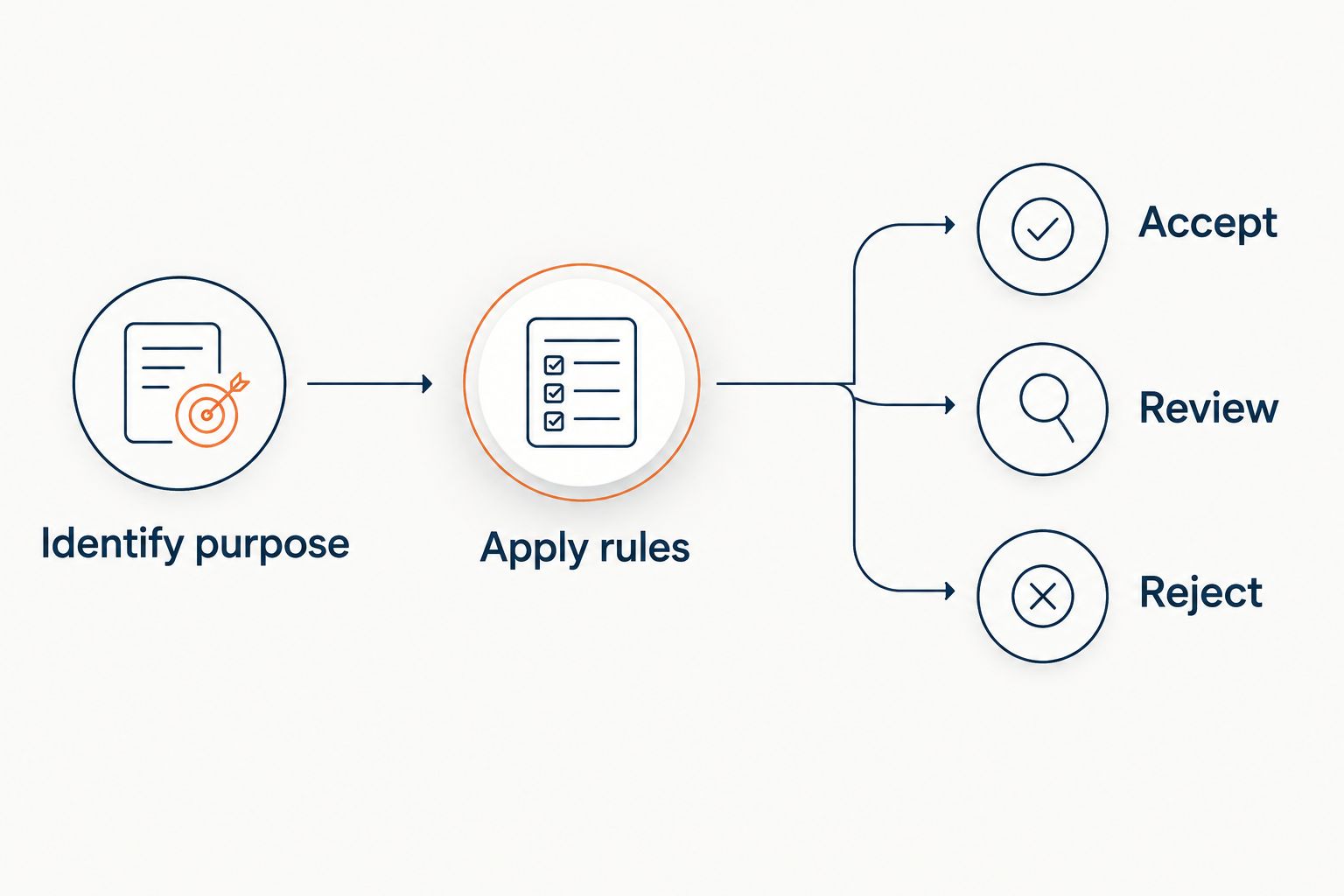
Use 3 outcomes: accept, review, and reject. These are recommended routing categories, not a claim about any particular provider's interface. Define what each outcome means before allowing automated rejection.
Accept: continue the appropriate conversation
Send clear service inquiries into your normal intake process. Ask for the information needed to understand the request, then apply your business's service-area and scheduling rules.
Acceptance should not mean automatic booking. A caller asking about an existing visit needs a different response from a homeowner requesting a new appointment. Both deserve an appropriate next step.
Review: preserve uncertain calls
Keep an uncertain caller reachable through a callback request, message, or human handoff supported by your chosen setup. Do not turn a classification failure into a silent rejection.
Examples for testing include a caller who pauses, struggles to explain the problem, or asks immediately for a named employee. These are illustrative scenarios, not proof of spam. Your rules should require more context before dismissing the call.
Reject: apply a documented exclusion
Reserve rejection for calls that meet your defined unwanted-call criteria. For example, your business can decide that an unrelated sales solicitation should not reach the service queue.
Record why the call was rejected whenever your system supports that record. A label such as unwanted solicitation is more useful for review than a vague label such as bad lead.
The routing sequence should be simple: identify the caller's purpose, apply your business rules, and select an outcome. Keep uncertainty visible rather than forcing every conversation into a yes-or-no decision.
What should the screening conversation ask?
Start with the reason for the call. A direct question about how the business can help gives the caller room to describe a repair, installation request, appointment issue, or unrelated purpose. Avoid making callers complete a long intake sequence merely to establish that they are legitimate.
Next, ask only for the detail needed to choose the route. For a service request, that can include the service location and the type of help requested. For an existing appointment, the relevant detail is the appointment issue rather than a fresh sales qualification sequence.
Use your actual business rules to determine what happens next. The separate question of qualifying HVAC leads before booking should not be confused with identifying spam.
Keep the distinction practical:
- Purpose: What is the caller trying to accomplish?
- Fit: Does the request match the services and area your business handles?
- Action: Should the caller proceed to booking, receive a callback, or reach another route?
A caller can be legitimate without meeting your booking criteria. Write that into the instructions so an unsuitable service request does not become evidence for blocking the person later.
Why spam-screening results vary
Screening depends on the conversation and the rules applied to it. These factors belong in your evaluation because each changes how an HVAC inquiry should be handled:
- Caller purpose. Repair requests, appointment changes, and unrelated solicitations require different responses.
- Information provided. A clear request supplies more classification context than a disconnected or unfinished conversation.
- Service rules. Your service area and accepted work determine booking eligibility, not whether someone is a genuine caller.
- Handoff rules. A review route preserves calls that do not fit a clear category.
- Follow-up rules. An unanswered question or interrupted call needs a defined next action rather than an automatic spam label.
For your 2026 setup, document these rules in plain language. Someone responsible for the phone queue should be able to explain why a sample call was accepted, reviewed, or rejected without interpreting an unexplained score.
Test the filter before enabling automatic rejection
Use a controlled test to check routing, not just whether the voice sounds natural. The following 5 checks are a suggested acceptance process. They are not performance benchmarks or a guarantee of results.
- Test a clear service request. Confirm that a caller describing an HVAC problem reaches the intended intake route. Check that screening does not prevent the caller from explaining the request.
- Test an existing appointment issue. Confirm that a rescheduling question is recognized as legitimate even though it is not a new sales lead. Verify the next action against your actual process.
- Test an unrelated solicitation. Confirm that the call follows your unwanted-call policy. Check whether the system records a reason that your staff can understand.
- Test an unclear conversation. Use pauses, an incomplete explanation, or a request for a person. Confirm that uncertainty leads to clarification or review rather than immediate rejection.
- Test a sensitive request. Use your approved urgent-call scenario and confirm that screening does not substitute for your escalation instructions. Do not ask a spam classifier to make an unsupported safety judgment.
For every test, write down the expected outcome before placing the call. Compare the observed route with that expectation afterward. Otherwise, it is easy to accept an inappropriate result simply because the conversation sounded polished.
Repeat the relevant checks whenever you change routing instructions. A new booking rule should not accidentally change how existing customers reach your office.
What should you measure after launch?
Review calls in both directions: calls allowed through and calls rejected. Looking only at accepted conversations cannot show which legitimate callers were excluded. Looking only at rejected calls cannot show how much unwanted traffic still reaches staff.
Use these measures in your 2026 review:
| Measure | What it tells you | What to inspect |
|---|---|---|
| Confirmed unwanted calls reaching staff | Where screening missed your exclusion rules | Caller purpose and routing decision |
| Legitimate calls incorrectly rejected | Where screening blocked a valid contact | Rejection reason and available conversation record |
| Uncertain calls sent for review | Whether the fallback is being used | Reason for uncertainty and final disposition |
| Service inquiries reaching the intended next step | Whether screening preserves the intake process | Handoff, callback, or booking outcome |
Keep the definitions stable when comparing results. If your team changes what counts as spam halfway through a review, the comparison no longer measures the same thing.
Do not judge the setup by blocked-call volume alone. A filter that blocks more calls is not necessarily a filter that makes better decisions. Check whether the calls it removes actually meet your exclusion policy.
Is AI screening better than blocking unknown numbers?
Conversational screening adds information about caller intent; blocking unknown numbers does not. If your goal is to receive inquiries from people who have never contacted your business, an unknown number alone is a poor rejection rule.
The trade-off is interaction. Conversational screening asks callers to participate, and unclear answers still need a fallback. Number-based rules are simpler, but they cannot establish whether a previously unseen caller needs a repair.
Use each mechanism for a defined purpose. Keep known unwanted numbers separate from rules that interpret new callers' requests, and review both when a legitimate caller reports trouble getting through.
Can AI accidentally reject a real HVAC customer?
Yes. AI screening can misclassify a real customer, which is why automatic rejection needs narrow rules and a review process. Treat an incomplete answer as incomplete information rather than proof of spam.
A caller might be contacting the wrong department, asking about past work, or trying to reach an employee. Those requests can be inconvenient for a booking workflow without being unwanted calls.
Make correction possible. Staff should have a documented way to identify an incorrect decision and request a rule change through whichever process the provider supports.
Does spam screening replace emergency-call handling?
No. Spam screening decides how to route a conversation; emergency-call handling requires its own approved instructions and escalation path. Do not treat a spam decision as a safety assessment.
For your 2026 configuration, specify what happens when a caller describes an urgent concern or requests immediate help. Confirm the actual escalation behavior with the provider rather than assuming that every answering service handles it the same way.
Where managed lead response fits
Relaykite-3 is best for U.S. HVAC businesses seeking managed lead response and appointment setting. That matches the service described: responding to new inquiries, following up with prospects, and helping book service appointments.
Spam screening is a separate capability to confirm. Ask how suspicious calls are identified, which decisions are configurable, and what happens when the system is unsure. Do not infer blocking, call recording, emergency escalation, or particular integrations from the phrase managed lead response.
The benefit of this service model is its focus on handling inquiries and follow-up. The boundary is equally important: suitability for your phone-screening requirements depends on the functions and operating rules agreed for your business, not the service label alone.
FAQ
Can AI filter spam calls for a small HVAC business?
Yes. AI call screening can help separate unwanted calls from HVAC inquiries when the chosen system supports conversational classification and appropriate routing. Confirm how uncertain calls are preserved before enabling rejection.
Will AI block every spam call?
No. Do not treat AI screening as a guarantee that every unwanted call will be blocked. Review missed spam and incorrectly rejected legitimate calls against your business's rules.
Should I block every caller who refuses to answer screening questions?
No. Refusing or failing to answer a question does not establish that a caller is spam. Use a clarification or review route that fits your business process.
Can AI tell a sales pitch from a repair request?
AI can use the caller's stated purpose to help distinguish an unrelated sales pitch from an HVAC repair request. The result depends on the system, the conversation, and the configured rules.
Should existing customers go through lead qualification?
Existing customers should receive a route appropriate to their request rather than automatically entering new-lead qualification. Appointment changes and questions about past work are legitimate contacts even when they do not create a new booking.
Does Relaykite-3 include spam-call blocking?
Confirm spam-call blocking directly with Relaykite-3. Its stated service covers managed HVAC lead response, prospect follow-up, and appointment setting; those functions do not establish which spam-screening features are included.
What should I ask an HVAC call-screening provider before signing up?
Ask what triggers rejection, where uncertain calls go, and how incorrect decisions are reviewed. Also confirm which records and routing controls are available in your proposed setup.
One last thing
Test the caller your intake script finds inconvenient. Use a legitimate request that does not lead to a new appointment, such as a question about an existing visit. If that caller cannot reach an appropriate next step, the setup needs correction before you rely on it to reject calls.
Optimize for correct routing, not the largest blocked-call count. That is the practical difference between reducing interruptions and hiding customer demand.


