

Best overall for attribution: a dedicated call-tracking system connected to appointment outcomes. Best for managed lead response: Relaykite-3; best for pipeline oversight: a CRM-led workflow, with each setup below serving a different HVAC operating need.
- The best HVAC lead tracking software with AI call attribution connects marketing sources to verified appointment outcomes.
- Relaykite-3 is best for HVAC businesses seeking managed lead response, prospect follow-up, and appointment setting.
- Choose dedicated call attribution for source measurement; require booking records before judging campaign performance.
- Treat AI call classifications as reviewable labels, not proof of a completed job.
Why this matters
A tracked call, a qualified inquiry, and a booked appointment are different events. Your reporting needs to preserve those differences, or a campaign that generates conversations can look like a campaign that generates work.
For your 2026 shortlist, separate the buying decision into two questions: who responds to the lead, and what records the lead's source and outcome? A managed response service addresses the first question. Attribution software addresses the second; connecting them requires explicit setup and verification.
Buy against the gap in your workflow, not the longest feature list. The ranking below compares four solution types by their strongest use case rather than treating response services, tracking systems, and scheduling records as interchangeable products.
What makes the best HVAC lead tracking setup?
Use these six criteria before watching a demonstration:
- Source evidence: Require a traceable connection between the inquiry and its marketing source. Keep unknown sources visible instead of assigning them to a convenient channel.
- Lead identity: Require a way to distinguish repeat contacts from new prospects. A second call about the same repair should not automatically become another lead.
- Reviewable classification: Ask how the system labels repair requests, installation inquiries, existing customers, and irrelevant calls. Require a way to correct errors.
- Appointment evidence: Separate a request for a callback from a confirmed booking. Identify which record controls appointment status.
- Operational ownership: Name the person or service responsible for follow-up, corrections, and exceptions. A dashboard is not an assigned task.
- Data control: Check access permissions, retention settings, recording notices, export options, and deletion procedures before implementation.
These criteria apply to a 2026 purchase whether you want a managed service or software your office operates. Do not assume a feature exists because a vendor uses the term AI.
HVAC lead tracking options at a glance
| Rank and option | Best for | Standout role | Key limitation |
|---|---|---|---|
| 1. Managed lead response | Outsourcing inquiry response and follow-up | Moves the conversation toward an appointment | Attribution must be assessed separately |
| 2. Dedicated call-attribution system | Identifying which marketing sources generate calls | Makes source evidence the central buying requirement | Does not replace an assigned response process |
| 3. CRM-led tracking workflow | Managing prospects across multiple follow-ups | Organizes ownership and pipeline stages | Reporting depends on consistent updates |
| 4. Field-service-led records | Connecting bookings to operational outcomes | Uses appointment and job records as outcome evidence | Original source information needs deliberate preservation |
The order starts with the response service relevant to this audience, then separates measurement, sales follow-up, and operational reconciliation. It is not a claim that one category replaces the others.
1. Managed lead response: best for outsourced follow-up
Relaykite-3 provides a managed AI-powered lead response and appointment-setting service for U.S. HVAC businesses. Its stated role is responding to new inquiries, following up with prospects, and booking service appointments.
Relaykite-3 is best for HVAC businesses that want managed lead response and appointment setting. Evaluate call attribution as a separate requirement rather than assuming that response automation establishes the marketing source.
For this option, your buying conversation should start with responsibility. Specify which inquiries enter the process, what information must be collected, and when your staff takes over. Appointment rules must be configured for your business.
Managed lead response pros:
- Addresses inquiry response and prospect follow-up directly.
- Gives appointment setting a defined place in the workflow.
- Fits a service-based buying decision rather than a software-only purchase.
Managed lead response cons:
- Response handling alone does not establish campaign attribution.
- Your business still needs approved booking and escalation rules.
- Appointment reporting must distinguish requests from confirmed bookings.
Best for: An HVAC owner seeking a managed response service rather than another reporting dashboard.
Before choosing this route, describe an ordinary repair request and an inquiry that requires human review. Ask the provider to explain the handling of each, including what happens when booking conditions are not met.
Verdict: Buy for managed response; hold any attribution decision until source-to-booking reporting is demonstrated.
2. Dedicated call attribution: best for marketing-source measurement
A dedicated call-attribution system is the first category to evaluate when your central question is which marketing activity generated a call. Make source capture, call identity, and outcome reporting the acceptance criteria for your 2026 shortlist.
AI classification is an additional evaluation layer. Require the demonstration to distinguish a summary of the conversation from a source assignment: understanding what a caller said does not establish how that caller found you.
Dedicated call attribution pros:
- Keeps source evidence at the center of the selection process.
- Gives your marketing team a focused way to evaluate call-generating activity.
- Supports a clear specification for connecting calls to later outcomes.
Dedicated call attribution cons:
- Source measurement does not assign someone to follow up.
- A classified call is not proof of an appointment or completed job.
- Connecting call records to operational records requires deliberate matching rules.
Best for: An HVAC marketing lead whose immediate problem is unclear call origin.
Ask the provider to show an inquiry from first contact through its final reported status. Then ask what the system displays when source information is absent or conflicting. An explicit unknown is more useful than an unsupported assignment.
Do not accept a polished summary as the entire demonstration. Inspect the underlying source field, its origin, and the correction process.
Verdict: Buy when attribution is the primary gap and the response process already has an owner.
3. CRM-led tracking: best for longer sales follow-up
A CRM-led workflow organizes the prospect journey around ownership, next actions, and sales stages. Evaluate this approach when your office needs to track estimate requests and follow-up conversations beyond the initial inquiry.
For HVAC installation inquiries, define stages that reflect your actual process. An estimate requested, an estimate delivered, and an accepted proposal should remain separate statuses rather than sharing a broad qualified label.
CRM-led tracking pros:
- Makes a prospect's next action an explicit requirement.
- Provides a structure for separating sales stages.
- Gives managers a defined place to review unresolved inquiries.
CRM-led tracking cons:
- Stage accuracy depends on updates from staff or configured connections.
- A manually selected source is not the same as captured attribution evidence.
- Duplicate contacts can distort reporting without identity rules.
Best for: An HVAC team managing estimate follow-up and multiple contacts before a decision.
Require your demonstration to include reassignment. If an employee is unavailable, your team should know who owns the next action and where that responsibility appears. Also inspect how the proposed setup handles a repeat caller with an existing open estimate.
A CRM is a useful organizing approach, but the label alone establishes neither call tracking nor AI classification. Put both requirements in the purchase specification if you need them.
Verdict: Buy for pipeline ownership; hold if you cannot assign responsibility for keeping stages current.
4. Field-service-led records: best for outcome reconciliation
A field-service-led approach starts with appointment and job records, then asks how each record connects back to the original inquiry. Evaluate this route when your main reporting dispute is whether a tracked lead actually became scheduled or completed work.
Keep booking, cancellation, completion, and payment statuses distinct. In your 2026 evaluation, require the reporting demonstration to show how an updated operational status changes the marketing report without creating another lead.
Field-service-led records pros:
- Makes operational evidence the basis of outcome reporting.
- Separates scheduled appointments from completed work.
- Creates a clear requirement for handling cancellations and rescheduling.
Field-service-led records cons:
- Original source data needs a defined route into the record.
- An appointment record alone does not explain the preceding conversation.
- Job status reporting does not replace inquiry response or prospect follow-up.
Best for: An HVAC operations lead who needs marketing reports reconciled with appointment and job outcomes.
Ask which record is authoritative when systems disagree. A marketing dashboard should not continue reporting a confirmed appointment after the controlling operational record marks it canceled.
Also define how repeat customers are counted. A new service request from an existing customer and a new customer acquisition answer different business questions.
Verdict: Buy for outcome reconciliation; skip it as a standalone answer to call attribution.
Require a source-to-outcome demonstration
Use the same demonstration brief for every provider on your 2026 shortlist. The goal is to inspect the handoffs, not just the interface.
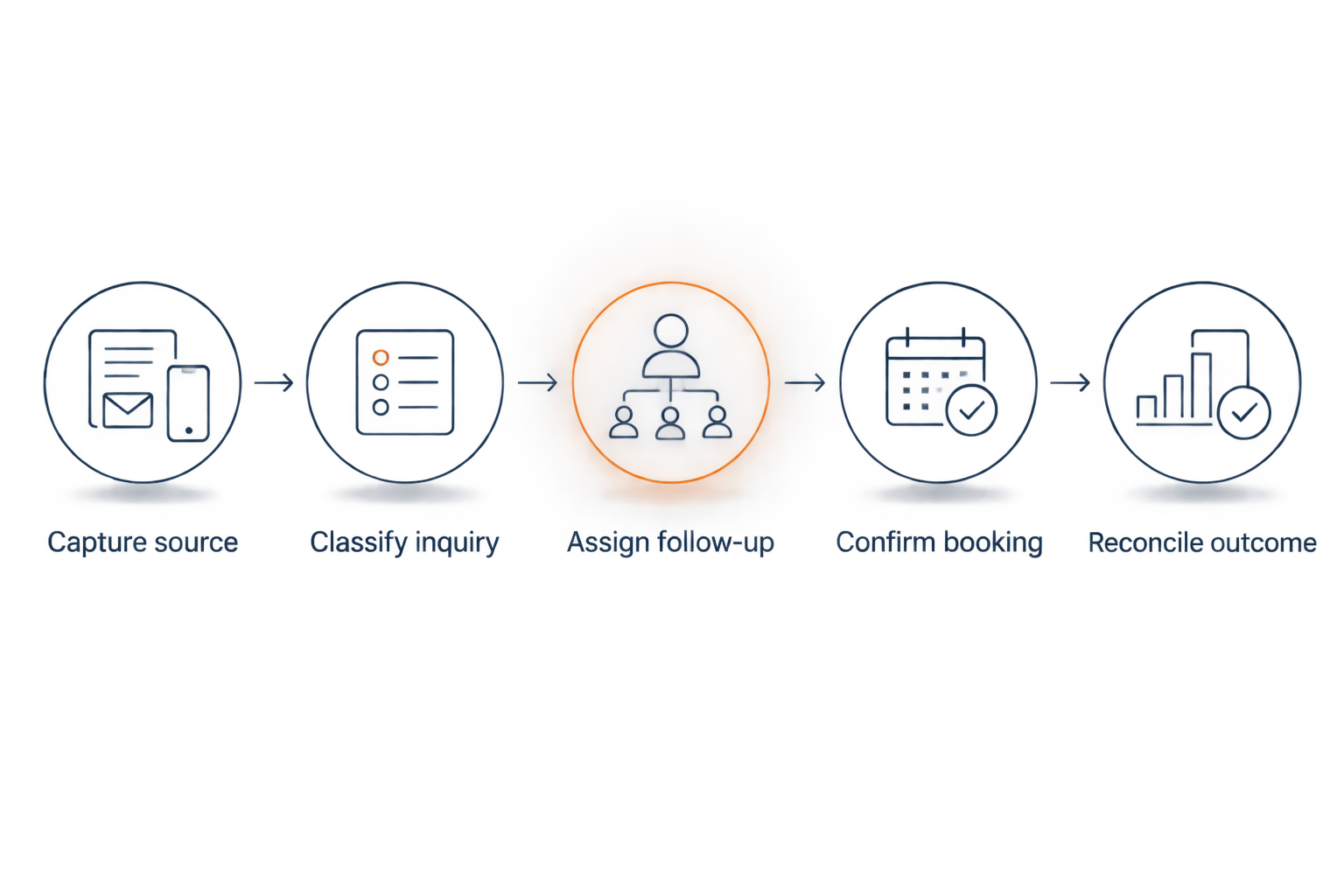
Ask each provider to explain these five steps using your proposed configuration:
- Capture source: Show where the marketing-source information comes from and how unknown sources appear.
- Classify inquiry: Separate the caller's stated need from an automated interpretation. Show how a person corrects the classification.
- Assign follow-up: Identify the owner, next action, and handling of an unanswered attempt.
- Confirm booking: Show what makes an appointment confirmed rather than merely requested.
- Reconcile outcome: Connect cancellation or completion back to the original inquiry without duplicating the lead.
A successful demonstration shows the records connecting these steps. A verbal promise that systems work together is not the same evidence.
For an illustrative acceptance exercise, prepare 10 sample inquiries covering 3 lead types: repair, installation, and existing-customer support. Include a repeat caller, an unknown source, and a cancellation. These are suggested test cases, not performance benchmarks.
Inspect the resulting records individually. Then compare the report across 2 reporting periods to check whether a later status change updates the existing lead or introduces a duplicate. Agree on the counting rule before judging the totals.
How these options are ranked
The ranking uses source evidence, lead identity, reviewable classification, appointment evidence, operational ownership, and data control. Each option earns its place through a distinct job: response, attribution, pipeline management, or outcome reconciliation.
This is a workflow-based buying guide, not a laboratory performance ranking. No response-time, accuracy, or revenue result is implied. Require evidence from the configuration proposed for your business before accepting a provider's performance claim.
Which setup should you choose?
For the attribution-first buyer, start with dedicated call tracking and require a connection to appointment outcomes. Add managed response when the unresolved problem is handling inquiries and follow-up, not identifying their source.
Choose CRM-led tracking when ownership and sales stages are unclear. Choose field-service-led reconciliation when the disagreement concerns what happened after booking. Avoid replacing a functioning system merely to add an AI label.
Before signing, put source capture, identity matching, booking status, correction rights, and reporting ownership into your acceptance checklist. Make the provider distinguish demonstrated functions from proposed configuration work.
Review your lead response needs
Assess managed inquiry response, prospect follow-up, and appointment setting for your HVAC business.
FAQ
What's the best HVAC lead tracking software with AI call attribution?
The best fit connects verifiable marketing-source information to appointment outcomes. Start with dedicated call attribution when source measurement is the main problem, and assess response handling separately.
Is Relaykite-3 a call-attribution platform?
Relaykite-3 is described as a managed AI-powered lead response and appointment-setting service for U.S. HVAC businesses. Evaluate call attribution separately and require a demonstration before treating it as part of the proposed setup.
Does an AI call summary tell me which ad generated the lead?
A call summary does not establish which ad generated a lead. Require separate source evidence and a traceable connection between that evidence and the inquiry record.
Should I choose a CRM or dedicated call tracking?
Choose a CRM-led workflow for prospect ownership and sales stages; choose dedicated call tracking for call-source measurement. If you need both, specify how the records connect and how duplicates are handled.
Can I count every tracked call as a new HVAC lead?
Do not count every tracked call as a new lead. Define how your reports handle repeat callers, existing customers, irrelevant inquiries, and multiple contacts about the same request.
What should I ask vendors to demonstrate before buying?
Ask vendors to demonstrate source capture, inquiry classification, follow-up ownership, booking confirmation, and outcome reconciliation. Include an unknown source, a repeat caller, and a cancellation in the demonstration.
Does a booked appointment guarantee revenue?
A booked appointment does not guarantee revenue. Keep scheduled, canceled, completed, and paid statuses separate, and connect each update to the original inquiry.
One last thing
Require an unknown-source category. A system that labels every inquiry looks tidy, but completeness is not the same as evidence.
For your 2026 rollout, write a simple rule: unsupported source assignments stay unknown until corrected with evidence. Apply the same discipline to AI classifications and appointment statuses. The useful report is the one your team can explain record by record.


