
Best for managed response: Relaykite-3. Best for office-controlled follow-up: a CRM-led workflow. Best for custom routing: a connected automation workflow. Best for personal handling: a staffed inbox. This 2026 guide compares these approaches to turning Facebook lead ads into HVAC appointments, including what to verify before choosing.
- The best HVAC lead response software for Facebook lead ads fits your booking rules and follow-up ownership.
- Relaykite-3 suits U.S. HVAC businesses seeking managed lead response and appointment setting; confirm Facebook lead delivery before choosing.
- A CRM-led workflow fits an office that owns prospect follow-up and booking.
- Test lead capture, service-area screening, calendar handling, and human escalation before launch.
Why this matters
A submitted Facebook form is an inquiry, not a confirmed service visit. Your response process still needs to establish what the customer wants, whether your business serves the address, and what appointment you can actually honor.
Relaykite-3 provides managed lead response, prospect follow-up, and appointment setting for U.S. HVAC businesses. That service model belongs on your shortlist when you want managed execution rather than another system for your office to operate. Confirm the Facebook lead connection, supported communication channels, and scheduling setup before committing.
Choose the operating model before choosing the software. An unattended inbox and an unattended automation both leave ownership unresolved.
What makes the best HVAC lead response software?
Use these criteria for your 2026 shortlist. Ask each provider to demonstrate the complete process using your business rules, not a generic appointment calendar.
- Lead capture: Show how a Facebook submission reaches the response process, including failed deliveries and repeat submissions.
- Follow-up ownership: Identify who maintains conversations, handles exceptions, and stops outreach after a reply or booking.
- HVAC qualification: Check service area, requested work, urgency, and any information your dispatcher needs.
- Booking control: Distinguish an appointment request from a confirmed slot that your team can fulfill.
- Human handoff: Define the destination for uncertain requests, complaints, safety concerns, and scheduling conflicts.
- Traceability: Retain the inquiry source and the eventual outcome so your office can reconcile conversations with appointments.
A feature checklist is not enough. The useful demonstration starts with a form submission and ends with either a valid appointment or a clearly assigned next action.
Your options at a glance
These are operating-model recommendations, not measured vendor performance rankings. Only the managed service below is a named provider; the other entries describe workflows you can evaluate against your existing systems.
| Option | Best for | Standout characteristic | Key limitation |
|---|---|---|---|
| Relaykite-3 | Managed execution | Managed lead response, follow-up, and appointment setting | Facebook connection and scheduling details require confirmation |
| CRM-led workflow | Office-controlled follow-up | Customer records and assigned follow-up in one working process | Your staff still own execution |
| Connected automation workflow | Custom routing | Explicit rules connecting separate workflow stages | Connections and exceptions need an owner |
| Staffed inbox workflow | Personal handling | A person reviews and responds to each inquiry | Coverage depends on staffing |
Do not read the table as a promise that every CRM or automation platform supports every listed task. Treat each workflow as a configuration to demonstrate before adoption.
1. Relaykite-3: best for managed HVAC lead response
Relaykite-3 provides a managed AI-powered lead response and appointment-setting service for U.S. HVAC businesses. Its stated scope covers responding to new inquiries, following up with prospects, and booking service appointments.
Relaykite-3 is best for U.S. HVAC businesses seeking managed lead response and appointment setting. For Facebook lead ads, the deciding question is how that service receives your submissions and operates within your scheduling rules.
Relaykite-3 pros
- Managed service rather than a software-only operating model.
- Stated focus on U.S. HVAC businesses.
- Response, follow-up, and appointment setting within the stated service scope.
Relaykite-3 cons
- The stated service scope does not establish a specific Facebook lead connection.
- Communication channels, escalation procedures, and calendar behavior require confirmation.
- Your business still needs to supply accurate service and scheduling instructions.
Best for: An HVAC owner who wants a managed response process instead of assigning all follow-up to office staff.
During evaluation, submit an illustrative repair inquiry and an installation inquiry. Ask the provider to explain which details are captured, what triggers a handoff, and when a booking becomes confirmed. Request a demonstration configured for your business; a demonstration is not a guarantee of future results.
Verdict: Buy only after the Facebook-to-booking workflow passes your acceptance checks.
2. CRM-led workflow: best for office-controlled follow-up
A CRM-led workflow makes your customer record the center of lead handling. Your office receives the inquiry, assigns responsibility, records contact attempts, and manages the booking decision using the capabilities configured in its system.
This approach fits a team that wants control over conversations and already maintains its records consistently. It does not remove the need for a person to own the queue.
CRM-led workflow pros
- Keeps follow-up responsibility tied to a customer record.
- Gives office staff a defined place to record outcomes.
- Lets your team retain direct control over qualification and appointment decisions.
CRM-led workflow cons
- Follow-up still depends on staff execution.
- Facebook delivery and scheduling connections must be verified for the selected system.
- Incomplete recordkeeping leaves the next employee without conversation context.
Best for: An HVAC office with a named employee responsible for lead response throughout its stated coverage hours.
Before adopting this workflow in 2026, ask an employee to handle a repeat inquiry without opening a separate spreadsheet. The employee should be able to identify previous contact, determine the next action, and see whether an appointment already exists.
Do not confuse a task reminder with completed follow-up. Your acceptance check should include a lead that remains unanswered and a lead that replies after the initial contact attempt.
Verdict: Buy when your office owns the queue; skip when staffing is the unresolved problem.
3. Connected automation: best for custom lead routing
A connected automation workflow passes information between separate systems according to rules you define. A proposed setup might move a Facebook inquiry into a customer record, assign a response task, and send a booking request into a scheduling process.
Those are design requirements, not assumed capabilities of any particular platform. Demonstrate each connection and its failure behavior before relying on it.
Connected automation pros
- Makes routing conditions explicit.
- Lets you design different paths for different service requests.
- Separates capture, qualification, and booking into inspectable stages.
Connected automation cons
- A failed connection needs a visible exception and an assigned owner.
- Changes to form fields or downstream systems require review.
- Duplicate submissions can create duplicate work unless the design handles them.
Best for: A business with someone accountable for maintaining custom workflow connections.
Start with the simplest path that satisfies your operating rules. Adding branches for every hypothetical situation makes a workflow harder to inspect; leave unusual requests with a person until the handling instructions are clear.
For a 2026 evaluation, include a deliberate failure test. Disconnect a test destination or submit incomplete information, then confirm that someone receives an actionable exception rather than a silent failure.
Verdict: Buy when custom routing is necessary and maintenance has a named owner; otherwise wait.
4. Staffed inbox: best for personal lead handling
A staffed inbox workflow places incoming inquiries in a queue that an employee reviews and answers. The employee qualifies the request, checks the schedule, and records the outcome.
This is a valid alternative when you want direct human judgment and can actually cover the queue. It is not unattended lead response, even if notifications arrive automatically.
Staffed inbox pros
- Gives an employee direct control over unusual requests.
- Lets staff clarify ambiguous form answers before booking.
- Keeps responsibility visible when each inquiry has an assigned owner.
Staffed inbox cons
- Response coverage depends on employee availability.
- Handoffs require clear notes and ownership.
- An inbox alone does not establish appointment or follow-up controls.
Best for: An owner or office team that deliberately reserves time to handle new inquiries personally.
Write down what happens when the assigned employee is on another call, away from the desk, or finished for the day. An alert without a backup owner is not a coverage plan.
Separate appointment requests from confirmed visits in your replies. A customer should not interpret an employee's acknowledgment as a technician commitment before the schedule has been checked.
Verdict: Hold if personal handling already works; skip as an unattended response solution.
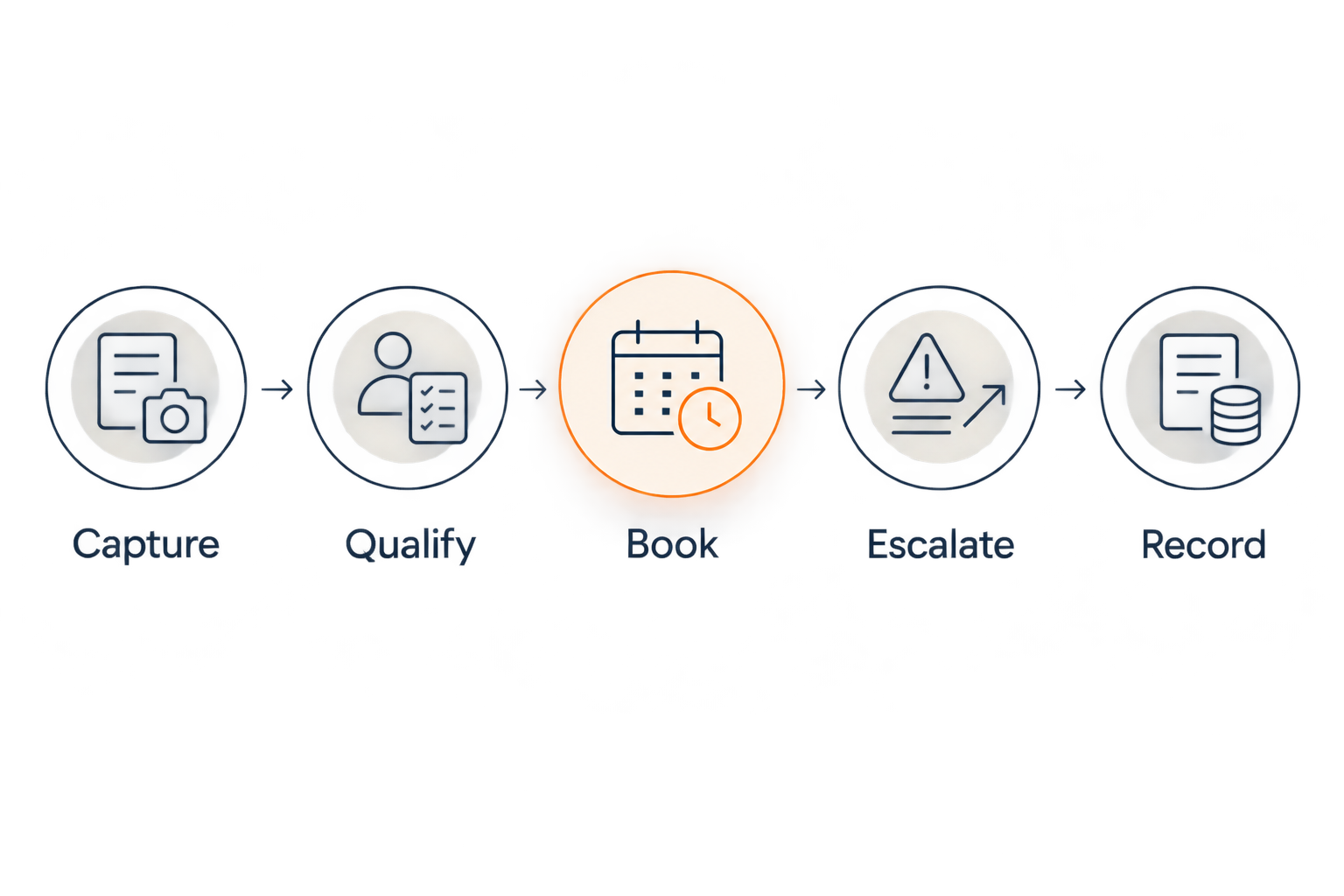
Test the Facebook-to-booking workflow before launch
Use the same acceptance sequence for every option on your 2026 shortlist. The objective is to expose unclear ownership and incorrect bookings before real inquiries enter the process.
Capture
Submit a test inquiry through the actual form. Confirm that the destination receives the contact details, requested service, and source information you intend to preserve.
Qualify
Check an in-area request and an out-of-area request. Confirm that repair, maintenance, and installation requests follow the instructions your business supplies rather than sharing an unsuitable booking path.
Book
Test an acceptable slot and a conflicting request. Require a clear distinction between collecting a preferred time and confirming an appointment.
Escalate
Introduce an unclear request that requires human review. Confirm who receives it, what context accompanies it, and who is responsible for responding.
Record
Inspect the final record. Your office should be able to determine whether the lead was contacted, remains pending, was declined, or became an appointment.
Keep outreach permissions and contact preferences in the acceptance review. Have qualified counsel review the applicable calling and messaging requirements; a software configuration is not a legal compliance determination.
For implementation planning, use the Facebook lead ads to booked HVAC appointments workflow alongside your provider demonstration.
How these options are ranked
The ranking follows operating responsibility: managed execution first, office ownership second, custom connections third, and direct inbox handling fourth. It prioritizes the stated need to respond, follow up, and book—not a claimed speed advantage or conversion lift.
Apply the same criteria to every demonstration: capture, ownership, qualification, booking, escalation, and traceability. Reject any proposal that leaves a critical handoff without an accountable owner.
Which approach should you choose?
Start with managed response if your main problem is that nobody consistently owns new inquiries. Start with a CRM-led workflow if your office has coverage but needs a clearer process.
Choose connected automation only when the routing requirement justifies maintaining separate connections. Keep a staffed inbox when personal handling is deliberate, documented, and covered—not simply because it is familiar.
Your 2026 decision should rest on an observed workflow configured for your business. Do not substitute a persuasive demonstration of the first reply for proof of correct follow-up and booking.
FAQ
What's the best HVAC lead response software for Facebook lead ads?
The best choice depends on who will own follow-up and booking. Choose managed response for delegated execution, a CRM-led workflow for office control, or connected automation when custom routing has a maintenance owner.
Is Relaykite-3 software or a managed service?
Relaykite-3 is a managed AI-powered lead response and appointment-setting service for U.S. HVAC businesses. Its stated scope includes responding to inquiries, following up with prospects, and booking service appointments.
Does a managed response service automatically connect to Facebook lead ads?
Do not assume a Facebook lead connection is included. Ask the provider to demonstrate how your actual form delivers an inquiry and what happens when delivery fails.
Can Facebook lead ads become confirmed HVAC appointments?
A lead-handling workflow can be designed to turn an inquiry into an appointment after qualification and scheduling checks. Confirm which steps your selected service performs and which remain with your office.
Is a CRM enough to handle HVAC Facebook leads?
A CRM-led workflow fits a team that owns follow-up and keeps records current. A customer record does not itself establish staff coverage, a working lead connection, or correct booking behavior.
What should an HVAC business test before enabling automatic booking?
Test service-area screening, requested work, schedule conflicts, duplicate submissions, and human escalation. Confirm that an appointment request cannot be mistaken for a confirmed technician visit.
Should HVAC lead follow-up continue after someone books?
Stop acquisition follow-up once an appointment is confirmed. Keep any appointment-related communication separate and respect the customer's contact preferences.
One last thing
Test a second submission from the same prospect before you launch. A workflow that handles a new lead correctly can still create confusion when someone submits again after booking.
Require the process to recognize the existing appointment or route the duplicate for review. The best final check is not another successful first reply; it is proof that your system avoids starting an unnecessary second conversation.


