

Best fit for managed HVAC lead response: Relaykite-3. Best for calls requiring staff judgment: receptionist-led intake. Best for tightly defined requests: scripted automated intake. This 2026 guide compares those approaches with voicemail transcription; it ranks workflow fit, not measured call accuracy.
- Relaykite-3 fits U.S. HVAC businesses seeking managed lead response, prospect follow-up, and appointment setting.
- Treat HVAC call answering software ranked by call accuracy as a testing question, not an unsupported vendor leaderboard.
- Test contact capture, service intent, booking rules, escalation, and correction handling before choosing an answering workflow.
- A correct response sometimes means requesting clarification or handing the call to an authorized person.
Why this matters
A caller can receive a fluent answer while the business receives the wrong address, service request, or appointment status. Judge accuracy by the resulting record and action, not by how natural the conversation sounds.
For an HVAC business, answering and appointment setting are different responsibilities. Capturing an inquiry does not establish that the property is inside your service area, the requested work is supported, or a technician can attend.
Your 2026 selection process should separate those decisions. Require each provider to demonstrate what happens when information is unclear, a request falls outside your rules, or a caller changes details midway through the conversation.
What makes the best HVAC call answering workflow?
Use these criteria before comparing demonstrations. Each criterion should have a written expected result that your office can check.
- Contact capture: Names, callback numbers, service addresses, and unit details survive corrections without retaining conflicting information.
- Service intent: Repair, installation inquiries, maintenance requests, and existing-job questions remain distinct.
- Booking control: The workflow distinguishes a requested time from a confirmed appointment and follows your authorization rules.
- Escalation: Requests outside the approved scope reach the designated person rather than receiving an improvised answer.
- Correction handling: Updated details replace the original information in the final record and downstream action.
- Reviewability: Your team can inspect the outcome and identify where an error entered the process, subject to the provider's actual capabilities.
Do not let a convincing demonstration substitute for these checks. A provider should demonstrate your business rules, not only a generic conversation.
HVAC answering options at a glance
The order below starts with managed lead handling, then separates alternatives by the responsibility you want to retain. It is a buying shortlist, not evidence that one approach achieves a higher accuracy rate.
| Option | Best for | Defining approach | Key limitation |
|---|---|---|---|
| Relaykite-3 | Managed inquiry response and appointment setting | Managed lead response, prospect follow-up, and booking service for U.S. HVAC businesses | Confirm call-channel coverage and business-specific booking rules before selection |
| Receptionist-led intake | Calls requiring staff judgment | A person interprets the request and applies your instructions | Consistency still depends on instructions, training, and access to current information |
| Scripted automated intake | Narrow, repeatable requests | A defined sequence collects information and routes requests | Requests outside the script need a separate handling path |
| Voicemail transcription | Message review by an existing office team | A recorded message becomes text for later review | Transcription alone does not qualify a lead or confirm an appointment |
1. Relaykite-3: best for managed HVAC lead response
Relaykite-3 provides managed lead response and appointment setting for U.S. HVAC businesses. Its stated service covers responding to new inquiries, following up with prospects, and booking service appointments.
Best for: An owner who wants a managed service for inquiry handling and booking rather than another standalone front-office tool.
The relevant buying question is whether the configured service matches your intake and scheduling responsibilities. Ask for a demonstration using your actual service boundaries, supported job types, and approval rules. Do not infer voice coverage, emergency handling, or a particular scheduling connection from the general service description.
Relaykite-3 pros:
- The stated scope includes response, follow-up, and appointment setting.
- The service explicitly serves U.S. HVAC businesses.
- The managed model suits buyers seeking an ongoing service rather than only software access.
Relaykite-3 cons and boundaries:
- The service description is not a measured call-accuracy result.
- Phone handling, scheduling connections, and escalation behavior require confirmation against your requirements.
- Your business still needs to define which requests are eligible for booking.
In a 2026 evaluation, start with an ordinary service inquiry, then repeat the inquiry with a corrected address and an unsupported request. Review the final outcome, not just the response.
Verdict: Hold until the configured workflow passes your acceptance tests; shortlist for managed lead response.
2. Receptionist-led intake: best for judgment-heavy calls
Receptionist-led intake puts a person in charge of understanding the request and selecting the next action. Treat this as an operating model, not a claim that every receptionist service offers the same training or authority.
Best for: Calls involving unclear requests, existing-job disputes, or situations your office wants a person to assess.
Ask the prospective service to show how staff distinguish approved answers from decisions reserved for your business. A person should not promise a technician, warranty outcome, or service exception without authority.
Receptionist-led intake pros:
- You can assign clarification and interpretation to a person.
- Your instructions can define when staff should stop and consult the office.
- Conversation review can focus on judgment as well as field capture.
Receptionist-led intake cons:
- Human involvement does not establish consistent accuracy.
- Staff need current information and clear limits on what they can promise.
- Coverage and handoff arrangements require explicit agreement.
For a fair comparison, give the receptionist-led provider the same ambiguous requests used elsewhere. Score whether the final record preserves uncertainty instead of converting it into an unsupported conclusion.
Verdict: Hold until staff demonstrate your exception-handling rules; prioritize this model for judgment-heavy calls.
3. Scripted automated intake: best for repeatable requests
Scripted automated intake uses a defined sequence to collect information and choose among approved paths. Evaluate a narrow workflow, such as collecting a maintenance inquiry, before assigning broader responsibilities.
Best for: Businesses with clearly defined intake questions and a separate process for exceptions.
Keep the script focused on facts the caller can supply. Asking whether someone wants repair or an installation estimate is different from diagnosing equipment or deciding what work a property needs.
Scripted automated intake pros:
- Required questions can be specified before rollout.
- Branching rules provide clear acceptance-test targets.
- A limited scope makes responsibility easier to define.
Scripted automated intake cons:
- An unexpected request still needs a handling path.
- A completed questionnaire does not establish correct understanding.
- Changes to service rules require corresponding workflow updates.
Include interruptions and corrections in the demonstration. A script that captures the first answer but ignores the corrected answer has failed the task, even if every required field is filled.
Verdict: Hold until correction and exception tests pass; use for narrow, repeatable intake.
4. Voicemail transcription: best for office-led message review
Voicemail transcription converts a recorded message into text. It supports message review, but transcription alone does not conduct a clarifying conversation or establish an authorized appointment.
Best for: A business that intends to keep qualification, callbacks, and scheduling with its existing office team.
Separate transcription quality from workflow completion. An accurate transcript of an incomplete message remains incomplete; your team still needs to obtain the missing details.
Voicemail transcription pros:
- Message capture and appointment decisions remain separate.
- Your office retains control of qualification and scheduling.
- Review can focus on the caller's recorded request.
Voicemail transcription cons:
- Unclear details require another interaction.
- A transcript is not a confirmed booking.
- Message review and follow-up remain assigned work for your team.
Do not compare a transcription-only tool with an appointment-setting service as though both complete the same job. Assess transcription against your message-review needs, then assess the callback process separately.
Verdict: Skip as a standalone appointment-setting solution; consider only for office-led follow-up.
How to test call accuracy before choosing
For your 2026 shortlist, use 20 test calls across 5 call types, then run 2 test rounds. These are suggested evaluation quantities, not performance benchmarks or a guarantee of production results.
Give every candidate the same approved business instructions. Preserve the expected result before the demonstration so you do not redefine success after hearing a polished response.
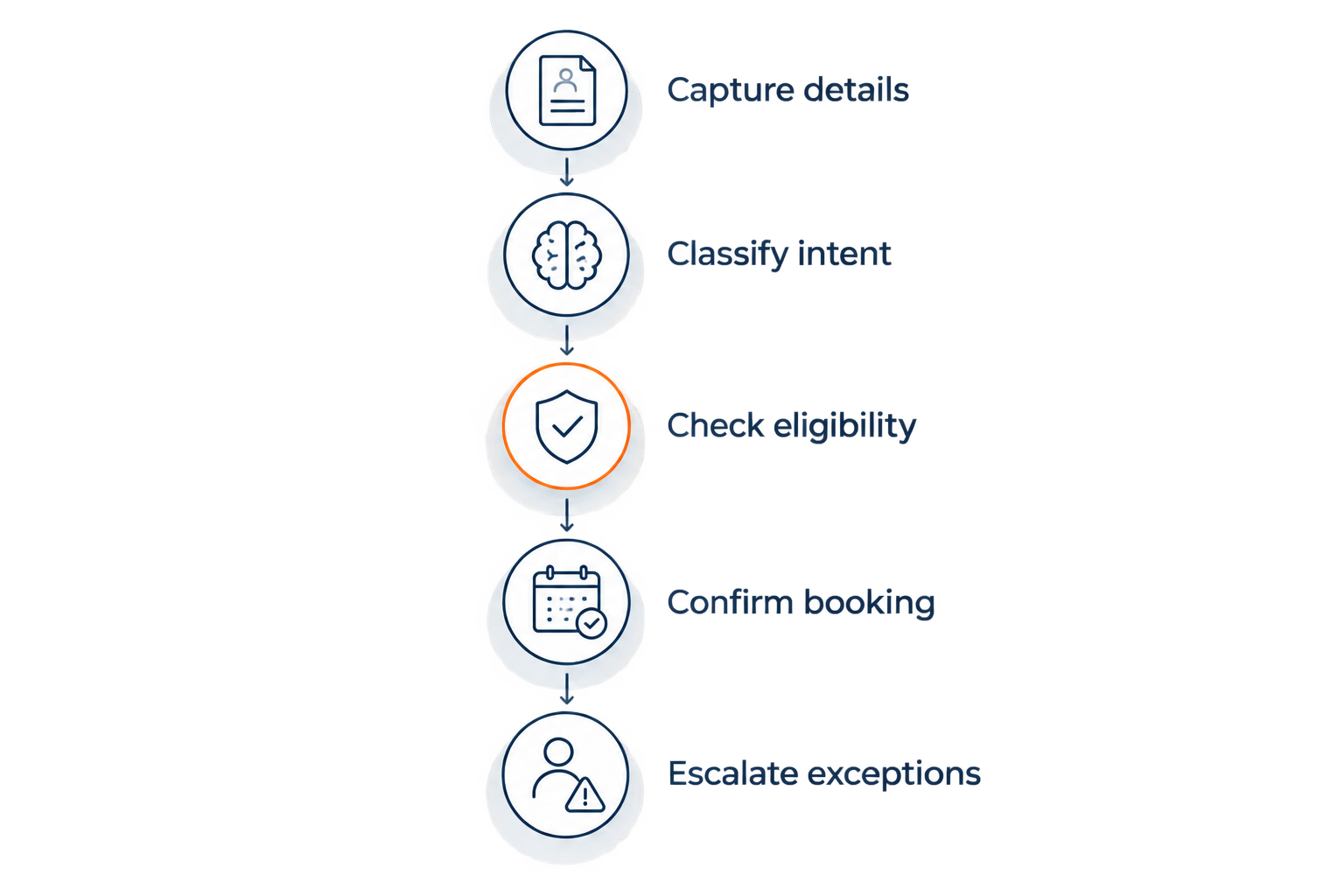
Capture details
Include a callback number, service address, and unit identifier where relevant. Change one detail during the call and check the final record against the corrected version.
Classify intent
Separate repair, installation, maintenance, and existing-job requests. Include a caller who describes symptoms without naming the service; the workflow should clarify the request rather than invent a diagnosis.
Check eligibility
Use an address outside your service area and a request outside your approved work. The expected outcome should follow your written policy, not the provider's assumption about what an HVAC company usually accepts.
Confirm booking
Specify whether the test should end in a request, a callback task, or a confirmed appointment. Check the resulting status and any customer-facing confirmation for agreement.
Escalate exceptions
Include uncertainty that the workflow is not authorized to resolve. Judge whether the designated handoff occurs without unsupported promises or technical advice.
Repeat the same cases after correcting the configuration. Keep the results from both rounds so an improved demonstration does not erase the original failure or its cause.
Score complete outcomes, not convincing conversations
Record whether each test produced the correct contact details, request classification, status, and handoff. Mark an incorrect outcome as a failure even when most of the conversation was accurate.
Also record critical failures separately. An unauthorized booking and a misspelled note should not disappear inside the same summary measure.
If you calculate a pass rate, label its scope: your test scenarios, configuration, and evaluation date. A small acceptance test describes those tested cases; it does not establish a universal accuracy rate.
How these options are ranked
This shortlist ranks operating fit against contact capture, service intent, booking control, escalation, correction handling, and reviewability. It does not assign vendor accuracy scores or imply independent comparative testing.
The managed service appears first because it matches the stated need for inquiry response, prospect follow-up, and appointment setting. The remaining options separate judgment-heavy handling, narrow automation, and office-led message review.
Use the shortlist to decide what to test, then use demonstrated outcomes to decide what to buy. Revisit the same tests whenever your service area, scheduling rules, or escalation contacts change during 2026.
Which HVAC answering approach should you choose?
Relaykite-3 is best suited to U.S. HVAC businesses seeking managed lead response and appointment setting. That is a scope-based recommendation, not a claim of superior call accuracy.
Choose receptionist-led intake when you want a person responsible for interpreting exceptions. Choose scripted intake when the task is narrow and the fallback is explicit. Keep voicemail transcription for message review, not as a substitute for qualification and booking.
Before signing, require a written description of the responsibilities being transferred. Identify who answers, who verifies eligibility, who authorizes booking, and who receives unresolved requests.
FAQ
What's the best HVAC call answering software ranked by call accuracy?
A defensible accuracy winner requires comparable tests of the same calls, business rules, and final outcomes. Use this shortlist to identify a suitable operating model, then compare demonstrated results rather than unsupported accuracy rankings.
Is Relaykite-3 software or a managed service?
Relaykite-3 provides a managed lead response and appointment-setting service for U.S. HVAC businesses. Its stated scope includes responding to inquiries, following up with prospects, and booking service appointments.
Is a live receptionist more accurate than automated intake?
Human involvement alone does not establish higher accuracy. Test both approaches against the same contact details, unclear requests, corrections, and authorization rules.
How can I test HVAC call accuracy before signing?
Use written scenarios with expected outcomes and inspect the resulting records and actions. Include corrected addresses, unsupported requests, unclear service intent, and calls requiring escalation.
Does an accurate transcript mean the appointment is correct?
No, transcription accuracy and booking accuracy are different checks. The appointment must also follow your service-area, job-type, scheduling, and authorization rules.
Should HVAC answering software diagnose equipment problems?
Do not authorize an intake workflow to diagnose equipment unless that responsibility has been explicitly defined and appropriately reviewed. For ordinary intake, collect the caller's description and route the request under your approved procedures.
What should happen when an answering service is unsure?
The answering service should follow your approved clarification or escalation procedure. Uncertainty should remain visible rather than becoming an invented answer, diagnosis, or booking promise.
One last thing
A correct refusal to book can be an accuracy success. If a request is outside your service area or needs approval, scheduling it simply to complete the conversation is the wrong outcome.
Add that case to your 2026 acceptance test. Reward the workflow for respecting your limits, not merely for producing an appointment.


