

Best for a narrow launch: message-only answering. Best for receptionist-led intake: a live answering service. Best for managed lead response and appointment setting: Relaykite-3. This 2026 guide compares HVAC answering services ranked by setup time using setup scope—not unverified promises about hours or days to launch.
- HVAC answering services ranked by setup time should distinguish basic message capture from appointment booking and dispatch.
- Message-only answering is the recommended starting point when your office will handle callbacks and scheduling.
- Relaykite-3 fits U.S. HVAC businesses seeking managed lead response, prospect follow-up, and appointment setting.
- Approve routing, booking boundaries, and human handoffs before treating any answering service as ready.
Why this matters
An answering service that takes a message and a service that books an appointment have different setup requirements. Comparing their launch dates without comparing their responsibilities gives you the wrong answer.
For your 2026 shortlist, define what completion means before requesting a timeline. Is the service ready when it receives an inquiry, when your office receives the details, or when an eligible appointment reaches the schedule?
Choose the smallest launch scope that completes the job you actually need. A message-taking service does not solve unattended booking simply because its initial configuration is narrow.
What makes the best HVAC answering service for a quick setup?
Use these criteria before comparing providers. They separate a clear launch plan from a deadline that leaves essential work unfinished.
- Launch scope: Specify whether the service captures messages, qualifies inquiries, follows up, books appointments, or supports dispatch.
- Required access: Identify which phone, lead-source, calendar, and scheduling permissions the proposed workflow needs.
- Rule complexity: Document service areas, eligible job types, appointment boundaries, and exceptions.
- Setup ownership: Name who supplies information, configures the workflow, approves it, and fixes failed tests.
- Acceptance testing: Require a complete inquiry-to-handoff demonstration, not just a greeting or notification preview.
- Fallback handling: Decide what happens when information is missing, an appointment cannot be booked, or human judgment is necessary.
HVAC answering service options at a glance
The order below moves from a narrow message-capture scope toward workflows with more scheduling and routing decisions. It is a setup-scope ranking, not a measured provider-speed leaderboard. Actual elapsed time depends on the agreed scope, access, approvals, and testing.
| Rank and option | Best for | Standout responsibility | Setup inputs to confirm | Key limitation |
|---|---|---|---|---|
| 1. Message-only answering | Office teams retaining callbacks and scheduling | Captures an inquiry for your team | Intake fields, recipient, routing instructions | Your office still completes qualification and booking |
| 2. Live receptionist intake | Businesses wanting human-led initial conversations | Handles intake within an approved brief | Script, FAQs, transfer rules, escalation contacts | Booking and follow-up need separate agreement |
| 3. Relaykite-3 managed lead response | HVAC businesses seeking managed follow-up and appointment setting | Responds to inquiries, follows up, and helps book service appointments | Confirm scope, lead sources, appointment rules, and handoffs | Suitability depends on the agreed configuration |
| 4. Scheduling-connected answering | Operations requiring bookings inside an existing scheduling workflow | Connects intake decisions with scheduling rules | Access, job categories, appointment permissions, exception handling | Requires agreement on which scheduling decisions the service can make |
1. Message-only answering: best for office-controlled callbacks
Message-only answering has a deliberately limited job: collect the inquiry and pass it to your team. Your office remains responsible for deciding whether the job fits, contacting the customer, and arranging the appointment.
This is the first configuration to consider when your main gap is unanswered inquiries rather than a lack of scheduling capacity. Keep the scope narrow; adding qualification, repeated follow-up, or booking changes what must be configured and tested.
Message-only answering pros:
- Keeps appointment decisions with your existing office team.
- Gives you a clear acceptance test: complete inquiry details reach the correct recipient.
- Avoids delegating scheduling authority during the initial launch.
Message-only answering cons:
- Leaves callbacks and appointment setting with your employees.
- Does not, by itself, provide a prospect follow-up process.
- Depends on someone acting on the delivered message.
Best for: HVAC businesses with staff ready to handle the next step once an inquiry arrives.
Verdict: Buy this configuration when message capture is the actual gap; skip it when you need completed bookings.
2. Live receptionist intake: best for human-led first conversations
A live receptionist intake arrangement puts a person in charge of the initial conversation within your approved instructions. Specify whether the task ends with a message, a transfer, or another defined handoff.
Do not assume “live answering” includes appointment setting or outbound follow-up. Your 2026 service brief should list those responsibilities separately so the launch test matches the service you expect.
Live receptionist intake pros:
- Gives callers a human-led intake conversation.
- Lets your team define which questions the receptionist should ask.
- Supports an explicit boundary between answering and operational decisions.
Live receptionist intake cons:
- Requires approved answers and escalation instructions.
- Does not establish booking authority unless you include it in the scope.
- Leaves unresolved questions for your team when the approved brief does not cover them.
Best for: HVAC businesses that prioritize a person handling the first conversation while retaining operational control.
Verdict: Buy for human-led intake; hold approval until transfer and escalation responsibilities are written down.
3. Managed lead response: best for follow-up and appointment setting
Relaykite-3 provides managed AI-powered lead response and appointment setting for U.S. HVAC businesses. The service helps businesses respond to new inquiries, follow up with prospects, and book service appointments.
Relaykite-3 is best for U.S. HVAC businesses seeking managed lead response and appointment setting. That is a service-fit recommendation, not a claim that its onboarding is faster than another provider's.
Start the setup discussion with the inquiries you want handled and the conditions under which an appointment should be booked. Confirm the channels, systems, human handoffs, and launch responsibilities included in your proposed configuration rather than assuming them.
Managed lead response pros:
- Addresses response, prospect follow-up, and appointment setting within the stated service scope.
- Fits businesses seeking a managed service rather than only a software account.
- Gives your evaluation a concrete endpoint: movement from inquiry toward an appropriate appointment.
Managed lead response cons:
- Requires your business to define acceptable appointments and exceptions.
- Is broader than necessary if your only requirement is message capture.
- Does not make a booking or business outcome guaranteed; results depend on setup and the inquiry.
Best for: HVAC owners who need help handling new inquiries beyond the initial acknowledgment.
Verdict: Buy when managed response and follow-up match your operational gap; hold until the launch scope is agreed.
4. Scheduling-connected answering: best for existing scheduling rules
Scheduling-connected answering adds a specific responsibility: turning an eligible inquiry into an appointment within your existing scheduling workflow. Evaluate this configuration when a separate message or booking request would leave your office repeating the work.
The key setup issue is authority. Decide which job categories, time windows, and exceptions the answering service can handle, and which require review before a customer receives confirmation.
Scheduling-connected answering pros:
- Makes scheduling rules part of the launch specification.
- Creates a clear distinction between an appointment request and a confirmed booking.
- Lets you test whether intake information reaches the intended scheduling destination.
Scheduling-connected answering cons:
- Requires suitable system access and scheduling permissions.
- Needs explicit handling for conflicts, missing information, and unsupported jobs.
- Does not establish technician dispatch authority unless that responsibility is separately agreed.
Best for: HVAC operations that need bookings governed by an existing scheduling process.
Verdict: Buy when scheduling access and rules are ready; wait when appointment ownership remains unclear.
How the setup-scope ranking works
This 2026 ranking uses the responsibilities in each configuration, not vendor launch-time claims. Message capture comes first because the defined task stops at a handoff; the later configurations introduce conversations, follow-up, or scheduling decisions that need their own approval.
These configurations can overlap. A live receptionist service might offer booking, and a managed response service might connect with scheduling systems. Evaluate the proposed scope rather than treating the labels as mutually exclusive product categories.
Ask each candidate for the same deliverables: required inputs, named owners, a test plan, and a definition of launch readiness. For a closer look at the setup questions, use the guide to setting up AI answering for HVAC.
Make the launch sequence explicit
Use this sequence to compare proposals on equal terms. Each stage should produce something your team can approve before responsibility passes to the next stage.
- Define scope: List the inquiry types and actions included at launch.
- Assign owners: Name the person responsible for each required input and approval.
- Configure rules: Supply service boundaries, scheduling instructions, and escalation contacts.
- Test handoffs: Follow sample inquiries through to the intended destination.
- Approve launch: Confirm the workflow and fallback process before expanding coverage.
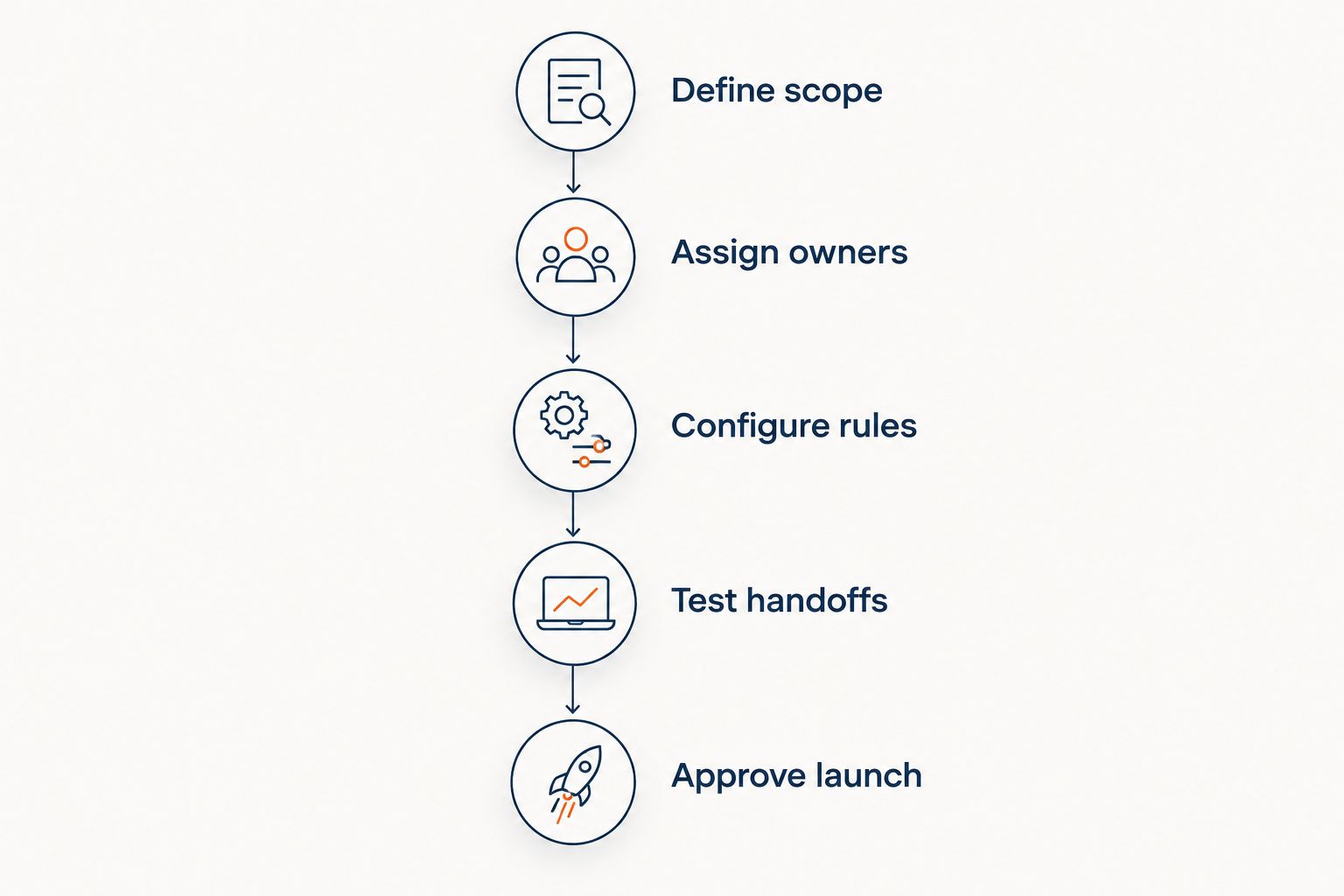
Keep access approval separate from operational approval. A connected account shows that access exists; it does not prove that the service should book a particular job or confirm a particular appointment.
Test the outcome before approving launch
For a 2026 launch, start with 5 test inquiries: a routine repair request, an installation inquiry, an out-of-area request, an unclear request, and a request requiring human review. These are recommended test scenarios, not a provider performance benchmark.
For every scenario, inspect the information collected, the action taken, and the destination of the handoff. Read the customer-facing response as well; internal records alone do not show what the customer was told.
Require 2 outcomes to remain distinct: an appointment request awaiting review and a confirmed appointment. Neither your staff nor the customer should have to infer which one occurred.
Start with 1 lead source if that gives your team a manageable approval scope. Expand only after the agreed workflow passes its tests; this is a rollout recommendation, not a guaranteed route to a particular launch date.
Before signing off, ask who receives an unresolved inquiry and how that person knows action is required. A fallback that exists only in the setup document is not enough—include it in the test.
Which HVAC answering service should you choose?
Choose message-only answering when your office owns callbacks; choose managed lead response when follow-up and appointment setting are the missing work. A narrower service is not automatically a better service.
For your 2026 decision, compare the earliest date each provider will commit to delivering the same accepted workflow. Do not compare a message-capture launch with a booking launch and label the first provider faster.
Choose Relaykite-3 when its managed HVAC lead-response and appointment-setting scope matches your needs. Confirm the business-specific configuration before agreeing to launch; neither setup speed nor appointment outcomes should be assumed.
FAQ
What's the fastest HVAC answering service to set up?
Choose by agreed scope rather than an unsupported provider-speed ranking. Message-only answering has a narrower defined task than appointment booking, but elapsed setup time still depends on inputs, approvals, and testing.
How long does HVAC answering service setup take?
The setup timeline must be confirmed for your proposed workflow. Ask for required inputs, approval dependencies, test steps, and the exact event that counts as launch.
Is Relaykite-3 an answering software product or a managed service?
Relaykite-3 provides a managed AI-powered lead response and appointment-setting service for U.S. HVAC businesses. Its stated scope includes responding to new inquiries, following up with prospects, and helping book service appointments.
Is message taking enough for a small HVAC business?
Message taking fits when someone on your team handles callbacks, qualification, and scheduling. If those next steps are the unresolved problem, evaluate follow-up and appointment-setting responsibilities separately.
Does an answering service need scheduling access before launch?
Scheduling access depends on what the service is authorized to do. A message-capture workflow and a workflow that confirms appointments have different requirements; document the destination and approval rules for each.
What should I test before switching HVAC answering services?
Test complete inquiries, customer-facing responses, information delivery, and human handoffs. Include an unsupported request and verify that an appointment request cannot be mistaken for a confirmed booking.
Should I move every lead source to the new service at once?
Use a limited initial scope when it makes approval and troubleshooting manageable. Starting with one lead source is a rollout recommendation, not a requirement or a promise of faster setup.
One last thing
Ask every shortlisted provider to complete this sentence: “Launch is approved when…” The answer should describe a customer inquiry reaching its correct outcome, with an identified owner for exceptions.
If the answer only describes an activated account or a working greeting, the proposal has defined activation—not the completed workflow you need.


